
in view of continuing hate crimes against asians and asian americans and the horrific killings in atlanta, so much love for and solidarity with asian communities.
white supremacy is a deadly disease.
The Warp & Weft – Third Set of Stories
4 new warp & weft stories today including one from kashmir by Akmal Hanan, one about post world war II germany from ireland by Renate Debrun, a powerful poem by Selena Fleming, a raw, courageous story by Annette Ramos, and a beautiful dance response by Alaina Olivieri. pls listen and watch here.
Repost from Rochester Contemporary Art Center:
Today the third set of stories from the Warp & Weft archive launch! Head over to maraahmedstudio.com and listen to:
Because Every Goliath Meets Its David by Selena Fleming
I’m fresh off the boat—the one fashioned from ramparts of a journey laden with trauma, ugly-fulfilling prophecies, can’t-get-it-together tendencies and shoulders that have borne more than any one person should ever be allowed to bear.
If Mountains Were Oceans by Akmal Hanan
The world has seven continents and more than 190 countries, but destiny decreed that I was born in a landlocked country called Kashmir. [Photo: Shahnawaz Shah]
COVID Rebirth by Annette Ramos
Two years before COVID-19 spread around the world I was already facing one of the biggest challenges of my life. My creative life was in transformation.
Gertrud by Renate Debrun
In old family photographs I sometimes catch a glimpse of her: a stolid, middle-aged woman always in the background or at the margins. All that remains of her life now is in a small cardboard box in my sister’s attic: some papers, postcards, photographs, a bible. This is Gertrud. [Photo: Raymond Deane]
Empty Spaces by Alaina Olivieri: A dance response to the archive
Listen to/read the full stories at maraahmedstudio.com
The Warp & Weft is a multilingual archive of stories that seeks to capture the 2020 zeitgeist. The archive is curated by interdisciplinary artist and activist filmmaker Mara Ahmed (@mara__ahmed). A set of new stories will be released each week via RoCo and Mara’s social media, during the course of ‘Last Year on Earth.’

My art video ‘Le Mot Juste’ is here
My experimental/art video is here! Check out ‘Le Mot Juste‘ along with 20 other works of art! I created this piece out of footage shot by Rajesh Barnabas and a dance performance by Mariko Yamada and Cloria Sutton <3
Enter the Diasporic Rhizome to experience the works of 21 artists who are reexamining our histories, commenting on current social issues, and dreaming of new realities. The collective works in this virtual exhibition use innovation and imagination as change agents where the digital space becomes the apparatus for community building, challenging the world around us to transform and address our growing needs.
The 21 participating artists in Diasporic Rhizome were selected from an open call by the following jury: Faisal Anwar, Ambika Trasi, Brendan Fernandes. (Ambika Trasi curated the Salman Toor exhibition that I loved at the Whitney Museum)
Diasporic Rhizome is produced by South Asia Institute.

How Portugal silenced ‘centuries of violence and trauma’
Ana Naomi de Sousa: There are monuments and statues up and down the country dedicated to navigators, missionary priests responsible for the conversion of Africans and Indigenous people to Catholicism, or soldiers who fought against African independence in the colonial wars. Meanwhile, it is often said that “Portugal is not a racist country”, despite enormous structural inequalities and decades of documented discrimination. “There has been a silencing here of centuries of violence and trauma,” says Kia Henda.
However, a burgeoning movement here – the Movimento Negro – along with global calls to “decolonise history”, have begun to challenge the way Portugal views itself, from past to present. The Movimento Negro has been around in various forms in Portugal since the start of the last century; the latest resurgence of it is now in its second generation. Most of the sizeable Black population in Portugal today are immigrants and their descendants from the former Portuguese African colonies, who emigrated here from the 1960s and hold in their memories and histories a very different version of Portugal’s past. Kia Henda’s memorial is seen as part of this process; erupting on the national landscape and expected to stay.
Significantly, the memorial is not an initiative of the Portuguese government, but came about in 2017, when the Djass Afro-descendent Association, a non-governmental organisation (NGO) founded by the Portuguese MP, Beatriz Gomes Dias, won a popular vote for public funds.
That the memorial’s artist comes from Angola, the country that suffered the most catastrophic loss of lives during the trade in enslaved people at the hands of the Portuguese, is poignant. By the 19th century, Angola had become the largest source of enslaved people taken to the Americas. “For me, it is about building a bridge to the past as a way of establishing a dialogue about these historical cycles of violence,” says Kia Henda.
“The modern world would not exist if it was not for enslavement,” he says. “The modernity you see here was built on the backs of Black people. It’s important that there is awareness about that.” More here.
my art/video work part of south asia institute’s diasporic rhizome
thrilled to announce that my art/video work will be included in this juried #art #show coming up soon: #DiasporicRhizome by the south asia institute in #chicago starting march 15th!

International Women’s Day 2021
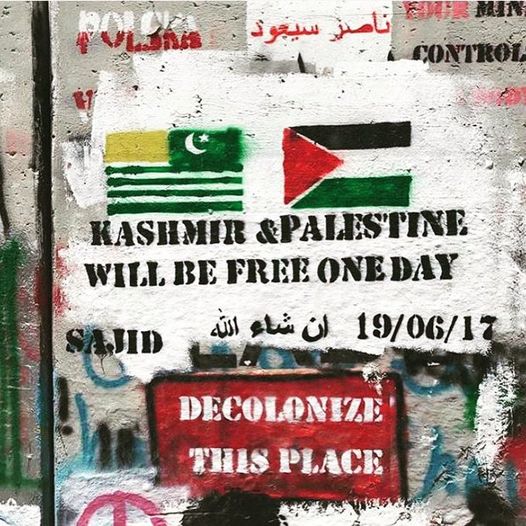
Today on International Women’s Day, a tribute to the women of Kashmir and Palestine, and all women living under occupation and facing genocide. “Palestine and Kashmir are both carved up by borders. People are swallowed whole. Stories are silenced and blood flows into rivers. Military checkpoints, armored vehicles, and borders occupy not just the land, but penetrate deeper, into the psyches of people. Occupation is sophisticated. It aims to destroy culture and to terminate people. For many Palestinian and Kashmiri women, their very existence is a form of resistance. Women are the culture bearers. They are the bringers of life. Their stories of existence and resistance hold in them a vision for a future where the bodies and spirits of their children will not bear the marks of occupation. This vision is the whisper of freedom.”
[From: ‘Makers of Memory: Women in Occupied Palestine and Kashmir’ by Tara Dorabji and Susan Rahman]
The Warp & Weft – Second Set of Stories
4 more stories today, including one in Spanish, and a 3-part artistic response by Andrea Vazquez-Aguirre Kaufmann! Stories by Tania Day-Magallon, Erica Bryant, Darien Lamen and Charlotte Clarke. Listen here and pls ‘refresh’ if it takes time to load.

El Lenguaje es mi Tierra, mi Identidad por Tania Day-Magallon
Language is my Land, my Identity by Tania Day-Magallon: Language is my land, my home, my mother; and these three elements are feminine in Spanish. When you strip me of my language, it takes away my form of expression. A part of me and my Divine Feminine is left bone-dry. My identity is not only changed – I migrate out of myself and end up farther away from home, which is already physically distant, on the other side of the wall.
Celebrate With Me by Erica Bryant
I have one photograph of my great grandfather, Roscoe Foster. He is sitting in a rocking chair, on the porch of his home in Columbia, Mississippi, with a black dog. Family says that when the Ku Klux Klan was riding near, he would sit on that porch with a shotgun.
Time Travelers by Charlotte Clarke
Time. It is stamped upon our birth certificate upon arrival and upon our death certificate at departure. It is also the container for everything in between.
A Cover Story by Darien Lamen
Sometimes I feel like a ghost, haunting the ruins of respectable society. My name is Darien Lamen, PhD. But Lamen isn’t my real name – it’s a cover story.
A Three-Part Response to the Archive by Andrea Vazquez-Aguirre Kaufmann: A dance and video response
The Warp & Weft is a multilingual archive of stories that seeks to capture the 2020 zeitgeist. The archive is curated by interdisciplinary artist and activist filmmaker Mara Ahmed. A set of new stories will be released each week via RoCo and Mara’s social media, during the course of ‘Last Year on Earth.’
What It’s Like When Racism Comes for You
‘The trope of the “perpetual foreigner” has long kept Asian Americans from being viewed as fully American. Geopolitics can make it worse, Borja said: American politicians now regularly criticize—even villainize—China, admonishing its government on issues related to trade policy, technology, and human rights. When that rhetoric is irresponsible—when it targets regular people, not leaders—even Asian Americans who aren’t Chinese can feel the effects stateside.’ More here.
The Warp & Weft – First Set of Stories
The wait is over! The Warp & Weft is coming to life! Here are the first 4 stories and a musical response. Pls listen here.

My Story by Lauren Jimerson
I have a story for you and, I am sorry to say, it is not a happy one. My son and I completed work for a BIPOC art show, at a local gallery. I submitted a self-portrait that depicts a human alien. It’s a visual representation of the alienation I experience being out in the world.
My Love Affair with Food by Debora McDell-Hernandez
My relationship with food is a story of a quest for culinary euphoria, but there are many chapters in this story such as family traditions, friendships, travel, love, grief, comfort, and survival.
Black Futures Matter by Quajay Donnell
Growing up, I don’t recall sitting down with my mother and stepfather talking about the birds and bees, but I do remember the other talk. The one about how to respond and act when dealing with the police. That talk is one of survival if you find yourself face-to-face with the law. I remember it vividly.
Moja djeca, gdje duša na?e mi smiraj – Alma Omerhodzic
My Children: Where My Soul Finds Peace by Alma Omerhodzic: It always starts this way. Suddenly, without warning, and right in the deepest core of my being. Sometimes it is a smell, sometimes a taste, and other times, I am not even sure why, but a word will hit me in the depths of my soul, depths that I didn’t know existed.
Lost Property by Sarah Gillespie: A musical response to the archive
The Warp & Weft is a multilingual archive of stories that seeks to capture the 2020 zeitgeist. The archive is curated by interdisciplinary artist and activist filmmaker Mara Ahmed (@mara__ahmed). A set of new stories will be released each week via RoCo and Mara’s social media, during the course of ‘Last Year on Earth.’
Decolonizing Art for Art’s Sake – The Markaz Review
My piece about decolonizing art for art’s sake in The Markaz Review today! It looks at Rameau’s opéra-ballet, ‘Les Indes Gallantes,’ and compares a stunning production choreographed by Bintou Dembélé (she uses street dance to subvert the colonialist ideology of the opéra) with two underwhelming mainstream white performances that somehow made it to prestigious stages. It’s a look at racism in the arts and how it leads to the recycling of sub-par work. To more art and narratives by people of color. Read here.
dance and collab/community
on friday i taught a combined ‘dance performance and collaboration’ & ‘dance and community’ class at nazareth college where my dear friend Mariko Yamada invited me to share work on my new film The Injured Body: A Film about Racism in America.
most of the students were dance students so at the end of my presentation, i shared the video portion of a multimedia piece mariko and i presented at the fringe festival in 2017. it’s a fusion of text, sound effects, film clips, music and dance that convey the oppressive impact of racism on the human body. i asked the students to reflect on the piece and come up with a movement phrase inspired by what they experienced.
as always, they blew me away. one student talked about the entwining of blackness and queerness, and created a powerful dance accompanied by words recorded in 20 min. amazing. students talked about the abruptness of the fringe piece in which breathing accelerates and climaxes as loud sounds are mixed with hectic footage. they compared it to a panic attack.
they described micro aggressions as a ‘cycle’ one is stuck in against one’s will and a ‘pill’ one is forced to swallow every day. students talked about BIPOCs being watched relentlessly and the self-consciousness and stress that comes from that policing. they incorporated the ‘hands up’ movement in their dance, to mirror gestures used by protestors.
one student talked about the effects of holding in too much, not being able to breathe freely, and how that can lead to mental health issues and medical problems. we talked about the heaviness of racist micro aggressions and how a just vision for the future can give us hope.
and so do bright young people <3

“The Warp and Weft” Weaves Stories Reflecting on an Unprecedented Year
The wonderful Abi Rose did this excellent story on the Warp & Weft for Reclaiming the Narrative. Pls listen here.

editing a film trailer
editing a feature length documentary again, after 6 years! finished working on ‘a thin wall’ in 2015. getting the hang of premiere pro (still learning) thx to Rajesh Barnabas and creating a beautiful, exceptionally long trailer (can’t fit all this richness in 2 min). so grateful for this work and the people it highlights, in this case more than 20 women of color, thru interviews and dance. it’s always hard to get started (transcription, getting all the materials aligned, technical obstacles, the sheer magnitude of the task) but once i do, i can’t stop. art-making elevates everything. it gives one hope <3
[Ayni Ali photographed for ‘the injured body’ by Arleen Thaler]

Rochester Officers Will Not Be Charged in Killing of Daniel Prude
how long can we continue to believe in the american justice system? how long can we continue to pretend this is a democracy? un-effing-believable. read more here.
i don’t know all muslim/brown people
a friendly FYI: because i was born outside of the US and i’m brown and muslim, it doesn’t mean that i know all muslims, brown people, immigrants, or folx from south asia.
in one of my first jobs at ABB, in CT, my boss would come running to my office to say something like, ‘i was just on the phone with this guy from india…’ there would be no other connection, just some random guy’s indian-ness affixed to my apparent pakistani origins.
i met a white person on zoom the other day, someone i know professionally, and he told me (for no reason whatsoever) that in school he had a friend named muhammad and that the only memory he had of him was making out with girls at his place. relevance u might ask? well, u wouldn’t be the first. i guess it was muhammed’s muslim-ness that i was supposed to dig.
i don’t need to know about a cousin’s best friend who happened to be pakistani or about the unforgettable trip to india whilst in college. imagine if we started bonding with the mainstream by listing all the white people/places we know.
so, no need to mention brown or muslim folx if their identity seems to be their only function. i probably don’t know them. there are a lot of people in south asia and about a quarter of the world population is muslim. just sayin:)