
Nick Estes: The United States has a long history of sacrificing or killing off groups of people—through war or disease or both—in the name of its self-proclaimed destiny. This belief in the country’s violent superiority was already evident among the early Puritans, who attributed the mass die-off of Indigenous peoples to divine intervention. “God hath so pursued them” John Winthrop, the Puritan leader of the Massachusetts Bay Colony, wrote of the Indigenous to the King of England in 1634.
[…] To blind themselves to the destruction they wrought, colonizers wove cultural fictions about the “vastness” of a continent devoid of human civilization—terra nullius—and thus open for white European settlement. (This was an early ideological ancestor of the Zionist phrase, “a land without a people for a people without a land,” that has come to justify the expulsion and colonization of Palestinians.) General Henry Knox, the revolutionary war hero and the United States’ first secretary of war, was less confused about how the land was emptied. He recalled “the utter extirpation of all the Indians in the most populous parts of the Union” by measures “more destructive to the Indian natives than the conduct of the conquerors of Mexico and Peru.” No small feat.
The imperial project wasn’t confined to what became the continental United States. It soon turned outward, as the settler state exported the horrors it had committed against the Indigenous to the rest of the planet. Most historians have failed to draw what are obvious connections between heightened rates of infection and conditions of war, invasion, and colonialism. We need only look at the cholera outbreak in Yemen to see the relationship of disease to U.S. foreign policy. No one is disputing the fact that the infection of millions and the deaths of thousands there at the hands of this preventable disease are the result of a U.S.-backed, Saudi-led war, which has destroyed Yemen’s health care infrastructure. It shouldn’t surprise us to learn that one in four surgical amputations conducted at Red Cross centers in Iraq, Syria, and Yemen are the result of diabetes. These three countries have been the staging ground for U.S.-backed military interventions and invasions that have disrupted critical food and medical supply chains.
Economic sanctions, frequently hailed by politicians of all stripes as a “humane” alternative to war, are simply war by another means. U.S. sanctions currently hit hard in thirty-nine countries—one-third of humanity—causing currency inflation and devaluation and upsetting the distribution of medicine, food, power, water treatment, and other human needs. A 2019 report by the Center for Economic and Policy Studies found that U.S. sanctions on Venezuela accounted for an estimated forty thousand deaths and a loss of $6 billion in oil revenue between 2017 and 2018. As Iran began to experience increased rates of coronavirus infection, the country faced medical supply shortages because of sanctions. While countries like China and Cuba, themselves both sanctioned by the United States, provided international aid to other countries suffering from the pandemic, Trump actively prevented other countries from adequately responding to the crisis.
Indigenous scholars have long contested the “virgin-soil epidemics” thesis. Today, it is clear that the disease thesis simply doesn’t hold up. More here.
Category: politics
black internationalism and global solidarities
this is a historic discussion. using the lens of black internationalism, it ties black liberation in america (in the belly of the imperial beast) to south asian struggles led by the dalit community in india and the sheedis (african diaspora) in pakistan. what a beautiful vision of solidarity across geographies, languages, and histories. black internationalism is what i find most exciting in black liberation movements because it illuminates the necessity to see the big picture – how wars abroad, for example, are directly connected to police violence, how inequities amongst nations are reflected in racial and economic hierarchies here in the US, etc.
it’s a longish video, in three different languages, with two interpreters, but it’s one of the most hopeful things i’ve seen in a while. and may i say, how much i love dr west. his generosity, how he gives access to his time and energy, to his person, whenever he can support oppressed people anywhere in the world, is immensely moving. he doesn’t just talk solidarity, he does it.
i hope that my south asian community will watch and reflect on the anti-blackness and casteism that’s so embedded in our language and society. i also hope that my american friends will watch and learn about movements, on the other side of the planet, fighting the same fight for rights and dignity. it might unsettle some of the notions americans have about india and pakistan.
thank u Equality Labs.
How the Karen Meme Confronts History of White Womanhood
many times, it has been pointed out to me how patriarchy is older and deeper than racism. case in point? (1) black men got the vote before women did and (2) we’ve had a black male president but still feel nervous about a woman president.
this line of reasoning makes me cringe. to start with, what came first is not a cogent argument and oppression olympics are meaningless. also, the absorption of POCs into systems that are designed to crush them, is not progress but in fact a shoring up of the legitimacy and power of said regimes.
in the same way, women and LGBTQI folx joining the american military is not an achievement when the entire purpose of the military is to establish empire – use extreme violence to maintain unjust structures that kill and rob the most vulnerable, the poorest, the most disadvantaged.
how can such a world order help women, POCs and queer people? it is no coincidence that we are seeing the same hierarchies, policing and violence right here in the US.
this is a good article about the historical context within which to locate present day ‘karens’. in time magazine, no less.
Cady Lang: The historical narrative of white women’s victimhood goes back to myths that were constructed during the era of American slavery. Black slaves were posited as sexual threats to the white women, the wives of slave owners; in reality, slave masters were the ones raping their slaves. This ideology, however, perpetuated the idea that white women, who represented the good and the moral in American society, needed to be protected by white men at all costs, thus justifying racial violence towards Black men or anyone that posed a threat to their power. This narrative that was the overarching theme of Birth of a Nation, the 1915 film that was the first movie to be shown at the White House, and is often cited as the inspiration for the rebirth of the KKK.
“If we’re thinking about this in a historical context where white women are given the power over Black men, that their word will be valued over a Black man, that makes it particularly dangerous and that’s the problem,” says Dr. Apryl Williams, an assistant professor in communications and media at the University of Michigan.
“White women are positioned as the virtue of society because they hold that position as the mother, as the keepers of virtuosity, all these ideologies that we associate with white motherhood and white women in particular, their certain role in society gives them power and when you couple that with this racist history, where white women are afraid of black men and black men are hypersexualized and seen as dangerous, then that’s really a volatile combination.”
Williams says the exposure is challenging this position. “That’s part of what people aren’t seeing is that white women do have this power and they’re exercising that power when they call or threaten to call the police.” More here.
my review: au revoir les enfants
saw ‘au revoir les enfants’ for the third time and loved it even more. there is a simplicity and natural rhythm to it that’s incredibly difficult to orchestrate and capture on film. it’s unaffected.
there is a universality to the film. although it’s semi-autobiographical (louis malle went to a boarding school during the german occupation of france in the second world war), the film at its core is about difference. how it seduces and threatens, how it must be rooted out and disappeared, how it’s delineated and construed by power.
there is also an important socio-economic subtext to the story. the rich are so easily beautiful. even children seem to sense it.
the scene at the end, when children are picked out of a school assembly (their names read from a list), and asked to separate from the group and go stand against a wall, is a clear comment on the arbitrariness of who is deemed valuable or not, who ends up on the right side of the state or not, how easy it is to cross that liminal space, and how war intensifies the good vs evil binary. without intrusive music or sentimentality, ‘au revoir les enfants’ moves deeply. on hbo max and youtube.
Change the Name
Repost from @culturestrike:
We’re joining the call to support our Native American communities & demand complete divestment from using depictions of indigenous people as mascots.
Culture, identity, and existence are not costumes. Native communities have been calling for this change for decades and it’s about time that the world finally listened! @r_dsk_ns & the @nfl do not get a pass in this battle for equality and justice.
#TheTimeIsNow #ChangeTheName
two part interview with instruments of memory
Repost from Instruments of Memory
•
“Inspired by the words in ‘Snowmen’, a poem by Agha Shahid Ali, This Heirloom explores notions of identity by recreating Mara Ahmed’s family history using photographs of her ancestors and juxtaposing them against South Asian architectural details. The vivid and colorful montages contrast with black and white images of Ahmed’s parents, Nilofar Rashid and Saleem Murtza, her maternal grandfather, Rashid Ahmad Qureshi, her maternal great grandfather, Adbul Majeed Qureshi, and her paternal grandmother, Niaz Fatima. By placing her subjects on the wrong side of the India-Pakistan border, Ahmed defies the dividing lines that separated territories more than seventy years ago.”
.
.
Learn more in @mara__ahmed Mara Ahmed’s two-part interview (see comments)
.
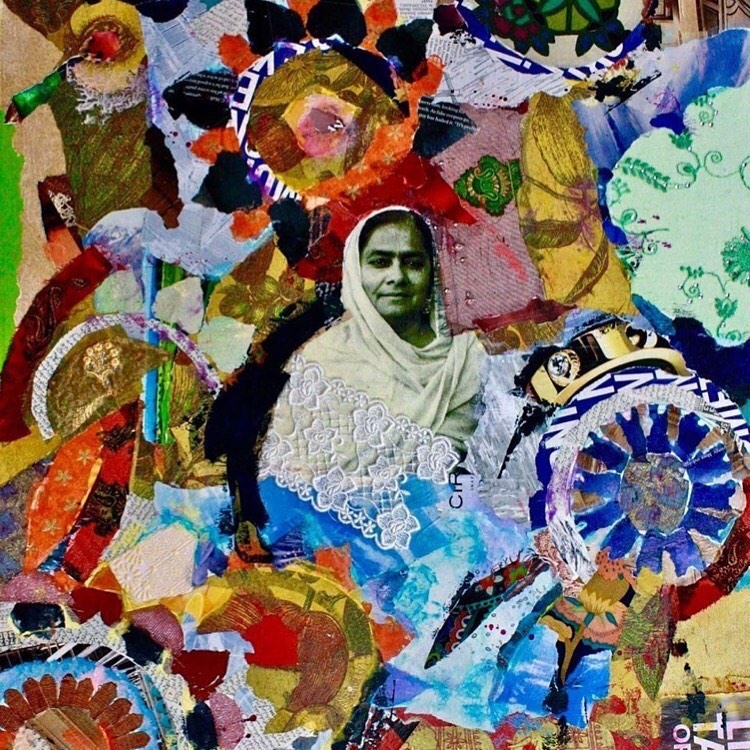
Tanzeela Qambrani
Tanzeela Qambrani is the first Afro-Pakistani woman politician in Pakistan. She belongs to the Sheedi community (the African Diaspora in Pakistan) and is going to become a member of the Sindh Assembly this Friday.
#BLM and support for Palestine
trying to avoid rants and engage in conversation, as that’s the world we want to build, the world we must prefigure, where everyone has worth and dignity and our relationships are dynamic and balanced.
so just pointing out, with respect, that one cannot support BLM without supporting their very clear stance on palestine (read their statement on palestine and israel). one cannot admire angela davis without acknowledging her support for BDS (boycott, divestment and sanctions – a palestinian-led movement for equality and justice). one cannot fight settler colonialism and racism in one context while ignoring settler colonialism and racism in another.
if people don’t know about palestine, now is a good time to learn. while we’re resisting police brutality and asking for this racist institution to be defunded, learn about ‘deadly exchange’ whereby american law enforcement is trained in israel with israeli police, military and the shin bet. look up jewish voice for peace’s work on this. the knee-on-the neck, for example, is a well-known staple of israel’s occupation of palestine.
if u need books or resources, let me know. the more we know, the better poised we will be for this fight.
The Injured Body gets a grant
Friends, I am excited to share that The Injured Body: A Film about Racism in America is now fiscally sponsored by New York Women in Film & Television (see below) and that we recently got a grant from First Unitarian Church of Rochester for post-production. We are also updating our website (will share soon). There is still a lot of work to do, but we are moving forward. More here.
Calida Rawles: water as visual language
From CulturedMag.com:
“It was about five years ago when water entered my life,” says Los Angeles-based painter Calida Rawles. Pregnant with her third daughter, she began swimming. “It started as exercise, and then it became almost like a therapy. I learned how to really swim as an adult. My breathing became more meditative. I felt so much better in the water.”
Soon after, she embarked on creating the body of work for which she has subsequently become celebrated: gorgeous, photorealistic paintings of black figures immersed in turquoise waters.
Rawles says she feels that her compositions are, above all, celebratory. “In my culture, seeing black bodies in water is special.” While for her personally, swimming might be a tool for self-care—a means of escaping both the immediate demands of family life and, more broadly, the pressures of contemporary black life in America—black bodies have not historically been associated with swimming pools. There are complex reasons why—even today, sixty-four percent of African American children are not able to swim—and these are rooted in racial segregation, Jim Crow laws and economic disparity. A painting such as Little Swimmer (2016), showing a young black girl surging beneath the surface of the water, is therefore a vision of hope and freedom.
Reina Gossett + Dean Spade (Part 1): Prison Abolition + Prefiguring the World You Want to Live In
love this interview so much because it validates my own thoughts about not using the same blueprint/MO/logic that we’ve taught by neoliberal, carceral, colonial, capitalist systems in order to fight those same systems.
Cornel West: Black Lives Matter and the fight against US empire are one and the same
Cornel West: In the end, if you really want Black people to be free, and I do, Black people will never be free under a system of predatory capitalism. We will never be free under a system with imperial tentacles, [we] will never be free with Pentagon elite running amok with militaristic policies and killing people in Latin America and in the Caribbean, and so forth.
So it is not a luxury which is theoretical or academic, to say ‘Oh, we don’t have time for interconnectivity and interdependency, [and] we’ve got to deal with this particular issue’. That particular issue is always already connected. More here.
In memory of Sarah: Reflections on violence, fear and pain
The same regime that grounded its legitimacy on rescuing Egypt’s secular identity from Islamist fanatics, the same regime that professes itself as Europe’s inevitable bulwark against floods of refugees and Islamist terror, has terrorized and persecuted Queers and trans people on a regular basis to purport moral rectitude. Yes, patriarchy is also secular.
[…] Queer fear is sometimes contagious and relentless. It can be temporarily soothed, it can be made dormant; the physical conditions that allow it to unfold can be abolished or suspended, but it continues to nag you in distant places. It continues to live under your skin. You smell it in the cold air of your exile, it lies on the surface of the things and bodies you touch. It can pop up in the corners of a city, when you suddenly realise that it will remain alien, no matter how often you walked the streets and cherished the company of its people. It inhabits our contemplations on longings and loss, it manifests itself in the sheer absence of home, the same home that we – oddly enough – escape out of fear. More here.
sarah hegazi <3
heartbroken by the death of sarah hegazi, a 30 year old queer activist who was imprisoned, placed in solitary confinement, and tortured by egyptian police for raising a rainbow flag at a concert. she was given asylum in canada and had been living there, in exile, since 2018.
in her suicide note she wrote: ‘to my siblings – i tried to find redemption and failed, forgive me. to my friends – the journey was harsh and i am too weak to resist, forgive me. to the world – you were cruel to a great extent, but i forgive.’
the tributes by her community are beautiful and heartrending. ‘a reminder as queer people, that we are not meant to survive…’
as we rise up against police brutality here in the US and thousands march for black trans lives in brooklyn, i cannot help but think about the broader policing of bodies and minds, of the vulnerability of queer and trans lives, of the state’s brutal mechanisms of course, but also our co-option of its violent borders and othering in order to demarcate and maintain our own heteronormative privilege.
talking about the policing of borders, perhaps political asylum is not the panacea for oppression elsewhere, but rather less imperial policing of movements for justice and democracy emerging in the rest of the world. it would allow people to stay home, where they can be connected, supported, and centered.
we have so much work to do. rest in power sarah.
Borderless: A conversation with Mara Ahmed, Part 2
We did this interview in early May, before George Floyd’s murder and the uprising that followed. But I’m glad Claudia asked me about the pandemic and its impact on immigrants and communities of color. Here is the second part of my interview with Instruments of Memory:
It is uncertain how we are going to overcome the recent health and economic crisis that has hit immigrant communities and people of color the hardest.
When I asked Ahmed what would be a way to engage and support these communities at this time, she admits: “This is a big question. Many have said how the pandemic is a great equalizer. Sadly, it’s quite the opposite. The pandemic throws into sharp relief the gross inequities and cruelties of a maniacally greedy, profit-oriented, dehumanizing capitalist system. Income and wealth inequalities in the US are obscene. The global distribution of wealth is even more distorted and disturbing. It’s a suicidal system.
At this time of crisis, we need to provide resources to the most vulnerable: large public projects that provide employment and housing, healthcare, testing and personal protective equipment for all, and equal access to technology, which is essential for remote learning, online work, and social distancing. People’s lives depend on this.
We should also keep in mind that pre-corona life is NOT what we want to return to. This is the time to imagine and organize a just, kind, and decolonial world. We must be wary of disaster capitalism and remain committed to our vision, even in the midst of a disorienting crisis. It can’t be said often enough that we are all in this together.” More here.