
“Fear, he decided, was their chief governing principle. It was meant to make you want less, to efface the past and to tether the imagination so no future but theirs could be loosened into the world. It taught you how to tighten your own rope so the neck would bear not marks.”
—Fire in the Unnameable Country, Ghalib Islam
Category: politics
Borders Can Be Borderlands
My piece in Mason Street’s Winter Issue 2021 published today.
‘It used to be that borders were formed naturally, by oceans and mountains, carved out by the physical contours of the earth’s surface. There was something poetic about these landforms, extending from foothills and valleys, to plains and plateaus, all the way to seafloors. They were shaped by wind and water erosion, pushed up by the collision of tectonic plates, forged by volcanic eruptions, sandblasted and weathered over millions of years. They were substantive, grounded in history.
The borders that came out of the crumbling of empires, in the 20th century, were different. Cartographic inventions meant to divvy up world resources and power, divorced from indigenous logic or priorities. A few sheets of stolen paper.’
More here.
the warp & weft
friends, i have been working non-stop on this project for the past 5 months and am truly in awe of what it is becoming. super psyched to launch it in march with roco. pls be ready for the warp & weft! more info about this project and its launch here.

the memes are for us
just to clarify, the bernie memes are for us, hardcore bernie supporters. we’re not posting to defang bernie or minimize his message, but because he’s the real deal. me personally, i am also enjoying the memes because, as jennifer jajeh pointed out, inaugurations are corny. also, settler anthems, flags, expensive peacoats, and other misc pageantry don’t do anything for me. so i am with bernie: apart from the crowd, doing his own thing, aware of the sabotage, but continuing the work. neoliberals, centrists and warren fans who went after bernie, hands off pls:)
To be published in a literary magazine!
Last year in Sept, in the midst of working on my film and several other projects, I wrote a longer piece and submitted it to Mason Street for their Winter 2021 Issue “Frontiers and Borderlands.” My piece is a collage of personal and collective history, poetry, and art. It combines many voices and points of view, but it starts with my mother’s story and how she experienced the violence of the 1947 partition. I got an email from the editors today. They have accepted the piece!!! It should be published online in Feb. I am incredibly thrilled! Writing is something I’ve loved since I was a child. Although I continue to write for films, articles and presentations, it was important to try and write for a literary publication. I was nervous. It’s an art form I have not invested in for too long. This validation means the world to me.

a year ago
a year ago, with the beautiful kit miller and pamela kim <3

my presentation today
from my presentation today, for the UR medical humanities conference. thank u Donna Favitta, Jean Douthwright, Lawrence Hargrave, and all the other lovely people who attended. in the Q&A, at the end, a person of color said that they ‘felt seen’ during this presentation. there is no better validation for my work.
Presenting at the UR Medical Humanities Noon Conference
So this is happening tomorrow. I’m presenting at the UR Medical Humanities Noon Conference and talking about my film, The Injured Body: A Film about Racism in America (the film is not finished yet, this is a talk with some clips).

On the importance of joy in political work
Angela Y. Davis: Outrage is not the only emotion that political people should experience. Joy is a political emotion… If one is going to engage in this collective struggle over a period of years and decades, one must find ways to imagine a much more capacious political self.
A new book takes on the problematic academic discipline of “Jihadism”
The study of jihadism generally takes for granted that organizations like Hezbollah, Hamas, the Islamic State, al-Shabab, the Afghan Taliban, and various Iraqi Shia militias should be grouped under one category. This grand category also happens to include solitary individuals engaged in acts of violence not directed by any organization. Huge disparities of geography, language, sect, and politics are more or less ignored in favor of a narrative understandable through the single term of “jihadism.”
“Consider for a moment three different things: the Irish Republican Army, the Republican Party in the United States, and Plato’s Republic,” Li told me, by way of analogy. “All of these employ the term ‘republic,’ and all of them somehow have a connection with violence. If you lumped them together and claimed they represent an ideology called ‘republicanism,’ that obviously wouldn’t make any sense. Yet that’s what the category of ‘jihadism’ essentially does.”
[…] “The discourse on jihadism has a misguided focus on individuals, particularly the idea that a meaningful understanding of political violence can be found by getting inside their heads,” Li said. “If you took a random sample of the motivations of U.S. military service members, you would probably find that some believed in their mission, some just needed a job, and some were sadists who wanted to kill people. But you couldn’t go directly from analyzing the mindsets of individual soldiers to understanding the political goals or causes of the U.S. wars in Iraq and Afghanistan.”
[…] In a way, the U.N. peacekeepers came to Bosnia for reasons not so different from the foreign volunteers who called their cause a “jihad.” Acting on behalf of a supposed “international community,” the peacekeepers bore arms under the banner of values that they proclaimed as universal and applicable to all of humanity. Many also happened to be Muslims. Some of the veteran peacekeepers that Li met in Islamabad, years after the Bosnian war, demonstrate that they saw no conflict with upholding two universal ideas at the same time: the defense of liberal values and their duty to aid oppressed coreligionists.
[…] Despite this, the perception of foreign fighters as radically evil by default — something like modern equivalents of pirates or highwaymen — tends to exaggerate differences between them and other combatants.
“People who invoke jihad are not necessarily any less brutal, callous, or hypocritical than other violent actors, and there is no shortage of things they can be condemned for. But there’s a world of difference between criticism and dismissal,” Li said. “Criticism requires spelling out some criteria and accepting that those criteria should apply to others too, including oneself. Dismissal is a refusal to think, it’s condemnation that doesn’t submit itself to standards or scrutiny.” More here.
seeing ‘the changemakers’ at RMSC
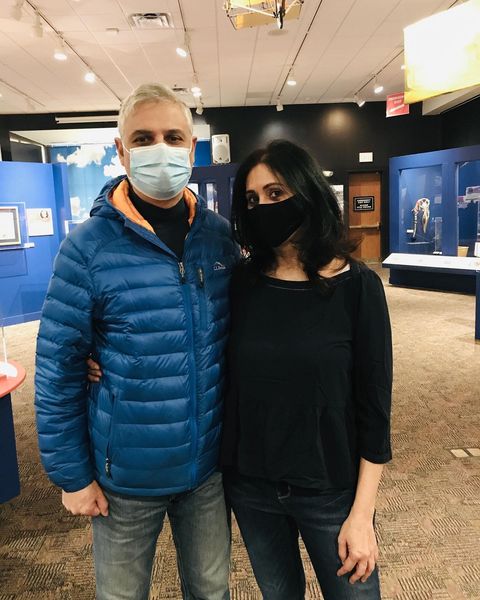
at the rochester museum & science center today where we saw ‘the changemakers’ exhibit which is stunning. recognized so many beautiful women friends who are part of the exhibition. two pieces from my art series ‘this heirloom’ are on display there. one is a graphic collage with my mom and her sister, when they were little girls. the other is called ‘embroidered dreams’ and it’s a tribute to my paternal grandmother, niaz fatima. my grandmother became a widow when she was quite young and struggled to raise and educate her children, in a highly patriarchal family system. i was wondering how she would feel about her picture hanging in a museum in rochester, new york, a tribute by a granddaughter she didn’t see grow up. it felt empowering.
.
rmsc #thechangemakers #beachangemaker #womensupportingwomen #womenempowerment #pakistan #rochesteny


What terrifies people more than cops
Harsha Walia: You know what terrifies people as much (or more than) cops: social workers apprehending your children and tearing apart your family; border agents and immigration enforcement detaining and deporting you to a certain death; jail guards assaulting and incarcerating and torturing you; private security guards and city officials stealing your tent and belongings in the dead of winter because you have nowhere to sleep but outdoors; psychiatrists and health care professionals forcibly detaining you and throwing you in involuntary treatment; western-funded and trained military units and occupying forces killing and massacring you and your family members in one of the hundreds of permanent imperial wars across this globe. The carceral regime of social control within racial capitalism is a networked system of violence upholding ‘organized abandonment alongside organized violence’ (as Ruthie Gilmore calls it), of which cops are one of many interconnected deathscape infrastructures we need to abolish.
The NYT’s terrorism fetish
“We fell in love with the fact that we had gotten a member of ISIS who would describe his life in the caliphate and would describe his crimes,” New York Times executive editor Dean Baquet told NPR in an interview. “I think we were so in love with it that when we saw evidence that maybe he was a fabulist, when we saw evidence that he was making some of it up, we didn’t listen hard enough.”
That’s it? The NYT was madly in love with ISIS fantasies, so they didn’t bother to check whether their one and only source, Shehroze Chaudhry, had ever been to Syria? Rukmini Callimachi, their terrorism star, gets reassigned and we move on?
This is the problem with the West: their obsession with lurid, Orientalist, violent, but also perversely erotic readings and portrayals of the non-West. It’s a full-time job that requires constant snooping and make-believe, the invention of entire disciplines and colonial projects, the production of art and culture, as well as plentiful funding and prestigious awards. Whether it’s the Nobel or Pulitzer, the Peabody or the Oscars, look at the stories being told. What gets rewarded and what gets left on the dusty pile of rejection.
This reward and punishment scheme is so consistent and normalized, that even people of color with connections to the non-West get it. They know what stories to tell or how far they can go in their criticism of Europe and its stellar intellectual history. The trick is to complicate, to rely on subterfuge, and not make the indictment of the non-West too obvious, racist, or one-note. The formula works well, particularly if the oeuvre is inspired by Plato’s Dialogues or Leopardi’s Canti.
The ‘Caliphate’ fiasco is hardly an anomaly. NYT terrorism expert Judith Miller cheerled the invasion of Iraq, because her source “clad in nondescript clothes and a baseball cap pointed to several spots in the sand where he said chemical precursors and other weapons material were buried.”
This is the precarious foundation on which the War on Terror and its attendant propaganda are built, buttressed by stories of magic WMDs and ISIS elves. Failures of American journalism, however spectacular, never make a dent because this is the reflection we want to behold. We can only be good and right, if someone else is bad and wrong. Even if we get caught lying like a rug, we can turn around and say we were so madly in love with the truth, we just didn’t listen hard enough.
akimbo books
jeff bezos’ wealth jumped by $90.1 billion, to $203.1 billion, from march to october this year. amazon does *not* need more of our money. we can buy books from local bookstores and online businesses that desperately need our support to survive these harsh times. here is one such wonderful online book store, right in the middle of rochester. pls support by ordering books through them.
It is time to talk about caste in Pakistan and Pakistani diaspora
Shaista Patel: Concerns raised by Dalit and anti-caste thinkers from Pakistan often remain ignored and outright dismissed, especially by caste and class privileged Pakistani Muslims who refuse to see caste, let alone the caste dominance and caste terror prevalent in Pakistan and its diaspora.
Pakistanis need to stop believing that Dalits live only in India. There are about 40 castes, 32 of which were listed as scheduled castes under the November 1957 Presidential ordinance of Pakistan.
[…] As Sindhi anti-caste scholar Ghulam Hussain, who has contributed ground-breaking work on caste relations in Sindh, notes, Sayedism and Brahminism are infused with each other. Sayed supremacy – which Hussain labels as Sayedism – comes from the (unproven) belief that Sayeds are genealogical descendants of Prophet Muhammad and therefore have a more authentic grasp on Islam and all social and political matters.
Another anti-caste researcher, Haris Gazdar, points out that “the public silencing on caste contrasts with an obsession with it in private dealings”. More here.