yesterday at #lessons of the #hour – a #video #installation about
#frederickdouglass by Isaac Julien at the Memorial Art Gallery
will be #writing about it soon 🙂
photo by sarita arden

yesterday at #lessons of the #hour – a #video #installation about
#frederickdouglass by Isaac Julien at the Memorial Art Gallery
will be #writing about it soon 🙂
photo by sarita arden
yesterday i spoke at a rally organized by Jewish Voice for Peace Rochester in support of Ilhan Omar and then gave a talk about migration and borders at Spiritus Christi Church.
in my presentation i urged people to imagine a world without borders. it’s not a fantasy because for the rich and privileged, a borderless world is already a reality. migration only becomes a crisis when poor people are on the move. somehow we don’t use the word ‘migrant’ for wealthy americans who choose to retire in puerto vallarta.nation states contained inside hard borders organize the world based on racialization and colonization. they divide people and produce a global pecking order. this is how rich states protect their interests – by facilitating the movement of capital and the theft of resources across borders, but keeping those who are affected by that pillage and violence out.
a world without borders must be part of any struggle for justice and equity. it certainly has everything to do with I/P.
Some pictures from the Jewish Voice for Peace Rochester rally in support of Ilhan Omar today at the Federal Building in downtown Rochester.


Pls join Jewish Voice for Peace Rochester this Sunday and be seen and heard. “We, the members of Rochester JVP as well as the broader Rochester community, stand by Ilhan Omar and her right to critique the influence that Zionism has on US politics. Join us as we deliver our petition to congressman Morelle and rally outside his office to demand an end to Islamaphobia and malicious mis-appropriation of anti-semitism.” More info about the rally here.
‘We should consider why it is so much easier for some to believe that a young black refugee Muslim woman who wears hijab is motivated by anti-Semitism in her criticism of a lobbyist group, rather than by a desire to end warfare and the pain of refugeehood?’ Read more.
You can also sign this petition here.
place #setting: a #juried #art #exhibit at The Yards including the #work of Shadia Nilforoush ?
more photos here.

today i presented my work at a class on “black bodies: intersecting intimacies” at the University of Rochester. the class is taught by the brilliant kate mariner. i had met kate a few years ago and we had bonded over claudia rankine’s book, “citizen: an american lyric.” her students have been reading the book for this class and rankine’s work has also inspired The Injured Body: A Film about Racism in America (a work in progress).
i shared some clips from the interviews we’ve filmed so far, Rajesh Barnabas and i, and showed them pictures shot by photographer Erica Jae. i also shared footage i edited for a multimedia piece that was presented at the fringe in 2016, in which we combined dance and film. i continue to collaborate with choreographer Mariko Yamada on “the injured body.”
i talked to them about a project i am working on with 6 other artists based in england, france and turkey, which has to do with orientalist representations of women from the colonies in the 19th century. i shared artwork by Afsoon Afsoonagain and Salma Caller.
i ended with a recent article by Teju Cole titled “when the camera was a weapon of imperialism (and when it still is), pointing out the right to opacity as advocated by edouard glissant.
it was a long lecture but the students asked some wonderful questions – about new research on racism and PTSD, about the power of the gaze in film and photography, about ways to right colonial theft and extraction, about how conflicts in africa and the middle east lead to immigration to western countries with their own deeply embedded histories of racism.
many students stayed behind after the class to talk about maimouna guerresi’s work, orientalist depictions of women, and film festivals where they’d like to see my work. perhaps the loveliest feedback was from a young woman from taiwan who said that her parents had seen my film A Thin Wall in taipei and were v excited for her to meet me! what a small world it is. glissant would approve 🙂

we watched oscar-nominated, animated shorts last night and i fell in love with this animated film from ireland. the writer-director, louise bagnall, explains how she wanted to explore the different stages of a woman’s life and the idea that identity is so dependent on memories. it moved me to tears. i was able to find the entire 10 minutes-long animation on youtube. here it is.
so #lovely to come across this while #driving in the #city
#madiba #nelsonmandela #rochesterny

Visited Nita Brown at MansaWear, Custom-made Clothing & Accessoriestoday and ordered a dress in beautiful Ghanaian fabric. Am thrilled to have such a unique piece of clothing 🙂
Btw it’s super icy today (more than I can ever remember) so pls be careful out there.
wow. this was 7 years ago. rochester magazine did this wonderful story about me in their feb issue – it was called “filmmaker, political explorer.” loved what editor mark liu took from my interview (esp what i had said about my film Pakistan One on One) and loved the picture by matt wittmeyer.


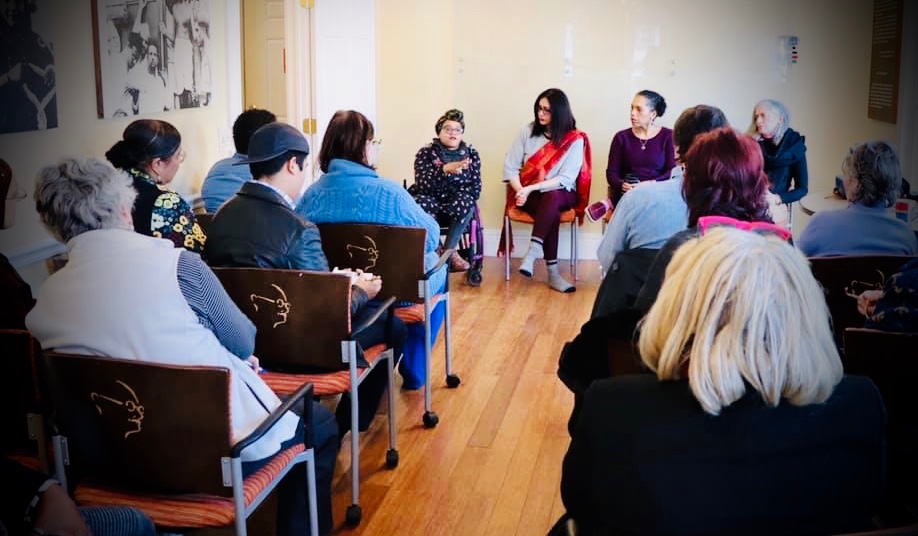
jan 26, 2019: with my #beautiful co #panelists Luticha A Doucette and Kristin Hocker at the #gandhiinstitutefornonviolence after a #discussion about “from #inclusion to full #equity: the #diversity #advantage”
photo by Maria Engels

went on a drive to Canandaigua Lake yesterday and saw horizontal snow, for the first time since i’d been to standing rock in north dakota, more than 2 years ago. complete whiteout with almost zero visibility. an impetuous combination of mighty snowbanks, wind and drifting snow. later as we sat by the window of a restaurant with a beautiful view of the lake, i discerned, far away in the distance, what seemed like a finely orchestrated dance of fallen leaves. they were carried by the wind, up and down and sideways, animated by nature’s breath. but they also seemed to have a life of their own. how are they not buried in the snow? why do they seem to have agency? like notes unmoored from a musical score coming together to sing over and over again. as we looked closer, we realized it was a small flock of tiny birds, following the dictates of the wind but also trying desperately to chart its own flight, stuck in some kind of imaginary vortex. one of the loveliest things i’ve ever seen ?


solid discussion on the “diversity advantage” at the gandhi institute today. it took more than 6 months for me to put this community event together (it was free and open to the public), along with a preview on wxxi’s connections. getting the panel together and negotiating its constantly fluid, evolving make-up was challenging (thank u kristin for being such a trouper and jumping in – i owe u one), finding a venue that made sense, getting some money, bringing food, promoting on social media and otherwise, figuring out how all our disparate pieces would fit together, and then writing my presentation on the complex work of edouard glissant took time and energy. but hopefully, to the frequent question of “why do we need these discussions?” we could submit, “because we might learn something new, meet the other, hear from the other, and change the way we think and act?” possibly.
we learned about ecology and how diversity endows plant and animal systems with resilience. we also learned how some of those ecological principles and habitats can help us design better urban environments. we learned about ableism as a system of segregation and how more intelligent/inclusive design can create public spaces that enrich all of our lives. we learned about the beast of racism and how it disrupts and distorts our most intimate as well as collective experiences. finally, we talked about the work of an incredible martinique poet and philosopher who offers us a language to imagine a world different from ours. by using ideas such as creolization, archipelagic thinking, relation and opacity, glissant allows us to wrap our minds around what could be.
my film, A Thin Wall, tries to imagine a decolonized south asia, in which our common past and pressing present would allow us to break through the colonial framework we’ve been stuck in for the last 70 years. if only we could see through the thin wall that separates us, we would recognize some of our sameness. the last words in the film, which are echoed by my indian co-producer (i was born in pakistan, on the other side of the border) and friend Surbhi, are: “nothing happens, unless we dream it first.” dreams are important.
thx to my valiant co-panelists luticha doucette, mary scipioni and of course kristin hocker, to maria engels our host at the gandhi institute, and to all those who came and added their presence to our dreaming.
[photograph by andrew brady]