muslim american prosperity is tinged with alienation, survey finds

an interesting article in the los angeles times, march 3, 2009:

Muslim American prosperity is tinged with alienation, survey finds
They have a higher employment rate than the national norm but carry a sense of cultural alienation, a yearlong Gallup Poll reports. The young say they are particularly dissatisfied.

By Sarah Gantz
March 3, 2009

Reporting from Washington — A study of Muslim Americans released Monday presents a portrait of an often misunderstood community — one that is integrated socio-economically but culturally alienated; that succeeds in the workforce but struggles to find contentment.

The numbers suggest economic and career success among Muslim Americans — they have a higher employment rate than the national average and are among the nation’s most educated religious groups. Yet only 41% described themselves as “thriving.”

And though the report by the Gallup Center for Muslim Studies states that Muslim Americans are more likely than the general public to hold a professional job, they expressed less satisfaction with their standard of living and community.

The disparity is a sign of the alienation some Muslim Americans may feel, experts say. Ahmed Younis, a senior analyst for the center, said some Muslim Americans feel a sense of “otherness” created by outside perceptions of their religion and a lack of involvement in their larger community.

Three-quarters of Muslim Americans polled said they were satisfied with their community, as opposed to nearly 90% among respondents from other religions. They also were less optimistic about the future of their communities. Muslim Americans ranked highest among American religious groups who believed their communities were getting worse.

The data reflect the responses of 941 Americans who identified themselves as Muslim in a survey of more than 300,000 Americans over the course of 2008. The nonpartisan research center is affiliated with the Gallup polling organization.

“There’s no doubt that there is a certain sense of isolation and alienation — there’s no doubt,” said U.S. Rep. Keith Ellison (D-Minn.), the first Muslim elected to Congress.

One reason for this may be because Muslim communities revolve around the mosque, Ellison said in an interview after the report’s release. The key to a better-integrated Muslim American community, he said, is to make the mosque more welcoming for non-Muslims.

Muslim Americans ages 18 to 29 in particular reported discontent with their jobs and communities.

On average, those youths were unhappier, angrier and less optimistic than their peers in other religions, according to the report.

Only 78% of young Muslims reported having smiled or laughed the day before, while nearly 90% of Protestants, Catholics and Jews of the same age said they had.

A great deal of the emotional turbulence among young Muslims is due to the stereotypes and suspicion of Islam since the Sept. 11, 2001, terrorist attacks, experts say.

“I can only imagine a 10- or 12-year-old getting the type of questions I get” about Islam, said Suhail Khan, a board member of the American Conservative Union and former public outreach aide in George W. Bush’s administration. “I grew up in the ’70s and ’80s, and it wasn’t an issue. It just wasn’t.”

Khan described Muslim Americans’ integration into American society as a long, slow process tainted with discrimination and stereotypes, but one that other minorities have overcome.

“There is no doubt in my mind that we will not only see an end to the discrimination and the fear-mongering,” Khan said, “we’ll soon look back and wonder why some of this even went this far.”

The entire report is available at www.MuslimWestFacts.com.
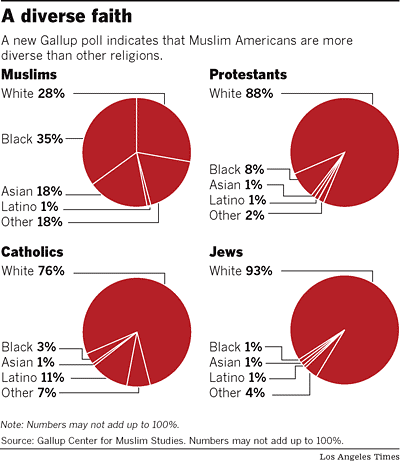
graph

“guaranteed” by eddie vedder from “into the wild”

this is a lovely song by eddie vedder from the film “into the wild”. directed with an artist’s eye by sean penn, the film has much lyricism. it’s the true story of christopher mccandless, a bright young man who decided to abandon all worldly possessions, hitchhike to alaska and live in the wild. a stunning decision.

i loved the use of christopher’s diaries to fill out the film’s narrative. however, the crosscuts with past family scenes and his sister’s commentary (which both strain to explain the whys of his journey) are disruptive. they break the film’s spell. emile hirsh is spectacular.

the wrestler

saw “the wrestler” last week. i know that everyone’s saying it but nevertheless, mickey rourke is magnificent in this film. his performance is so honest, it’s heartbreaking. don’t get me wrong, this is not a sentimental film. like it’s hero it doesn’t pander to anyone’s pity. it takes things as they are and moves on.

mickey rourke’s always intrigued me. he was irresistible. then he disappeared and like many i was enormously curious to witness his return to film. his face has changed – dramatically. but the charm is intact. when he makes eye contact with you it’s hard to let go.

the effects of war on soldiers – lecture and art exhibit at the memorial art gallery

attended a lecture by dr jonathan shay last sunday at the memorial art gallery. dr shay uses the study of homer’s iliad and odyssey to understand the plight of soldiers today. he recommends training and various techniques of cohesion and fair treatment within military ranks in order to equip soldiers with mental and emotional equivalents of helmets and flak jackets. however, as the Q&A progressed and the audience pressed him to comment on today’s wars, it became clear that the only good solution to the problem is to minimize war, VEHEMENTLY.

dr shay recommended a reading of homer’s iliad by derek jacobi and that of the oddyssey by ian mckellan. i have heard derek jacobi read j.m. coetzee’s “disgrace” on bbc world and i have to say that i was enthralled – the experience was far richer than simply reading the book.

this lecture was offered in conjunction with an exhibition of gregory van maanen’s work. van maanen is a vietnam vet, a self-taught artist who has overcome the trauma of war by transforming it into deeply personal art. van maanen’s paintings are haunting, the central figure of a skull being a recurrent theme. inspired by mexican reverence for the spirits of the dead, van maanen has achieved the same easy co-existence of life and death in his work. though his paintings are populated by skeletal figures they are also delicate and beautiful. rather than being disturbing they are filled with vast cosmic backdrops that seem to scintillate, calming symmetry, much beauty and hope. van maanen uses personal symbols to make sense of chaos, as if he had to devise his own language to come to terms with the enormous trauma and futility of war.

his other claim to fame of course is that he is married to my friend, june avignone, a remarkable writer who can conjure up the same intensity of experience with perfectly chosen words.

gregory van maanen paintinggregory van maanen painting

humanitarian crisis in gaza

a team of american doctors went to gaza to provide much needed medical help. you can read about their first hand experiences, see pictures and watch coverage in american news by visiting ammgaza.com.

the military offensive might be over but we cannot forget the horrific humanitarian crisis left behind. the average age is 16 in gaza, so we are talking about a lot of wounded and traumatised children. the doctors describe how in the absence of basic medical supplies, they had to stitch kids up without anesthesia.

it is important to donate to international relief organizations operating in the region.

army suicide rate could top nation’s this year

“Army leaders are fully aware that repeated deployments have led to increased distress and anxiety for both soldiers and their families,” Secretary of the Army Pete Geren said. “This stress on the force is validated by recent studies of Iraq and Afghanistan veterans reporting symptoms of post-traumatic stress disorder or major depression.”

as obama escalates the war in south asia, we will be spending more on defense and less on fixing domestic problems. as the economy deflates further and unemployment rises, military enlistment is going to jump up. an untenable vicious circle. something will have to give.

here is the full article from cnn.

slumdog millionaire

so after being pestered by my friends for the umpteenth time, i finally went and saw “slumdog millionaire”.

it was different from what i expected – less bollywood, more “city of god”. the colors are supersaturated, the cinematography is brisk, the editing is frenetic. the end result is edgy, but more like a nifty mtv video than a hardcore, trainspotting-style, danny boyle film.

most of the film is a handheld marathon through the slums of india. we witness non-stop injustice and brutality through the eyes of two orphaned brothers living on the edges of india’s highly stratified society. some have accused the film of being “poverty porn” – the inappropriate glamorization of crushing destitution. in any case, the cruel negligence and violence with which we treat our poor in south asia rang true. i was captivated but not moved.

my 13 year old son found the happy ending a bit over the top but i have to say that i welcomed the relief, even the bollywood dance at the end!

the final credits are some of the swankiest i’ve ever seen and the music by a.r. rahman is riveting.

holbrooke’s appointment

holbrooke’s appointment is a positive step. he is a brilliant diplomat and someone of his caliber is what we need in south asia. however, where his appointment falls short is the breadth of his portfolio. we choose to focus on the apparent “problem children” in the region without any reference to the big daddy of south asia – india. btw here is a great article about how that came to pass.

the pakistan-india conflict is at the epicenter of much of what we see today and kashmir is what keeps that conflict boiling. if some kind of pakistan-india accord could be brokered it would take the steam out of the pakistan army, the ISI and the whole concept of asymmetric warfare that gave birth to the taliban. it would strengthen pakistan’s civilian government.

another thing that would help of course, would be our abandonment of the latin american model of supporting military dictatorships in pakistan. the time has passed for that approach.

what obama should do in pakistan

from “what obama should do in pakistan” by malou innocent, huffington post, jan 23, 2009:

…U.S. missile strikes prove tactically problematic for three reasons.

First, missile strikes undermine the authority of sitting Pakistani leaders. The August 19th resignation of former army general Pervez Musharraf demonstrated how the burden of assuming a pro-American stance can prove a political liability for “war on terror” allies. Aligning with pro-U.S. policies is one reason why Asif Ali Zardari, Pakistan’s new president, is reviled by many of his countrymen, while opposition leader Nawaz Sharif, who has been openly critical of U.S. actions across the border in Afghanistan, has seen his popularity soar.

A second reason to be skeptical of relying almost exclusively on missile strikes is that they encourage Federally Administered Tribal Areas (FATA) militants to lash out against their closer enemy, Pakistan, causing disastrous ripple effects that further damage the already weakened country. Suicide bombers are striking Pakistan’s large urban centers with increasing frequency and are signals of the spreading insurgency engulfing the Islamic Republic.

The final, and most important, reason to be circumspect about escalating military force in the tribal areas is that it will almost certainly fail. The clans, subclans, and extended families that weave the complex fabric of Pashtun tribal society have endured hundreds of years of foreign invasions. Time and again, Persian, Greek, Turk, Mughal, British and Soviet invaders have discovered these peoples to be virtually unconquerable. Pashtun social values include loyalty (wafa), honor (nang), and badal, the Pashto word for taking revenge. Vendettas, personal and collective, have been known to last for generations. While U.S. missile strikes can certainly extinguish high-value targets, they also trigger collective armed action throughout the tribal agencies.

The dilemma for President Obama is that as long as militants continue to infiltrate the hundreds of unguarded checkpoints along the Afghan-Pakistan border, the security environment in Afghanistan will continue to decline. While Obama is correct to argue that we have no choice but to attack militants inside FATA as long as we remain in Afghanistan…

(here on i stopped agreeing with ms innocent – she doesn’t realize that she just stated the problem – “as long as we remain in afghanistan” – exactly, we need to get out!)

u.s. drone attacks kill 17 in waziristan: first obama-era strikes

the latest u.s. attacks inside pakistan are deeply disturbing.

they are a continuation of the same lazy, ineffective and arrogant warfare ushered in by the bushies. however targeted these air strikes might be, based on whatever “actionable intelligence” might be available to americans living on the other side of the globe, they overwhelmingly result in the killing of poor villagers. and i am sick of hearing about “collateral damage” so let’s not even go there – it’s just convenient linguistic whitewash.

i read this analogy somewhere and it really struck home. if we had actionable intelligence that a serial killer was hiding in an apartment in manhattan, would it be ok to bomb that entire block? is that how we go after criminals? no, of course not, this would be unthinkable. civilian life is too precious. collateral damage would be too high. how can collateral damage be then justified in waziristan? we are not at war with pakistan.

on to more practical considerations. will killing a few militants (if that can ever be achieved and properly confirmed) mean an end to terrorism? for every militant who’s killed, for every villager in a wedding party who’s bombed to shreds, there will be ten more people who will become radicalized and will want to strike back.

there is direct correlation between u.s. bombings in pakistan’s northern areas and suicide attacks all over pakistan. suicide bombings are completely new to pakistan and they too have been v “targeted”. hafiz gul bahadur, a militant leader in north waziristan, warned that his men would launch suicide attacks on foreigners and government targets across the country unless the raids stop. and so it has been – police stations, army depots, the islamabad marriott where many government dignitaries and foreigners can be found, the list goes on. the pakistan army and government are thought to be complicit in america’s war on the people of pakistan and they have therefore sustained historic numbers of casualties.

on the one hand obama wants to stabilize and engage that region but on the other hand his military strategy will only create more hatred, violence and chaos in south asia. pakistan is already feeling the strain. there are power outages in islamabad and major cities like lahore and karachi, every other hour. food is so expensive that it’s becoming increasingly hard for people not to starve. as the pakistani people are pitted against their own government and army, many see civil war around the corner.

things are so bad right now that the only intelligent thing for us to do is to GET OUT. nothing even remotely good has ever come out of u.s. presence and aggression in that region.

thomas friedman – journalism or infotainment?

here’s the deal. when mr friedman is quoted by people as if he were a real journalist, i find it hard to keep a straight face, for i am constantly entertained by what naomi klein calls his “fake-sense pronouncements”.

some examples: (my comments in parenthesis)

(1) TF’s assessment of the 1990s, on the charlie rose show:

there were 3 big bubbles in the 1990s – the nasdaq bubble, the corporate governance bubble and the terrorism bubble. the first two bubbles were based on creative accounting, the third was grounded in moral creative accounting (what the ???).

this so-called terrorism bubble is a “fundamental threat to our open society”. and that’s why america needed to burst this bubble because otherwise, the terrorists would feel they could use suicide bombers to level the balance of power between them and the united states.

the only way to do it was for the united states to go into the muslim world: “what they needed to see was american boys and girls going from house to house, basra to baghdad, and basically saying, ‘which part of this sentence you don’t understand? you don’t think we don’t care about our open society? you think this bubble fantasy–we’re just going to let it grow? well, suck on this. okay'”. (nicely put TF)

TF continued: “that, charlie was what this war was about. we could have hit saudi arabia. it was part of that bubble. we could have hit pakistan. we hit iraq because we could. that’s the real truth.” (that might actually be true)

(2) TF’s endorsement of rabid capitalism: two countries with mcdonald’s restaurants won’t go to war (fast food will save us all in the end…)

(3) his metric for success in iraq (whatever that means): when salman rushdie can give a lecture in baghdad… you are not going to get a reformation in islam or arab politics without this.

is that supposed to be journalism or something?

ten things you can do about the war in congo

the war in congo is horrific. for some historical perspective watch “king leopold’s ghost” by pippa scott (on netflix). for the devastating effects of the war on women watch “the greatest silence: rape in the congo” by lisa f. jackson (an HBO doc).

we should educate ourselves about what’s going on in the congo. here is a good way to start.

ten myths about pakistan

hope president obama will talk to some people who know something about pakistan (for real, not just from books by people who spent a weekend there once or flew over pakistan on their way to another country) before deciding to escalate the war in afghanistan.

Ten Myths about Pakistan by Mohammed Hanif (The Times of India, January 4, 2009)

Living in Pakistan and reading about it in the Indian press can sometimes be quite a disorienting experience: one wonders what place on earth they’re talking about? I wouldn’t be surprised if an Indian reader going through Pakistani papers has asked the same question in recent days. Here are some common assumptions about Pakistan and its citizens that I have come across in the Indian media…

Pakistan controls the jihadis: Or Pakistan’s government controls the jihadis. Or Pakistan Army controls the jihadis. Or ISI controls the jihadis. Or some rogue elements from the ISI control the Jihadis. Nobody knows the whole truth but increasingly it’s the tail that wags the dog. We must remember that the ISI-Jihadi alliance was a marriage of convenience, which has broken down irrevocably. Pakistan army has lost more soldiers at the hands of these jihadis than it ever did fighting India.

Musharraf was in control, Zardari is not: Let’s not forget that General Musharraf seized power after he was fired from his job as the army chief by an elected prime minister. Musharraf first appeased jihadis, then bombed them, and then appeased them again. The country he left behind has become a very dangerous place, above all for its own citizens. There is a latent hankering in sections of the Indian middle class for a strongman. Give Manmohan Singh a military uniform, put all the armed forces under his direct command, make his word the law of the land, and he too will go around thumping his chest saying that it’s his destiny to save India from Indians . Zardari will never have the kind of control that Musharraf had. But Pakistanis do not want another Musharraf.

Pakistan, which Pakistan? For a small country, Pakistan is very diverse, not only ethnically but politically as well. General Musharraf’s government bombed Pashtuns in the north for being Islamists and close to the Taliban and at the same time it bombed Balochs in the South for NOT being Islamists and for subscribing to some kind of retro-socialist, anti Taliban ethos. You have probably heard the joke about other countries having armies but Pakistan’s army having a country. Nobody in Pakistan finds it funny.

Pakistan and its loose nukes: Pakistan’s nuclear programme is under a sophisticated command and control system, no more under threat than India or Israel’s nuclear assets are threatened by Hindu or Jewish extremists. For a long time Pakistan’s security establishment’s other strategic asset was jihadi organisations, which in the last couple of years have become its biggest liability.

Pakistan is a failed state: If it is, then Pakistanis have not noticed. Or they have lived in it for such a long time that they have become used to its dysfunctional aspects. Trains are late but they turn up, there are more VJs, DJs, theatre festivals, melas, and fashion models than a failed state can accommodate. To borrow a phrase from President Zardari, there are lots of non-state actors like Abdul Sattar Edhi who provide emergency health services, orphanages and shelters for sick animals.

It is a deeply religious country: Every half-decent election in this country has proved otherwise. Religious parties have never won more than a fraction of popular vote. Last year Pakistan witnessed the largest civil rights movements in the history of this region. It was spontaneous, secular and entirely peaceful. But since people weren’t raising anti-India or anti-America slogans, nobody outside Pakistan took much notice.

All Pakistanis hate India: Three out of four provinces in Pakistan – Sindh, Baluchistan, NWFP – have never had any popular anti-India sentiment ever. Punjabis who did impose India as enemy-in-chief on Pakistan are now more interested in selling potatoes to India than destroying it. There is a new breed of al-Qaida inspired jihadis who hate a woman walking on the streets of Karachi as much as they hate a woman driving a car on the streets of Delhi. In fact there is not much that they do not hate: they hate America, Denmark, China CDs, barbers, DVDs , television, even football. Imran Khan recently said that these jihadis will never attack a cricket match but nobody takes him seriously.

Training camps: There are militant sanctuaries in the tribal areas of Pakistan but definitely not in Muzaffarabad or Muridke, two favourite targets for Indian journalists, probably because those are the cities they have ever been allowed to visit. After all how much training do you need if you are going to shoot at random civilians or blow yourself up in a crowded bazaar? So if anyone thinks a few missiles targeted at Muzaffarabad will teach anyone a lesson, they should switch off their TV and try to locate it on the map.

RAW would never do what ISI does: Both the agencies have had a brilliant record of creating mayhem in the neighbouring countries. Both have a dismal record when it comes to protecting their own people. There is a simple reason that ISI is a bigger, more notorious brand name: It was CIA’s franchise during the jihad against the Soviets. And now it’s busy doing jihad against those very jihadis.

Pakistan is poor, India is rich: Pakistanis visiting India till the mid-eighties came back very smug. They told us about India’s slums, and that there was nothing to buy except handicrafts and saris. Then Pakistanis could say with justifiable pride that nobody slept hungry in their country. But now, not only do people sleep hungry in both the countries, they also commit suicide because they see nothing but a lifetime of hunger ahead. A debt-ridden farmer contemplating suicide in Maharashtra and a mother who abandons her children in Karachi because she can’t feed them: this is what we have achieved in our mutual desire to teach each other a lesson.

The writer is the author of ‘A Case of Exploding Mangoes’

the country was made ours

this article by cenk uygur (the huffington post, jan 21) articulates many of my own feelings. here it is:

The Country Was Made Ours

I know I have emphasized this theme before, but I can’t tell you what a relief it is to have the Reign of Error over (I don’t know who to credit for that turn of phrase; I saw it on the internet somewhere and thought it’s perfectly appropriate). I love that Obama was inaugurated today. But I have to confess that I think I loved Bush leaving more. That was the world’s greatest helicopter ride out of town.

I was even more relieved when they swore Joe Biden in, knowing that Dick Cheney could not torture one more man, break one more law or invade one more wrong country.

I feel released from the oppression of one more injustice or one more grave error around the corner. What will they do next? What heinous or negligent act lies ahead for us? But, now it’s over. It feels like a burden has been lifted off of me. I feel liberated.

The liberation of America has begun!

The reason for my relief is not my abiding faith that Obama can do no wrong or will make no mistakes. It rides on one single idea – he will do his best. Unlike Bush, he will be diligent, intelligent, responsible and caring. And that makes all the difference.

It’s not that Bush didn’t care about anybody. I’m sure he loves his family and thinks he loves his country. What I mean is that he didn’t care to do the job right. He didn’t take his responsibility seriously. It didn’t keep him up at night. He didn’t diligently think through his actions. He didn’t appreciate the consequences of his decisions. He was careless with our well-being.

Obama might not always do right, but I believe he will at least try with all his might. That is the new faith I have in our president and in our country.

And in that light, let me end on this note. I wasn’t sure the Roosevelts, the Kennedys or the Bushes really represented me. Not that they were all bad presidents, because they surely weren’t (not all of them at least). But because I wasn’t sure they were one of us.

Were they from a different class of people? Were they part of a different group I didn’t have a chance of joining? Did they rule us instead of lead us?

Bill Clinton was genuinely middle-class. He seemed to show that a real American without any connections or privileges could make it to the top. But you always wondered. Was there something we didn’t know about Clinton’s connections to the world of the powerful?

With Obama those doubts have been erased. Obama wasn’t born as anybody. Obama didn’t know anybody. Obama became somebody. It turns out there are no secret elites that exist above us. We are truly a democracy. Any of us can make it.

With this inauguration, this country was made ours. For the first time – as much as I have loved it before – I feel like it is truly our own now. Any one of us can really be the first among equals. The hope that America actually stands for what it proclaims has been realized. That is not to be underestimated. And that is part of why so many people were out in Washington, DC today. Because they came to their inauguration.

America was made real today.