
oct 2, 2014: the diversity conference at suny brockport was most excellent! enjoyed the multicultural food tasting. my favorites: south african masala pineapple, caribbean meat patties and ethiopian lamb kebabs. the screening went v well. great audience and good intro by dr james spiller, who’s the dean of the graduate school. he asked me the last question during Q&A: “what does it feel like to see extremists commit acts of violence in the name of one’s religion? isn’t it the ultimate desecration?” i told him it was a good question but it doesn’t apply uniquely to muslims. after all, violence is being committed all over the world, by all kinds of people, in the name of all kinds of ideologies. does it make us feel better if we proclaim that the violence we’re committing is in the name of democracy? i talked about iraq: one million killed, 10-12 million people displaced, chemical weapons used extensively in fallujah with devastating results to this day. is it less of a desecration because it was done in the name of democracy? or capitalism (which is a religion in america, according to naomi klein), or oil, or some kind of ethno-religious ideology (such a zionism)? shouldn’t we start being objective, ignore all the window dressing and condemn violence for what it does – inflict pain and suffering on other human beings? dr spiller thought i was being “provocative” but i was just being sincere. more about the conference here.
Category: self-authored
FCP 6 on osx mavericks
sept 28: this morning i had a major panic attack: finally set up my new mac pro (with osx) and was excited to install final cut pro 6 and get on with editing “partition stories.” nothing doing. osx is too advanced for fcp 6, it wants fcp x. i have absolutely no wish to upgrade to fcp x (too expensive and too weird) so i began to explore online forums to see if i could find a way around this horrible problem. most people said no, there is no compatibility. but i didn’t give up. finally i found a guy who swore that if u use ur snow leopard (older os) disc to install “rosetta”, fcp 6 would run seamlessly. i did just that. found rosetta under “optional installs”. it took 10 seconds to download and voila, fcp 6 is now being installed on my computer! all the filmmakers out there, you too can do it if u want. we don’t have to follow apple’s dictatorial edicts. we are not helpless minions!
ISIS style executions in 2-year old turkish film
i know that questioning the US govt’s discourse on “evil terrorism” is blasphemy and political suicide, so i won’t make any comments or draw any conclusions. just watch this film, 60 minutes in. apparently it’s a turkish thriller that came out 2 years ago, long before ISIS (ISIL/IS/whatever) was hot. indulge me.
Kurtlar Vadisi Pusu 230. Bölüm Tek Parça
circus orange’s “tricycle” in rochester
sept 20, 2014: circus orange was at manhattan square park last night, part of the rochester fringe festival. the show’s finale was this wonderful dancer inside a pyro wheel, 60 feet above our heads. and then everything exploded into fireworks. spectacular. here’s a review by jake clapp.


a most wanted man
went to see “a most wanted man” last night. went for philip seymour hoffman so didn’t read any reviews or do any research. if msm doesn’t do a good enough job for u, as far as stereotyping muslims and islam, then this is definitely the film to see. terrorism is articulated exclusively in terms of islam, the surveillance of mosques isn’t even an issue, safety lies in recruiting loyal informants inside the muslim community (and hugging them every now and then to prove western sincerity), a lawyer for asylum seekers is called a social worker for terrorists – she’s told not to spout nonsense about trampling all over the constitution because we are at war with a “nation” called islam, well-integrated tolerant muslim leaders are probably a front for al-qaeda (they fund “rockets” through their “charities”), finally, never have people praying in a mosque or at home looked as ominous as in this film. my husband has faith in le carré and tells me much of this is irony. yes, there is the pushy arrogant american official who lords it over her european counterparts, yes german intelligence is truly concerned about the insiders they use as bait in their entrapment schemes, yes the chechen youth is child-like and looks a bit like ryan o’neal (after he’s shaved his unkempt muslim beard), but seriously, when can we paint a religious or ethnic minority in such unidimensional, exotic and threatening colors (however ironic) and get away with it? the dehumanization project continues.
How the War on Terror Created the World’s Most Powerful Terror Group
this is such a confused piece of writing! many people connected to syria have been saying for a long time now that partrick cockburn doesn’t know his head from his —, but this article in the nation is a masterpiece of erroneous analysis.
Patrick Cockburn: “The “war on terror” has failed because it did not target the jihadi movement as a whole and, above all, was not aimed at Saudi Arabia and Pakistan, the two countries that fostered jihadism as a creed and a movement. The US did not do so because these countries were important American allies whom it did not want to offend. Saudi Arabia is an enormous market for American arms, and the Saudis have cultivated, and on occasion purchased, influential members of the American political establishment. Pakistan is a nuclear power with a population of 180 million and a military with close links to the Pentagon.”
apart from the fact that assad is cockburn’s good guy, there are some other serious problems with his thinking. the US didn’t want to “offend” pakistan and saudi arabia? good manners are never an impediment to pursuing imperial goals. pakistan is an american client state where the US has supported the army for over 60 years. even now it uses the pakistani military as a mercenary force. saudi arabia is ruled by a ruthless dictatorship which the US protects anxiously (they have military bases in saudi arabia). the war on terror isn’t just a management failure on the part of an overly courteous US, it’s imperial aggression and conquest. like the war on drugs in central and south america, it only helps create the chaos and violence that it claims to be fighting. finally, i think he got the wrong country when he talks about a “nuclear power and a military with close links to the pentagon” which can do no wrong even though it fosters terrorism.
…
so while cockburn admits america’s culpability in creating ISIS, he is still completely on board with the racist, imperial premise of the war on terror. his only objection is that the wrong set of brown people got invaded and obliterated (it shouldn’t have been iraq & afghanistan, it should have been pakistan & saudi arabia). altho i have no sympathy for the saudi dictators or the pakistani military establishment, what cockburn fails to explain is america’s role in propping up their power.
i grew up in pakistan in the 1980s, in a society traumatized by general zia ul haq. yet america continued to support his regime because he was channeling money and arms into afghanistan, to fight the soviets. the misogynistic hudood ordinance, the preposterous blasphemy laws, the expansion of wahabi influence exerted by saudi arabia, the divisions created b/w shias and sunnis, the explosion in drug trafficking and widespread addiction as well as the inflow of automatic weapons into pakistan – most of this was facilitated by zia in order to consolidate his power.
now for cockburn and his friends at the NYT to constantly incite war against pakistan is madness. it’s a damn client state. as cockburn points out 180 million people live there, most of whom are not members of the rhetorically reviled yet perennially US subsidized pakistani army.
accepting the very legitimacy of the WOT is a non-starter. it’s as sound an argument as “israel’s right to defend itself.” let’s talk about colonialism, control and violent exploitation first. don’t give me a list of which brown people need to be bombed next.
…
what i mean by “his friends” at the NYT is that the paragraph that i quoted in my first comment (which u posted) is standard fare for the NYT. they’ve been saying that for years. i know he’s not american. i’m more familiar with his brother’s writing tho.
if patrick doesn’t support bombing anyone, what does he mean by:
The “war on terror” has failed because it did not target the jihadi movement as a whole and, above all, was not aimed at Saudi Arabia and Pakistan, the two countries that fostered jihadism as a creed and a movement.
how could the war on terror have “targeted” the jihadi movement in pakistan and saudi arabia?
…
i find it interesting that when so-called western powers (such as the united states or israel or great britain) commit war crimes and violence on a massive scale (hiroshima and nagasaki, vietnam, korea, the philippines, iraq, afghanistan, palestine, ireland, india, kenya, i could go on forever) we never advocate “targeting” them in a war on murderous imperialism. they too are types that cannot be reformed. one quick reading of american history proves that. why do we always self-identify with the US? i live here and call it my home but i feel like a citizen of the world. military intervention in a country like pakistan (it’s already being droned btw) or saudi arabia or iraq (for the umpteenth time) is as disturbing to me as advocating arab or russian military intervention in the US because it’s a regime that simply cannot help killing large numbers of people.
Karachi uncovered: website reveals city’s hidden architectural gems
i lived in karachi for 4 years and was always awestruck by its diversity. it’s a huge melting pot of religions and cultures, languages and ethnicities, old and new immigrants, commerce and history. it’s constantly teeming with political tensions, economic disparities, and an ever increasing population boiling over its city limits. it’s violent and overwhelming and gritty in the way that nyc was when i moved here in the early 1990s. i wish i had been more familiar with karachi’s architectural side. for more on that, here is farooq soomro, the karachi wallah.
colonial feminism?
naomi wolf’s answer to someone asking her about the “demographic threat” (more palestinians than jews in palestine/israel): “i don’t give a s— about it, it is racist. the issue is values not ethnicity. if the demographic boom turns into an extremist state with female genital mutilation that would make me sad. but that is the risk you take with democracy (we have our own lunatics in the US). but if there is a collective push to humane democratic civil society values why should i care if there are more ethnic palestinians than ethnic israelis?” — i am glad that naomi thinks the entire concept of “democratic threat” is racist (and colonialist) but why the heck is she talking about FGM? what does that have to do with palestinians? also, her assumption that more palestinians would probably result in more “extremism” is such a load of crap. look at israeli society now. if that’s not extremism, then what is? justifying the killing of children with cold logic (based on propaganda about self-interests) is hardly moderate let alone humane. i’m glad that naomi is finally “discovering” the truth about palestine/israel and getting excited about it, but perhaps she should read a few more books before articulating her noble pronouncements.
antisemitism in france
i condemn judophobia (just like i condemn any kind of islamophobia) and i would like to know more about what happened in france. just want to comment, very humbly, that before we make definitive connections between anti-semitism and the north african community in france, we should remember that france (and europe in general) has a long and disturbing history of anti-semitism that goes way beyond its muslim immigrants. perhaps we feel that such racism is now behind us, that white europe has metamorphosed into an evolved entity that is utterly race-blind, except for its culturally otherized minorities. reality seems to indicate otherwise. not too many north africans in this paris rally, earlier this year.
in honor of my unforgettable friend mike ludwig
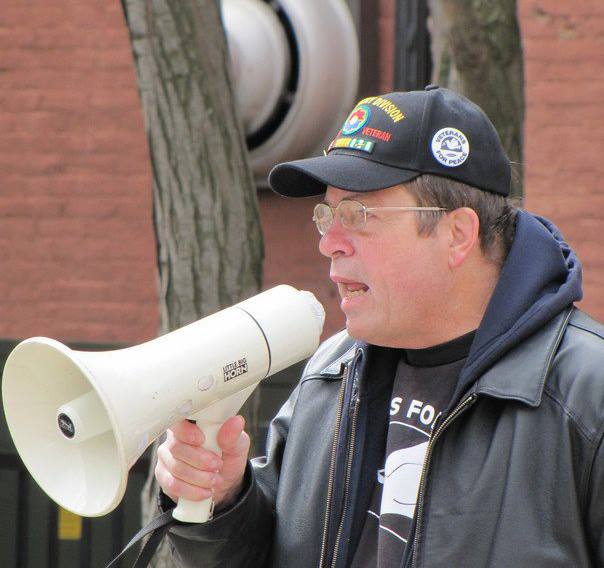
my dearest friend mike ludwig passed away on july 1st, 2014. a vietnam veteran against the war, a veteran for peace, a consummate activist, a loyal friend, a beautiful and humble human being. it was such an honor to know him. i had every intention to meet him one day, probably at a rally or protest. will miss his brilliance, his courage, his honesty, his kindness.
may you rest in power, dear mike. may your family find the strength to deal with this immense loss. you will continue to inspire me… always.
Gerry Rafferty – Right Down the Line
it’s funny how a single song, a tune you seem to have known all your life, can take you back – reconstruct your past around you, recreate an entire era in the fraction of a second. such is the power of gerry rafferty for me. i heard this song on the radio today and it was magical. the feeling of being transported back to one’s childhood, to familiar landscapes with edges softened by memory, to languorous summer days spent reading books from the school library, and endless evenings on roller-skates, rockin’ it to sister sledge songs. how i love this calm, meditative voice in the midst of guitar and saxophone riffs. whether he sings of alienation or love, of baker street or the woman of his life, i will always love gerry rafferty.
Life will never be the same again for Waziristan people
the pakistani army’s on-going operation in north waziristan is horrific. no surprise there. remember swat? millions of refugees, large scale death, destruction and human suffering and what did they achieve? swat is still largely infiltrated by the taliban, in spite of the military occupation. there is no military solution to poverty, injustice and violence. unfortunately, bombing their own citizens is the only thing the pakistani army can manage.
…
Life will never be the same again for Waziristan people
By Zulfiqar Ali
PESHAWAR: “The decision to take whom and leave what behind was difficult,” says Khalil Wazir, the last man standing in his Dattakhel village of Miramshah.
He had been reluctant to leave because he cared for those, who could not get out during the three-day evacuation period. The elderly people were the ones whom he was worried about.
Children and women were just put in the trucks like chicken. Many people left behind their elderly parents since they could suffocate to death in the truck, Mr Wazir said while narrating his ordeal.
The residents of North Waziristan Agency who had to rush to get out of their troubled homeland left behind their cattle and stored grains, the year’s food supply. But the elderly people, who were unable to walk for long, faced much of the pain as they had to either separate from their children or bear the heat in the suffocating truck.
Mr Wazir, a social worker from North Waziristan, having a 120-member family, always sounded optimistic about the restoration of normalcy in the area. He is president of North Waziristan Action Committee, a welfare body having over 1,500 volunteers and blood donors to help ailing people. Till recently, he used to help others in need, but now he himself needs help.
He would squint at any suggestion to shift the family somewhere else, saying their departure from the area would create panic among the residents of Dattakhel village, a hamlet of around 80 houses. Finally he had to compromise with the situation.
He had never been so much demoralised in life as he feels now with the dislocation of his family from the native area. He decided to leave but unlike others first he arranged for his 60-year-old diabetic mother to safely go to Afghanistan with some relatives.
A driver of a mini truck charged him Rs80,000 to take his family from Miramshah to Bannu.
Leaving everything behind, Mr Wazir locked the main gate of his fortress like house and left Miramshah at about 1pm on Friday and arrived at Saidgi checkpost at 9:30am on Saturday. His family members spent sleepless night on the road.
“Many aged men and women are still there. They either can’t travel or stayed back for guarding properties and cattle or simply because they are too old and weak to travel,” said the traumatised Wazir.
He shifted his ailing mother to Afghanistan, but could not evacuate 10 lactating cows and other belongings because of logistic problems. Harvesting season has just ended and the granaries stocked with year’s food have been left behind. He knows in his heart that life is never going to be the same after this one tragedy is over.
Observers and some senior government officials have termed the current displacement a ‘human tragedy’. Military operations have resulted in wanton destruction in the tribal area.
The situation, after this ‘human Life will never be the same for Waziristan people tragedy’ is over, is what no one has tried to measure so far.
Before launching operation Zarb-i-Azeb on June 18, security forces had bombed Matchis Camp village near Miramshah on May 22. Officials claimed that several terrorists were killed in the action.
However, local and independent sources said that elderly people were killed in indiscriminate shelling. Some people, who had stayed at their homes for protection of properties, were apprehended, they claimed.
Security forces have an experience of battling militancy, spanning over a decade in Fata and Khyber Pakhtunkhwa, as they carried out nine major operations against militants in the region. Two operations — Sherdil in Bajaur Agency in 2008 and Rah-i-Nijat in South Waziristan Agency in 2009 — had caused widespread collateral damage.
Army has been in North Waziristan since 2005, having huge network of human intelligence and aerial surveillance system. There are reports that militants have already left Miramshah, Mirali and surrounding areas before the launch of Zarb-i-Azb.
A senior official said that security forces might not face resistance in Miramshah and Mirali, which were hotbeds of local and foreign militants. Forest-covered Shawal mountains, adjacent to the Afghan border, are believed to be a sanctuary of militants.
Sources said that track record of security forces on the humanitarian side in militancy-affected areas of Fata was not satisfactory despite the fact that International Committee of the Red Cross (ICRC) arranged courses and workshops for military officers since the beginning of militancy in the region.
Over 60,000 houses of civilians have been damaged in the ongoing insurgency only in four tribal agencies of Fata. Many non-combatants have been killed in air strikes and shelling. Small bazaars had been dismantled. Officials of Fata Disaster Management Authority (FDMA) said that rehabilitation and reconstruction of private properties required approximately more than Rs35 billion in tribal areas.
Collateral damage can’t be averted in both internal and external conflicts. Attacks that are expected to cause collateral damage are not prohibited but the laws of armed conflict restrict indiscriminate attacks.
Widespread collateral damage occurs in the conflict when principle of proportionality is ignored. Under the law of the armed conflict, parties to an armed conflict must always distinguish between civilians and civilian objects, because civilian population enjoys immunity.
People of North Waziristan have already suffered a lot. Ruthless militants on the ground, retaliatory action by the security forces and US drones have turned Waziristan into a living hell. The people have lost self-esteem, perhaps even identity, in this elusive conflict. Yet it is not too late. The authorities can still win the hearts and minds of the people of North Waziristan Agency if principle of ‘proportionality’ is followed in Zarb-i-Azb.
Published in Dawn, June 23rd, 2014
Asim Rafiqui: Bagram – The Other Guantanamo
last week while in providence, RI, where i interviewed dr zamindar for “partition stories,” i also met and interviewed asim rafiqui. photographer extraordinaire, writer, journalist, activist. born and raised in pakistan, studied at columbia, is now based in sweden. brilliant, perceptive, incredibly humble. his work on the families of 40 pakistani men held at bagram will be on display at brown throughout this summer. he photographs some of the most marginalized, brutally invisibilized pakistanis, yet their beauty and dignity shine in his work. these are some of the most beautiful photographs i have ever seen and some of the most compelling stories i have ever read.
…
“They are ghosts, and I have spent nearly two months trying to find any evidence of them. They are the 40 Pakistani men who remain imprisoned, without charge or evidence, by the Americans at the Bagram Air Base in Afghanistan. They have not been see or heard by anyone other than their immediate families who are granted carefully monitored and heavily censored telephone and internet video call access. Some of the men have been in Bagram, often called one of America’s most notorious prisons, for over 11 years. Denied access to the press, human rights organizations, and legal representation, these men have been silenced and erased, the evidence and rationale for their incarceration beyond the eyes, ears and focus of the public and the media. This is intentional and part of a process of systemic dehumanization that enables the unjust detention and cruel prison conditions the men face. Until 2012, their own government refused to recognize them as citizens of Pakistan. I have spent two months traveling across Pakistan trying to discover something, anything, about them. And I have found the traces of these imprisoned men in the testimonies and stories told by their families–the children, wives, parents, and siblings they left behind, who anxiously wait for their return, and determinedly fight for their release. Sitting in homes located in the deepest depths of the slums of Pakistan’s mega-cities, in small farming communities, and in remote settlements near the border with Afghanistan, I have heard tales of the men’s lives, childhood, dreams and hopes, and, of the emotional and economic consequences inflicted on the lives of entire households. My journey has brought me in touch with some of the most economically marginal and desperate people I have ever met. And what I have felt as I have sat in their tenement rooms and mud homes is a terrible shame and anger at the realization that not only has their own government failed to live up to its responsibility, but that another nation–one that brags about its global economic might and unmatched military power, has chosen to torture, humiliate, and indefinitely incarcerate some of the poorest, and the most economically weak people I have ever met.”
More here.
Love In The Time Of Cholera And Hélène Cixous by Mara Ahmed
17 June 2014
Countercurrents.org
As I finished reading Gabriel Garcia Marquez’s “Love in the Time of Cholera” for the second time in my life, I was left with much to think about. It’s a book about a love affair between Florentino Ariza and Fermina Daza that spans over half a century. It starts with fervent love letters in their early youth, becomes one-sided when Fermina loses interest and Florentino continues to be single-mindedly devoted to her (whilst engaging in a wildly promiscuous love life), and resumes 53 years later in their old age when Fermina’s husband dies in a freak accident and Florentino reasserts his undying passion for her.
I love Marquez’s captivating storytelling: the shifts in time, the multivarious voices in which the story is told, the evolution of the main characters in all their complexity and quirkiness and humanness, the subplots and supporting characters which create a rich and contrasting tapestry, the undeniable beauty of his language and the fecundity of his imagination. I appreciate the subtle yet indispensable political context which forms the book’s backdrop: colonialism, civil wars, disease, the splitting of society along economic and racial lines which extend to institutional religion, progress and environmental degradation, poverty and other structures of social violence.
Marquez breathes life into the unnamed Caribbean city where the story takes place (ostensibly Cartagena, Colombia) with his masterly depiction of its streets and neighborhoods, it flora and fauna, its smells and superstitions, its riverboats and people. The book is a treatise on love, the oppression of old age and the social stigma attached to aging, and the ridiculous capriciousness of death.
Love is explored in all its convolutions: platonic love and the possibility of friendship between a man and a woman, romantic idealized love, the profundity of conjugal love, physical, transient or depraved love, love as a sickness (with symptoms similar to cholera), love as a violation and obsession, love as a cure, love as the ultimate raison d’être.
I agree completely with the knotty and evasive nature of love, but as a woman, some of the narrative details made me deeply uncomfortable. Florentino Ariza struck me less as a heroic personification of romantic love and more as a creepy, obsessive-compulsive seducer who is able to garner our sympathy for his “cause” while surrendering to all his instincts. It is casually mentioned, in one line, that he, who had assaulted a servant girl and made her pregnant, had sadly lost much of his manly vigor in old age. The whole question of rape is problematic in the book. I understand that Marquez might be trying to invert the idea of rape (Florentino loses his virginity when he is raped by a woman) but one of the strongest female characters in the book, Leona Cassiani, responds to her brutal rape by falling in love with her attacker and that is difficult to digest. Florentino’s description as a “hunter” looking to catch little “birds” and his assertion that “when a woman says no, she is waiting to be urged before making her final decision” fit too snugly into what we can finally articulate as rape culture.
Florentino Ariza’s deliberate seduction of his 14-year old ward, a distant relative who is entrusted to his care by her parents, is difficult to read. Sex scenes are mixed in with walks in the park where they eat ice cream and play ball. Once he reconnects with the love of his life, the recently widowed Fermina Daza, he jilts the child. She begins to do poorly in school and eventually commits suicide. Many of the women who become Florentino’s lovers are shown as being independent, in touch with their sexuality, and fully cognizant of what they’re getting into, yet pain is taken to express clearly that he is the one who always ends the affair, except for one instance, i.e. his women lovers can be sexually free but are not in control.
The descriptions of “black” and “mulatto” women are incredibly offensive. They are painted as uncontainable voluptuous bodies which ooze (and therefore invite) sex. These stereotypes, which hearken back to slavery, are not representations of what the characters think or feel and therefore time-appropriate. These descriptions are provided by the writer. Although the story happens in the late 19th to early 20th century, the book was written in 1985. Yet we don’t see any “modern” sensibility in the endless caricatures of women Marquez draws.
It must be said that the book’s female protagonist, Fermina Daza, is brilliantly and comprehensively sketched. Her haughtiness, self-command and decisiveness make her strong. Her quick temper and ability to break with tradition make her interesting. She can love with a kind of devotion and clear-mindedness that is moving. Leona Cassiani is another powerful female character. She is a naturally gifted businesswoman and rises to the top of the River Company of the Caribbean. She is in charge of her life and work and possesses more foresight and sangfroid than most of the male characters in the book. She is also the one who confuses rape with love.
In short, while I cannot deny the spectacular genius of Gabriel Garcia Marquez, I’m left wondering if most great literature is filled with problematic representations of women and how they relate to men. I have to meditate on how quick we (men and women) are to justify female stereotypes: oh, it’s a reflection of the times, it’s symbolic, it’s a metaphor, an abstraction, it’s deconstruction. It seems almost provincial or petty to mention the fact that literary (and artistic) devices and explorations mostly play out on the bodies of women.
We’ve become so reconciled to these images of women, written by men for the most part, that we are inured to how they shape our thinking and society. I long for more writing by women, what Hélène Cixous calls l’écriture feminine, which goes beyond women writing women, for women.
Cixous sees Western culture as rooted in the dichotomy between binary opposites: male/female, good/evil, light/dark, language/silence, speech/writing. In each of these pairs the first term has primacy over the second.
She talks about Freud’s description of women as being the “dark continent.” Women are synonymous with darkness, otherness, Africa. Men are the opposite. They represent lightness, selfhood, Western civilization. Women are the colonized, men the imperialists. This same apartheid is imbedded in language.
Cixous sees anyone subscribing to existing linguistic hierarchies as inadvertently taking up the position of a “man.” However, these restrictions on language are historico-cultural and surmountable. For Cixous writing must take place in the spaces in-between, without any preference for or reference to opposing terms. Women are more than equal to the task on account of their “gift of alterability.” As mothers, women are naturally adept at nourishing, eliminating separation, re-writing codes: “in woman, personal history blends together with the history of all women, as well as national and world history.”
Rather than remain trapped inside men’s language and grammar, Cixous urges women to explode that structure and invent a language they themselves can get inside of. This is why she describes feminine writing in non-representational ways such as song, milk, flight, and rhythm. She calls for a literary revolution, and we are reminded every day, in every part of the world, that we’re in desperate need of it. More here.
free speech vs hate speech
next time someone makes the argument that ayaan hirsi ali’s blatantly anti-muslim bigotry “challenges us” (the words of irshad manji), or that racist cartoons depicting arabs with bombs in their turbans “protect our freedom of speech,” or that racist native american mascots “honor” the people they caricature, pls ask them to google julius stricher:
“On October 16, 1946, a man named Julius Stricher mounted the steps of a gallows. Moments later he was dead, the sentence of an international tribunal composed of representatives of the United States, France, Great Britain, and the Soviet Union having been imposed. Streicher’s body was then cremated, and – so horrendous were his crimes thought to have been – his ashes dumped into an unspecified German river so that “no one should ever know a particular place to go for reasons of mourning his memory.”
Julius Streicher had been convicted at Nuremberg, Germany of what were termed “Crimes Against Humanity.” The lead prosecutor in his case Justice Robert Jackson of the United States Supreme Court had not argued that the defendant had killed anyone, nor that he had personally committed any especially violent act. Nor was it contended that Streicher had held any particularly important position in the German government during the period in which the so called Third Reich had exterminated some 6,000,000 Jews, as well as several million Gypsies [Romas], Poles, Slavs, homosexuals, and other untermenschen (subhumans).
The sole offense for which the accused was ordered put to death was in having served as publisher/editor of a Bavarian tabloid entitled Der Sturmer during the early-to-mid 1930s, years before the Nazi genocide actually began. In this capacity, he had penned a long series of virulently anti-Semitic editorials and ”news.”
Stories, usually accompanied by cartoons and other images graphically depicting Jews in extraordinarily derogatory fashion. This, the prosecution asserted, had done much to “dehumanize” the targets of his distortion in the mind of the German public. In turn, such dehumanization had made it possible or at least easier for average Germans to later indulge in the outright liquidation of Jewish “vermin.” The tribunal agreed, holding that Streicher was therefore complicit in genocide and deserving of death by hanging.”
(Ward Churchill, “The Nuremberg Precedent”)
…
i think it’s worthwhile to consider whether there are things such as hate speech, bigotry, racism, sexism, anti-semitism, anti-muslim prejudice, etc and what limits to place on civil discourse in view of the existence of social and power structures which enforce inequality. if we are all agreed that it’s not a level playing field, then we have to consider how the already marginalized and institutionally disempowered are being affected by hate speech. it’s always been a bit amusing to me that the “free speech” crowd gets much more agitated about hirsi ali’s right to demand that all muslims be forced to convert but is infinitely more relaxed about severe restrictions placed on political speech (govt attacks on activists for example, who can be beaten up and jailed for expressing dissenting views).
how to differentiate between hate speech and free speech? here’s the definition of hate speech:
Hate speech is speech that attacks a person or group on the basis of race, religion, gender, disability, or sexual orientation. [i would add “culture” to this list. post WWII there has been a shift in how racism is expressed. prejudice based on “race” has become too tawdry and repulsive, so it has been replaced with “culture.” when we talk of “islamic culture” being incompatible with democracy and human rights for example, it’s just a cover-up for racism.]
In law, hate speech is any speech, gesture or conduct, writing, or display which is forbidden because it may incite violence or prejudicial action against or by a protected individual or group, or because it disparages or intimidates a protected individual or group. The law may identify a protected individual or a protected group by certain characteristics. In some countries, a victim of hate speech may seek redress under civil law, criminal law, or both. [minorities should certainly be protected groups and so should be people who have been historically colonized, ethnically cleansed, enslaved, persecuted, etc and who are still disenfranchized on account of that history. ideally, i’m all for absolute free speech but that would work only if we were dealing with a level playing field – socially, economically, politically, etc. unfortunately, that is NOT the reality we live in.]
Critics have argued that the term “hate speech” is a contemporary example of Newspeak, used to silence critics of social policies that have been poorly implemented in a rush to appear politically correct. [this is where i like to draw a distinction b/w mocking/offending/dehumanizing groups of people (the danish cartoons for example) and political speech (the right to criticize govt policy, politicians, heads of state, the IMF, the NSA, etc.) if comedians are not allowed to make sexist jokes or brandeis decides not to give an honorary degree to hirsi ali, it doesn’t really upset me much. i don’t think the world is poorer for it. however, when activists protesting drone strikes are arrested and imprisoned (it happened to a close friend of mine), that is extremely disturbing. it undermines the very structure of democracy.]