
who is this kamel daoud? apparently he writes in french and his translated piece about “the sexual misery of the arab world” was just published in the NYT. all i can say is eeewww. says a lot about this disgraceful rag that they would choose to publish such blatant repugnant orientalist trash. it’s just the arab world that’s obsessed with sex? what could be more french than houellebecq and strauss-kahn and what they represent? also, wondering if the NYT followed up on the story of alan dershowitz’s escapades with underage girls. there seems to be a lot of “sexual misery” here at home as well, people, and it’s expressed in all kinds of misogynistic depraved ways. get real.
Category: self-authored
Kathryn Bevier’s artwork at the Geisel Gallery
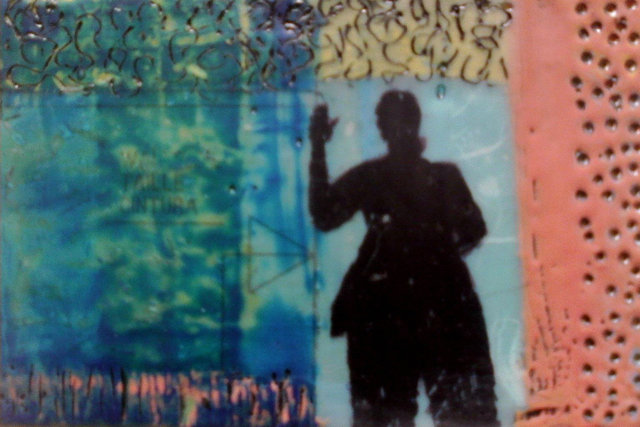
saw Kathryn Bevier‘s beautiful artwork at the Geisel Gallery yesterday (1 Bausch and Lomb Place, in Rochester). kathryn uses the encaustic technique of painting with pigmented wax to create vibrant compositions. her work has a calming, serene elegance to it and of course anything that involves image transfer, collage, texture and multiple media speaks strongly to me. i was particularly taken with her “shadow self” series. this picture (taken with a flip phone) do not do justice to her work. u can check it out until the end of january.
Beasts of No Nation
“Beasts of No Nation” is a stunning film. It is written and directed by Cary Joji Fukunaga and based on Uzodinma Iweala’s novel about a child soldier. The film is beautifully written and shot. Not only should Idris Elba have been recognized for his excellent work, but I’m even more shocked that no mention has been made of the incredibly sensitive, masterful performance by Abraham Attah, the film’s child protagonist. The Academy Awards are rubbish.

Terror Hub or Empire of Fear by Mara Ahmed
my new piece published in countercurrents today.
…
A wonderful housewarming party the day after New Year’s, in a Rochester suburb covered with bright, powdery snow. A diverse group of guests – musicians, poets and academics, but also physicians and lawyers, neighbors, grandmothers, Indian, Iranian, Russian, Belgian, and of course, everyone soundly American. The hors d’oeuvres are splendid, I assume that the wine is good, the conversation flows.
In the midst of preliminary introductions and stories about work, the subject of terrorism comes up. It’s to be expected. Rochester has just experienced the latest terror plot in which a socially marginalized Muslim man with a history of mental illness was bulldozed by the FBI into planning an attack, and then quickly arrested. New Year’s fireworks were cancelled and Rochester joined the ranks of global metropolises like Paris and New York City. The excitement didn’t last long though, as the sad details of a local panhandler’s entrapment became known.
“Why has Belgium become a terror hub?” someone asks. There is some discomfort, some evasion, but the question is repeated several times. The Belgian guest explains how things have changed over time. We talk about Molenbeek, a municipality of some 95,000 people in the Belgian capital, an area inhabited by Muslims and North Africans, the alleged suburb “at the heart” of the Paris attacks. I express my displeasure at stereotyping entire neighborhoods for the actions of a few. I remember some of my Moroccan and Algerian friends at the Lycée Emile Jacqmain in Brussels. They might have been from Molenbeek. It wasn’t on the radar in those days, not newsworthy enough.
We discuss the social inequities that exist in many European cities, the impossibility for second and third generation, non-white immigrants to be absorbed by the mainstream, the high rates of unemployment and crime, the clustering of poverty, and the geography of racist segregation whereby central Paris becomes a foreign country to those relegated to the banlieues. Disaffection does not need to be imported from abroad, it’s borne of systemic, multigenerational discrimination.
Someone marvels at Europe’s difficulties with immigrants in light of the relative success we’ve had here in the United States. I mention Black Lives Matter and the ongoing war on American black men. But they’re not immigrants, I’m told. Indeed, they’ve been here forever and they’ve built this country, yet the projects look incredibly similar to the banlieues. Could racism be a point of intersection?
In an interview with Bill Moyers, in November 1988, Derek Walcott spoke about the appalling ghettoes of America, about the “colony” which exists within the empire. He said it might have something to do with denying the responsibility of being an empire, not just a global empire but also a domestic one.
This denial of empire creates endless confusion in American political discourse and lends itself to dangerous manipulation. It’s astonishing that the American public, protected by the mightiest military juggernaut in human history, is constantly afraid.
Al Qaeda, and now ISIS, can strike fear into the American heart in a way that is completely out of whack with reality. After all, it’s our military power that continues to flatten countries and kill innumerable people in the Global South, in invisible, largely privatized, open-ended wars, not the other way around.
The discussion at this lively party, organized by a dear friend, leaves me unsettled. I come home to find an article about Molenbeek in the Socialist Worker. It sounds all too familiar. In the piece, dated November 2015, Belgian activist Farida Aarrass describes heavy police presence in the area. There are frequent house raids, blatant profiling and use of racist language. These problematic dynamics with law enforcement remind me of inner city Rochester.
Aarrass explains how every terrorist incident or so-called plot is used to escalate repression. The media join in cheerfully by beating the drum of “jihad” and in the world outside of Molenbeek, there’s steady harassment and Islamophobia. People are frightened. Their fears are legitimate, grounded in a threatening reality, in which their homes and physical sense of security are routinely violated.
Americans, on the other hand, are 353 times more likely to die from a fall, while cleaning their gutters or putting up Christmas lights, than from a terror intrigue. But even those odds are not satisfactory. The policing of thought, preemptive arrests, the profiling of minorities, even the targeting of the mentally ill, are all permissible in the quest for perfect security. The rest of the world knows that such a quest is bound to fail and that fear is a miserable way to live. Let’s hope we catch on soon.
More here.
Welcome 2016
In my childhood, I was convinced that everything that went astray on earth ended up on the moon. But the astronauts found no sign of dangerous dreams or broken promises or hopes betrayed. If not on the moon, where might they be? Perhaps they were never misplaced. Perhaps they are in hiding here on earth. Waiting. (Eduardo Galeano)
To a better world – happy new year everyone!
Soothing tastes and sounds of Mexico
Jugo verde is the most refreshing drink I’ve ever had. Pineapple, freshly squeezed orange juice, cactus and parsley. Not too sweet, not too acidic, pleasantly flavorful. Perfect for breakfast. Actually, its soothing taste reminds me of the people of Tilcajete who create delicate wood carvings of fantastical creatures called alebrijes. They speak Spanish in such dulcet tones that it melts in one’s ears. Sounds like gently falling rain.
Monte Albán, Mitla and the Tule Tree
Today: Monte Albán, Mitla and the 2,000 year old, still v green Tule tree.
Besides being one of the earliest cities of Mesoamerica, Monte Albán’s importance stems also from its role as the pre-eminent Zapotec socio-political and economic center for close to a thousand years. Founded around 500 BCE, in the next 1,000 years Monte Albán had become the capital of a large-scale expansionist polity that dominated much of the Oaxacan highlands and interacted with other Mesoamerican states such as Teotihuacan to the north. The city had lost its political pre-eminence by the end of the Late Classic era and soon thereafter was largely abandoned.
Mitla is the second most important archeological site in the state of Oaxaca. While Monte Albán was most important as a political center, Mitla was the main religious center. It was inhabited perhaps as early as 900 BCE. Mitla is famous for its small, finely cut, polished mosaics and massive stone pieces which have been fitted together without the use of mortar. The high priest’s room is quite impressive. The doorways into his chambers are intentionally low so people would have to bow in order to get in.
Finally, we got to see the giant, 2,000 year old Tule tree – a stunning Montezuma cypress in the town of Santa Maria del Tule.
Oaxaca
We visited the Church of Santo Domingo de Guzman in Oaxaca today. It is one of the most lavishly decorated Baroque churches in all of Mexico. Its adjacent convent houses the Museum of the Cultures of Oaxaca and contains the Treasures of Tomb 7 from Monte Alban, a Mixtec burial site discovered in 1932. It includes finely crafted gold and silver but what really blew me away were alabaster bowls so fine, so delicate, that they’re translucent. This is the greatest treasure that has ever been found in Mesoamerica and it’s kinda cool that these remarkable pre-Colombian objects are displayed in a convent built by the Spaniards, conquerors who did everything they could to erase that very same culture.
Puebla City
Stopped over in Puebla City on our way to Oaxaca and had the best lunch ever. So mole was invented here. I’ve had it in the US and in other parts of Mexico (like Puerto Vallarta) but mole poblano is something else -incomparable. My husband tried some toasted grasshoppers while we were roaming around the market, but I preferred to focus on the beautiful Talavera pottery. We visited the Church of Santo Domingo and the Chapel of the Rosario. Not since St. Peter’s Basilica in the Vatican have I seen so much gold and such overwhelmingly intricate work. So many stunning (and mostly blue and white) tiles are incorporated into the facades of buildings here that it sometimes feels like Tunisia or Morocco. Love how cultures and histories intersect in the most unexpected ways.
Teotihuacan
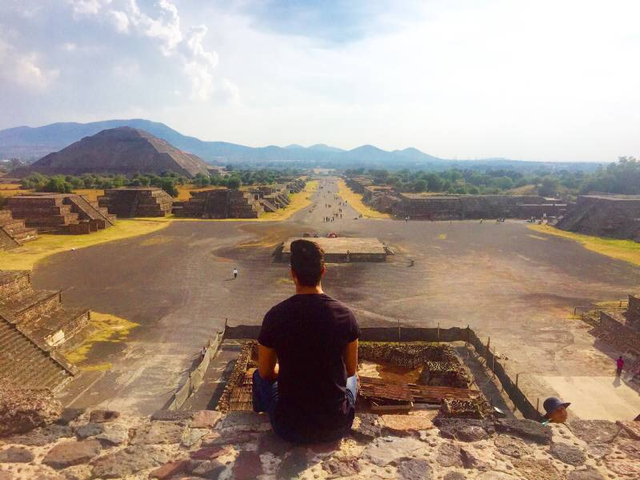
Yesterday afternoon we visited the Temple of the Sun and the Temple of the Moon at Teotihuacan. I’m always reminding my kids that “history,” as we know it, is very Eurocentric and therefore to always look for alternative narratives and diverse angles from which to view the human story. What a great lesson we got from Teotihuacan: “Around 300 BCE, people of the central and southeastern area of Mesoamerica began to gather into larger settlements. Teotihuacan was the largest center of Mesoamerica before the Aztecs. The city had already been in ruins for 500 years by the time it was discovered by the Aztecs. It is thought to have been established around 100 BC. At its zenith, perhaps in the first half of the 1st millennium AD, Teotihuacan was the largest city in the pre-Columbian Americas, with a population estimated at 125,000 – 250,000, making it one of the largest cities in the world during its epoch.” The city is stunning on account of how beautifully organized it was, the geometrical symmetry and integrity of its architecture, its apartment complexes and elevated temples, the level of astronomy and mathematics that its inhabitants were obviously familiar with, and so much more. Wish we knew more about this fascinating civilization and so many other ancient people – e.g. the Indus River people who built Harappa and Mohenjo-daro (now in Pakistan) around 6000 BCE. There is much in the world apart from Europe 🙂
How Diego Rivera imagined Tenochtitlan
How Diego Rivera imagined the Aztec capital city of Tenochtitlan, with volcanoes and snow-capped mountains in the background. The city was a set of islands on Lake Texcoco, hence the canals and waterways, all painted in this gorgeous blue color. Mexico City is built on top of Tenochtitlan and everywhere it’s possible to get a brief glimpse of the civilization that lies underneath. These pictures do not do justice to the mural.
Exploring Mexico City’s Zocalo
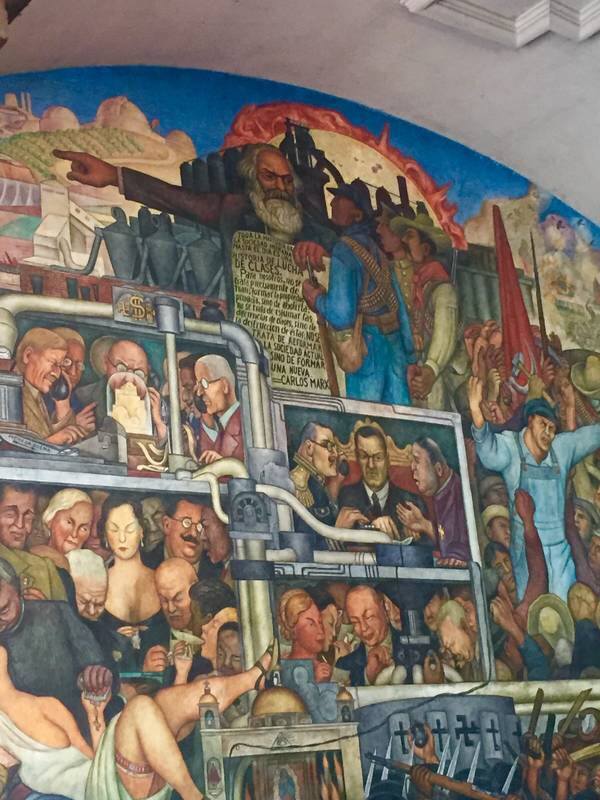
Our hotel is right next to the Zocalo, or the main plaza in Mexico City’s centro historico, so today we walked around the square and explored the Palacio Nacional, the Cathedral Metropolitana and the Templo Mayor archeological site. Modern Mexico City was built by the Spaniards on the ruins of the capital of the Aztec Empire and it is this layering of history (this stratum upon rich stratum of culture and diversity, of architecture and religious beliefs, of violence and beauty, of art and truth telling) which makes Mexico so bewitching. One of the reasons I wanted to visit Mexico City was Diego Rivera’s monumental work: his murals at the Palacio Nacional. They did not disappoint. Imagine Karl Marx as a Moses like figure standing on Mount Sinai with his commandments. It took 22 years for Rivera to complete his masterpiece. It’s astonishing both as an artistic achievement, a detailed historical narrative, a triumph of the human imagination as well as bold politics. He tells it like it is, all of it, the good, the bad, the ugly but also the hopeful. Since the Palacio houses the President’s offices, my son asked pointedly if such art and politics could ever be displayed on the walls of the White House. A very good question.
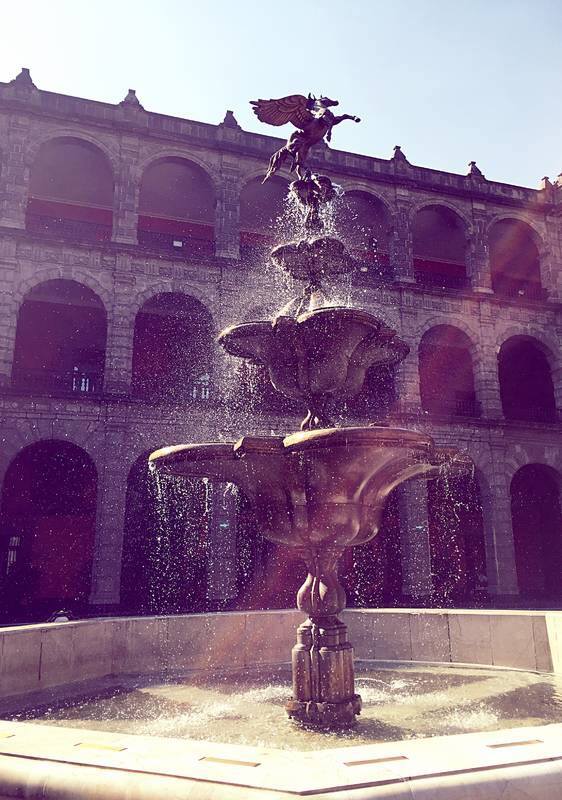
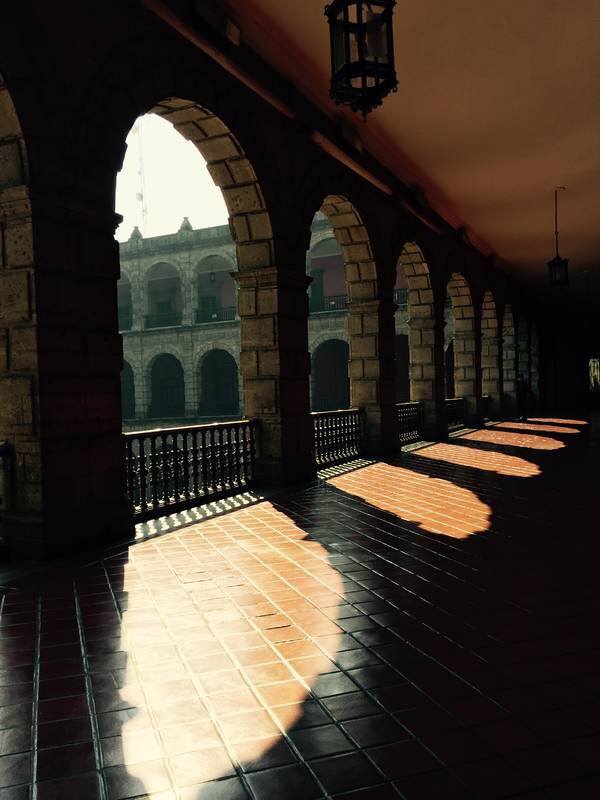
Mexico City!
After being detained at Toronto airport for two hours for further security checks on my husband (traveling while sporting a male Muslim name), waiting to get on a plane for another 4 hours (weather related airline issues) and surviving an excessively bumpy flight (the kid behind us kept asking his dad why we were “dropping” – an apt description), we are finally in downtown Mexico City!
native informant asra nomani in the washington post
native informant asra nomani, whose hero is new atheist/dedicated shill for empire bill maher, writes an article in the washington post warning good americans not to stand in solidarity with muslim women who wear the hijab. after all, muslim women who choose to be visibly muslim and can be coded as such, don’t deserve solidarity but rather the verbal and physical violence that they’ve been subjected to in an increasingly hysterical west. muslims constitute 1% of the american population, muslim women a whopping 0.5% and those who wear the hijab an even smaller fraction of that 0.5% – let’s not let things get out of hand. she begs decent westerners not to translate the word hijab as “headscarf” (even articles of clothing worn by muslims must embody some sort of nefarious intention) and urges them not to encourage islamist ideology. what courage it must take for ms nomani to address 99% of the american public, already in the throes of islamophobic anxiety, and enjoin them to view a microscopic and vulnerable contingent of mostly non-white women as some kind of ominous threat to pro-women western values. what next ms nomani, forced unveilings like those practiced by the french in colonized algeria? whether nomani believes in the hijab or not and whatever sinister significance she wants to attribute to it, women have the right to dress whichever way they want. what women choose to do with their bodies is a personal choice, whether it be their uterus or their face or the top of their head. live with it.
FBI on San Bernardino massacre: Shooters did NOT post support for jihad on social media
doesn’t surprise me at all. one of the alleged shooters was supposed to have liked something on a terrorist’s fb page, under some alias, and this was reported by some unnamed sources. what kind of crap journalism is that? also, my activist friends have their fb pages frequently shut down on account of their anti-imperialism, anti-racism politics. since when do known terrorists have vibrant political lives on fb? msm are always happy to hop on the lurid bandwagon of racist hate and incitement but not so good at rescinding that bigoted misinformation. what’s been spewed into the world can never be retracted. it can never be unheard or unseen.
more here.