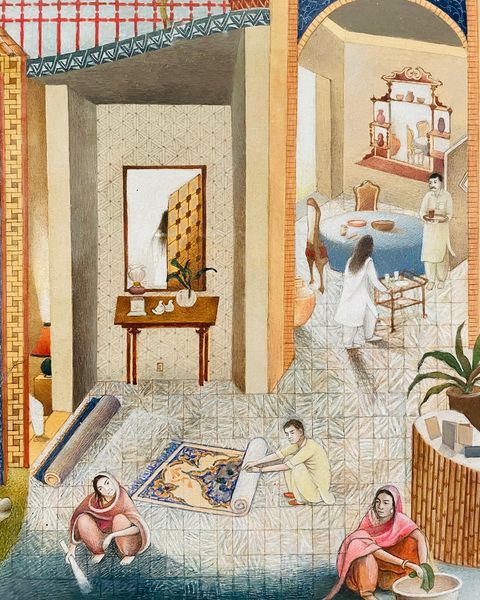
this past weekend, my sister, daughter and i went to see ‘shahzia sikander: extraordinary realities’ at the morgan library and museum in nyc. a tremendous exhibition even though it spans the first 15 years of her work only. she moved to the US the same year i did, in 1993, and i’ve been following her work since the 90s. rooted in rigorous research, filled with symbolism and iconography, unafraid to engage with the politics of empire, race and patriarchy, bent on creating a unique and personal vocabulary, sikander’s work is bold, original, and always ahead of its time. it is also beautiful – many pieces painted painstakingly over years. the details are astonishing, the overall impact of her images almost mystical (in how they simultaneously activate the mind and enchant the eyes), and the narrative intricacies of her work (with its rich subtext and references) demand attention. that she is an artist from lahore, educated at the national college of arts (NCA), who studied miniature painting under the tutelage of professor bashir ahmad, makes her all the more special to pakistanis. my daughter read every art label and took pictures of every artwork. she told me it was the best exhibition she’d ever been to. it’s moving to encounter extraordinary art. it’s sublime to recognize bits and pieces of oneself in it. i will be sharing images in several posts. as molly crabapple has said: if u are in ny, u owe it to yourself to see this exhibition.
rochester has lost David Dornford, an anti-war activist who showed up at every community discussion, rally and protest. i remember how he would always sit in the back and catch up personally at the end. he was soft-spoken, a gentle presence, yet consistently there to validate and uplift social justice work. in a world where we are taught to compete against one another to merely survive, where steve jobs and jeff bezos represent ultimate success, where selling products and selling ourselves have become a way of life, and preemptive aggression is thought to be the only way to be ‘safe,’ david exemplified an alternative ethos. kindliness, composure, sagacity and humility. however ruthless the systems we live under, the qualities david embodied will outlast all the machismo and sales spiels. they will continue to shine. rest in power dear david. thank u Anna-Kristina Pfeifer for capturing him so beautifully.
The sudden loss of one’s 31-year old beautiful, vibrant, activist daughter is pain that’s hard to even imagine. And then not be able to see her, hold her one last time, bid her farewell. To be imprisoned by the settler colony, once again, and be at the mercy of its occupying military. Cruelty, inhumanity, violence. Words are not enough.
Najwan Berekdar: At this horrendous moment of the tragic loss of her daughter, Khalida Jarrar, Palestinian revolutionary, parliamentarian & organizer, remains imprisoned in Israeli jails denied the last chance to kiss her daughter goodbye & the comfort of her loved ones. #FreeKhalidaJarrar
my mother’s sister, my khala rehana sarfraz malik, passed away yesterday. my mom and her four sisters were all beautiful women everyone said, each in their own way, but i always thought khala bibi was particularly charming. elegant, meticulously coiffed and dressed, with a captivating voice that reminded me so much of my own mother. many years ago, when my son was still a toddler, khala bibi spent two weeks with us in west hartford, connecticut, and we had a lovely time together. we went shopping, ate out, and talked all day. she made delicious haleem and got us mango and kulfa ice cream from the local desi store. i took her to mark twain’s house and once, when i was busy with a job interview, aitezaz took her and two of my friends from IBA who were also visiting us to gillette castle state park for a barbecue. what i remember most fondly are the late night chats we would have after everyone went to sleep. i asked her about her life, about being a young woman who lived on her own for a while (back when it wasn’t the norm), about marrying my khaloo, an older man and a widower – the love of her life. she had three step-children when she got married and then two sons of her own. she flourished. my uncle worked for the united nations and was posted to turkey for many years (in ankara, i believe) and khala bibi grew to love that life. she learned turkish and would speak to local officials in their own language. she became an outstanding hostess and a true partner in her husband’s consular work. it was a charmed life, but it didn’t last long. my uncle died unexpectedly in his sleep at a relatively young age, and my khala lived the rest of her life on her own. she was amply provided for and safe, she had her kids and later her grandkids, but she missed her gregarious, big-hearted husband and the lively, cosmopolitan life they had lived together. she was a devoted wife, mother and grandma, a strong woman who had to be stronger on account of what life threw at her, an engaging presence who could pull people into her orbit with ease. may she rest in peace, as she’s finally reunited with her beloved husband. inna lillahi wa inna ilayhi raji’un.
[khala bibi with some of her siblings. she is the young woman standing on the left]
dilip kumar, one of india’s greatest actors, an icon, a legend, loved by many generations of south asian women, passed away at 98. his real name was muhammed yusuf khan, born to a muslim family in peshawar in 1922, before the city became part of pakistan. my mother loved him. there was no one else like him. no one. although i was born too late to fall under dilip’s spell (i preferred sanjeev kumar, and later naseeruddin shah and farooq sheikh) i understood his appeal: the sensitivity with which he approached his craft, less machismo, more intelligence, and that mellifluous voice. he spoke like no other actor. his own cadence, his soft-spoken, almost musical way of delivering dialogue. my mother’s wildest dreams came true when dilip visited quetta at a time when my dad was posted there. my mom got to meet her idol. she couldn’t muster the courage to have a deep conversation with him but she got to shake his hand and tell him what he meant to her. perhaps i should finally watch mughal-e-azam, with dilip kumar and madhubala, a masterpiece i’ve been told many times. something to do with my mom – to think about the good old days and remember dilip fondly. inna lillahi wa inna ilayhi raji’un.
a monster is dead, but the death and devastation donald rumsfeld unleashed cannot be reversed. wish it could be. one vile monster for thousands, millions of lives. for the water and air that were poisoned, the soil that was contaminated, the children who were born with congenital anomalies and cancers. and let’s not forget the others: dick cheney, george w. bush, tony blair, irving kristol, richard perle, paul wolfowitz, james woolsey, elliot abrams, robert zoellick, richard armitage, john bolton, condoleeza rice, colin powell, judith miller and countless more – neocons and liars, warmongers and imperial intriguers, islamophobes and racists. may their crimes follow them wherever they go. even in hell.
couldn’t post a picture of the genocidal man so here is an artwork by iraqi photographer and artist halim al karim. it’s called ‘lost memory 4.’
my friend Cat Ashworth retired yesterday, after teaching film at RIT for 32 years. that RIT didn’t have the grace to thank her for her stellar work over three long decades is appallingly egregious. it speaks to the larger issue of how work performed by women is systematically diminished and erased. how women themselves are routinely invisibilized, ignored, or minimized.
i took a class with cat many years ago. it was a hands-on documentary workshop during the course of which i edited my first doc, ‘the muslims i know’ – the film that made me a filmmaker. how lucky to have landed in cat’s class at such a crucial juncture in my life.
filmmaking was a second career for me so i was much older than the other students. i came to the class with a decisive goal in mind – to edit a feature length film in just a few weeks. there was an urgency to my task which cat understood instinctively. she supported me every way she could, even asking her assistant to teach me how to use keyframes and create motion paths in final cut pro.
not having formally studied filmmaking, i came at it from a different angle. sometimes i wouldn’t know the technical jargon or my ideas would be too unconventional or politically heavy and uncool. cat always sided with me. she never made me feel like i didn’t belong. she wasn’t annoyed by my drive. that set the tone for the way the other students responded to me. although they could be ruthless in their critique, cat made them believe i was doing something worthwhile and meaningful.
initially, i was thinking of hiring someone to do the film’s voiceover, but cat urged me to do it myself – not to hide but rather to embrace the personal nature of the project. the muslims i had interviewed were my people. islamophobia touched them just as it impacted me and my family. it was ok to own that and speak from that vulnerable position. and she was right. one of the most common reactions to the doc is the feedback i get about the voiceover – its warmth and ability to pull audiences in. only because of cat.
at the end of the class, when i screened the rough cut for RIT’s film faculty, the responses i got from some of the most prominent male professors in positions of power were disappointing. one particularly important one told me i shouldn’t use western classical music in the film because it didn’t fit all this talk about islam and muslims. i guess he was expecting some sitar and tabla. talk about orientalism. once again, cat pushed back publicly and also in private, encouraging me to stay with my ideas and in fact commit to them even more. it’s like she could predict the effect the film would have.
i’ve made two other films after it, but 15 years later, ‘the muslims i know’ continues to generate abundant viewership. it’s been integrated into college curriculums and i hear from professors who tell me how they use it in their class.
how many stories like this there must be from cat’s students and colleagues who have benefited from her generosity, attention and brilliance for 32 years. i am not even listing the outstanding work she has produced as an astute filmmaker and artist or her behind-the-scenes efforts to diversify RIT faculty.
thank u cat. we love u. enjoy ur retirement and know that u helped shape many lives and careers.
had the honor of interviewing filmmaker mats grorud (who directed ‘the tower’) and dr. dina matar (chair of the centre for palestine studies at SOAS) for witness palestine film festival today. a brilliant conversation that we hope to share soon. went for a walk to port jefferson afterwards and got a chocolate ganache raspberry cake from la bonne boulangerie. i’m sold on long island folx. all i need now is for all my friends to move here.
this picture broke my heart. three generations of this beautiful family, a family that looks like mine and so many other families i love, were killed violently by a white man in canada. what hatred and dehumanization have to be deployed for someone to drive their truck into human bodies, bodies made of flesh and bones just like their own. how can someone endure the sickening shock of that murderous, uneven impact? the horrible thud of it? i asked those same questions when an israeli soldier drove a bulldozer into rachel corrie’s body in 2003. she was a vibrant 24 year old, a righteous young woman protesting the demolition of palestinian homes in the gaza strip.
anti-muslim racism and palestine. the connections are unshakeable. in palestine too, the brutalization and extermination of the muslim body is systematically normalized. even the smaller, more delicate bodies of muslim children.
as this happened in canada (the land of nice people), some zionist members of the rochester community were going into overdrive, calling #freepalestine the modern-day equivalent of the swastika, going full-throttle against linda sarsour (calling her an antisemite for her anti-racism work and her palestinian american identity), organizing pro-israel rallies, and trying to derail the political careers of local leaders because they dared to speak up for the human rights of palestinians. it is surreal.
additionally, we are not allowed to talk about it. we are not allowed to talk about our own collective death. i will have to write about this in more detail. for now, i just want to send all my love and solidarity to my entire muslim community everywhere in the world. our lives are NOT disposable.
for the first time since we moved here, a little over a year ago, we met with a group of people. went on a ‘healing hike’ with the long island progressive coalition to uplands preserve, cold spring harbor, new york. so incredibly beautiful! spent 3 hours discovering how milkweed attracts monarch butterflies, what poison ivy looks like, how the white flowered mountain laurel is difficult to move or transplant on account of its sensitivity to soil chemistry, the subtle perfume of the multiflora rose (a climbing, rambling shrub), how woodpeckers communicate with one another, how the tulip poplar (also called tulip tree) is neither tulip nor poplar but closely related to magnolia trees, and how the american chestnut is super susceptible to chestnut blight, a fungus introduced to north america in the early 1900s which reduced the great american chestnut forests to a simple sucker sprout population that rarely produces any chestnuts. v cool to meet other activists as well – especially nia adams who traveled to rochester during the daniel prude uprising and knew all the brilliant women involved with free the people rochester. it was 81 F but we spent most of our time in fragrant shaded woods so didn’t really feel the heat.
In early May, we went to see ‘Blindness’ at the Daryl Roth Theatre in NYC. It’s ‘José Saramago’s timely, sinister story of a world in chaos… narrated with savage rage by Juliet Stevenson.’
Blindness is no ordinary play. Its setup is designed specifically for Covid-appropriate social distancing. This is how it works: People are ‘grouped in pairs who have come together… distanced from other pairs, and, at first, each pair sits under its own spotlight. There is no stage; the show occurs only in light and sound. Above audience members’ heads are a series of glowing neon tubes in primary and secondary colors, perfectly vertical and horizontal and meeting at right angles, reminiscent of the work of the artist Dan Flavin. The story, ably delivered, in a recorded monologue, by Stevenson, comes through headphones sporting “binaural” 3-D technology.’
The neon tubes move up and down, and for vast portions of the play, we are immersed in complete darkness.
As Kate Wyver wrote in the Guardian, ‘the piece is claustrophobic by nature, but when wearing the required mask… breathing suddenly feels much harder. At these points, the lack of sight is disorienting and the binaural sound design properly takes effect as the violence of the piece crawls beneath your skin. It feels as if Stevenson is whispering right into your ear, stroking your arm, holding that dripping knife.’
Light and sound have never been used more effectively to create patterns, moods, textures, and a sense of space and time. I was not surprised to learn that this is a Donmar Warehouse (London) production. I saw ‘Julius Caesar’ set in a women’s prison, brought to pulsating life by an all-female cast in 2012. Never forgot it.
The play’s narrator, or Storyteller, is voiced by the incredible Juliet Stevenson who’s absolutely dazzling here.
One of the strongest moments for me was towards the end, when the exit door opens. At that moment, Stevenson is describing her scarred city, come to a violent halt, littered with corpses, garbage, and dogs tearing apart flesh from the freshly fallen. That hell comes to an end, like a bad dream, when the door opens. We see a swath of beautiful green, welcome respite for deprived eyes. Yellow cabs pass by in the distance, pedestrians much closer to us. We hear the faint hum of a functioning city. Such relief and emotion.
Makes one wonder how a breakdown in food systems and other services would impact New York, how the idea of modern cities in general is ridiculous – rendering people helpless, isolated, vulnerable to shocks, fragile.
I was left with some thoughts about Saramago’s book. How he uses blindness as a metaphor — the stripping away “of the mirrors to the soul,” which ‘loosens the fragility of human and psychic bonds, and divests us of the will and rationale to maintain them.’
‘Near the end of the novel, when the blind people are getting their vision back, he has one of his characters remark:” I don’t think we did go blind, I think we are blind, Blind but seeing, Blind people who can see, but do not see.”’
Although Saramago’s blindness is a ‘white disease,’ a ‘milky sea’ that spreads by visual contact, like the evil eye, an analysis of the text thru the lens of Disability Studies is important. A little surprised that in a city, where a raging, highly infectious white blindness is breaking down existing systems, people who are already blind (and adjusted) don’t play a more powerful, positive, central role. Less comfortable with the fact that Saramago’s Storyteller/protagonist (she is the all seer, leader, organizer, moral compass of the story) is the only person who has sight.
A remarkable experience all in all, and very much in line with my interest in audio storytelling (the Warp & Weft).
i wrote this piece in the middle of the bombing of gaza. it’s a critique of raoul peck’s “exterminate all the brutes” and it pivots on his terse (and highly problematic) treatment of palestine. it got published by mondoweiss today. i know that a lot is going on right now that’s urgent, but i also think it’s more important than ever to root out liberal zionism from what’s considered the left:
No, Palestine is not complicated, Mr. Peck. It’s settler colonialism unfolding “live” before our eyes. As the Nakba continues in 2021, with full on ethnic cleansing in Sheikh Jarrah and war crimes in Gaza, it’s more egregious than ever to hide behind evasive language or recycled Zionist tropes. More here.
there is a ceasefire in place at the moment with a break in the bombing of gaza, thank god, but that does not change the reality of settler colonialism, ongoing ethnic cleansing, apartheid, an illegal blockade, military occupation, the imprisonment of children, checkpoints that negate freedom of movement, and non-stop human rights violations. this has been going on, in various forms, since 1948.
it’s been painful to read posts on social media, by well-meaning people who couch their support in abstract language, never mention israel as the aggressor/colonizer, or engage in bothsidesism (pray for both sides, mourn lives lost on both sides, there are extremists on both sides, etc). essentially, they are affirming the equivalent of ‘all lives matter.’
the majority of people have been silent which is even more unsettling.
consider this:
israel has one of the best equipped militaries in the world (thx to our tax dollars), palestinians do not have an army, air force or navy. they don’t control their borders, with no sovereign title over the west bank or gaza strip. this is why we see the obscene disparity in numbers of people killed and wounded.
another set of numbers might be helpful:
per capita GDP for gaza: $876 per capital GDP for israel: $34,185
gaza is sealed from all sides by israel. every few years they ‘cut the grass’ by bombing one of the most densely populated areas in the world. then they don’t allow concrete in, so palestinians can’t rebuild their homes. materials needed to construct vital water infrastructure are not permitted either so there’s a chronic water crisis in gaza. israel limits the amount of electricity gaza can access per day. they even restrict the amount of calories allowed for its population by blocking food.
another interesting fact:
children constitute about half of gaza’s population. the median age is 17.
there is no reason for not knowing – this information is freely available, a lot of it provided by the UN.
i look at this media/social media landscape and understand why grotesque crimes against humanity have been possible in history. it’s easy to look back and decry slavery and genocide. it’s much harder to recognize it, speak about it, and resist it while it’s happening.
those who have spoken up, written posts, made calls, protested, declared their position and invited wrath from their communities, thank you. we see you and we find hope in ur integrity. “the arc of the moral universe is long, but it bends toward justice.” inshallah.
Last year, I worked with JVP to organize a Palestinian film festival. One of the films I suggested was the story of a 15-year old boy named Obaida. The festival didn’t go anywhere, but we develop a sense of connection to the people on the screen. We learn a small part of their story. We feel like we know them a little. I just found out from a post by the film’s director that Obaida was killed earlier today. An Israeli soldier shot a bullet through his heart. I have no words, just deep grief and immense rage. Inna lillahi wa inna ilayhi raji’un. May u rest in peace, sweet child.
Matthew Cassel (May 17): I write this through tears after learning that Obaida Jawabreh, who I met in his refugee camp two years ago when he was just 15, was killed earlier today by an Israeli soldier’s bullet to his heart. Obaida was so curious, I was supposed to be the one conducting the interview but he spent our few days together asking me more questions than I asked him. He wanted to become a chef, but surrounded in every direction by Israeli military, checkpoints and settlements, even chasing such a simple dream was always going to be tough. He died before his 18th birthday. My heart goes out to his family, especially to his dear father Akram, who would send me the sweetest messages on holidays long after our meeting. He loved his son and wanted nothing more than to watch him grow up away from the occupation. Together with Defense for Children International – Palestine I made this video on Obaida in 2019. May he now rest in the peace that he was denied throughout his life.
thinking about my overwhelming experience that ad hominem attacks are often made by men. in political arguments, especially over palestine and other decolonial questions, men will very quickly resort to personal attacks rather than offer cogent counter arguments. it’s no coincidence that women are perennially stereotyped as ‘emotional,’ by men, when the most common logical fallacies are what they reach for instinctively. perhaps that’s the nature of guilt – to project one’s shortcomings/offenses onto the other.