my review of “moonlight,” a film by barry jenkins

finally saw “moonlight” and am completely floored. it will take me some time to resolve and articulate all my thoughts and emotions, but what a brilliantly immersive and intimate film. everything from the way the film is structured and shot, to the script, to the masterful performances, and the interplay between the actors, is fresh, compelling, indelible. the film explores broad themes such as identity, sexuality, masculinity, race, poverty, and the multigenerational effects of the war on drugs, but always with subtlety, through the life and eyes of its main character.

chiron, the film’s protagonist, a quiet and lonely boy living in a rough miami neighborhood in the late 1980s, is played by three different actors, each representing a different chapter of his life. the dialogue is sparse, in particular for chiron. what is left unsaid, however, is felt intensely and perhaps that’s why we are left gasping at the end of the film.

both alex r. hibbert and ashton sanders, who play chiron as a child and teenager, are magnificent but i found trevante rhodes, who plays chiron as an adult, to be absolutely astonishing. with very little dialogue and no other cinematic device, muted emotions flit across his face like shimmering moonlight. he speaks eloquently of internalized pain, vulnerability, discomfiting contradictions, repression and loneliness, without ever saying a word. he is a revelation.

the last few scenes between him and kevin (played by andré holland) are some of the most stirring love scenes i’ve ever seen on film but they’re played with incredible restraint and stillness.

i couldn’t help but think how this remarkable film is written, directed, acted and inspired by black men primarily, and how its lack of steven spielberg schmaltz, tom hanks all-americanness, and martin scorsese machismo, is what makes it refreshing. we are so used to watching movies made by white men that we can easily anticipate every cultural trope, every filmic trickery or dramatic gesture. this film opens a door to another world. let’s hope it’s just a beginning.
My review of Mustang

Last night I saw Deniz Gamze Ergüven’s film Mustang about five beautiful, orphaned sisters being duly oppressed in a Turkish village. The film has been compared to Sophia Coppola’s The Virgin Suicides because of its “dream-like intensity and mostly female cast,” but it made me think of Peter Weir’s Picnic at Hanging Rock.

The soft-focus, the beauty and nymph-like youth of the girls who function more as a sensual ensemble rather than fully fleshed out individuals, their otherworldly mystery (a kind of bafflement that appeals deeply to the male gaze) and the intimacy of shots capturing them in various states of undress, are all reminiscent of Weir’s atmospheric film.

It’s a v French aesthetic and certainly reflects Ergüven’s sensibilities – she studied and lives in Paris, the cosmopolitan daughter of a Turkish diplomat. What doesn’t ever gel in this story though, is its location in a nondescript Black Sea village.

The film makes a feminist statement by fetishizing the girls’ bold rebellion against a patriarchal, small-minded, asexual backdrop, but the question that I wanted to ask throughout, and which Selin Gökcesu asked in her excellent review “Five French girls walk into an Anatolian village,” was: how did a tiny backward village produce these Bardot-like, free spirited, European-looking creatures (down to their swimsuits, Converse shoes, skinny jeans and uninhibited sexual ease)?

The girls are completely alienated from their grandmother, who’s supposed to have raised them after the death of their parents, and everyone else around them. Perhaps that makes it easier for Western audiences to relate to them and be awestruck by their defiance, but it doesn’t make any sense.

This bizarre disconnect is impossible to ignore, and so the relentless tyranny suffered by the sisters becomes an operatic performance, rather than something urgent and real.

The film won four César awards in France and was the French submission for the best foreign-language film Oscar. Ergüven thinks it’s a surprising choice considering France’s questionable relationship with Islam and Muslim women in particular. I think not so much.

You Should Be Terrified That People Who Like “Hamilton” Run Our Country | Current Affairs

ALEX NICHOLS: The conservative-liberal D.C. consensus on Hamilton makes perfect sense. The musical flatters both right and left sensibilities. Conservatives get to see their beloved Founding Fathers exonerated for their horrendous crimes, and liberals get to have nationalism packaged in a feel-good multicultural form. The more troubling questions about the country’s origins are instantly vanished, as an era built on racist forced labor is transformed into a colorful, culturally progressive, and politically unobjectionable extravaganza.

As the director of the Hamilton theater said, “It has liberated a lot of people who might feel ambivalent about the American experiment to feel patriotic.” “Ambivalence,” here, means being bothered by the country’s collective idol-worship of men who participated in the slave trade, one of the greatest crimes in human history. To be “liberated” from this means never having to think about it.

In that respect, Hamilton probably is the “musical of the Obama era,” as The New Yorker called it. More here.

A shout-out to two friends and their wonderful books

Belén Fernández’s “Martyrs Never Die: Travels through South Lebanon” is hard to classify – it’s a travelogue, it’s journalism, it’s an honest and clear-eyed encounter with South Lebanon. What was surprising for me, in spite of my familiarity with the region’s history and politics, was the level, scale and frequency of Israeli violence in that part of the world, such that its presence is deeply imprinted on both the South Lebanese landscape and people. A must read.

Delia Robinson’s “A Shirtwaist Story” is a beautifully crafted book that tells the story of the Triangle Shirtwaist Factory Fire, from an unusual perspective. Inventive and dynamic, full of Delia’s fiery art and imagination, this is a book everyone should own.

Opera like no other

saw this wonderful mexican-american, multi-media opera at the eastman theatre today and loved every minute of it.

Daniel J. Kushner: In the opera, Soprano Tony Arnold plays the character known as “the author,” who battles the demons of writer’s block in an attempt to create lasting and meaningful art. Among the other characters are what Sánchez-Gutiérrez describes as “amorphous creatures,” ideas not yet fully formed that act as a kind of choir in support of the drama. The puppets and costumes featured in “Don’t Blame Anyone” (“No Se Culpe a Nadie” in Spanish) are fantastical and imbued with a cryptic surrealism.
While the visuals — somewhat similar in tone to those in the Guillermo del Toro film “Pan’s Labyrinth” — are a little discomforting, they’re also profoundly imaginative and fascinating. Adding to that the musical styles of both composers, the visceral combines with the otherworldly in a way that accentuates a sense of wonder, mysticism, and even dread.

This ambitious artistic endeavor benefits from the official involvement of the Mexican government — amid an American political landscape blanketed with the long shadow of Donald Trump-era, anti-immigrant discrimination and xenophobia. The operatic premiere begins to take on a major cultural significance in Rochester and beyond. More here.

The Occupation of the American Mind at the University of Rochester

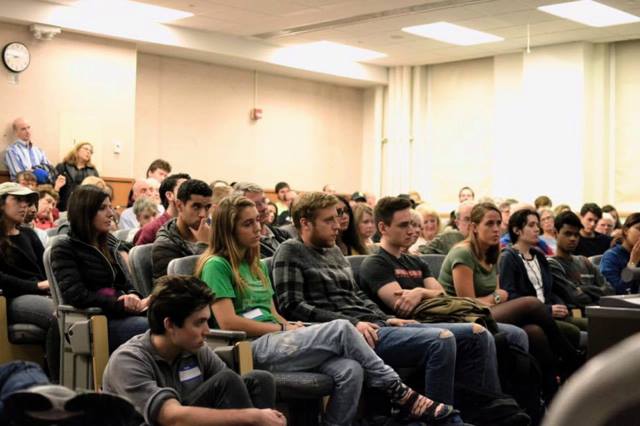
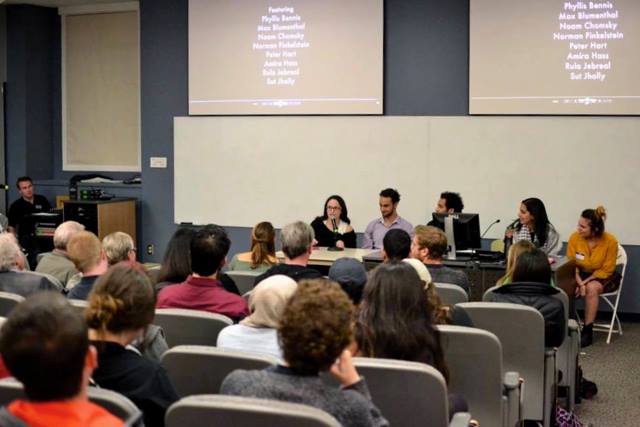
SDS at the University of Rochester screened The Occupation of the American Mind today as part of their Palestine Awareness Month. “Narrated by Roger Waters and featuring leading observers of the Israeli–Palestinian conflict, the film explores how the Israeli government, the US government, and the pro-Israel lobby have joined forces, often with very different motives, to shape American media coverage of the conflict in Israel’s favor. The Occupation of the American Mind provides a sweeping analysis of Israel’s decades-long battle for the hearts, minds, and tax dollars of the American people — a battle that has only intensified over the past few years in the face of widening international condemnation of Israel’s increasingly right-wing policies.” The organizers and panelists were able to produce an informative and powerful evening. They screened a film that educates people on Palestine/Israel thru investigative journalism and an adherence to truth rather than propaganda. It was extremely well attended (especially by students) which is a huge achievement. They were also able to moderate the discussion reasonably well, when it could have degenerated into a series of altercations. Bravo. [Photographs by SDS]

The Occupation of the American Mind at the U of R 1
The Occupation of the American Mind at the U of R 2

Mass Incarceration and Its Mystification: A Review of The 13th

i found “the 13th” to be excellent. but this is an important corrective.

Dan Berger: Some of the most robust avenues for understanding mass incarceration are unexplored in the film. The loudest silence is the inattention to women’s incarceration as well as the incarceration of lesbian, gay, bisexual, transgender, and queer people. As many do, The 13th treats mass incarceration as only a story of Black men in prison. Yet while women have always been a small percentage of the overall number of prisoners, their rate of incarceration—especially for Black women—has been higher than men. The film also overlooks the other labor women and queer and trans people do as a result of mass incarceration in maintaining families and communities. Other distinctive, and distinctly racist, areas of American prisons—such as the death penalty and long-term solitary confinement—are barely mentioned or overlooked entirely. More here.

City of Photos: Special Screening and Filmmaker in Person

went to see “city of photos” today at the dryden theatre, a documentary by indian filmmaker nishtha jain. i love the idea of imagining people’s lives (and times) by exploring the photographic archives of tiny photo studios in india. the film was shot in calcutta and ahmedabad in 2004. it has a loose narrative structure that drifts from theme to theme, story to story, photograph to photograph.

it’s also political and some of that political contextualization is careless and jarring.

the most problematic element for me was how the gujrat massacre was brought up. in 2002, the burning of a train carrying hindu pilgrims in the state of gujrat was blamed on muslims. as a result, hindu gangs went thru muslim neighborhoods in a paroxysm of violence. they raped, hacked to death, burned and demolished, in scenes reminiscent of the 1947 partition. at the end of 3 days (and less intensely over the following 3 months) about 2,000 muslims were killed, mosques were smashed, homes were destroyed. it was an ethnic cleansing that remains in effect to this day. the hindu nationalist state government, led by present prime minister narendra modi, was complicit in the massacre.

nishtha jain chooses to present this horrible episode in gujrat’s history thru the lens of a photographer based in ahmedabad (the state capital). she is fascinated by how he catalogued the aftermath of the riots with a series of photographs. we are shown some of these pictures. most of them focus on damaged property. jain mentions the “gujrat massacre” as a result of “communal violence” without any interest in how it impacted the poor muslim neighborhoods she is filming. it’s not just ambiguous, it’s irresponsible.

in the post screening Q&A, jain explained how hindu fundamentalism was so hegemonic at the time that she expressly went to ahmedabad to see if it had entered photo studios. since that was the purpose of her trip to ahmedabad, it would have been more honest and powerful to come out with it in the film.

she also explained how calcutta was home to most of these quaint photo studios and how the majority of their clientele is muslim, not hindu. a young woman in the film, who belongs to a conservative muslim family, talks about how photography is a sin in islam but she cannot help but indulge in her passion for pictures. she is attractive, compelling and determined to create an album of photographs in which she poses like famous movie stars.

jain was asked about her and she repeated the same line about how “photography is a sin in their religion.” not really. hence the abundance of these studios and their muslim clients.

although i appreciate the fact that she did not screen the film widely in india in order to protect that young woman and another couple’s secret romance, i find the privilege of going into otherized minority communities and telling their stories from one’s entitled, normalized vantage point to be questionable. it can be done right of course but it might be more difficult to do it justice in an abstract, splintered film. the narration could have added so much more to what we were seeing if it had acknowledged some of these indisputable politics and had steered away from further abstruse, romantic layering.

this was jain’s first film. i’ve seen her 2012 documentary “gulabi gang” and it’s a much better film in every respect.

Palestinian artist Abdulrahman Katanani

Abdulrahman Katanani, a sculpture artist a little over 30 years old, is a representative of the increasingly prominent young Palestinian artists who are staging exhibitions around the world. Unlike many of his peers, Katanani is a refugee – the descendant of refugees from 1948, who was born and raised in the Sabra refugee camp in Beirut, Lebanon.

“The barbed wire rounded into a tight circle forms a tornado symbolizing our connection to the past (since the 1948 Nakba), a tornado still swirling in the camp and collecting our generations, lives, hopes, happiness and dreams, and a storm moving toward the future. As for the material, barbed wire represents the occupation [barbed wire is ubiquitous at Israeli checkpoints on the West Bank and along Israel’s Separation Barrier] and the fear and instability of occupied life. In the moment some could interpret it as the tornado of violence in the Arab world, which would also be true.”

merged IV at rochester fringe festival 2016

saw merged IV today, a blend of dance, music and film at Kilbourn Hall The Eastman School Of Music. it’s part of the Rochester Fringe Festival. the first piece “continuum of solace” is choreographed by heather roffe to “continuum,” a captivating musical score written by jane antonia cornish for string instruments, and played live on stage. cornish describes the piece as connecting time, tides, and place. it is so full of longing, it’s impossible not to be moved. this yearning for connection is visualized with lyrical dance choreography. dancers unite to support and lift one another only to unlink. the stage is partly lit and imbues them with the delicate quality of renaissance sculpture. so beautiful.

the second piece “dust” is choreographed by james hansens and inspired by the homily “if anyone will not receive you or listen to your words, shake the dust from your feet when you leave the house.” he’s contemporized it to reflect the current political climate in america.

“reflections” choreographed by roffe, is a collaboration with filmmaker Johannes Bockwoldt and includes both dance and film. how appropriate that it’s on the subject of intersectionality. johannes interviewed local artists, innovators and mavericks to talk about their work, their passions, their vision for the world (including yours truly) and then intercut the footage in a most dynamic way.

the last piece is choreographed by hansens to jeff buckley’s music including “lilac wine” (i’m obsessed by nina simone’s interpretation but this was also amazing). all in all, a brilliant evening. you can still experience it on sept 19 and 20, at 7pm, at kilbourn hall. don’t miss it!

Gabriel Josipovici on the importance of touch

In my wanderings during my last trip to Dublin, Ireland, right before my screening at The Pearse Centre, I discovered The Douglas Hyde Gallery, housed in Trinity College’s Arts Building. It’s small but extremely thoughtful. I was particularly taken by its collection of books, many of them written by John Hutchinson, the gallery’s director. I bought some of the most beautiful ones, little gems that combine his thoughts on art, beauty and the ways in which he sees the world, with works of art. The first of these books, The Bridge, is filled with most of the ideals and principles he still embraces. In his own words, it’s “a set of notes, perceptions, and speculations… Threads appear and disappear; there are echoes and gaps; metaphors are mixed.”

Here is something I love from the book:

Gabriel Josipovici has written about how we might learn to feel at home in a world that is largely indifferent to our personal needs and wishes. He suggests that contentment and happiness may only be possible if we value *touch* over sight. Although sight seems to give us a sense of the wholeness of what we behold, it is only when we try to overcome distance and to *touch* the world that we become whole. If we depend on sight, which seems to offer us frictionless control of what we perceive, we may avoid some of the pains and uncertainties of living, but we will also lose our full involvement with life.

Bombino – Akhar Zaman (Official Audio)

Last weekend we attended Celebrate Brooklyn in Prospect Park and were regaled with fantastic music by Bombino, a Tuareg guitarist and singer-songwriter from Niger, and by Femi Kuti, a Nigerian musician who’s the eldest son of afrobeat pioneer Fela Kuti. It was a hot summer day but the concert started later in the evening, when the sun’s harsh heat had begun to settle down. It was a free community event attended by an amazing crowd of diverse people – every possible color, culture, accoutrement, age group and dancing style was duly represented. As I looked around, I saw a vast and happy slice of humanity, fixated on a single idea – to lose themselves in the energetic beat of the music. I couldn’t help smiling and thinking to myself how this is the kind of world we should all be living in. Thx Aliya apa for clueing us in 🙂

Diane Arbus at the Met Breuer

On Saturday we had brunch at Penny Farthing, a wonderful East Village tavern not too far from where my son is based in NYC, and then went to see “Diane Arbus: In the Beginning” at the Met Breuer. This exhibit includes 100 photographs from the first 7 years of her career, 1956 to 1962. The famous child with toy hand grenade in Central Park is here as well as the identical twins and luminous photographs of female impersonators she took at Club 82. She first took pictures from the audience’s vantage point in order to capture the performances but later ventured into the performers’ dressing rooms and that’s where the fascinating power of her work truly shines. Arbus’s interest in New Yorkers, their diversity and eccentricity, and later in fringe communities is apparent here. But we also discover her passion for cinema, how pictures are painted with light and shadow in order to create magical worlds. See “The Kiss” or “Clouds on Screen at a Drive-in Movie” below. Finally, the way her work is displayed at the Met Breuer is interesting. Each photograph is exhibited on a standalone flat pillar and therefore throngs of people interweave across all sides of each photograph, without a set trajectory. One is constantly bumping into other visitors and making eye contact. It’s a bit disorienting but perhaps a just tribute to an artist who never took the obvious path to anywhere.

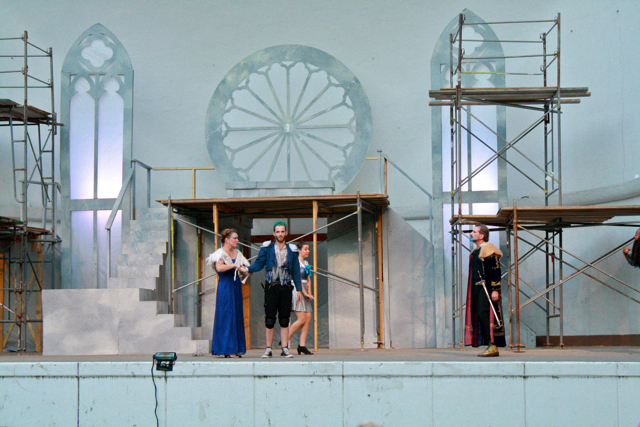
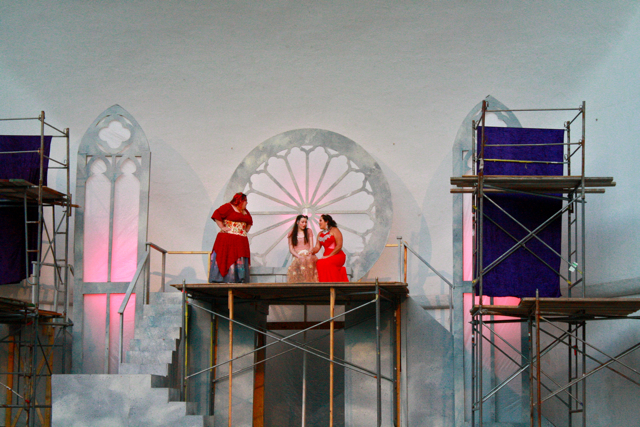
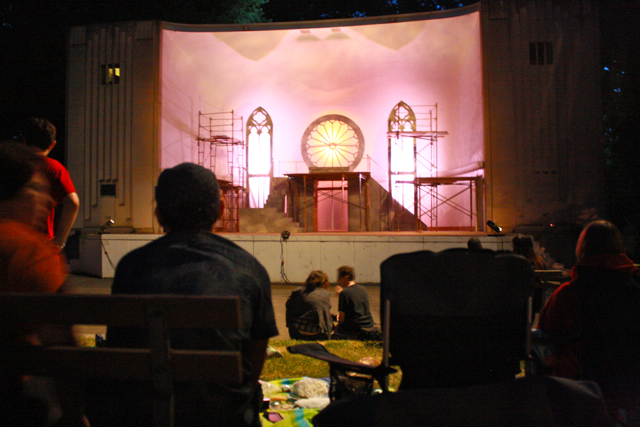
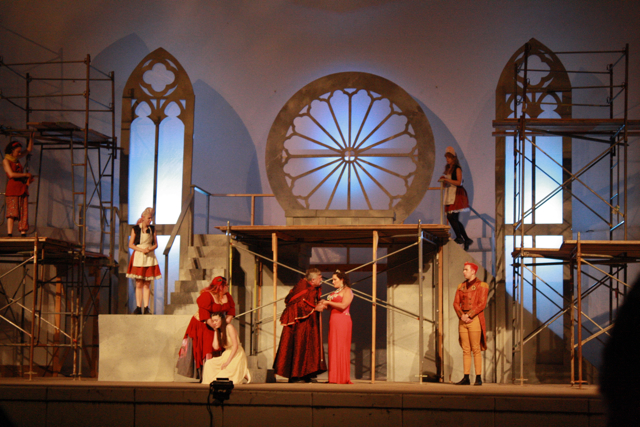
shakespeare in highland park

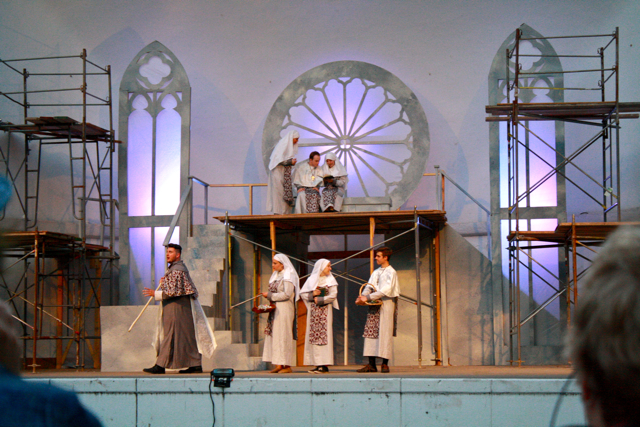
last night, shakespeare in the park, i.e. highland park in rochester (also designed by frederick law olmsted). the production was a colorful, fast-paced, punk-inspired take on “romeo and juliet” – not to my 16-year old daughter’s liking (she’s a purist who knows much of the play by heart) but i thought it was great fun. loved the diversity of the cast (Shakespeare Players of Rochester) and found chris peterkin, who played romeo, to be particularly wonderful. great set and lighting. some high-octane music. popcorn, soda, and an enthusiastic audience seated comfortably in folding chairs or lounging on blankets. a great evening!

IMG_0001
IMG_0003
IMG_0009
IMG_0016
IMG_0005

Abbas Kiarostami (1940-2016)

“Done with the patience of a Sufi master with an eternity as his frame of reference, his long shots/long takes dwell on a vision of reality long enough to strip it of all its pretenses of meaning. Once the absolutism of reality (as the German philosopher Hans Blumenberg would call it) begins to ooze out of our received conceptions of what is real Kiarostami gently leads what remains into a whole new world of significance. His camera made the foreign familiar by making the familiar foreign.” (Hamid Dabashi)