
just spoke to a PEO chapter, here in pittsford, about my third film “partition stories” and the new series of artwork inspired by it. showed them clips from the film and a collage from “this heirloom.” excellent audience, great questions. more about PEO here.
Category: projects
last day in london
was interviewed by andrea gordon at TV apex studios in essex yesterday about my film work and activism. it was a lot of fun. in the evening we saw “the silence of the sea”, a powerful three character play about the awfulness of occupation and the doomed relationship between occupied and occupier (v true for nazi-occupied france but can people make the connection to current occupations in which they themselves are complicit?).
today “julius caesar” at the donmar (love the idea of an all female cast) and harold pinter’s “old times” with kristin scott thomas and rufus sewell. thank u to dr russell peck and his beautiful wife ruth for inviting me to be a part of this theater course. it was a once in a lifetime experience. this is professor peck’s last trip to london as a leader of this class. he’s been doing it for 23 yrs. we gave him a much deserved standing ovation (along with some chocolate cake). long live thought-provoking theater!
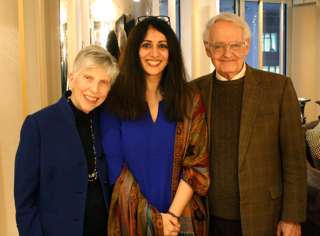
london!
off to london tomorrow for about 20 days, for a class in theater. can’t wait to see multi-media experimental plays along with some good old shakespeare and everything in between. will report soon, from across the pond.
The National Language – Granta Magazine
Uzma Aslam Khan: It’s Urdu poetry that I love best, more than Urdu prose. (And more than poetry in English, which, with a few exceptions, lacks the immediacy with which I feel poetry in Urdu.) If I had to single out one poet, it would have to be Faiz Ahmad Faiz. There’s no other artist who’s captured the range of human emotion more beautifully and heart-wrenchingly than Faiz. I still remember my first experience of not only listening to his poetry but actually understanding it, and this was while hearing his two oft-quoted poems ‘Hum dekhainge’ (‘We will see‘) and ‘Dashte tanhai me’ (‘In the Desert of Loneliness’) sung by the amazing Iqbal Bano. The songs were playing in our home in the 1980s, during General Zia’s military rule, and many of those present who were singing with Iqbal Bano were also crying. Later, my father asked if I understood the poems, the first of which was a fiery and optimistic call to change, the second of which was a lament of loss and separation. I felt I did understand them, but I let him explain that celebration and mourning, love and despair, in Pakistan, are two things that are never separated. If that was true in the eighties, it’s no less true today, possibly, it’s even truer, which is why Faiz continues to matter, continues to be remembered, and continues to make us sing and cry.
…
Manto’s short story ‘Toba Tek Singh’ was my closest glimpse of the scars of Partition that my father never shared with us. His family came to Lahore in 1947 from a tiny village near Amritsar; his grandparents were beheaded before his mother’s eyes. I think he let his children see his past through reading ‘Toba Tek Singh’, a satirical account of the inmates of a mental asylum who have nowhere to go at Partition, but are forever left in limbo, between Pakistan and India.
The story made me deeply suspicious of easy categorization, particularly along ethnic and religious lines. It also made me understand that I come from a country that wasn’t shaped by those who migrated to it, like my parents, nor by the many indigenous tribes who’d lived there long before any one presumed to scratch lines across their land. Mine is the first generation of writers to be born in Pakistan, so, like my parents, I also carry the weight of beginning. The need to look in Pakistan’s looking-glass and know the slippery ghosts of my history has been imperative for me as a writer. I don’t think I’ve ever stopped hungering to know my place in these chaotic layers. It’s the hunger to make up for what was never said. It’s the terror of being left as voiceless as the inmates of the asylum.
More here.
my artwork from the new series “this heirloom” up at the little theatre cafe!
my artwork is up at the little theatre cafe (nov 10-dec 7). thx to gallery manager kathleen farrell and photographer jason flack for helping me put it up – it looks brilliant. so happy!
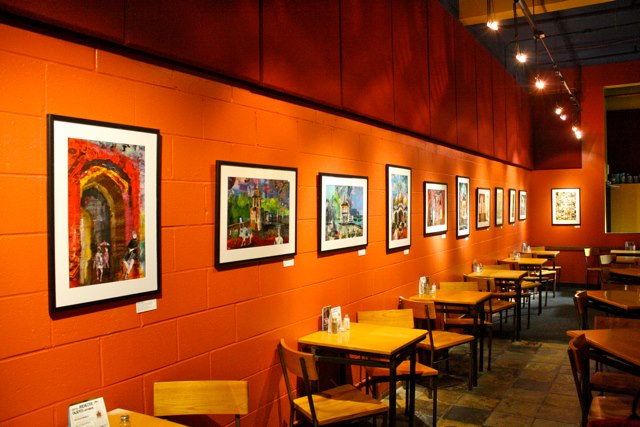
my new collage series “this heirloom” on show at the little cafe, starting nov 10th
this is the first collage in the new series inspired by my filmwork on the partition of india and by the idea of bearing witness as a dynamic act. that’s my maternal grandfather in the foreground. he went to aligarh university (in uttar pradesh, india). he spoke fluent urdu, english and sanskrit. he was a lawyer, an excellent tennis player and a soccer referee. altho he and his family survived partition, he died soon after moving to pakistan. maybe he couldn’t recover from the trauma and dislocation. i never knew him. i’ve seated him in front of delhi gate in lahore, which is one of the doorways to the walled city. it’s 1946. my grandfather is my connection to the turbulent history of the indian subcontinent. what he witnessed binds us together. agha shahid ali talks about this inextricable bond in his poem “snowmen.” his ancestors came from the himalayas.
“This heirloom,
his skeleton under my skin, passed
from son to grandson,
generations of snowmen on my back.
They tap every year on my window,
their voices hushed to ice.”

another screening of the muslims i know
just came back from a screening of “the muslims i know” at an OASIS community class called “the descendants of abraham.” the class is taught by jewish, christian and muslim instructors. extremely excited that they’ve been using my film in their introductory class for the last 3 yrs. a lady asked me a question that bothered me. i tried to stay calm but i might have seemed a bit cold. she said that the muslims portrayed in the film are well-to-do professionals. they r not the ones she’s worried about. she’s worried about the less well-off muslims who might send their kids to madrassas and teach them to hate others. ok. so my answer: first of all, the film is called the muslims i know. i refuse to stand up and pretend to speak for all muslims. the media do that. i don’t want to fall into that trap. i will not generalize. second, it’s interesting how people are uncomfortable with a certain “face” of islam. muslim doctors, lawyers and academics do exist. get over it. third, this connection between socio-economic class and violence is v disturbing. not only is that connection made with reference to muslims but also our own local communities, where poor inner-city neighborhoods are presumed to be violent as if, for some reason, they don’t share our civilized “values”. fourth, as one of the instructors added, violence is not just about shooting people, it’s also about enticing someone to take out a mortgage they can’t afford, foreclose their home and kick their family out on the street. pray, which socio-economic class perpetrates that kind of violence, which destroys the lives of many more people? finally, on the teaching of hate: how would u describe going to war with the second poorest country in the world, where most kids die of malnutrition, not extremism? who’s being taught to hate whom?
pakistan one on one to be screened in mashhad
my film “pakistan one on one” has been selected for the international ruyesh film festival, which will take place later this month in the city of mashhad, iran. the film is being translated and subtitled in farsi as we speak. how cool is that!
witness palestine film series 2012: “one family in gaza” and “home front”
MC melanie duguid-may along with panelists dr ismail mehr (who worked as a doc in gaza for 9 days during the 2008-2009 attacks) and “one family in gaza” director jen marlowe (who was skyped in from jerusalem), little theater, sept 27, 2012.

One Family in Gaza
this is one of the short films screened at the little theater, on sept 27, 2012, as the third event in the witness palestine film series. u can watch the entire film online.
One Family in Gaza from Jen Marlowe on Vimeo.
witness palestine film series 2012: “salt of this sea”
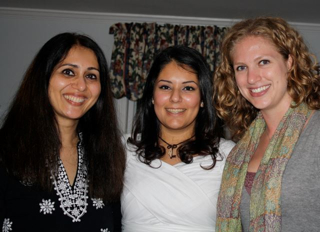
with haneen ali and julia c hurley both panelists for “salt of this sea” – second film in the witness palestine film series, sept 23, 2012 (photograph by elaine johnson).
Friends of Education Excellence: Helping Students Succeed
check out this pro bono project i worked on earlier this year. shot the footage in two days and edited/post-produced the video myself in another two days. worked with my friend bruce pollock, the man behind FREE partnerships.
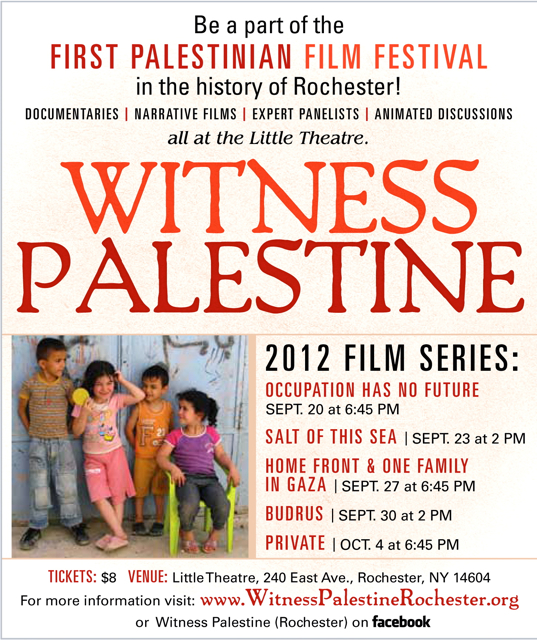
palestinian film series starts on sept 20th
opening of the palestinian film festival today, at the little, with “occupation has not future.” terrific attendance, in spite of everything else going on in rochester, and enthusiastic response to the film. here is MC jim tiefenthal and panelists dianne roe and david zlutnick (director and producer of the film, being skyped in from a coffee shop near portland).

the witness palestine film series is coming up soon…
code pink in pakistan
my friend, judy, is going to pakistan with code pink, to protest drone attacks, alongside imran khan and other pakistanis. she made this wonderful banner on which i got to write in urdu: band karo, band karo! drone humlay band karo! (stop it, stop it! stop drone attacks!). even tho i won’t be able to join this historic political rally, i feel like a part of me will be there. go judy!