A Thin Wall and Being Muslim in America at Hampshire College

I will be at Hampshire College, Amherst, next week to screen A Thin Wall and also talk about Islamophobia. Pls join us if u are in the area.

‘Hampshire’s Creative Writing Program, South Asian Studies, the Eqbal Ahmad Initiative, and their cosponsors announce “Islamophobia and Its Discontents,” a panel discussion, on Wednesday April 5, at 6 p.m. in the West Lecture Hall, Franklin Patterson Hall. It will feature Pakistani American filmmaker Mara Ahmed, whose talk is titled “Being Muslim in America.” She will be joined by Professors George Fourlas (philosophy), of Hampshire, who will address Islamophobia as racism, and Mehammed Mack (French and comparative literature), Smith College, who will speak on Islamophobia in France.’ More here.

Thx for organizing Uzma!

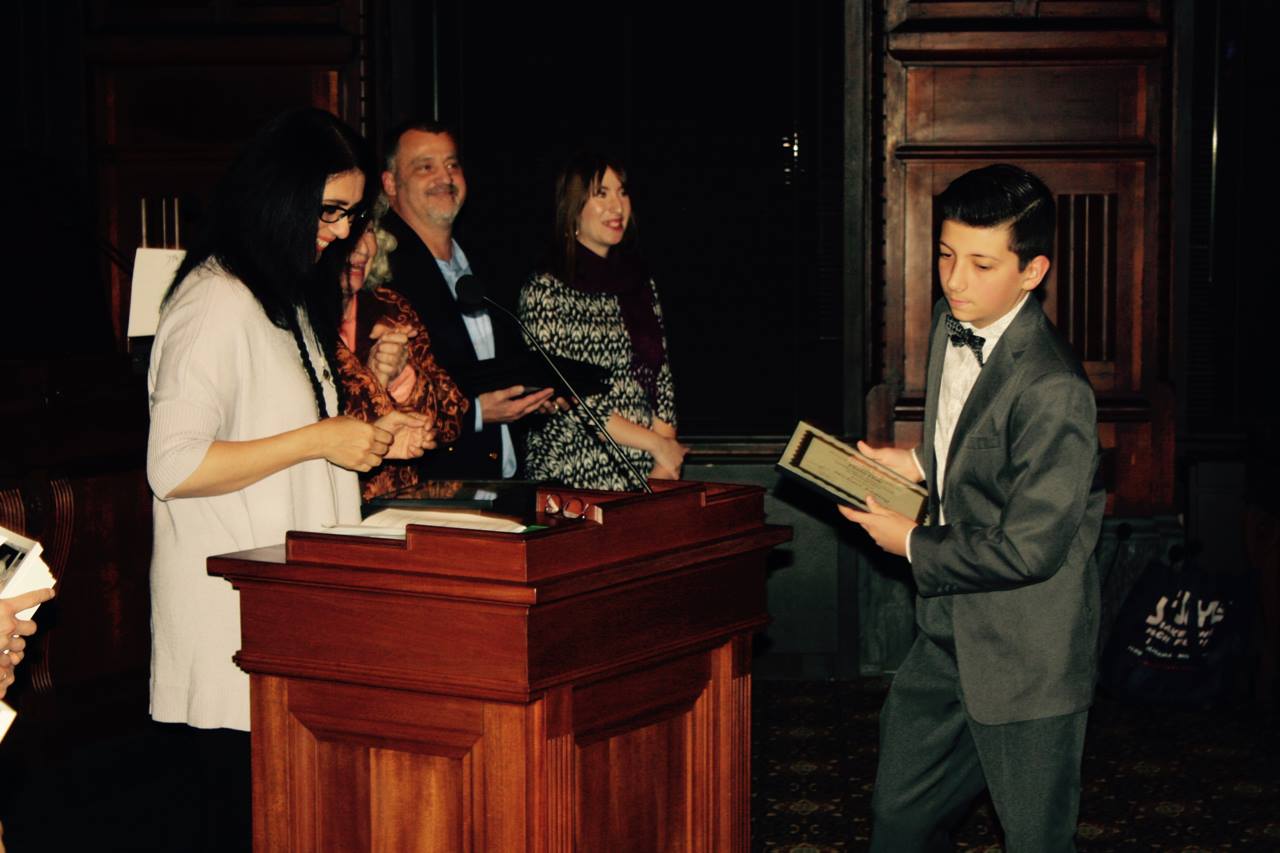
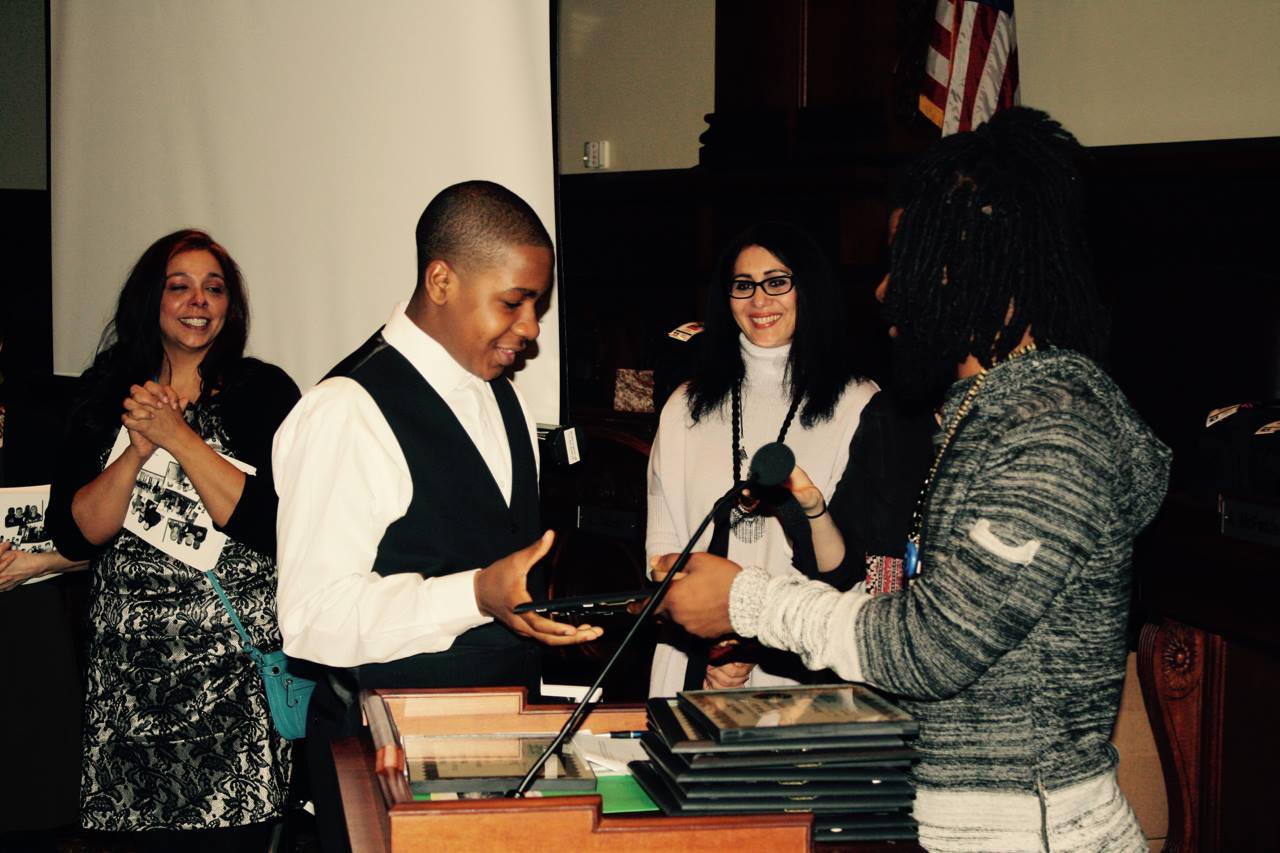
photography awards ceremony

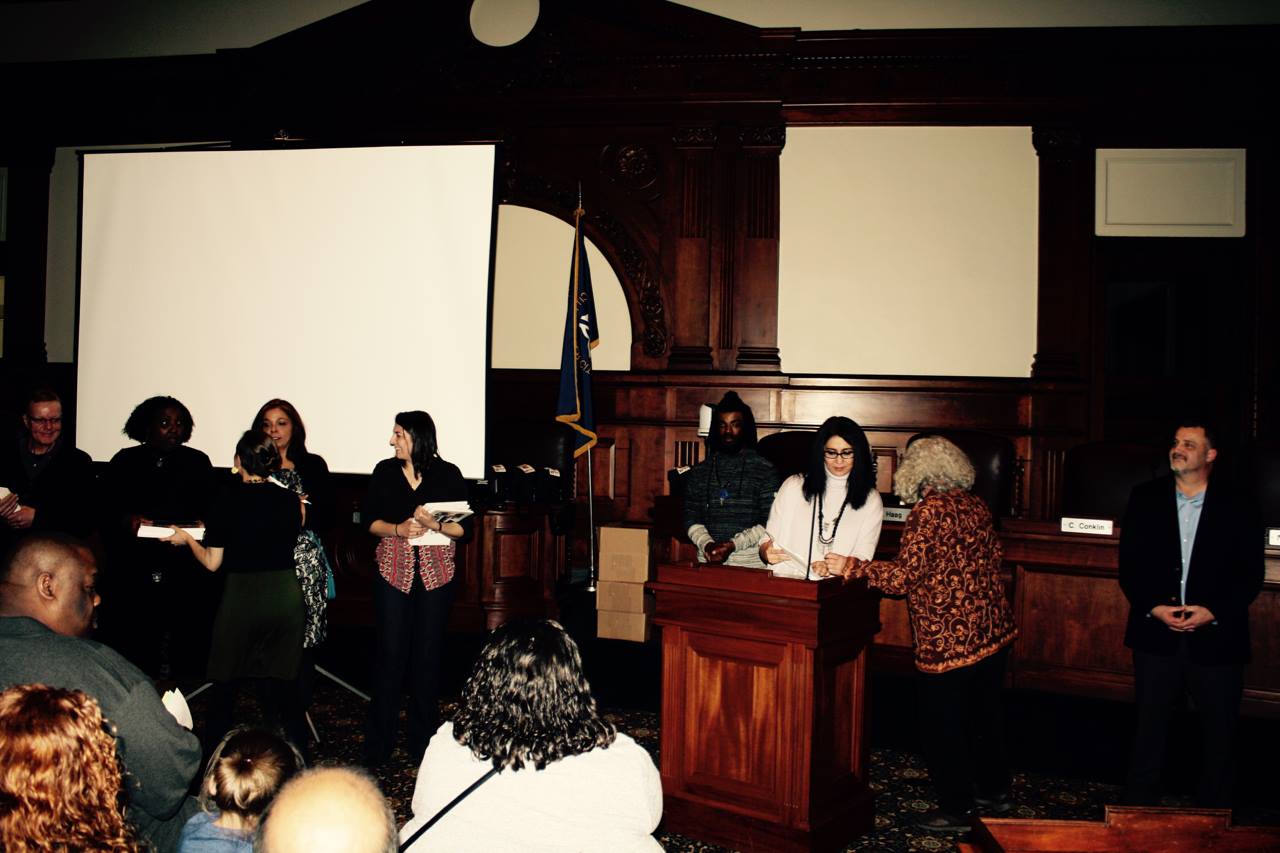
such a joyful ceremony at rochester city hall this evening. wilson foundation academy students were presented awards for completing Flower City Arts Center’s Studio 678 photography program. an honor to participate. grateful to my husband for attending with me after a long day at work and to amanda chestnut for connecting me to this program. thank u.


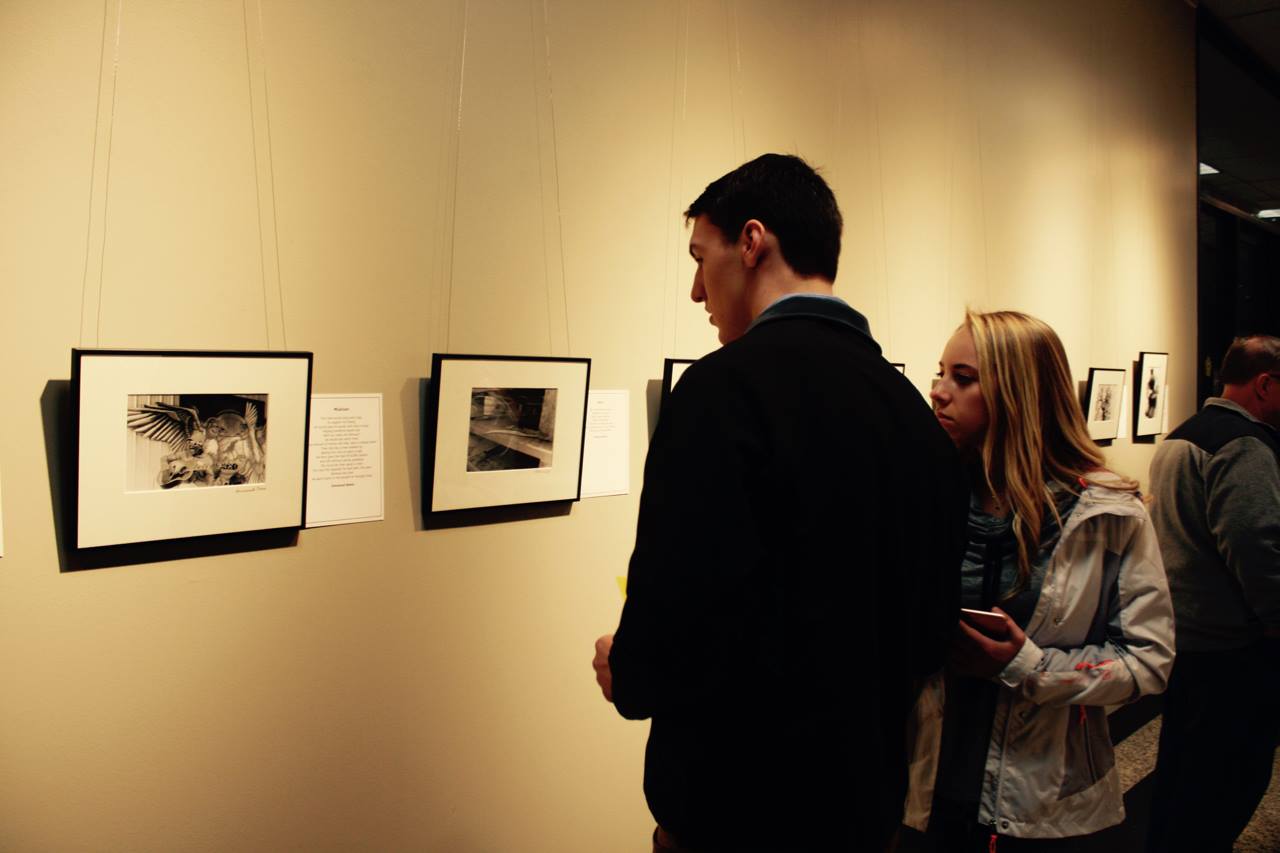
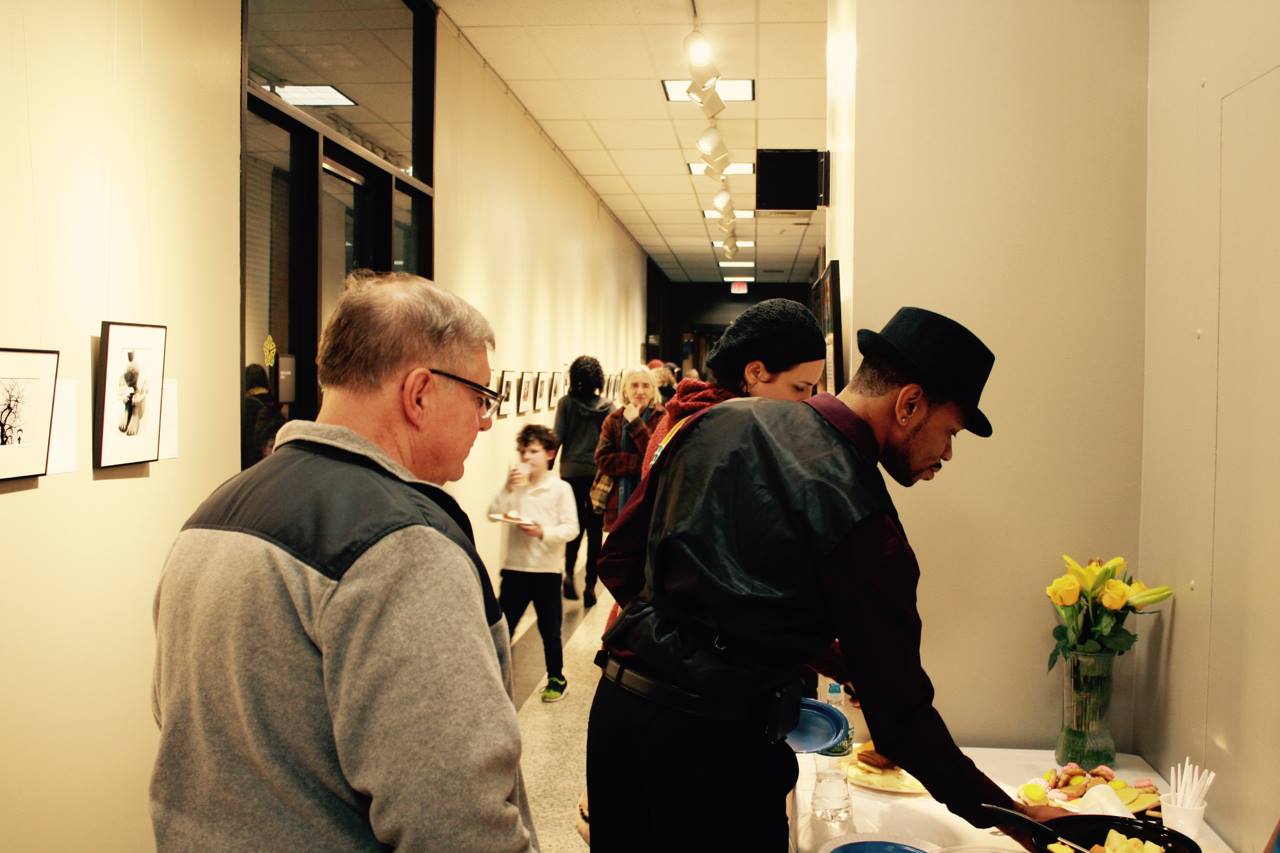
Studio 678 Exhibition – The Flower City Arts Center

Today at Rochester City Hall, 6:30-7:30pm, awards will be presented to students in Studio 678, the Wilson Foundation Academy Photo Club. This is the 19th year that Flower City Arts Center has provided this after school photography and writing program, currently to thirty 7th and 8th grade students of Wilson Foundation Academy. It is a 24 session program which includes several field trips. Students learn how to use 35mm film cameras, take pictures in the community, make their own black and white prints in the darkroom, work with spoken word poets to write poems to accompany their photographs, take portraits of each other in the lighting studio, scan their prints in the digital lab and use Photoshop and In-Design to create a book of their work. They also mat and frame two of their photographs for an exhibition at the link gallery, City Hall, and present all of their work as a multi-media presentation. Today’s award ceremony is open to the public. I will be there, hope that u can make it too. Let’s celebrate these brilliant students and their work. More here.

The Muslims I Know at RIT

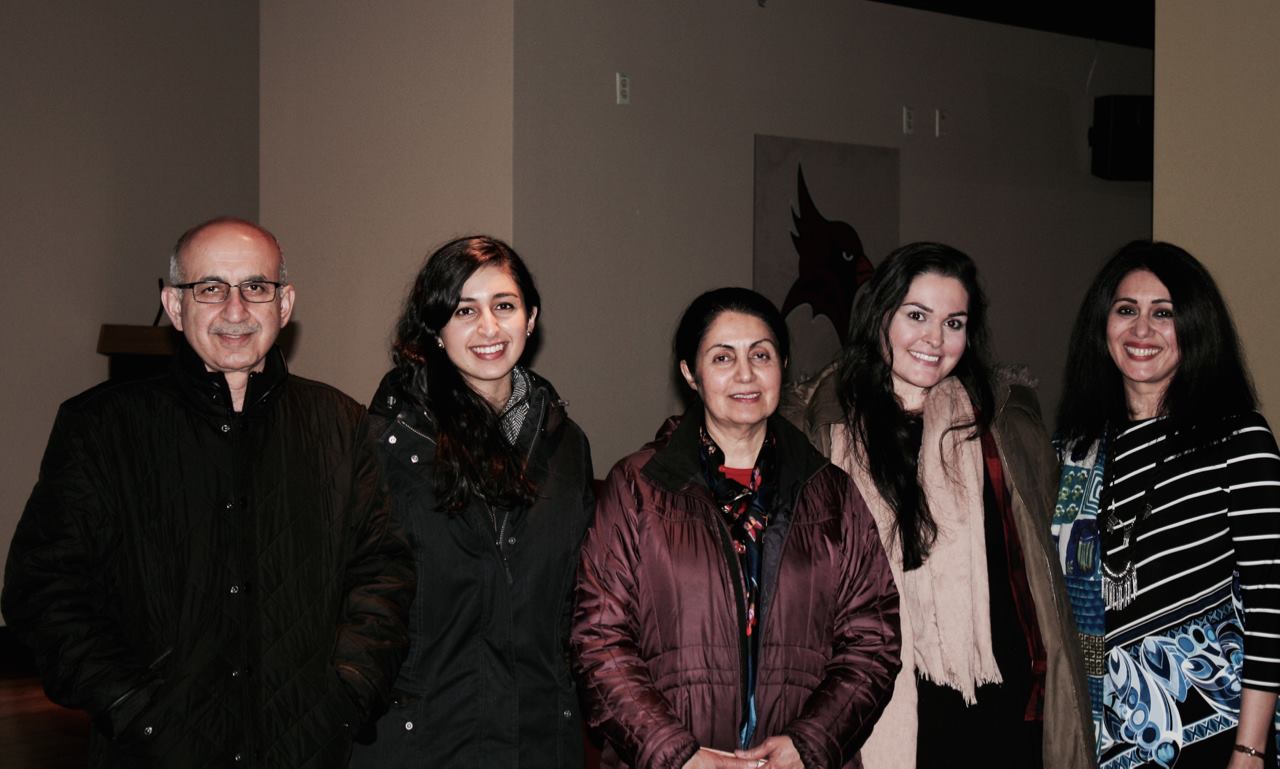
Wonderful screening of The Muslims I Know at Rochester Institute of Technology yesterday. Thank u for organizing Elisabetta Sanino D’Amanda, Paulette Swartzfager, Sara Armengot and RIT MSA! and thank u to all my friends who attended especially Susan Galloway and Ream Kidane ? [Photo by Elisabetta]

mara ahmed at RIT

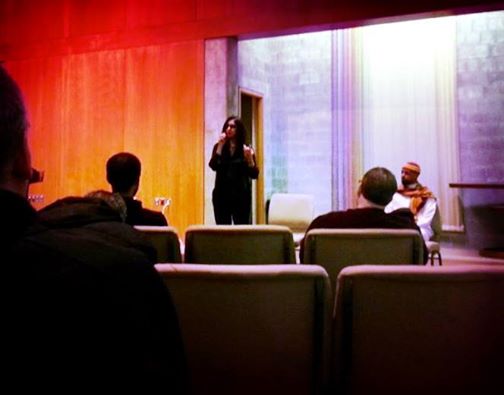
Screening of The Muslims I Know at RIT’s Allen Chapel today

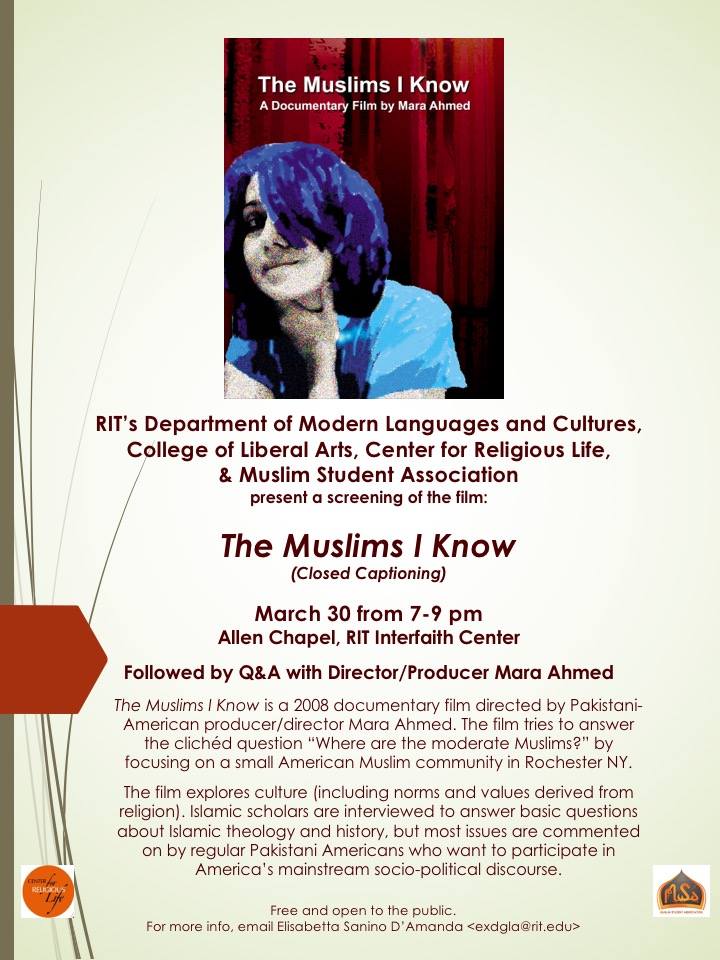
Film and Discussion “The Muslims I Know” (Closed Captioned): RIT’s Department of Modern Languages and Cultures, the College of Liberal Arts, Center for Religious Life, & the Muslim Student Association present “The Muslims I Know,” followed by Q&A with Director/Producer Mara Ahmed. The Muslims I Know is a 2008 documentary film directed by Pakistani-American producer/director Mara Ahmed. The film tries to answer the clichéd question “Where are the moderate Muslims?” by focusing on a small American Muslim community in Rochester NY. The film explores culture (including norms and values derived from religion). Islamic scholars are interviewed to answer basic questions about Islamic theology and history, but most issues are commented on by regular Pakistani Americans who want to participate in America’s mainstream socio-political discourse. Today at 7pm at Allen Chapel, Interfaith Center, RIT, One Lomb Memorial Drive, Rochester, NY 14623.

A Thin Wall: Nationalism and the Partition of India

Mara Ahmed: The documentary film “A Thin Wall,” a personal take on the partition of India shot on both sides of the Pakistan-India border, took me 7 years to complete. I directed and produced another film during that time and worked on several other projects but the idea of partition stayed with me and seeped into my readings on history and contemporary politics. It became apparent to me that even though nationalism could be a used as a rallying cry for freedom and self-rule, especially in a colonial context, it could also reduce complex struggles for equity and justice to the black and white language of separation and national borders. The nation state itself, as explained by Rabindranath Tagore, is not a timeless, universal template that works for every region of the world. Rather, it is a siloed, Western approach particularly suited to capitalism and a poor fit for India. Tagore understood that military ideologies must accompany nation states and he advocated universalism rather than nationalism. From “Nationalism” by Rabindranath Tagore (1918):

India has never had a real sense of nationalism. Even though from childhood I had been taught that the idolatry of Nation is almost better than reverence for God and humanity, I believe I have outgrown that teaching, and it is my conviction that my countrymen will gain truly their India by fighting against that education which teaches them that a country is greater than the ideals of humanity.

In his essay entitled “Of Balkans and Bantustans: Ethnic Cleansing and the Crisis in National Legitimation,” Rob Nixon discusses the importance of homogeneity, the very justification for the creation and existence of nation states:

Aspirant nation-states thus find themselves in a catch-22: despite the rarity of ethnically homogeneous states, prospective states find themselves held to an archaic and potentially destabilizing vision of what constitutes a nation. Yet in seeking to reinvent themselves as singular and homogeneous, they cannot legitimately resort to the conquests and “cleansings” that countries like France, Britain, Germany, Turkey, and Spain once used to secure the internationally sanctified statehood they now enjoy.

Nixon concludes:

That canny nineteenth-century philosopher of nationalism, Ernest Renan, recognized this temptation: “Unity,” he remarked, “is always effected by means of brutality.” While this may not be wholly true of “unity,” it certainly holds for homogeneity. In the current world climate, the rewards for the pursuit of homogeneity remain explosively high. Far from resolving minority-majority tensions, the pursuit of homogeneity is liable to provoke ever smaller microethnic claims in a spiral of action and reaction, destroying in the process precious legacies of intercommunal forbearance.

Such analysis reinforced my distrust of nationalism. It helped me make sense of the road that Pakistan and India have taken post-partition. Both countries had to reimagine themselves as homogenous nations, each with a singular identity (purely Muslim or Hindu) even when this national imaginary did not square with the realities on the ground. The problematic treatment of minorities in both India and Pakistan is a by-product of building this facade of uniformity by waging war on what is religiously or ethnically incongruent.

There have always been uncomfortable links between nationalism and fascism. Under Mussolini nationalism was a way to buttress unqualified obedience to the state, while in Nazi Germany nationalism expressed itself through the narrative of a unified master race that could not afford to be “contaminated” by difference. Traditionally nationalism does not have to embody the expansionist tendencies of fascism, but military aggression can be co-opted by nationalists, especially when it’s dressed up as necessary protection for the existence and wellbeing of the state. As is obvious today, national security is invoked frequently by countries that seek to invade and occupy in order to achieve economic and geopolitical goals. This is usually done in tandem with a domestic war on religious and ethnic minorities, launched under the pretext of national stability.

Although we have come to view the nation-state as a modern phenomenon with the potential to unify nations, facilitate self-government, and organize as well as produce the betterment of communities, it is helpful to analyze the very nature of this concept in order to understand its mechanisms and the excesses that it has been, and will continue to be, susceptible to. The intimate stories recounted in “A Thin Wall” illustrate how quickly lines can be drawn across a shared territory and how nation states, once they have been delineated, only concretize that process of separation and the development of contentious national agendas.

Organizing the reading of Jen Marlowe’s play

Excellent meeting with Reuben J. Tapp this morning. Found out that he’s involved with the African American theater companies that form The Rochester Bronze Collective and perform at MuCCC. Even more thrilled at the prospect of working with him on a play by Jen Marlowe. Thx for this brilliant connection Scott Lancer. And yes, 490 is driveable, although it’s better to stay slow. Apparently up to 42 inches of snow from this latest storm, in some areas of upstate NY. Stay warm everyone!

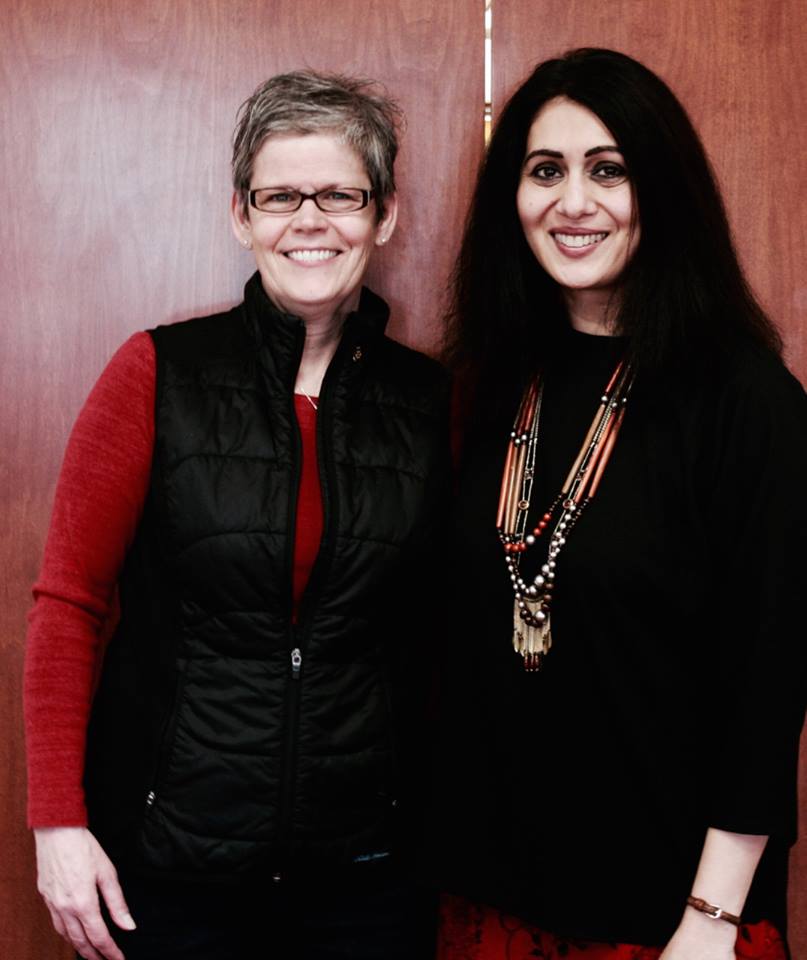
jim tiefenthal, reuben tapp and mara ahmed

feminism and intersectionality: my talk at SJFC

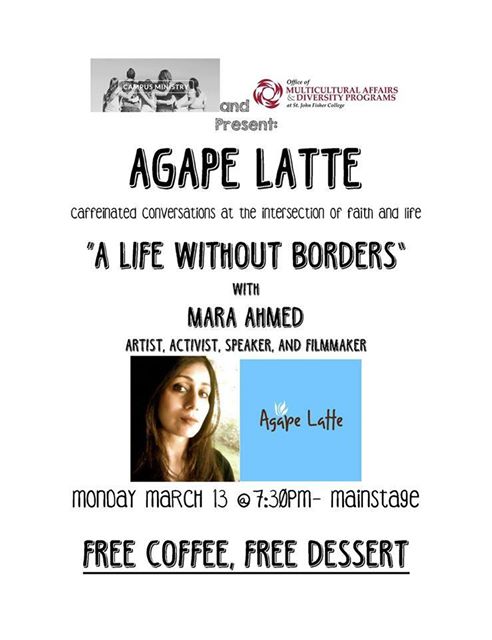
wonderful discussion about feminism and intersectionality at St. John Fisher College this morning. such a pleasure to talk about the work of lila abu lughod, saba mahmoud, houria boutelja, audre lorde, nadine naber and anu ramdas.

excellent questions from students – one about the contradiction between the west’s concern for women’s rights in muslim-majority countries and their sabotage/disruption of political movements for democracy and self-determination.

nadine naber has written extensively about the egyptian revolution – how women were “active participants in a grassroots people-based struggle against poverty and state corruption, rigged elections, repression, torture, and police brutality,” yet much of US public discourse framed the revolution through “islamophobia logics” and was driven by the question: what if islamic fundamentalists take over egypt? she locates this discourse “in the historical trajectory of the post-cold war era in which particular strands of US liberal feminism and US imperialism have worked in tandem. both rely upon a humanitarian logic that justifies military intervention, occupation, and bloodshed as strategies for promoting democracy and women’s rights. this humanitarian logic disavows US-state violence against people of the arab and muslim regions rendering it acceptable and even, liberatory, particularly for women.”

another question was about the need for muslims to condemn every act of terrorism when no such demand is made of the white christian majority. of course, we talked about mahmood mamdani’s “good muslim, bad muslim: america, the cold war and the roots of terror.”

we explored postcolonial feminism and muslim feminism and discussed saba mahmood’s work on the piety/mosque movement in many muslim-majority countries of the world.

finally, we examined the politics of “non mixite.” houria boutelja explains how colonialism and racism have already divided muslim men and women and therefore the idea of building feminine power by excluding muslim men might not be effective in this context. audre lorde too talks about racist oppression being shared by black women and men, because of which they develop joint defences and joint vulnerabilities. similarly, anu ramdas has written about how “the reformative agenda of taming dalit masculinity ignores the reality of inter-operating oppressive cultures in a caste society.”

so satisfying for me to mention these incredible women and analyze their incredible work, on this cold snowy morning, all thx to Roja Singh, who organized this event and drove me back and forth in this bad weather. a true sister in the stuggle for justice and equality. what feminism should be all about!

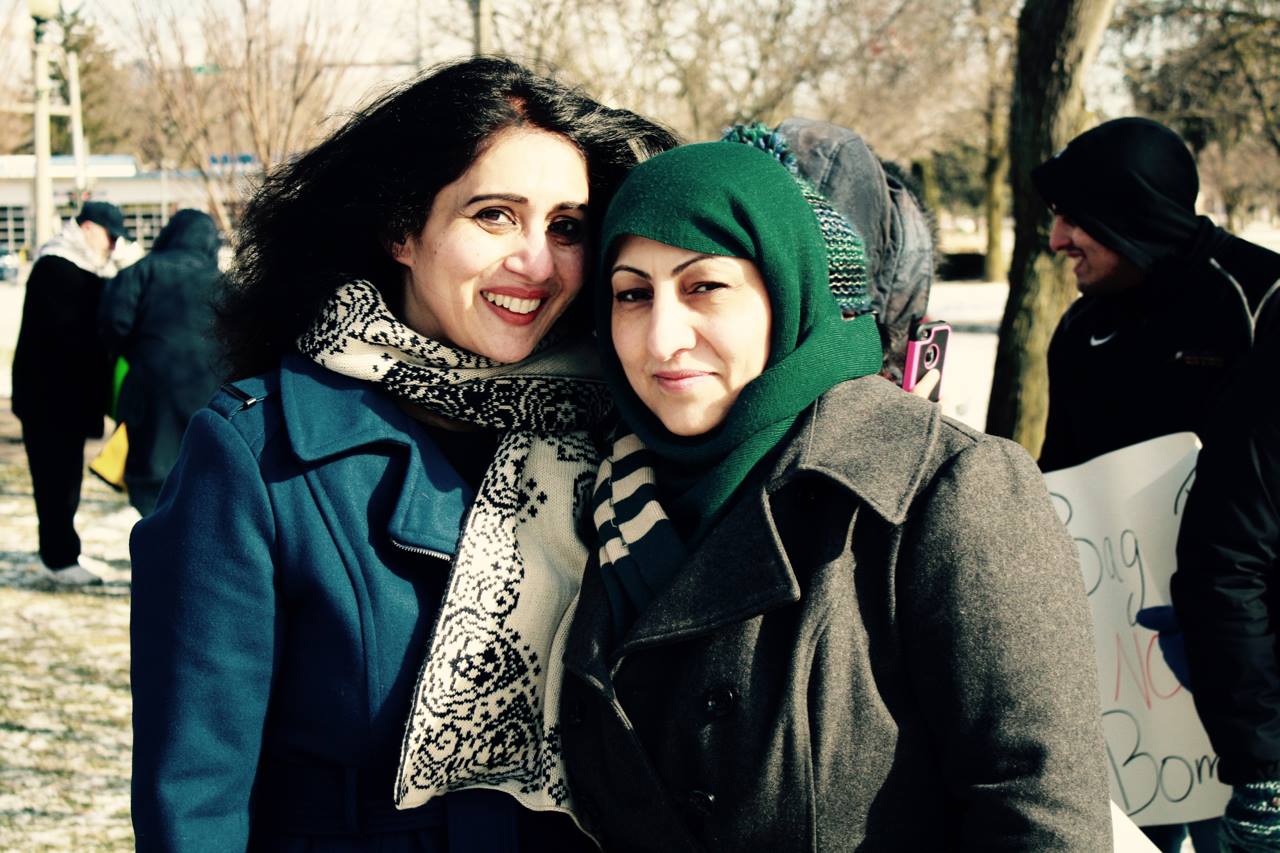
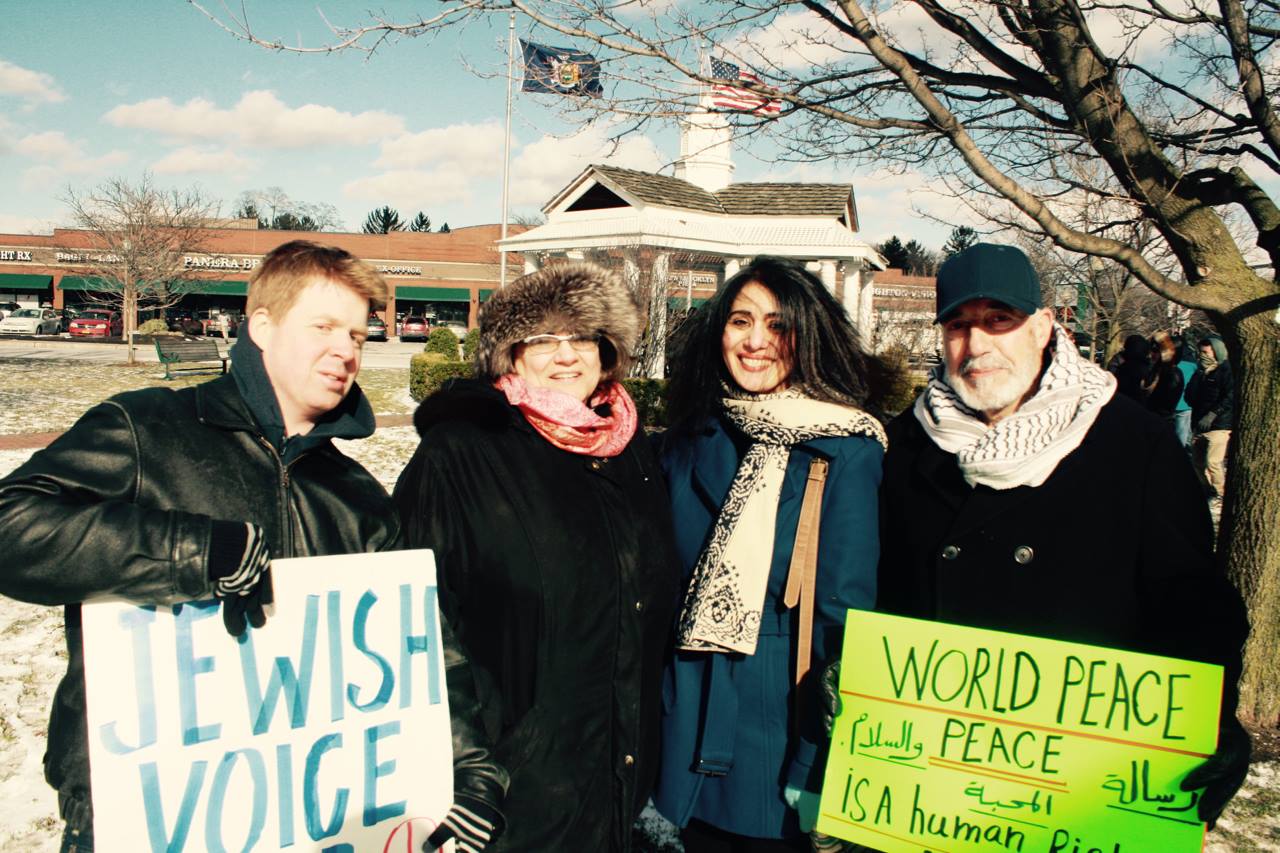
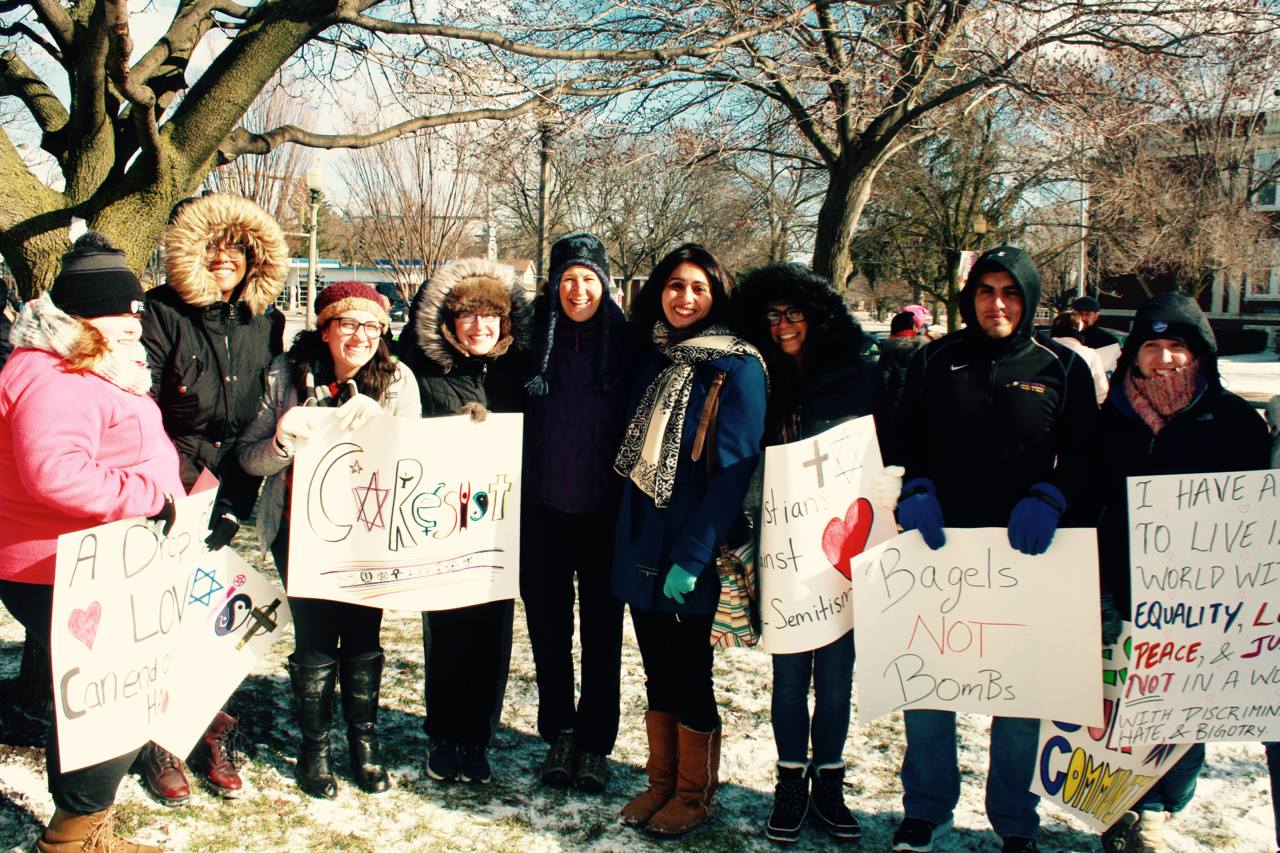
rally against anti-semitism today

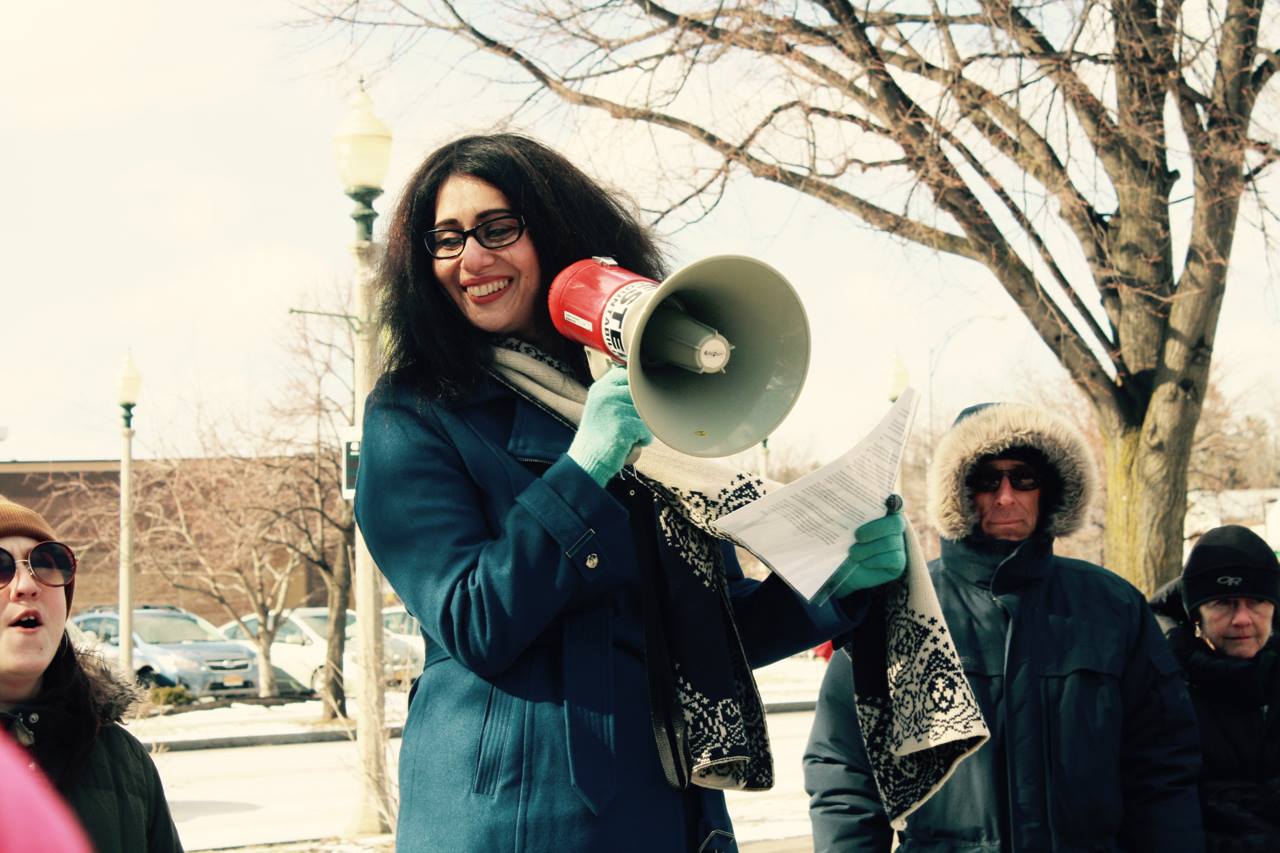
rally against anti-semitism today at 12 corners, rochester, ny: we are united in our fight against hate and bigotry.

mara ahmed

mara ahmed and obaida omar

mara ahmed with rabbi drorah setel and friends

aitezaz ahmed

mara ahmed with naz students and faculty

David Kramer: While the event organizers, Hannah Brown and Milo Lomi, are Jewish, the rally was designed to bring together a diversity of groups and social justice activists. As members of the Anti-Fascist League, Hannah and Milo are especially concerned about the upsurge of white supremacist activity in our area. Brighton has both thriving Jewish and Muslim communities, and it was inspirational to see so many members of the Muslim community at the Twelve Corners in solidarity. Brighton Town Supervisor William Moehle had that morning been at the JCC lending support. Bill said that when the JCC was threatened, members of the Islamic Center in Brighton immediately called him, asking what they could do to help. On Sunday we see what can happen when people of good will gather to condemn hate. More here.

international women’s day

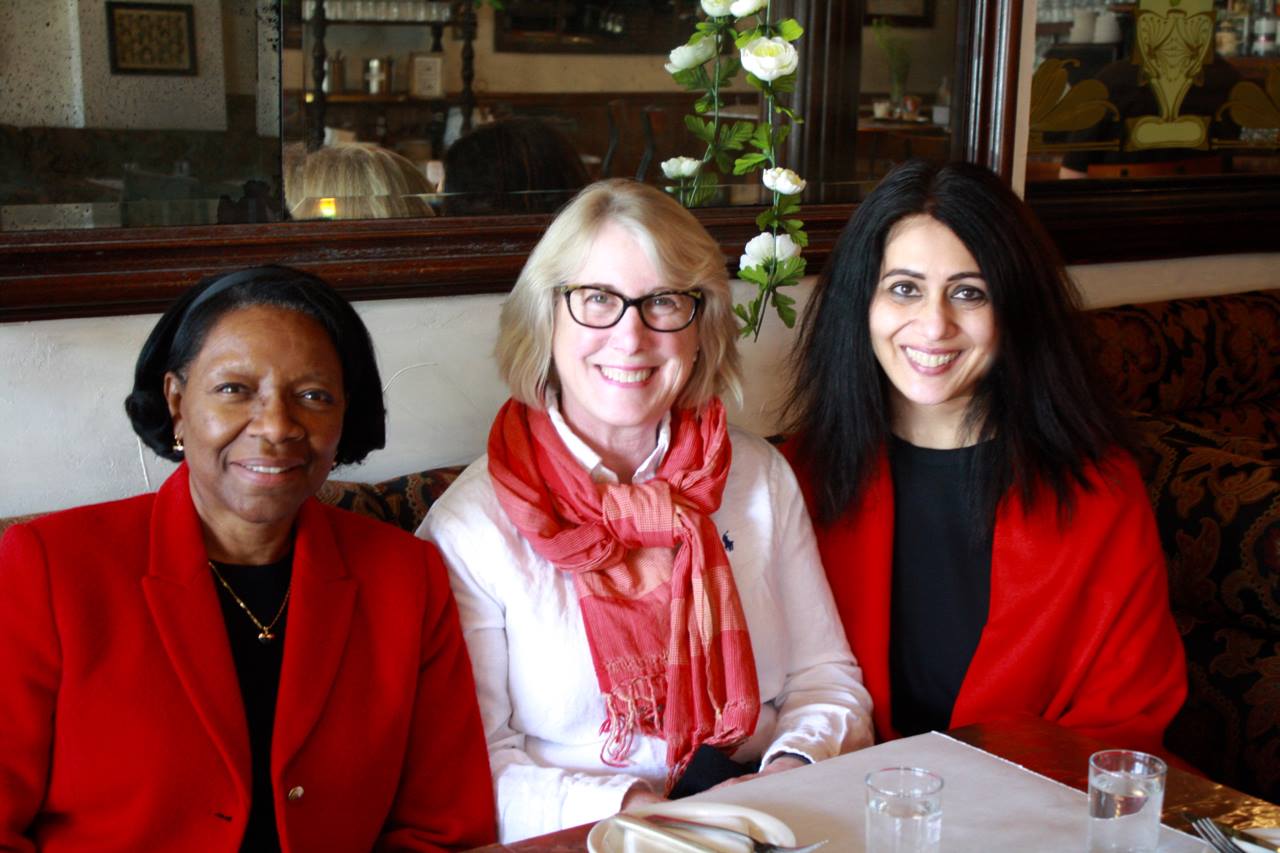
yesterday, on international women’s day, i spoke at the pittsford rotary about my work and started by explaining the history and importance of women’s day. wasn’t sure how a group of white businessmen in suits was going to respond to my presentation but they were not afraid to engage and asked excellent questions. the talk was organized by my dear friend, and person-2-person partner, jeanne strazzabosco. later i met with two close friends, judy toyer (an attorney who grew up in alabama during jim crow and is committed to anti-racism work) and sarita arden (an artist who came to social justice very early on as a school girl), to talk about revolution. and of course, we all wore red.

jeanne strazzabosco and mara ahmed

judy toyer, sarita arden and mara ahmed

tedx talk today

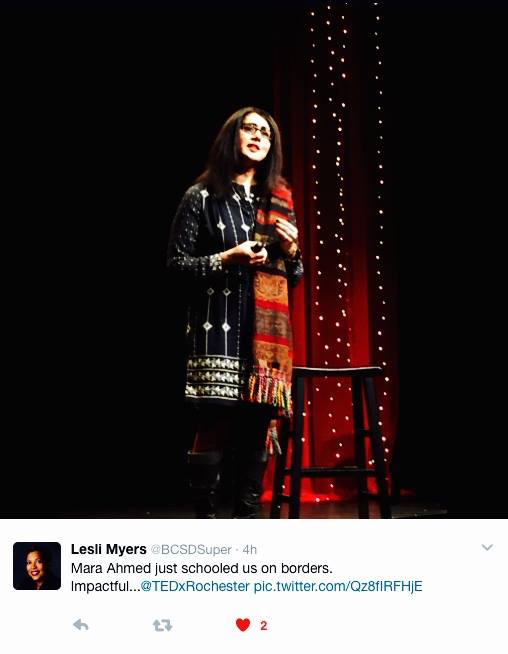
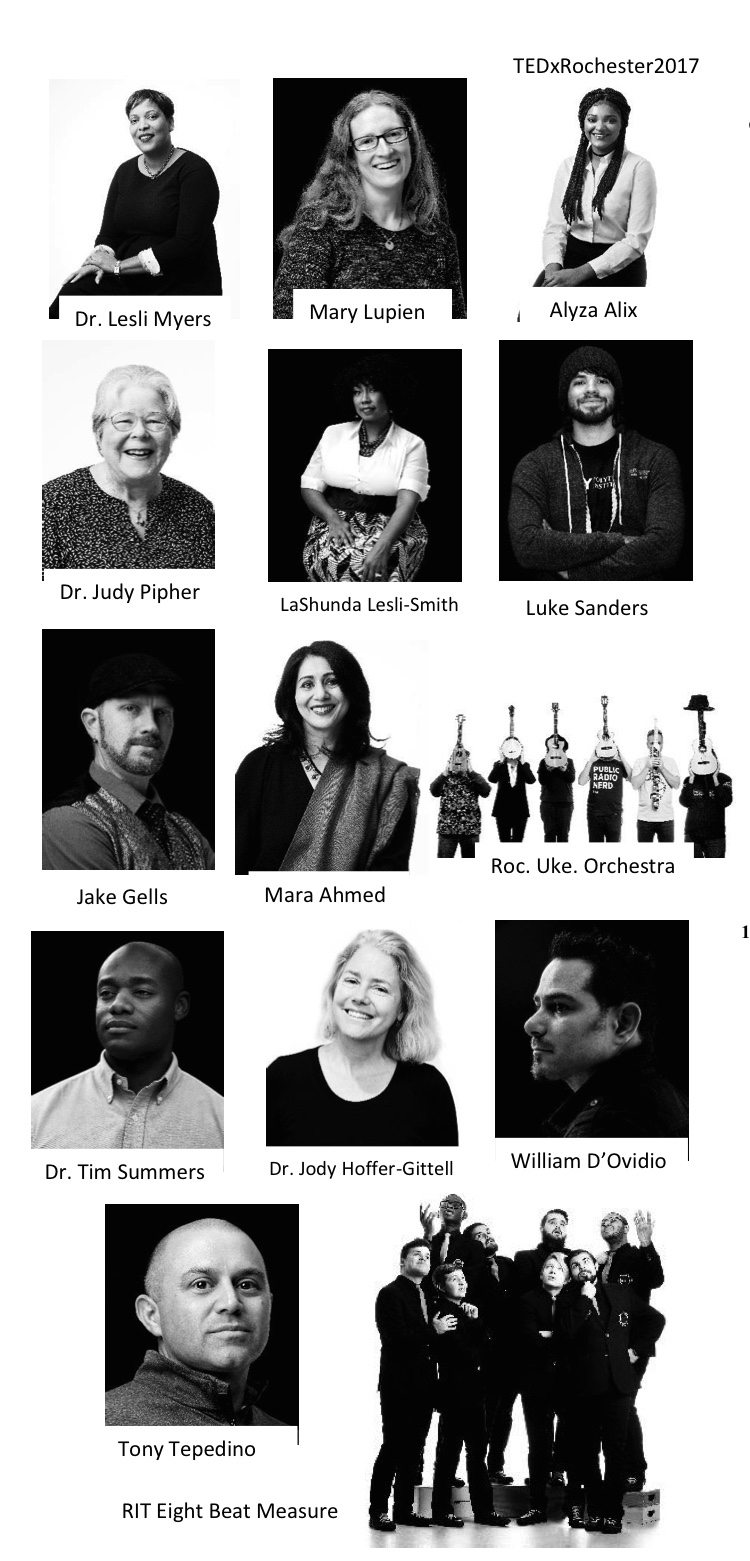
tedx talk: done. i did not blank out, i remembered all the sections of my presentation and i was able to navigate all my slides. can’t know for sure how i did until i see the video, but phew. i know many of u, my dear friends, were thinking of me/sending me good vibes. i owe u big time. here’s a lovely endorsement by one of my fellow speakers, the beautiful lesli myers, superintendent of schools in brockport, who spoke powerfully about hate and ignorance and shared the traumatic story of how her grandfather was lynched when her mother was 3 years old. an extremely diverse line-up of speakers and some thought-provoking, honest truth-telling. well done rochester!

mara ahmed at tedx