Blood Narratives and Feminist Heroes by Mara Ahmed

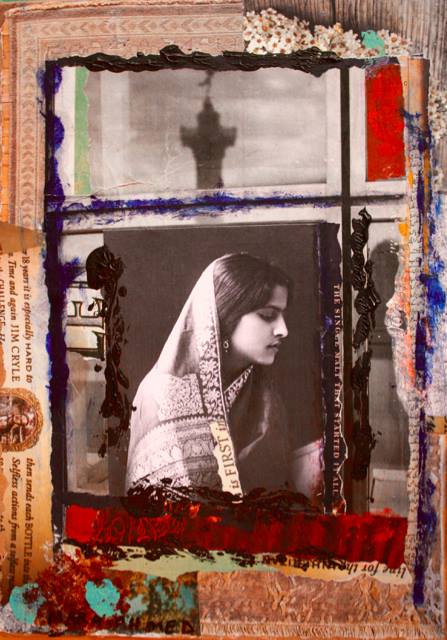
my thoughts on the stark differences between the west’s reaction to ahed tamimi and malala yousafzai – a further exploration of an article written by shenila khoja-moolji and a case study by sherene razack.

It might be an uphill battle to shame the Western elite into sabotaging their own narratives of superiority, but it is essential for those of us whose bodies “don’t matter” (because they are raced, gendered, disabled, classed, exploited, and oppressed) to look beyond dominant fictions and deploy our solidarity in uncompromising, meaningful ways. It is particularly urgent to unmask and stop the obscenity of state violence committed on the minds and bodies of our children. It’s nothing less than a matter of survival. More here.

Rochester organizations come together for Year of Douglass

Work on the “Re-Energizing the Legacy of Frederick Douglass” project got started last year, Eison says, when there was a flash celebration at Douglass’s grave site in Mt. Hope Cemetery for his 199th birthday [organized by ROC Douglass Consortium]. Eison and Bleu Cease, Rochester Contemporary’s executive director and another of the Douglass celebration organizers, had worked together in 2014 when RCTV and RoCo hosted the video project “Question Bridge” and decided to work together again to plan a commemoration of Douglass’s 200th birthday. More here.

A Thin Wall at Indian Institute of Technology, Kharagpur, India

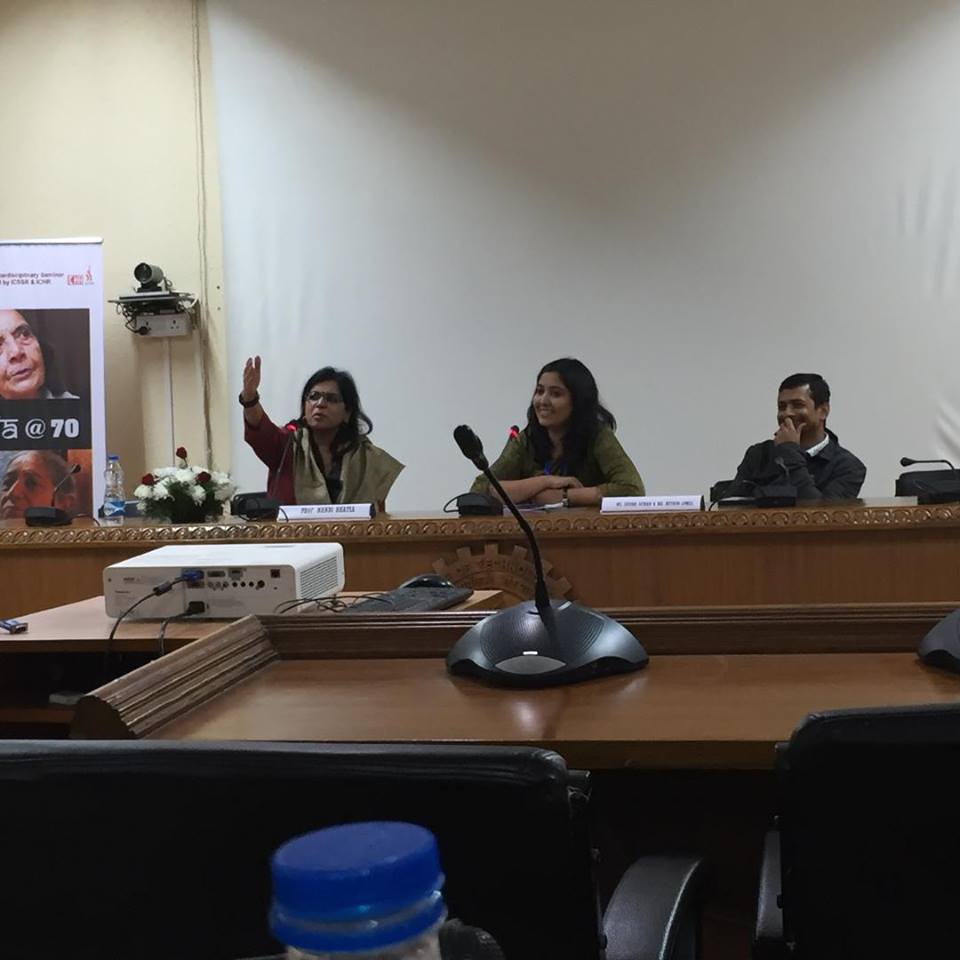
From A Thin Wall cinematographer Mithun Gomes: We felt honoured to be a part of the seminar on “India @ 70: Memories & Histories” organised by the Department of Humanities and Social Sciences at Indian Institute of Technology, Kharagpur. We screened our documentary film, A Thin Wall, to a lovely and receptive audience who presented us with many interesting thoughts and questions after the screening. Our short stay at the campus was quite a treat, especially the brief and insightful visit to the detention centre, where some very valuable historical markers have been carefully preserved. We couldn’t have asked for a better beginning to the year. Looking forward to more such opportunities for screenings and #dialogues. A Thin Wall is the result of a lasting collaboration between Mara Ahmed and Surbhi Dewan, who came together to create this detailed account of the survivors of the IndoPak partition.

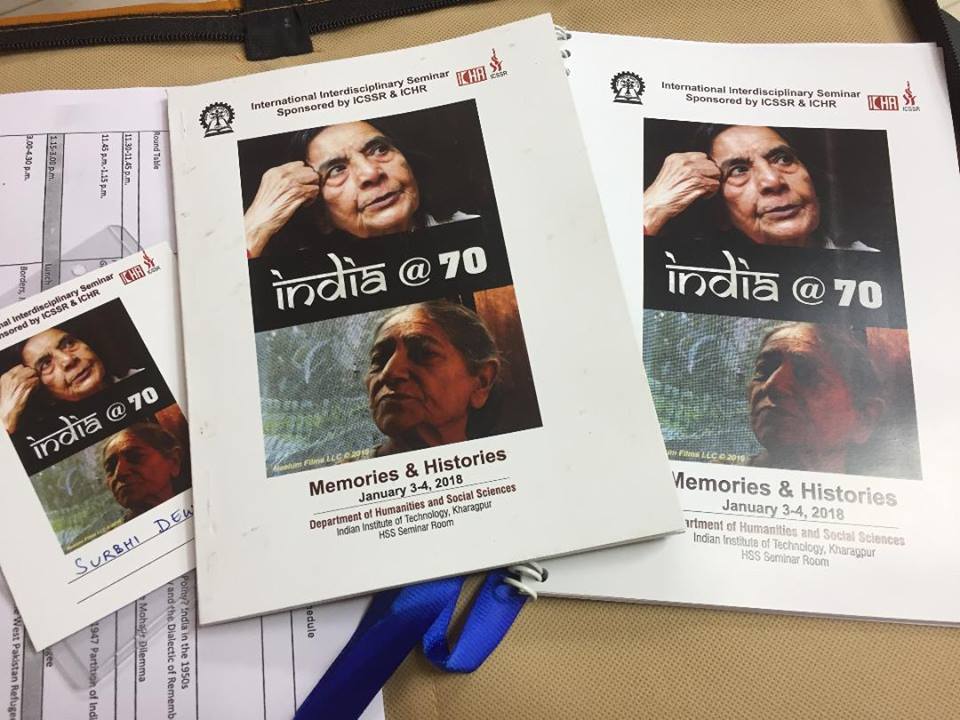
India@70 participant kit

Q&A moderated by Professor Nandi Bhatia, University of Western Ontario, Canada

Kathryn Myers on A Thin Wall

On Nov 8, 2017 A Thin Wall was screened at the Human Rights Film Festival at UConn. The post-screening Q&A with director Mara Ahmed was conducted by Professor Kathryn Myers, from UConn’s Art and Art History Department. Dr. Myers’s questions highlight her extremely attentive and sensitive reading of the film. Here they are:

— What was it like hearing these stories from your mother, starting with such sweet reminiscences of her old neighborhood in Gurgaon, and with the same calm measured way of speaking, later describing the atrocities she witnessed on the train and the sense of terror she felt after moving to Lahore and seeing looted and burned Hindu homes. When did you first begin to understand and process what she had been though and how has your understanding changed through the years?

— As you have collected and organized a vast amount of material, I’m curious about some of the challenges and strategies of interweaving different narrations. Some are recurring, such as the elderly survivors of partition who gradually tell their own stories throughout the film, including your mother, relatives, and family friends. In addition to yourself as a recurrent narrator, there is also Surbhi Dewan who starts by perhaps contrasting the dramatic stories of the partition survivors with what she describes as her rather “eventless” life and her imagining of what her grandparents went through when they left their home. She talks about her own leaving home for New York and her ongoing dreams of reconciliation. Other narrators appear just once between the recurring narratives and are from different professions and locations such as a writer from Massachusetts, an artist from Karachi, a photojournalist from Rwanda, a filmmaker from Vancouver, a historian from Delhi, etc. Each has different insights about related themes such as religious fusion, guilt, remorse and forgiveness, a lasting division of hearts, etc. Talk about your process of selecting/organizing these interweaving narratives and some of the choices you had to make, and the challenge of making it all flow together so well as it does and not feel disjointed.

— There are two sections, one in the beginning and one near the end, where you are asking questions to what seems to be average people on the street in Lahore and Delhi. Was this created to gain some unexpected comments and insights, such as the young woman who felt partition was good, (aside from the loss of life) because India and Pakistan could not otherwise live together. This might be typical of a younger generation that is more disconnected from history or have no stories from surviving relatives. In the later section of street questions, all of the people you spoke with seem to feel they can get along, but that it is governments that perpetuate the continuing conflict.

— There are times when the imagery is quite directly connected with the narrative, such as the interviewees and images we may take to represent places they imagine or remember. There are other times where you make striking juxtapositions of imagery and voiceover and I’m curious about some of your choices. There are many wonderful instances of the poetic combination of imagery and voiceover, but I was particularly moved by gorgeous scenes of fabric being dyed, while you speak of blurred boundaries and a former cultural mixing of Hindu, Muslim, Sikh, and Christian identities, ending with a statement about how dividing the indivisible is doomed to be violent, paired with the last scene of pink fabric being pushed down into water. How did you make some of these visual decisions?

— While we may know people well, our friends and relatives, we often have no idea what kind of storytellers they will be. I’ve found people can either shut down, or unexpectedly open up in front of a camera, or possibly in the case of your film, people of an age might have realized this could be the last chance to tell their story. Were you surprised at the kinds of stories, insights and emotions that came from the people you spoke to?

— Surbhi plays a very important role in the film for me, though it’s always images of her and a voiceover and not her directly speaking, which is quite a different strategy than the other narrators speaking directly to the camera. She has a wonderful lilting voice which is so suitable for describing the hopes and dreams she returns to again and again of a reconciled Pakistan and India. She starts with a wish to better understand what her grandparents went through and to be connected with this “great historical event.” Later she has interesting revelations about how her own travels and dislocations caused her to have a more complex understanding of home and homeland and the collective experience of travel. Later still, her description of her first trip to Pakistan at the border where the guard tells her not to use her camera, as if to say evidence of sameness is not permitted. Her last section is about the dream of being able to casually meet someone for lunch in Lahore, and is the first time it struck me that the distance was the same as from Storrs (CT) to New York. I could not imagine having that kind of restriction. Often you place her hopeful, dreamy and deeply insightful commentary between very difficult stories and testimony of the partition survivors. I’m curious to know more about how you conceived of her role in the film.

— I’m curious if your mother has been back to Gurgaon in the last 15 years and how she would feel in terms of the current sense of dislocation. You mention it yourself in trying to find the old house she lived in. It still seemed to be a sleepy village when I first visited India in 1999 but now represents the most aggressive development, swallowing everything that was there before, though I have heard that there are still village areas and old homesteads.

A Thin Wall at the Indian Institute of Technology, Kharagpur, India

A Thin Wall will be part of “India @ 70 Memories and Histories” – a seminar organized by the department of Humanities & Social Sciences at the Indian Institute of Technology, Kharagpur, India, 3-4 January 2018! This Seminar aims to complement and supplement the history of Independence through an exploration of the long-term repercussions of one of the most tragic events in Indian history. By reconstructing the personal stories of Partition survivors through literary, filmic, autobiographical and cultural representations as well as historical and testimonial narratives – the seminar hopes to create a better understanding of the afterlife of Partition in the personal, political and cultural spheres.

In revisiting these narratives, the Seminar will focus not just on the violence accompanying the process of nation-making but also on survivors’ resettlement. What were the processes initiated by the state to resettle refugees after the Partition? How did refugees negotiate with the state machinery to wrest rights and privileges? What were the networks they drew on to begin their lives anew? How did they negotiate their new status in new regions and host communities? How did their assimilation into host cultures dispossess them of language, culture and a sense of belonging? How did they reconstruct old homes in new places? What impact did the creation of new political borders have in the cultural sphere? These are some of the questions the Seminar aims to investigate.

A Thin Wall Producer Surbhi Dewan and Cinematographer Mithun Gomes will be present for the post screening Q&A. Pls join them if you can!

A Thin Wall at the Indian Institute of Technology, Kharagpur, India

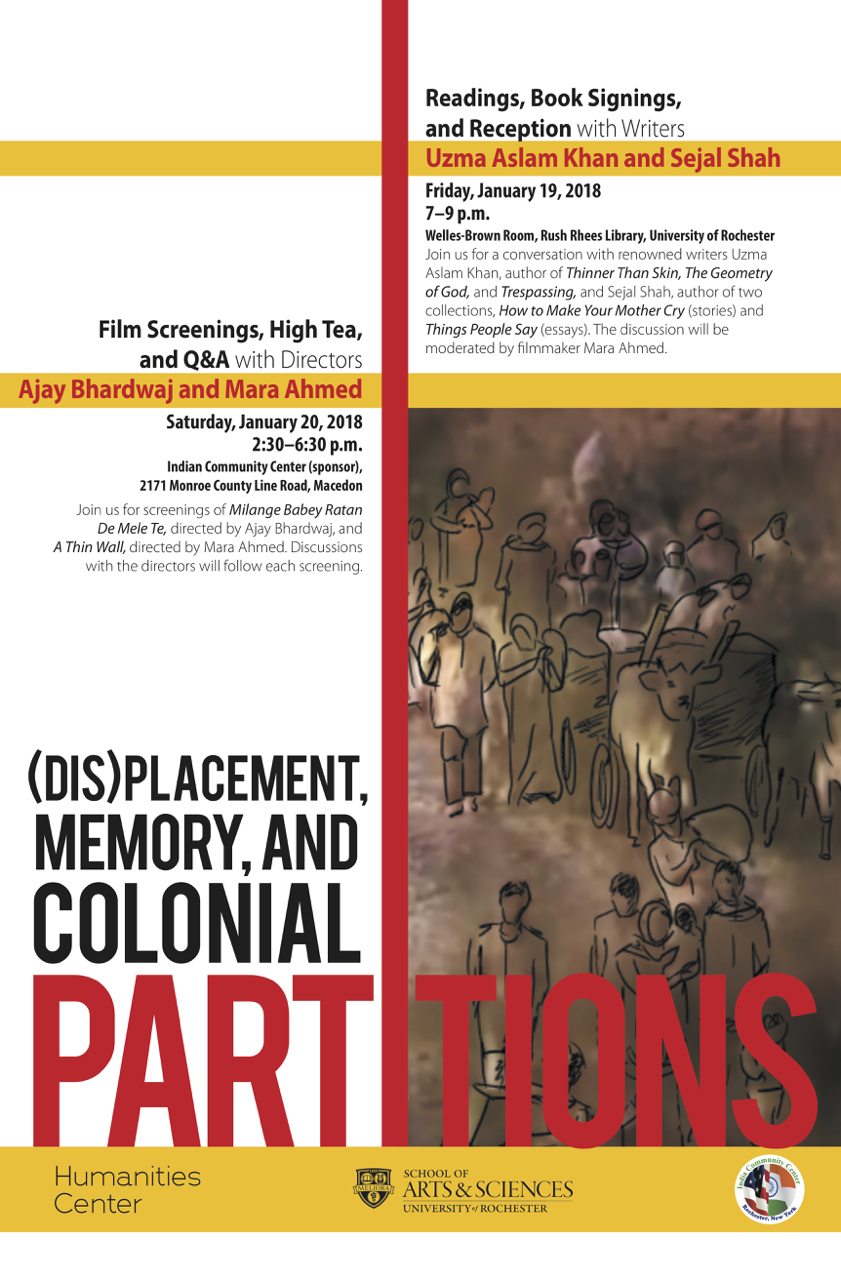
(Dis)placement, Memory and Colonial Partitions

Coming up in January 2018, on the 19th and 20th, readings by Pakistani novelist Uzma Aslam Khan and Indian American writer Sejal Shah, followed by screenings of films directed by Ajay Bhardwaj and Mara Ahmed. (Dis)placement, Memory and Colonial Partitions is being sponsored by the University of Rochester Humanities Center and the India Community Center of Rochester, NY. Pls add to your calendars!

(Dis)placement, Memory and Colonial Partitions

Indigenous Environmental Activism in Art

tomorrow is the last day to visit this one-of-a-kind exhibit. i contributed photographs i took on our way to and at standing rock last year. we traveled there right after a storm and the landscapes we encountered were astonishingly beautiful. hope u can make it.

Rebecca Rafferty: Jimerson wants the show to not only respond to the Standing Rock encampment, but also all of the different environmental issues going on around the nation. By way of example, she cites the Apache resistance to the Arizona Copper Mine in Oak Flat, and the resistance to the building of an observatory on Hawaii’s Mauna Kea volcano, which is sacred to Native Hawaiians. In 2015, there was a copper mine spill in Colorado’s Animus River that affected the Navajo people, Jimerson says.

“Standing Rock isn’t something that is brand new,” she says. “If you look at the history of the American Indian Movement, there’s always been this overarching resistance against things happening concerning the environment. It’s just that Standing Rock became this massive-scale resistance, and with social media involved, I think that’s something that made it even bigger and brought this higher awareness to it. But it’s something that’s been going on for a long time.” More here.

Some thoughts on women as nurturers

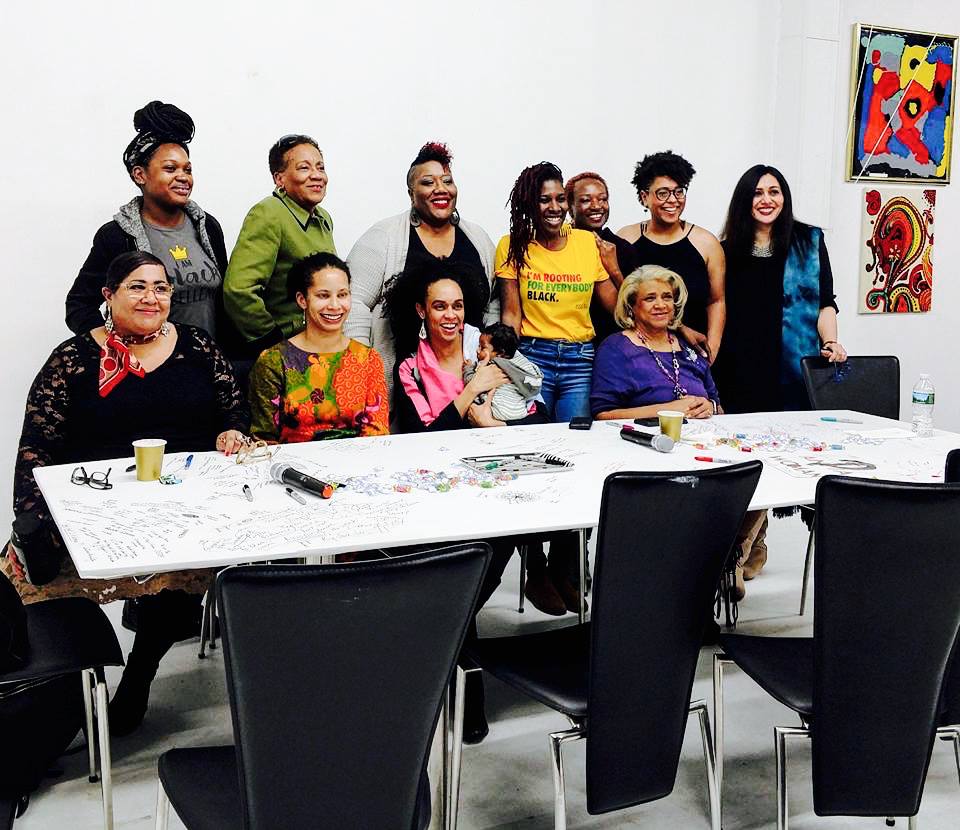
Last Saturday, I had the honor to be surrounded by brilliant women of color in a discussion on race, gender and intersectionality. The event, organized by Rachel Y. DeGuzman, was called And, Ain’t I a Woman: A Long Table Conversation/Installation.

In the course of the conversation, Annette Ramos made an important point about not devaluing motherhood, about the skills that a woman brings to society by virtue of being a mother. I wanted to build on that and mentioned Helene Cixous who wrote that women possess the gift of alterability. On account of being mothers, women have a natural ability to nourish, nurture, erase separation, and rewrite codes.

Later this premise was questioned by a queer white sister who asked why nurturing should be a feminine trait? Why shouldn’t men be nurturers? I couldn’t agree more. Hopefully, all human beings can be nurturers. However, I wanted to think more about this.

Saying that women have a propensity for nourishing and nurturing, doesn’t mean that all nurturers are exclusively women. In a gender-equitable world, perhaps all traits and experiences can become unmoored from gender but even then it would be a violence to erase gender history.

In our present world, there are irrevocable gender hierarchies that become further intensified and distorted by race, class, age, sexual orientation, and disability. The work of women is not only devalued but unpaid. It’s not a coincidence that it’s not economically quantified or part of a country’s GDP.

Most women who make it in our androcentric world, have to subscribe to a masculine ethos, a macho modus operandi. This is particularly true of women in politics. Look at Hillary Clinton’s push for war in Libya, Thatcher’s bashing of coal miners and unions and her ban on milk exports to Vietnam (after the American invasion), Madeleine Albright’s famous comment that the deaths of half a million Iraqi children were worth it as she continued to support harsh economic sanctions against Iraq, Condoleeza Rice’s role in an administration that launched a genocidal war and practiced torture, Indira Gandhi’s 1975 declaration of a state emergency and her forced-sterilization campaign. The list goes on.

In a world where masculinity is seen as universal and femininity considered a deviance, it makes sense to honor and name what women can bring to the table. After all, according to Cixous, language reflects masculine hegemony. Women are the colonized, men the imperialists. This apartheid is imbedded in language. One way to reclaim femininity from this subordinate assignation is to name what women have done beautifully since the beginning of time: given and nurtured life. It’s not the only thing women have done but isn’t it important to acknowledge it at a time when this role is regularly discounted, debased, and turned into an unwanted cost and liability?

Shooting a new film about racism

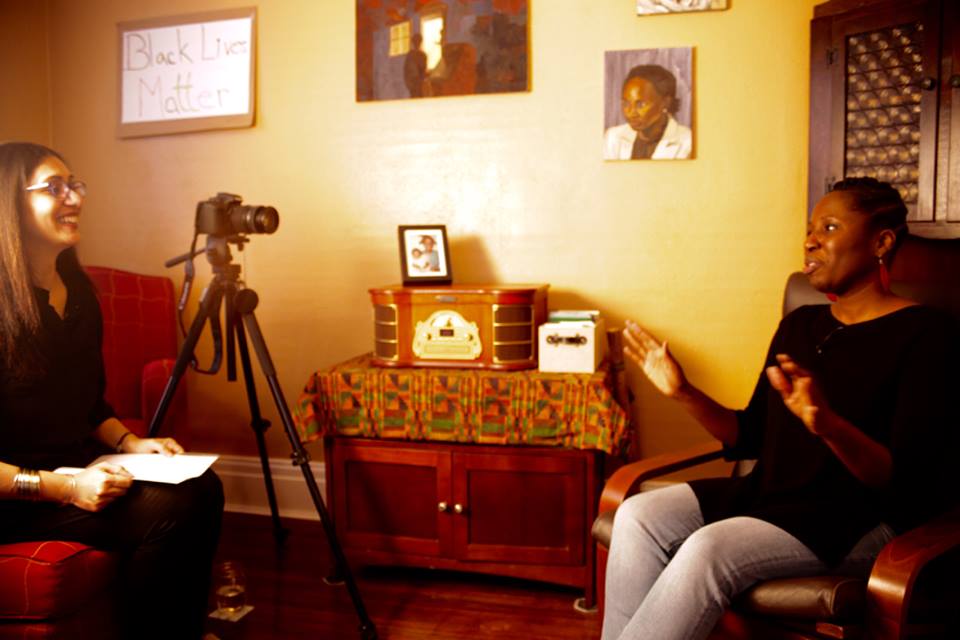
For the new film about racism in America, we’ve been interviewing these spectacular, vibrant, gorgeous women of color who have the most forward-looking, sophisticated ideas and should be leading our community. More pictures will be coming soon, but this is a shot from today’s interview with Liz Nicolas, taken by the amazing Rajesh Barnabas.

mara ahmed and liz nicolas

And, Ain’t I a Woman: A Long Table Conversation/Installation

honored to be engaged in a discussion about race, gender and intersectionality with some badass women of color yesterday at And, Ain’t I a Woman: A Long Table Conversation/Installation.

More than a century before Kimberlé Crenshaw introduced the concept of intersectionality to feminist theory in the 1980s, Sojourner Truth challenged sexist + racist notions with her extemporaneous “And, Ain’t I a Woman” speech in 1851 at the National Women’s Convention in Akron, Ohio.

This important interrogation is inspired by Truth and other bad ass women of color’s legacies; an art installation created by Amanda Chestnut; a spoken word performance by Reenah Golden and Tokeya Graham; and the interaction with fellow participants and other attendees.

The initial Long Table Conversation participants include Mara Ahmed, Jazzelle Bonilla, Erica Bryant, Amanda Chestnut, Rachel DeGuzman, N’Jelle Gage-Thorne, Reenah Golden, Tokeya Graham, Tianna Mañón, Deborah McDell-Hernandez, Annette Ramos, and Gaynelle Wethers.

mara ahmed with WOC activists and artists

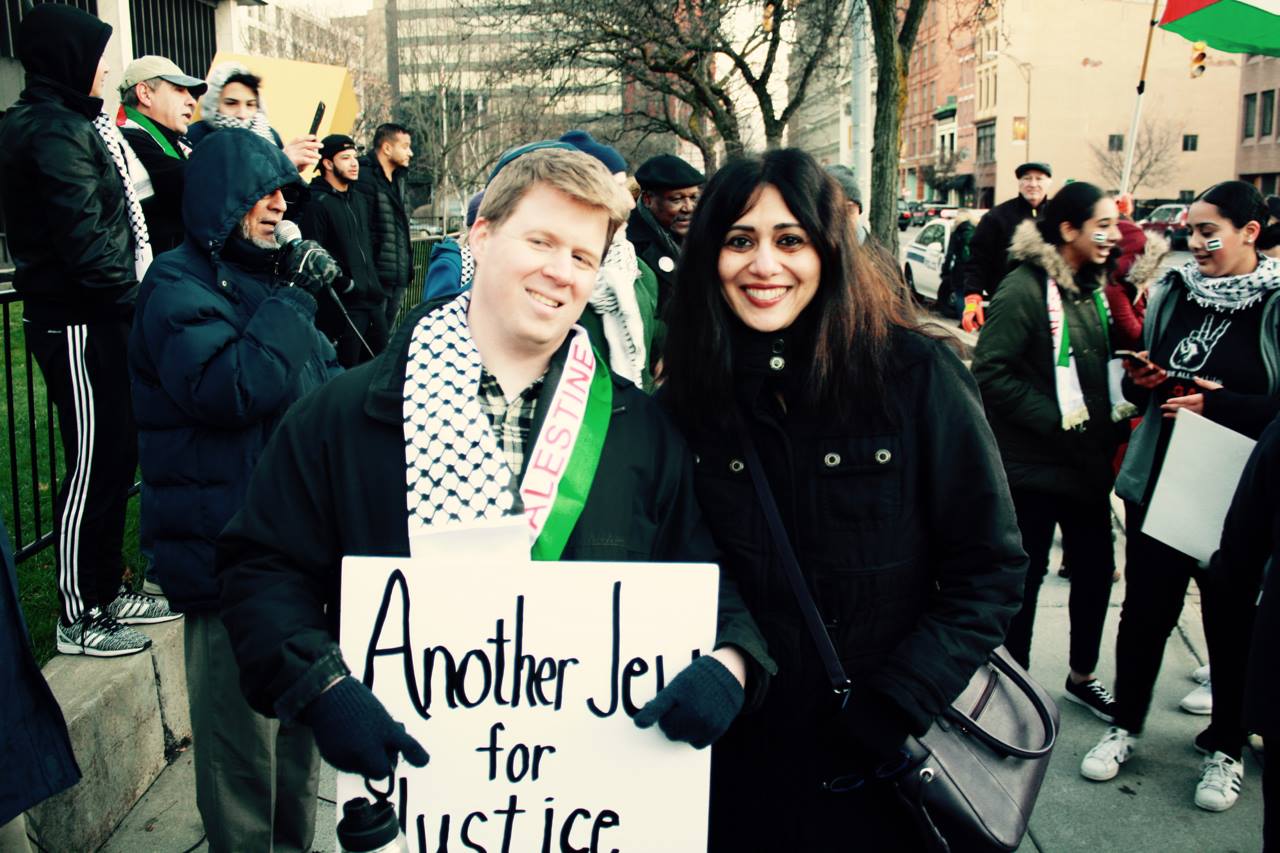
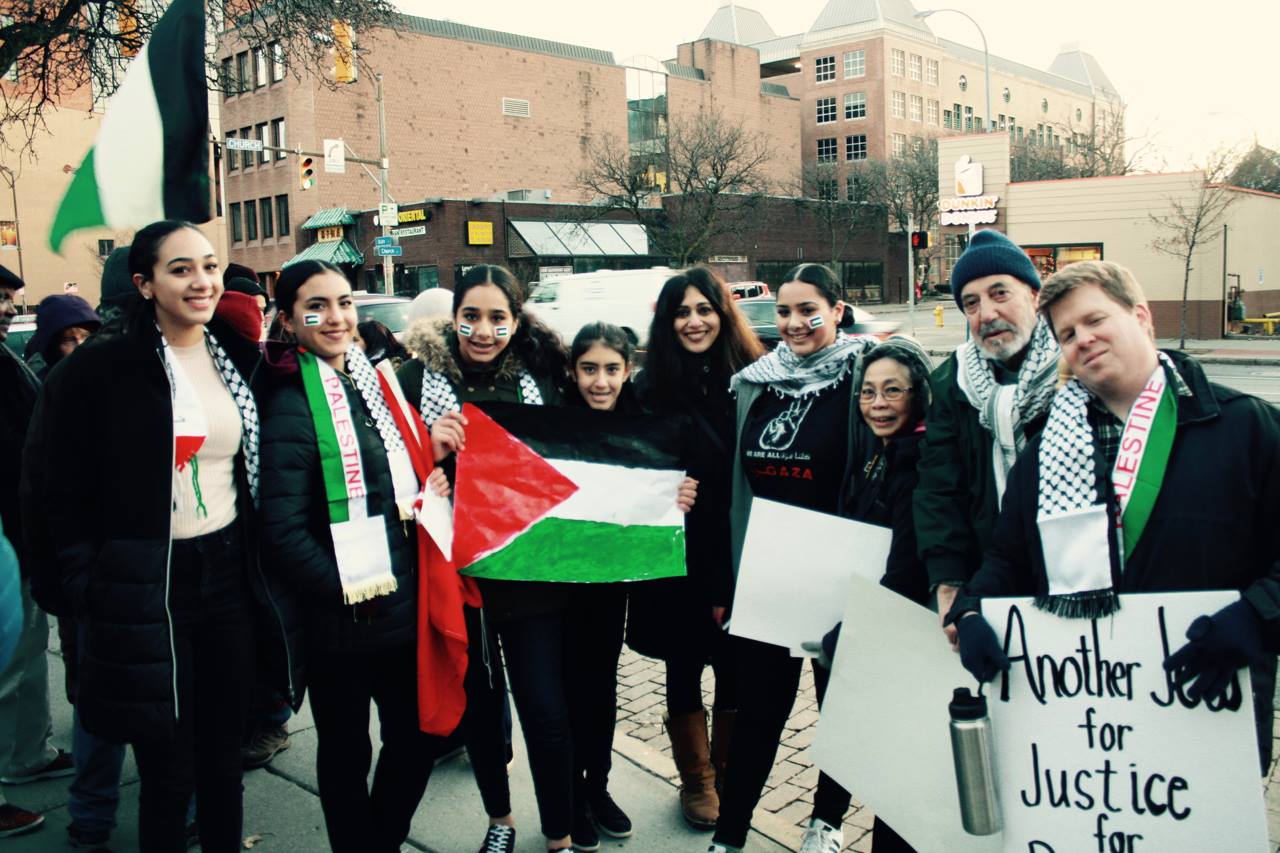
Emergency Demo: Jerusalem is the capital of Palestine

Diana Buttu: In the numerous years I have spent in Jerusalem, I have seen trends and events that have unequivocally changed it for the worse — whether the construction of Israel’s 25-foot concrete wall, the destruction of thousands of Palestinian homes for spurious bureaucratic reasons, the expulsion of friends from their homes, the construction of illegal settlements that have scarred the landscape, or the erection of countless checkpoints to control Palestinian movement. Jerusalem’s approximately 300,000 Palestinians are now squeezed — indeed suffocating — under Israeli military rule. Trump’s announcement will only serve to embolden those who wish to see Jerusalem free from Palestinians.

It is imperative that the world send a strong message to Israel that it will no longer accept Israel’s illegal actions in Jerusalem, which cause such harm to Palestinians living there and efforts to make peace in the region. Instead of turning a blind eye or rewarding Israel’s illegal acts, the international community should start imposing sanctions on Israel immediately, in order to let Israeli leaders and the world know that Israel is not above the law and that Palestinians are not beneath it.

‘And, Ain’t I a Woman’ conversation focuses on intersectionality

Rebecca Rafferty: While there are a limited (but important) amount of concrete things we can do to challenge racist and sexist national policies, our ability to creatively tackle inequity on local levels is just about boundless. Arts community organizer Rachel Y. DeGuzman is continuing her series of creative forums, “At the Crossroads: Activating the Intersection of Art and Justice,” on Saturday, December 9, with the audience-interactive performance “And, Ain’t I a Woman: A Long Table Conversation and Installation.”

Inspired by the “Long Table” performance-discussion hybrids by artist Lois Weaver, DeGuzman invited several WOC involved in the arts, education, and social justice — Amanda Chestnut, Reenah Oshun Golden, Tokeya Graham, Mara Ahmed, Jazzelle Bonilla, Erica Bryant, N’Jelle Gage-Thorne, Tianna Mañón, Debora McDell Hernandez, Annette Ramos, and Gaynelle Wethers — to join her in a free-form, “dinner table” discussion about the intersection of race and gender. After the first 30 minutes of talk, audience members can tap someone on the shoulder and take their place to join the continued conversation. More here.