
one of obama’s campaign promises was that he would close guantanamo, america’s detention camp/torture center. more than a decade later, it’s still open. and there are still people there.
‘Three years ago, I was unanimously cleared for release by the six federal intelligence agencies charged with keeping the USA safe. They concluded I was “no threat to the U.S. or its coalition allies”—as I have said all along. But then, before I could be sent home to Morocco, Donald Trump was elected with a promise that there would be “no further releases from Gitmo”. The time since I was cleared has been the hardest. Before, I experienced the profound isolation of being held in solitary confinement for years, the fear of dying on hunger strike and the helplessness of being force-fed. But there is something uniquely painful about knowing your freedom lies in the hands of one man who will not let you go.’ More here.
Category: politics
The Left Remakes the World: Amna Akbar on Canceling Rent, Defunding Police & Where We Go from Here
Amna Akbar: I want to take a moment to unpack “cancel rent” and “defund the police,” which are two really important demands that organizers and social movements are making across the country. Police and private property are central, defining institutions of life in the United States. We know the centrality of police to local budgets now, and the immense power that they have and their sprawling scale, because it has been on spectacular display for the last two months, since Minneapolis police killed George Floyd.
But it might be worth taking a moment to talk about private property, which is also everywhere and structures our everyday lives, but is arguably a bit more subterranean in how it does. Private property is the basis of our legal regime. It’s a settler regime, a capitalist regime, a racial regime. It creates these relationships where some people own property and most people don’t. And if you don’t own property, you have to pay for it. This is pretty weird, if you think about it. We are human. We have physical bodies. We need space to exist, to sleep, to eat, to take care of one another. But we live in a society where you need to pay for space to live. The private property regime then creates a direct contradiction with meeting people’s needs.
And so, both police and private property are rooted in the histories of enslavement and conquest. They are not systems rooted in collective care and social provision. And it’s not as if we have the police over here and private property over there. These are fundamentally interconnected institutions that prop one another up. They are central to the stories, the structures and the relationships that sustain things as they are. And so it might be helpful to think for a moment about the connection between these institutions, because part of what I argued in the piece is kind of this radical imagination coming out of today’s social movements that’s telling interwoven stories about the world that we live in and the world that we must build. More here.
India’s settler colonialism in Kashmir is not starting now, eliminating the natives is a process long underway
‘Perhaps the most significant of all aspects of social, economic, and political life that settler colonialism attacks is memory. The project of memoricide seeks to erase any traces of heritage and culture of the natives to appropriate the history, belongingness, and lineages of resistance. In Palestine, this was sought to be achieved by changing the names of places and sites resulting in a struggle with regard to social memory and rootedness in the land. Koshur words have long been pronounced (and these pronunciations sought to be made default) in faux Hindi and English. Calling Islamb?d (the district south of Srinagar) by its name instead of “Anantnag,” as the Indian state would have you call it, has subjected people to beatings and abuse. Post de-operationalisation of Article 370, where Urdu used to be the official language there were suddenly concerns that it might not remain so. This belief was strengthened when the advisor to the governor said, “All special provisions have been thrown into the dustbin of history where they always belonged.”‘ More here.
On impasse and hypocrisy
Nazia Kazi: Houria Bouteldja’s book is a takedown of white supremacy in its cultural, economic, and political forms. Yet the white supremacy that Bouteldja demystifies is not an objective category but a relational one.
She herself is delicately positioned not as part of the global south, but above it. “To the third world,” she writes, “we are white.” Her “crime,” as she calls it, is buffered by “the IMF, NATO, multinationals, the banking system . . . Between me and my crime, there is my father’s sweat and salary, social welfare, paid leave, labor laws . . . my passport.” She, too, is complicit, then, “in the exploitation of the South.”
As such, her work serves as a challenge to the very conception of white supremacy, a rebuke to those who sloppily invoke the term “person of color” without attending to the nuances of global geopolitics or regional inequality. Whiteness and blackness only exist in their relation to one another and to processes of capitalist exploitation and imperialist violence.
[…] Bouteldja’s book caused a maelstrom because it was unapologetic, marked with none of the lilting softness demanded of us when we speak about race, marked with no quarter for white fragility nor concern for whom it might offend. She claims this crudeness as a very marker of her social position: “The dispossessed indigenous person is vulgar. The white dispossessor is refined.” What are civility, vulgarity, and manners in a world shaped enduringly by the brutality of empire? “Many genocides have been glorified around dinner tables adorned with forks and knives made from actual silver,” writes Steven Salaita, “without a single inappropriate speech act having occurred.”
Indeed, in an uneasy twist, Bouteldja’s decolonial stance means she will not even bother to salvage feminism. (Decolonial feminism, perhaps, but that too with reservations.) “Reproaching us for not being feminist is like reproaching the poor person for not eating caviar,” she says, for feminism “would always be contained within the framework of liberal democracies, founded on the idea of the quality of citizens, and in which white women obtained rights because of their own struggles but also thanks to the Imperial domination.” More here.
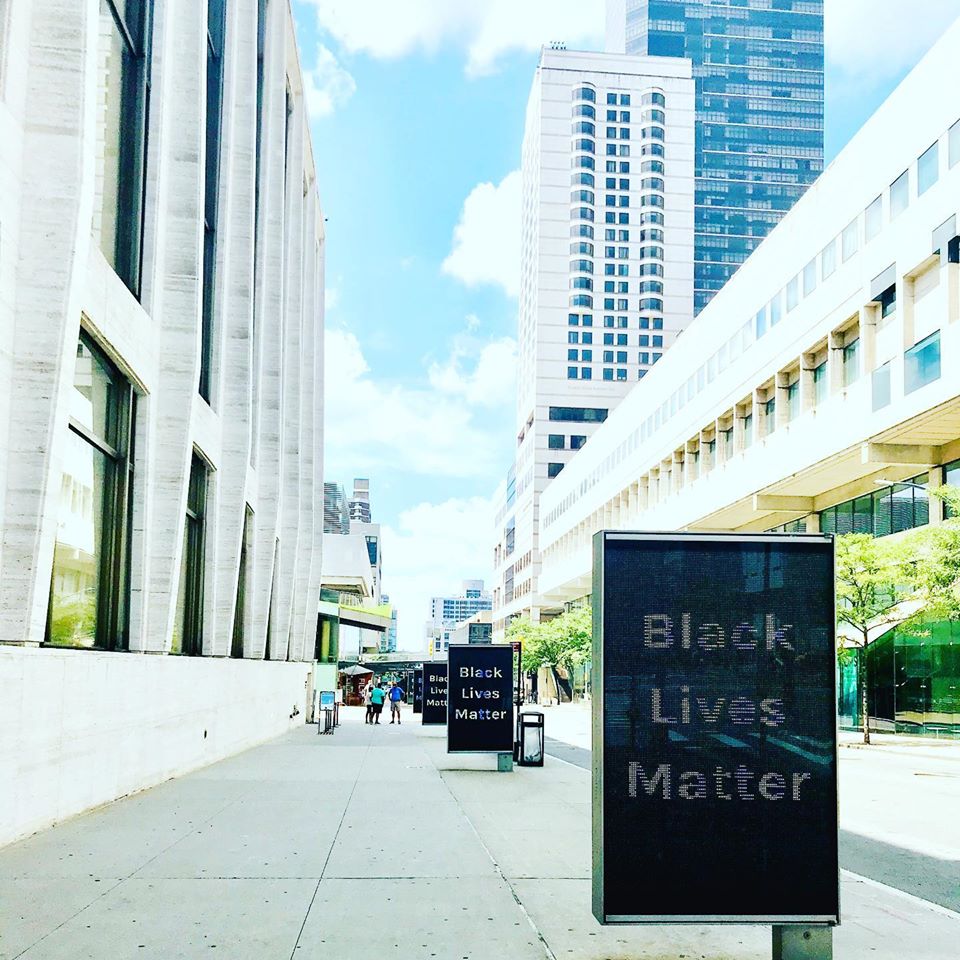
BLM in NYC
in new york looking for an apartment for my daughter and her friend. love this.
Polynesians steering by the stars met Native Americans long before Europeans arrived
‘By about 1200 C.E., Polynesians were masters of oceanic exploration, roaming 7000 kilometers across the Pacific Ocean in outrigger canoes. Guided by subtle changes of wind and waves, the paths of migrating birds, bursts of light from bioluminescent plankton, and the position of the stars, they reached and settled islands from New Zealand to Rapa Nui, or Easter Island, the closest Polynesian island to South America. So it’s natural to wonder: Did these world-class explorers make it the last 3800 kilometers to South America? A genomic study of more than 800 modern Polynesians and Native Americans suggests they did.‘ More here.
Not Every Radical Philosophy is Decolonial | Contending Modernities
Santiago Slabodsky: I invite my reader, therefore, to think of the revolutionary representation of radical continental philosophy as a colonially sanctioned dissent that universalizes a provincial difference while invisibilizing the underside of modernity. Coloniality not only monopolizes the only sanctioned path to universal redemption—in what Anibal Quijano calls evolutionism—but also selects its legitimate form of dissent. This is perhaps one of the most perdurable modern strategies of coloniality. In the now famous debate of Valladolid (1550–1551), conceived by critics as one of the most influential legitimizations of early modern racism, the imperial state appointed Euro-Christian theologian-philosophers to discuss “the nature” of Natives. In this discussion, Juan Ginés de Sepúlveda, retrieving Aristotle, offers one of the first modern formulations of biological racism and proposes to forcefully convert Natives into subservient Christians. Bartolomé de las Casas, enthroned as the radical and later liberationist alternative, develops one of the first formulations of cultural racism, insisting on Natives’ adaptability through conversion without physical force. If for the continental philosopher there is no possibility of thinking outside Europe, for the colonially appointed philosopher of religion there is no possibility of existence outside a totalizing Christian framework. More here.
The Injured Body: Greta Niu
Transcribing interviews for my new doc ‘The Injured Body’
Greta Aiyu Niu, came to Rochester as an academic, now Director of Grants at Planned Parenthood of Central and Western New York, lifelong teacher, reflects on micro-aggressions:
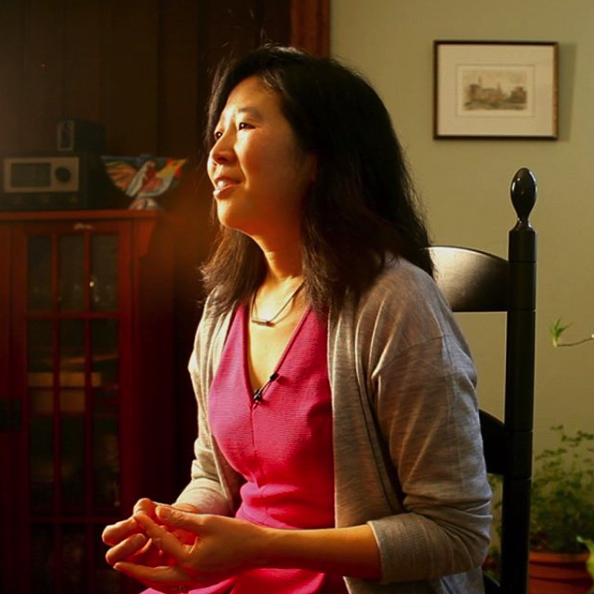
‘I just don’t want to lose sight of what makes up the micro-aggressions. So it is implicit biases around race or ethnicity or gender or gender expression or class or size or disability, those are the pieces that we’ve been fighting. And we’ve always been fighting against them. I don’t want people to think we’re done with that. Now all we have to deal with are these micro-aggressions. It’s a whole continuum of behaviors that are harmful, from a little poke to physical violence.’
.
#microaggressions #racism #womenofcolor #film #documentary#theinjuredbody #neelumfilms #microaggressionsareracism #microaggressionsarereal
The Injured Body: Lu Highsmith
Transcribing interviews for my new doc ‘The Injured Body’
Lu LutonyaRachel Highsmith is a poet, writer, and community activist. She is the founder and director of Roc Bottom Slam Team.
On how she processed racist micro aggressions she experienced in college:
‘As an 18 year old, my initial reaction was anger. I was really ticked off that they would say these things or even think these things. This was the late 80s, so it’s not like it was back in the 50s or 60s. I was very upset. I don’t know if it caused me to try to prove myself. I was on a mission to excel academically, culturally, creatively. It probably took a good 20 years for me to change my mindset. By my mid-30s, I was like, I’m just who I am.’
.
#microaggressions #racism #womenofcolor #film #documentary#microaggressionsareracism #theinjuredbody #neelumfilms

Bari Weiss Is Leaving the New York Times
No wonder she was whining, along with other people with massive followings/powerful platforms (J. K. Rowling, Fareed Zakaria, Malcolm Gladwell, Salman Rushdie, etc), about ‘free speech.’ Now she’s gone and self-expelled herself from the NYT. More of this sea change please.
Here is Greenwald on Bari Weiss: In her short tenure, Weiss has given the paper exactly what it apparently wanted when it hired her. She has churned out a series of trite, shallow, cheap attacks on already-marginalized left-wing targets that have made her a heroine in the insular neocon and right-wing intelligentsia precincts in which she, Bret Stephens, and so many other NYT op-ed writers reside. Exactly as she was doing a decade ago as a “pro-Israel” activist at Columbia and thereafter at various neocon media perches, her formula is as simple as it is predictable: She channels whatever prevailing right-wing grievance exists about colleges, Arabs or Israel critics (ideally, all of those) into a column that’s supposed to be “provocative” because it maligns minority activists or fringe positions that are rarely given platforms on the New York Times op-ed page. More here.
Natalie Diaz: ‘It is an important and dangerous time for language’
Sandeep Parmar: …she distrusts institutional power. “What is knowledge for an indigenous person? The things that I know are only considered knowledge if someone outside finds value in it. A large part of my work in the university is to teach my Native students that the things they know and are part of their practice of living – caretaking the land, caretaking their family, the ways we know weather – those things are research. And not just because a white academic studies us and declares there’s value in it.”
Equally, she is critical of “mastery” and the fixities of poetic craft. Her own use of traditional forms and allusions – Ashbery, Whitman and Sexton appear, as do Borges, Homer and Lorca – are means of expanding rather than circumscribing her practice. Poetry is a way to hold knowing to account and craft is “an exchange of different knowledge systems”. Sometimes to listen to Diaz speak about aesthetics is to overhear a longing more private than a mere laying out of the poet’s tools.
Community and correspondence pervade her work, as does a lyric self that shifts into the bodies of her “beloveds”: a brother, friend, mother or a lover. If love is a radical becoming, desire is a search for what’s possible.
“Most of us live in a state of impossibility,” Diaz says, by which I think she means not the inverse of hopefulness but an awareness of the limitations of an individual life. Impossibility as a state of desire, a will towards rebuilding. “In Mojave, our words for want and need are the same – because why would you want what you don’t need? For me, that’s true desire. Desire isn’t frivolous, it’s what life is.” More here.
The Injured Body: Ayni Ali
As I transcribe interviews for my new documentary, The Injured Body, I will be posting short excerpts from the conversations we filmed (cinematography by Rajesh Barnabas).
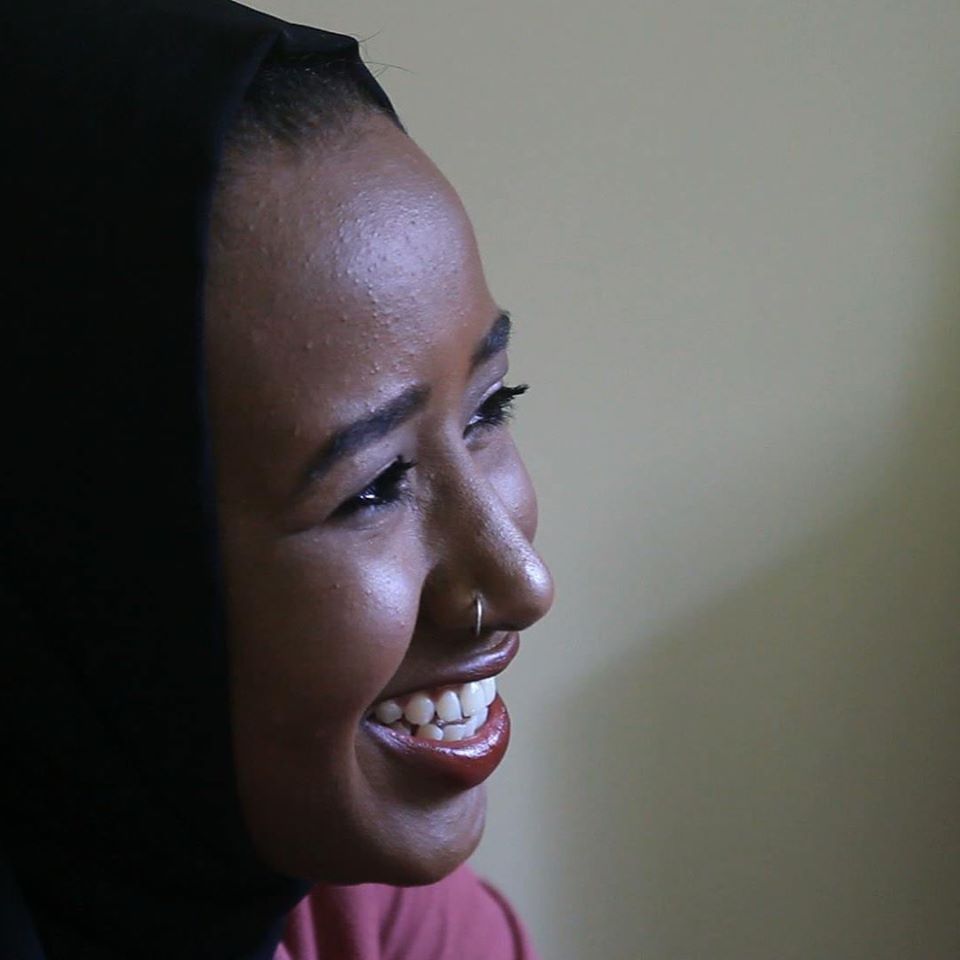
Here is Ayni Ali: 24 at the time of filming, a student at RIT, and a volunteer for Refugees Helping Refugees.
Her answer to where her drive (the fire that seems to animate her actions and words) comes from:
‘I think from being raised by a woman (laughs). I was raised by my grandmother. I’ve had strong women around me all this time.
[…] Because I was raised by a woman, I know what a woman can do.’
.
#theinjuredbody #muslimwomen #woc #womenofcolor #somalia #refugee#film #documentary #neelumfilms #microaggressions #racism
Belgian Princess Condemns Her Family’s Brutal Colonial History in Congo & Calls for Reparations
finally. from the time i was in school and there was no mention of the genocidal violence in the congo in any of our textbooks, to the normalization of racist children’s songs and images that permeated belgian culture, to 2016 when an audio tour of brussels talked about king leopold II as a benevolent king who liked to build and left the country with a proud legacy, this is not a second too soon. the damage didn’t end with colonization. so much more needs to be done.
Black Lives Matter protests in the U.S. have sparked a reckoning about racism and colonialism across the world, including in Belgium, where a growing movement is demanding the country address systemic racism and make amends for its violent colonial legacy. More here.
Letter to Sylvia Wynter
beautiful, lucid, unflinching writing by Ariella Azoulay. an exploration of what ‘judeo-christian’ means to someone with arab jewish ancestry.
‘This lesson of Frenchness, standardization, eradication has a name in French: laïcité. The term “secularism” doesn’t quite capture the stripping bare the worldliness, or being-in-the-world, of a person, which laïcité requires. Part of solving the “Jewish question” in Europe required the refashioning Jews as secular Europeans (who could still be “Jews” at home) before they could go in public. With the French conquest of Algeria, the Jews were singled out from the Arabs and were made into a “problem,” forced to get rid of what identified them as indigenous, so that a few decades later the colonial regime could reward them for their efforts with the gift of French citizenship. Thinking of this “Judeo-Christian” bargain in relation to the state process of laicité helped me. As my interlocutor, you helped me to identify the “Christian” component in the secular Jew.
Your uninterrogated use of the term—Judeo-Christian—assumes a readership that recognizes itself in it. If you could have anticipated a reaction like mine while you wrote, I am inclined to think that you would have asked more questions about it. It’s true, some of your Jewish readers, and maybe also some Christians, may find this category reassuring, a confirmation that the post-WWII bargain, the one which promised Jews whiteness and welcomed them into the Christian-secular world, and offered Christians a way out of their guilt, is respected. I’m Jewish, but I am not one of these readers, and I’m not alone.’ More here.
One Must Sing Before Tongues Are Tied: A Poet On Art And Survival In Kashmir Post Article 370
Urvashi Bahuguna: In her poem “Lightness of Being in a Heavily Militarised Zone”, whose title is inspired by Milan Kundera’s The Unbearable Lightness Of Being, Kashmiri poet, filmmaker and academic Asiya Zahoor writes:
“before they lay barbed wire
across our tongues
let’s sing of almond blossoms”
More than a month after the abrupt abrogation of Article 370 and the plunging of Kashmir into a state of lockdown, without internet connectivity or functioning telephone lines, Zahoor’s writing is instructive and perceptive, tackling the history and landscape of a place that has known devastating strife for decades. There is an urgency in Zahoor’s poems that feels particularly pertinent at this moment in history – time and freedom are both running out.
Born and raised in Baramulla, in the west of Kashmir, where she currently teaches, Zahoor’s newly published book of poems, Serpents Under My Veil, opens with “Medusa In A Burkha”, a radical reimagining of the Greek myth that perceived a certain kind of woman as dangerous.
The burkha-wearing Medusa is a threat twice over – she is both a woman and part of a religious minority that is often at the receiving end of suspicion and bigotry. Dreams, reimaginings, and personifications recur in Zahoor’s poems. More here.