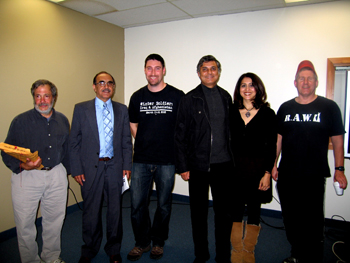
MY STATEMENT FOR PRESS CONFERENCE
My name is Mara Ahmed. I am an activist filmmaker and I found out about Rethink Afghanistan back in April this year when it was featured in The Nation as “Ten things you can do to oppose the war in Afghanistan.” It’s produced by Robert Greenwald and Brave New Films and the whole idea is to start a grassroots movement that will educate the American public, develop resistance against the war and get Congress people involved.
What’s key at this pivotal moment, when a strategy shift is on President Obama’s table, is to increase the pressure for constructive non-military solutions to stabilize Afghanistan and strengthen Pakistan’s fragile democracy.
As a Pakistani American who grew up under General Zia’s dictatorship in the 1980s I have seen the consequences of a military strategy in the region, up close. I have seen rows of trucks carrying arms and ammunition into Afghanistan. I have seen Afghan refugee camps swell up as 3 million Afghans fled their country and crossed the border into Pakistan. I have seen the rise of Islamic rhetoric to support the “jihad” against the Soviet invasion. I have seen the consequences of a ruthless, American-supported military dictatorship in Pakistan.
The situation is equally dangerous right now and even more certain to devolve into a catastrophe. You have to understand that American presence in the region and American drone attacks are not minimizing terrorism or instability, they are creating it. For example, suicide bombings were unheard of in Afghanistan and Pakistan before the American invasion in 2001. Now they have become part of every day life. What we have conveniently lumped together and branded as “Taliban” is a mixture of many diverse elements. In Afghanistan, it’s mostly Pushtuns trying to regain control of their territory by ousting American troops. In Pakistan a country plagued by poverty and injustice for most of its population, there are elements of a class struggle involved – there is a strong desire for democratic governance in Pakistan as evidenced by the Lawyers’ Movement. And then there are those who have lost everything to drone attacks and they are naturally absorbed by the resistance to foreign occupation.
Instead of inciting more resistance and hatred, we need to pull out of Afghanistan and Pakistan NOW. We must stop drone attacks. We need to distinguish between our opponents and not fight a fabricated homogenous enemy. We need to negotiate with Taliban leaders who are interested in collaborating with us rather than detaining them at Bagram. We need to develop a regional solution to the instability and involve Pakistan, India, Iran, China and Russia by dealing with their concerns. And we must act NOW to change this course of action.
MY REACTION TO THE STATMENT: PAKISTAN IS THE MOST DANGEROUS COUNTRY IN THE WORLD
When I watched Rethink Afghanistan for the first time, I have to say I had reservations about wanting to be associated with it. Although I agree with its ultimate message that we need to get out of Afghanistan, I have serious problems with how it describes Pakistan as the most dangerous country in the world. To me it’s becoming clear that this fear mongering about Pakistan’s so-called instability is going to become a convenient way of transferring the war yet again from Iraq to Afghanistan to Pakistan. Iran certainly seems to next in line – we have already started preparing the grounds for that war.
To me Obama’s Af-Pak approach is emblematic of how little we understand South Asia. Afghanistan and Pakistan are two different countries, with two very different sets of problems.
Afghanistan is a country of about 28 million. It is the 4th poorest country of the world. It has been ravaged by war for more than 3 decades – to give u an idea, the war in Afghanistan has lasted as long as the period starting with WW 1 in 1914 and ending with WW 2 in 1945. There are 1 million widows in Afghanistan with an average age of 35. When we started bombing Afghanistan in 2001, there were at that time 700,000 disabled orphans there – children who had lost their parents to war and who had been blinded or crippled by chemicals and land mines. This is the country we went to war with.
Pakistan is a country of 170 million people – the 6th most populous country in the world. For most of its life Pakistan has been ruled by military dictators. It’s a classic example of America’s Latin American model, now applied to South Asia. What this has meant to Pakistan as a country is that the military is highly privileged. It has been lavishly supplied with money and arms, and as an economic institution, the Pakistan Army has penetrated all facets of life in that country – from banks, to strip malls, to housing estates. Billions of dollars of American aid have gone into Pakistan, but the Pakistani people have not seen any of it. It has all gone into the military sector. This has created enormous imbalances inside the country and a huge amount of resentment toward the United States.
Yet in spite of all this there was a lawyers’ movement in 2007 which was eventually able to get rid of an American-backed dictator, General Musharraf. The same movement was also successful in restoring the judiciary and re-instating Chief Justice Iftikhar Chaudhry. Just think about it. This was an immense achievement, with the pressure coming from middle class professionals, mostly lawyers and human rights activists.
The media in Pakistan is one of the most vibrant in the world. I was there in February of this year and I was amazed by the open, abrasive political debate raging on every news channel. Most of these political debates were being moderated by extremely loud and assertive women journalists. I had never seen anything like that in the US. Everyone in Pakistan is a news junkie and everyone has a political opinion – from the fruit vendor on our street to the chauffeur to our tailor to my cameraman. It’s quite extraordinary. So much so that I decided, on the spot, to interview a vast spectrum of Lahoris about American foreigh policy. That documentary will be coming out soon.
In short, Pakistan with all its problems, has a strong desire for democracy. It’s coming from the people, from the middle class, and it’s very palpable. In every free election that has ever taken place in Pakistan, the Islamic parties have never received more than 5% of the vote, last election it was 3%. The people of Pakistan are hungry for democracy, they are moderate, they are politically astute and they have waited a long time to be heard. It’s with them that the American government should form an alliance, not with the military or any other weak puppet govt.
Thank you.