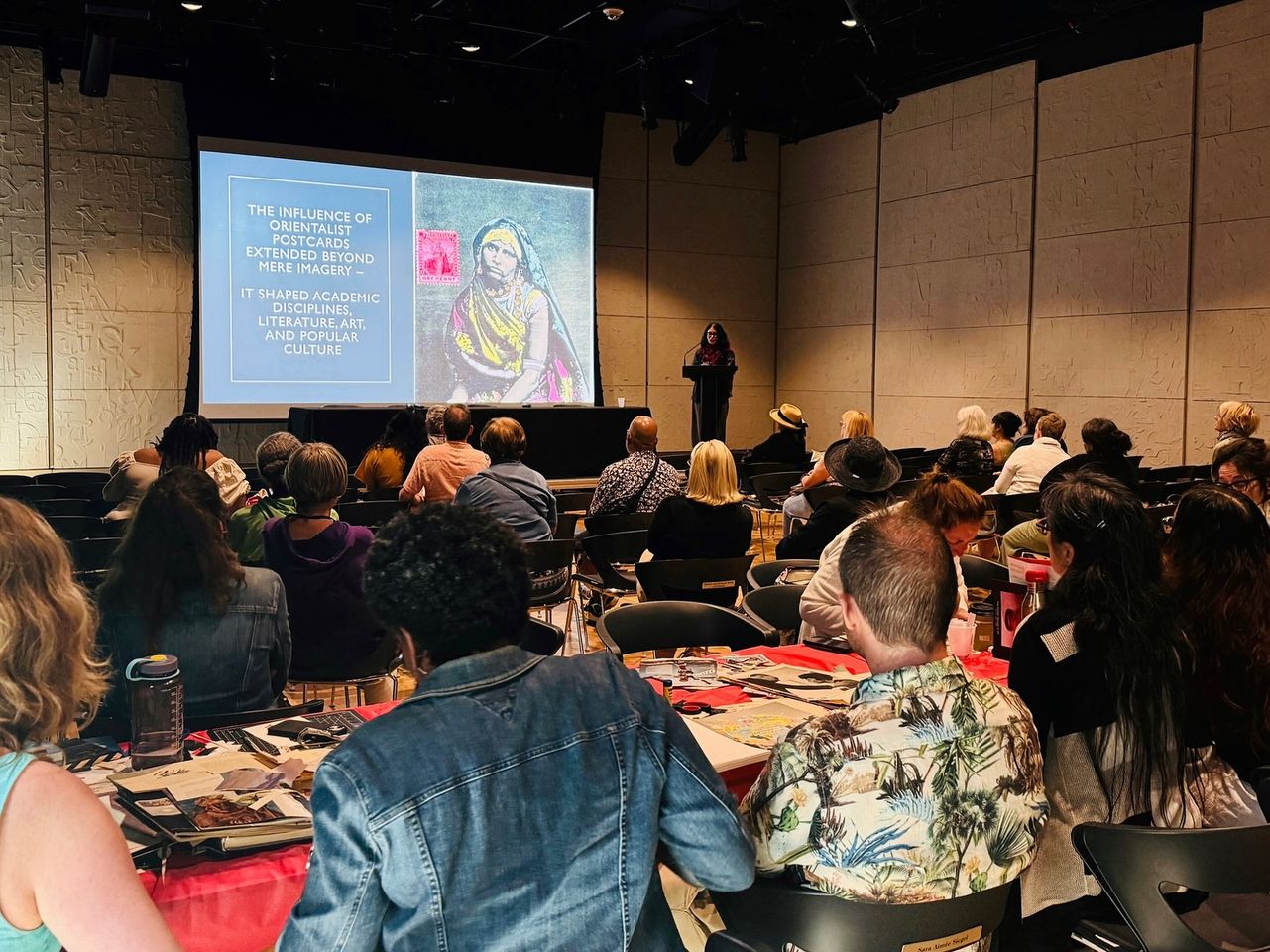
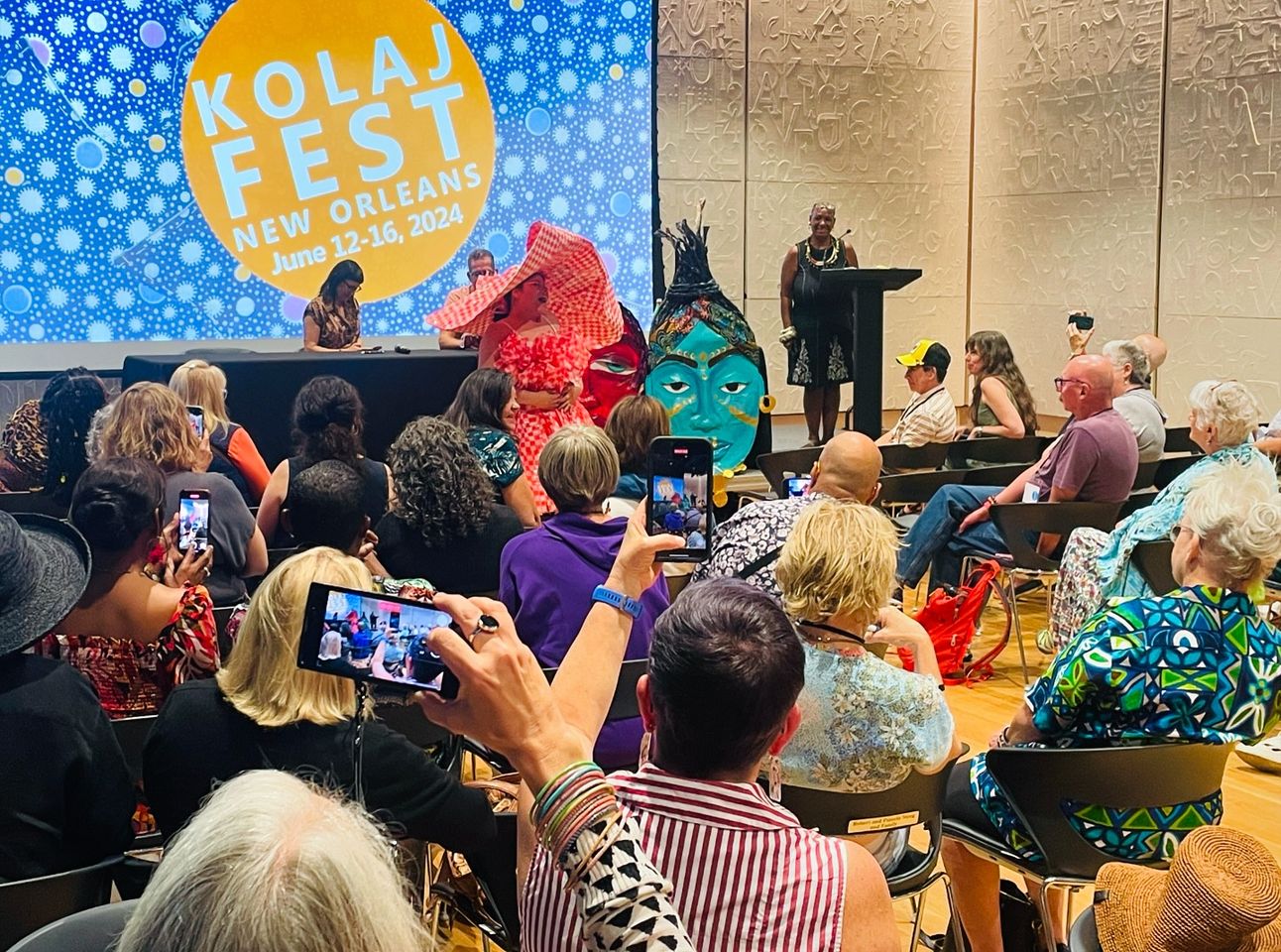
last post about kolaj fest new orleans: wanted to say something about my presentation and the screening of ‘return to sender: women of color in colonial postcards & the politics of representation.’
i started with a 20 min talk in which i expanded on some of the themes that are discussed in the film: the male gaze, the colonial lens, orientalism and the work of edward said, epistemicide and the work of ramon grosfoguel, photography as a tool of colonial surveys and expansion, white feminism, and of course palestine. i wasn’t sure of the reaction as my work digs deep into uncomfortable histories and racist systems, but i couldn’t have hoped for a better response. that many of the people in the audience were artists and scholars helped spark a vibrant discussion, but what meant most to me was what i heard from women, many of them women of color. there were a lot of tears and emotion, hugs and sharing. this is what art is for me: a way to interface and create community. thank u once again to the kolaj institute and all the wonderful people who attended
Here is a recap of a project I’ve been working on since December last year.
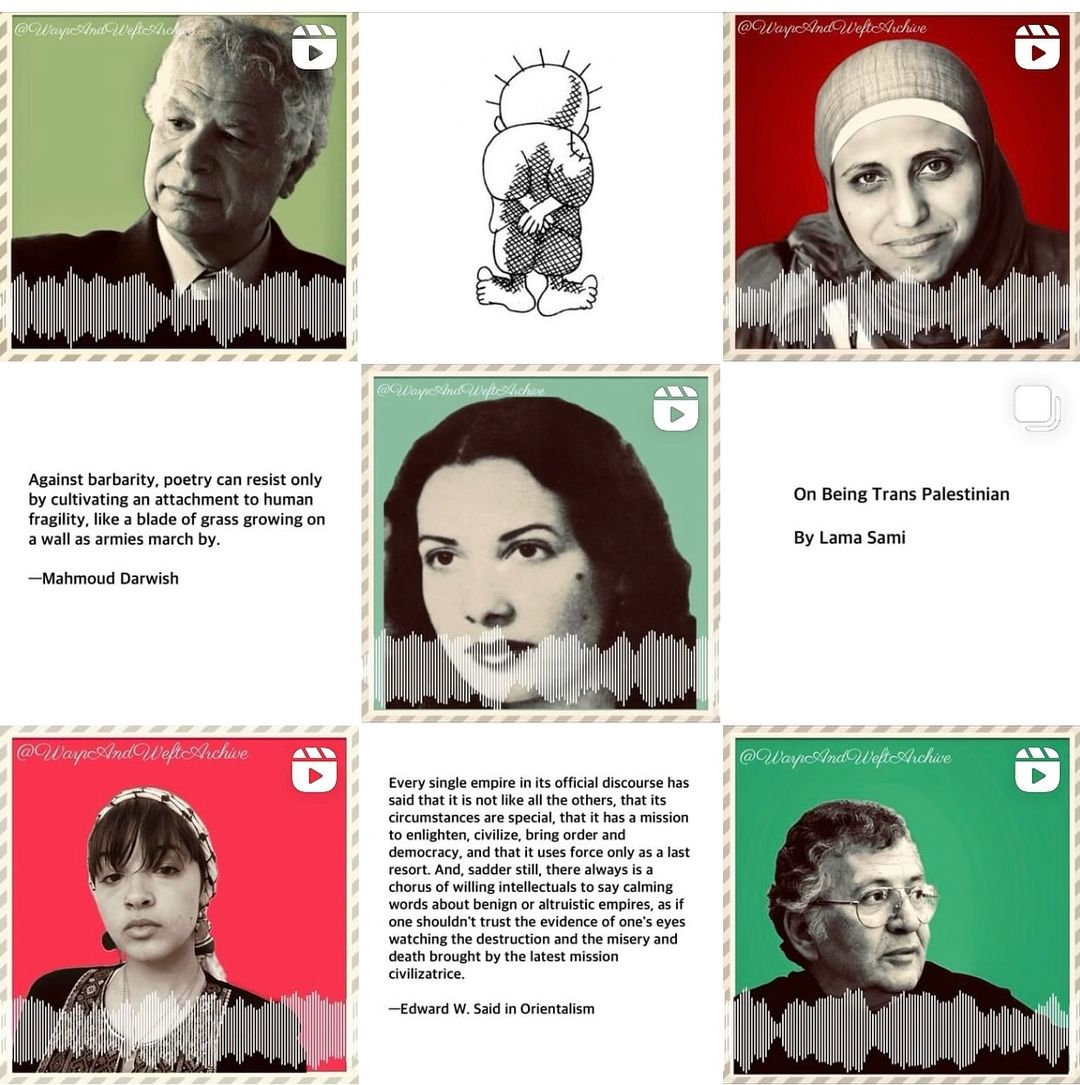
The Warp & Weft audio archive came together in 2020 as a way to connect people from across the world during a global pandemic that caused untold loss and grief.
It is an ongoing project that allows diverse people (separated by arbitrary political borders) to share their stories and feel a sense of collective power.
In December 2023 we launched the next phase of this project. In the midst of the gruesome genocide in Gaza, people from around the world are welcome to join us in reading, holding up, and sharing the voices and stories of Palestinian writers and poets.
This is an open archive, so contact us if you would like to contribute a reading and pls follow us on Instagram: @WarpAndWeftArchive
Rajesh Barnabas wrote a piece about this project for Boomtown Press back in January:
‘Sometimes it seems trivial to be reciting poetry at a time of genocide. It can feel like a stunning privilege. But it’s also an act of resistance that goes hand in hand with protests and activist actions. As the Palestinian poet George Abraham has said: “Poetry can’t stop a bullet. Poetry won’t free a prisoner. And that’s why we need to do the political organizing work as well. But if we can’t imagine a free liberated world in language, how can we build one?”’
friday june 14th in new orleans: started the day with a big breakfast at who dat cafe – had many brunches there back in feb. best biscuits and homemade jellies. arrived at cafe istanbul a bit late – apparently there is another ‘istanbul cafe’ on royal st and that’s the address i gave uber by mistake. so went on a longish car ride just to loop back to where i started. attended ‘collage & poetry’ followed by ‘time & fragmentation: collage theories.’ clive knights’ presentation intrigued me as i’ve been thinking about fragmentation in the context of war and its impact on the social/ political/ individual body. met the wonderful jenny veninga, a fellow activist and scholar, who shared other brilliant ideas with me. attended ‘getting organized: collage projects’ and then after a quick lunch at st. roch market, was inspired by ‘take me to the water: a baptism in collage,’ a workshop with the amazing lavonna varnado-brown, who talked about claudia rankine’s book ‘citizen’ and the idea of the body having memory – a major inspiration for my work. watch ‘the body has memory’ a video poem i created in 2022 and for which i won best in show at a juried exhibition organized by the huntington arts council in ny. link in comments
ended the day with collage & kiki, at the john thompson legacy center, hosted by lavonna varnado brown and jennella young. created collages with other artists and spent a lovely evening. so thankful to kolaj institute for creating this wonderful space at the intersection of art, activism, and academic research. hope to make this an annual ritual inshallah.
started working on this collage today. just a beginning, but love this photograph of newly arrived immigrants on ellis island. want to do something about outstripping/ transcending the frame/ the limits that are supposed to contain and define us.
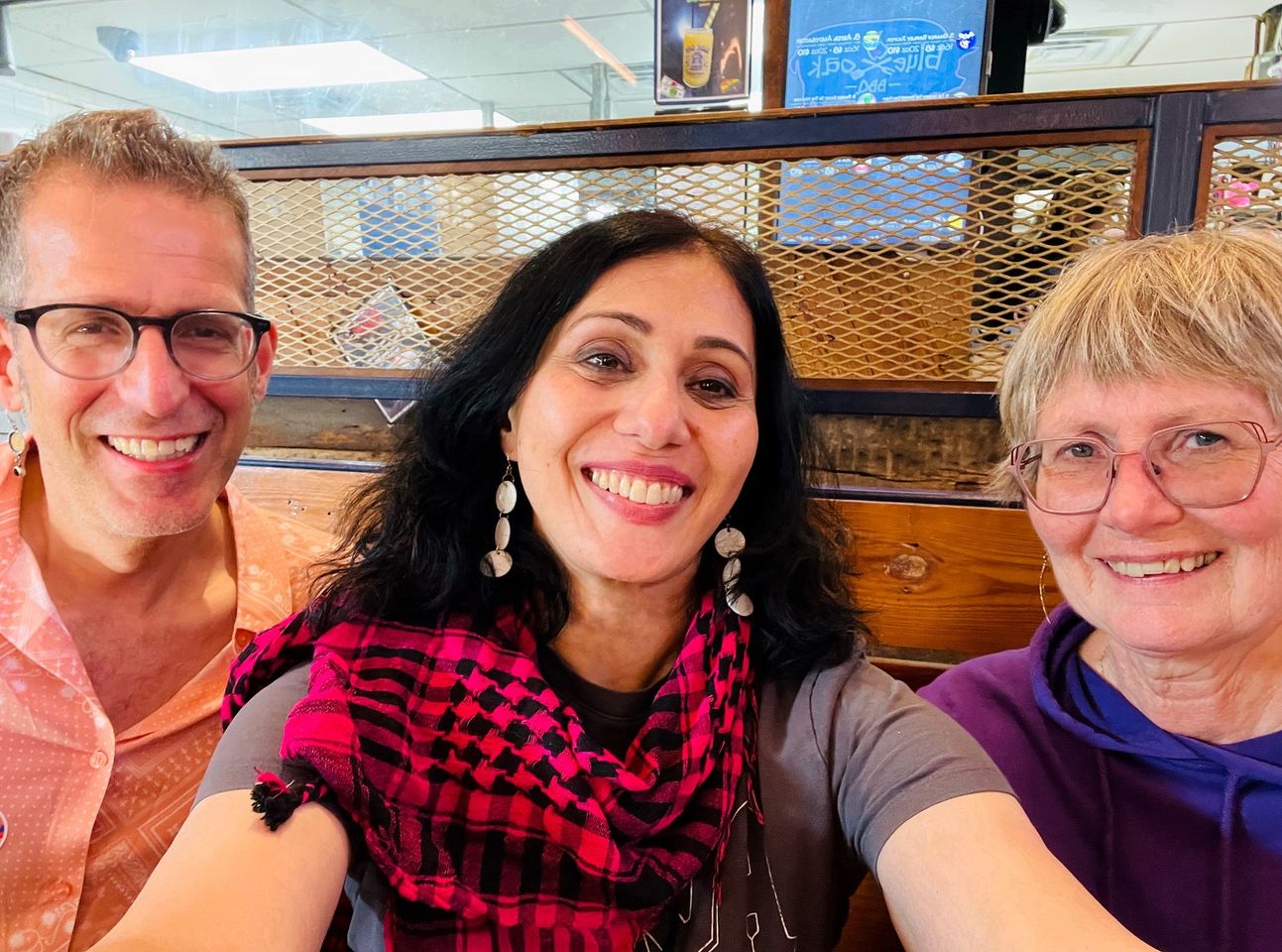
my day today, june 13th, as a series of non-linear moments: lunch at blue oak BBQ with artists phil and debi, a sketch of yours truly by the wonderful @stitchpixie who drew me as i spoke, the screening of ‘return to sender’ + my talk which introduced some of its themes + a brilliant and moving community discussion at the new orleans museum of art, the spectacular madera during a symposium on saving the planet, collage on screen at istanbul cafe, and hanging out with artists julie, diane and robin afterwards. wanted to listen to some jazz but decided to retire for the night. maybe tomorrow.
attended a panel discussion with artists ryann sterling, ashley teamer, and soraya jean louis moderated by artist and scholar kristina kay robinson. i was nodding vigorously the entire time. here are some things i loved. from soraya jean louis, the idea that POCs are an abstraction – something that cannot be fully encapsulated by the white gaze – but also something which is labeled in v concrete ways. she talked about how cutting/ deconstructing anatomy is not a european practice (picasso learned from egyptian paintings and stylized african representations of the human figure). it is a way for fragmented people to reconstitute/ reassemble themselves. ashley teamer explained how time is not linear in collage, but localized, a collection of moments. it can be stretched or elongated. also compared collage to DJ-ing. collage is broken because that’s the art form, just like scratching records (a blasphemy) is what DJs do because that is their art. finally, i learned about mother catherine seals and the temple of the innocent blood, as well as poverty point (centuries ago, when stonehenge was built and queen nefertiti ruled egypt, indigenous people were building earthen monuments in north louisiana). incredible.
I will be screening ‘Return to Sender: Women of Color in Colonial Postcards & the Politics of Representation’ and giving a talk at the New Orleans Museum of Art on Thursday, June 13th, 3:15-4:15 pm, as part of Kolaj Fest organized by the Kolaj Institute. New Orleans friends, pls join the discussion and come and say hello.
on june 22nd, 6-9pm, attend a gaza fundraiser in brooklyn organized by global feminists for palestine, AAWW and SAWCC at XENANA PROJECTS, 154 scott avenue, #317 in brooklyn. suheir hammad will be in the house! more on how to bid on this beautiful artwork by jaishri abichandani and buy tickets to the fundraiser here.
cate blanchett wears a dress at an award ceremony with some of the colors of the palestinian flag and everyone is thankful. it’s so little, folx. so very little for someone with that kind of platform and privilege. celebrities, except for susan sarandon, are useless. they will risk nothing, not even a tiny role in a film or a random award, to speak out against genocide. tiktokers urging people to block celebrities have the right idea.
My IG account was hacked and deleted on April 9th this year. A kind of erasure. I will be recreating history off and on by digging into posts archived elsewhere by friends and collaborators. Here is one from @phototrouveemagazine
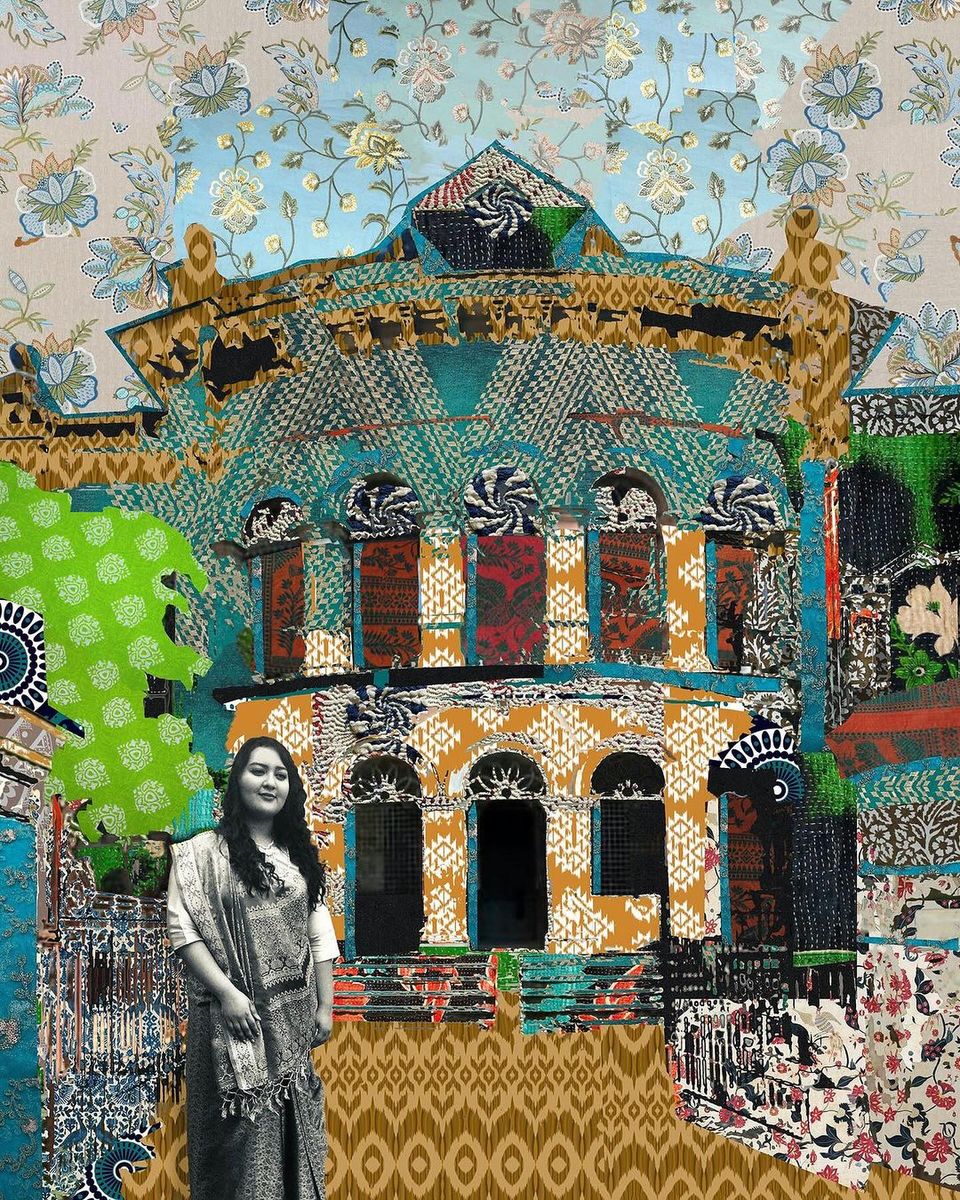
Spotlight on issue 12 featured artist Mara Ahmed @mara__ahmed. “My art practice focuses on crossing borders and dismantling political and cultural boundaries. I work in multiple disciplines and narrative formats to tell marginalized stories and build community. The personal and political are intertwined in my practice. For example, the experimental short film, Le Mot Juste (2021), which was selected for an exhibition by Chicago’s South Asia Institute, is a fusion of autobiography, film, and dance. It spotlights three languages: Urdu, French, and English. In the analog and digital collage series, This Heirloom (2012-2014) which has been widely exhibited in New York and California, I recreated my own history by using old black and white photographs sourced from my family archive. In conjunction with my NYSCA-funded film, Return to Sender: Women of Color in Colonial Postcards & the Politics of Representation (2023), I created three collages that subvert the colonial male gaze in found postcards from the British Raj (early 1900s). My aim was to rewrite history by relocating South Asian women from derelict studios, where they had been subjected to Orientalist fantasies, and reconnecting them to their roots. I placed the women in their native cities, adorned with architectural details and built with Indian textiles.”
it was a full house! thank u rajesh, casey, muna, urvashi, hernease, and sumayia. thank u beautiful friends and community. to more enlightening art and conversations, but also more courage and action. we can learn so much from students risking everything to change this racist violent world.
Cathy Salibian: ‘To me, that is the evocative edge of “Return to Sender.” Yes, it’s gratifying to see a current generation of South Asian women take back their images and stories. It’s even more illuminating—and unsettling—when I take or view a photograph, to ask myself: What is going on here? Who is the viewer, who is the viewed? What assumptions and power dynamics are encoded in this artifact? What is my role in all of this? This is how Ahmed invites participation in the living edge of history.’
Brilliant film review in the Beacon. Pls join us for a Rochester premiere and community discussion on May 4, 12pm, at the Cinema.
Went to see Ibsen’s An Enemy of the People at the Circle in the Square in NY last Sunday – a Broadway revival directed by Sam Gold, w Jeremy Strong and Michael Imperioli.
The stage is long and narrow, surrounded by audience members, lit by oil lamps, with various scenes taking place at different ends. It’s the late 1800s, we are in a Norwegian coastal town. The tone is set in the beginning, with actors singing Norwegian folk songs.
Jeremy Strong plays the protagonist, Dr Stockmann, w warmth and intensity. As my daughter said, the ensemble comes to life as soon as he steps on stage. He radiates sincerity.
The story is well-known. The economy and future of the town are intertwined with its recently opened Baths, which are meant to transform it into a health resort. Stockmann discovers that the waters are contaminated and his brother, the Mayor, goes to work doing everything he can to suppress his brother’s report and turn the townspeople against his “theories” which will destroy local businesses.
Stockmann is a typical Ibsen anti-hero – upright and courageous, yet also deeply flawed. There is a brief detour into eugenics and part of Stockmann’s crusade for the truth is activated by his arrogance, but Jeremy Strong endows him with vulnerability and earnestness, and breaks our hearts when the doctor is attacked and humiliated.
The parallels with our present reality cannot be overstated. As people are targeted, fired, silenced, and turned into pariahs for speaking the truth about settler colonialism and genocide in Palestine, we are seeing the same kind of crucifixions by ideological mobs.
I loved Strong’s performance in Succession, where he finessed his role into a complex Shakespearean character. Film is polished and controlled, whereas theater is raw, visceral, unfinished. Strong is absolutely brilliant. The end of the play is abrupt, and he was visibly shaken – still trying to sort his emotions as he took the final bow.
Amy Herzog’s adaptation is a seamless update of Ibsen’s language, a trimming down of the story and characters, and apt humor. After being pilloried by the townspeople, Stockmann thinks about moving to the US: “This could never happen in America.” Prolonged, raucous laughter from the audience.
Set design and direction are inventive, with a light touch. The town hall scene begins with a bar descending from the grid, serving Norwegian Linie with music by A-ha. Audience members gathered on stage to get drinks but then the actors appear and the town hall begins right in that setting. A fantastic crossing over of time and geography. This is what theater should be – unexpected, exhilarating, moving.
Friends, I would like to draw your attention to another gofundme, another family trying to escape the massacres in Gaza. This is Deema Dalloul, a 20-year old writer who shares her experiences of loss and displacement in the midst of a genocide in her Gaza diaries. Here is part of an entry from March 30, 2024. Pls help with whatever amount you can. Every bit matters
‘At first, I used to believe that small families are the best fit: you don’t need lots of luggage and it’s not even costly to escape at any moment. One car could be more than enough, no struggles with one room, and certainly, a single bed might do the trick. Yet, all my beliefs were altered once my friend’s twin brothers became martyrs in the south, away from all their other siblings, leaving a heartbroken family struggling to survive again with missed fractions. I realized that large families could do better in such tragedies. No matter how much effort it takes to get them in one car, or how many mattresses they might own — not to mention the food they would demand — it’s still a blessing to have someone left if (God forbid) any misfortune occurs.
Yet again, all of these reflections were to evaporate once again, after another friend told me that her family had been divided. Part of them were forced to the south, while the others remained in the northern areas. Other family members were sent to the sky sooner than they could have ever imagined. They have no way of contacting each other: they live in the continuous horror of “not knowing.” Even a tiny word can cause them to panic.’
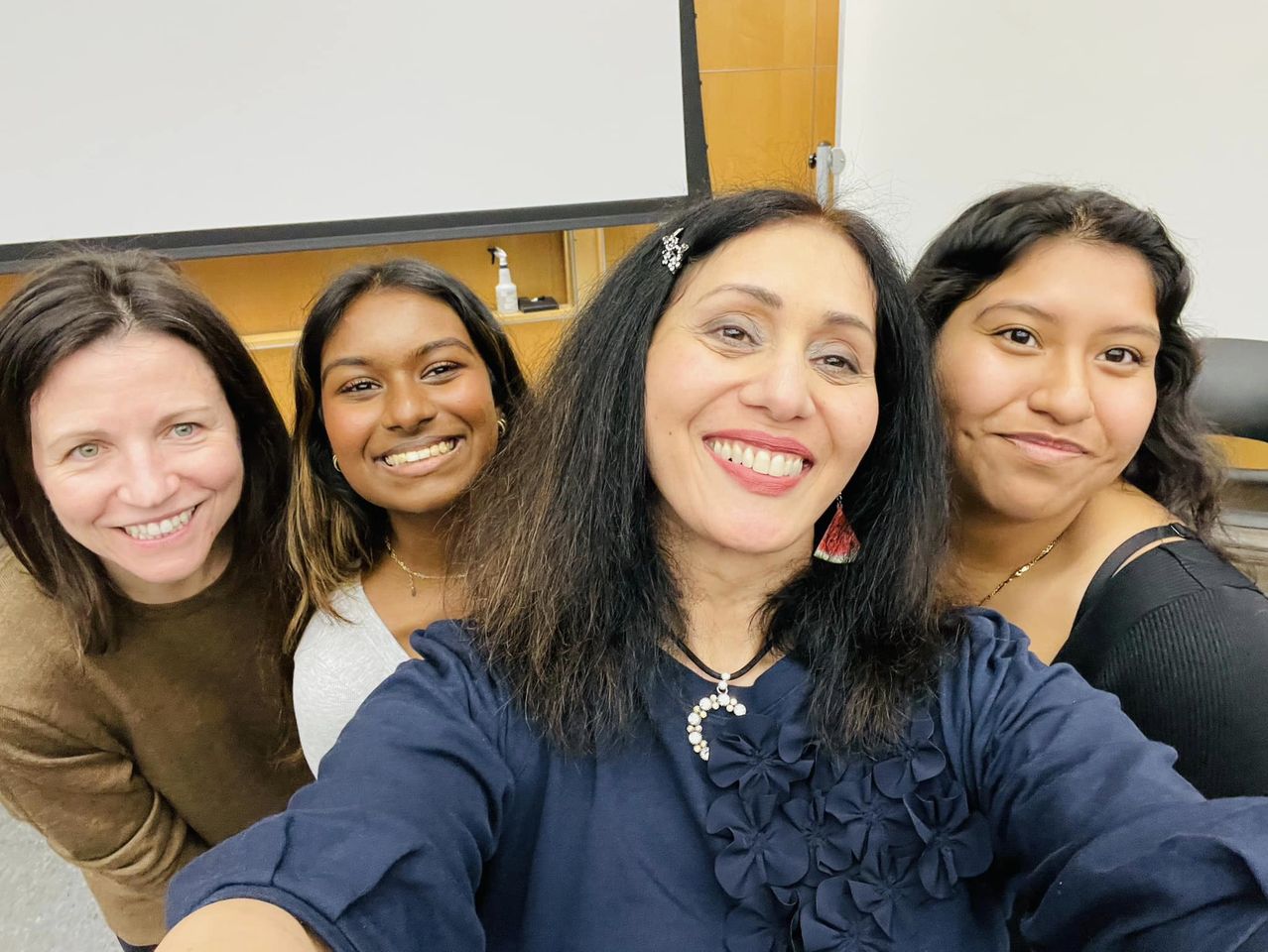
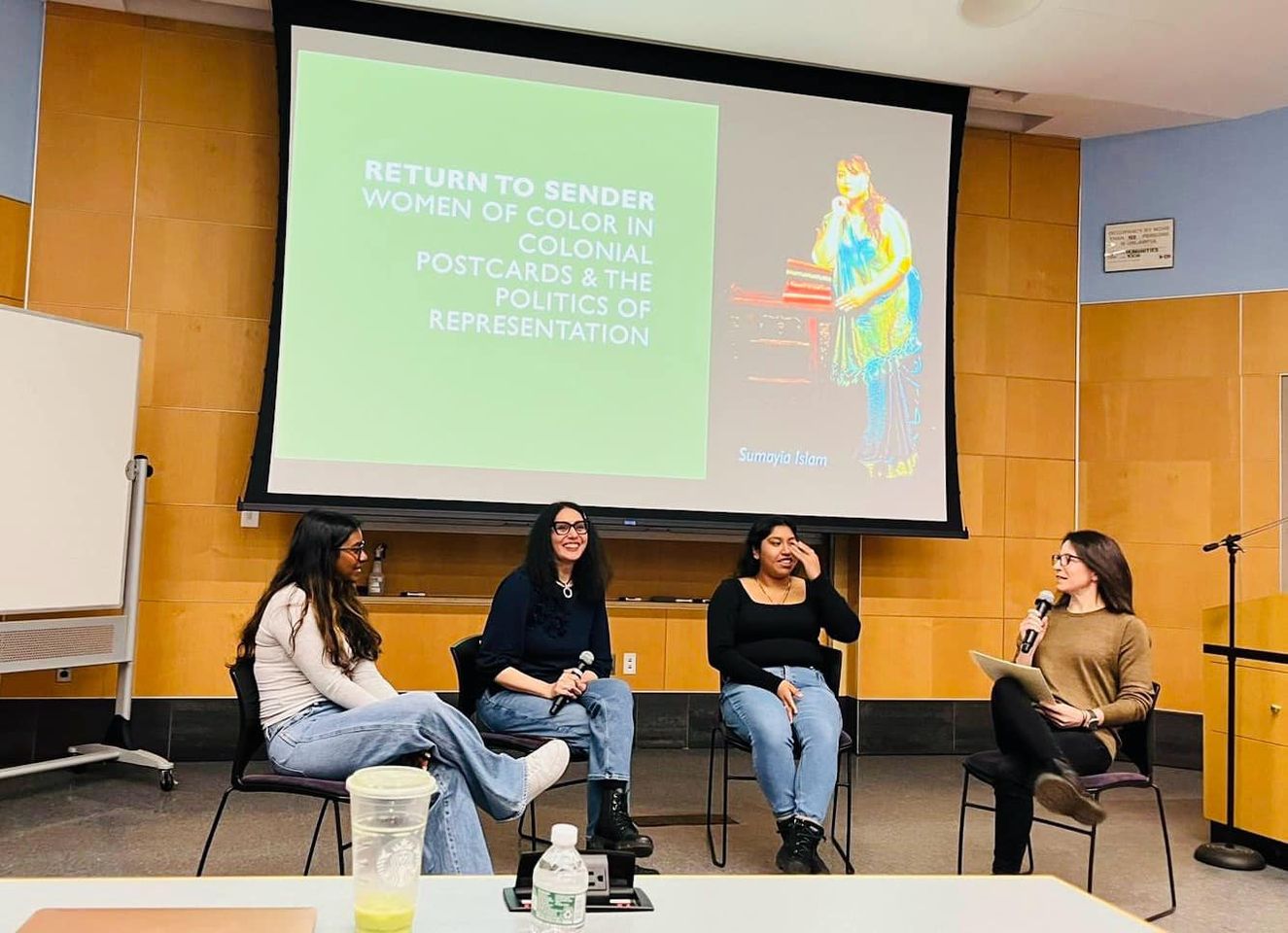
what a wonderfully organized screening of ‘return to sender: women of color in colonial postcards & the politics of representation’ at stony brook university’s humanities institute last night. a thrill to work with liz montegary, chairperson of women’s, gender & sexuality studies at stony brook, and to be a panelist along with avina mathias and emelyn pareja-garcia who both did an internship on this project. so many amazing friends and neighbors in the audience and then dinner at ixchel mexican cuisine to end the night on a high note.