
speak-out against government harassment of activists, rochester, ny, september 27, 2010 – photograph by al brundage.
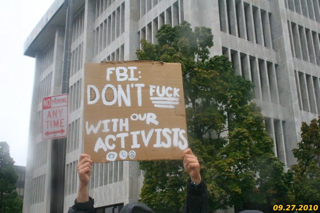
speak-out against government harassment of activists, rochester, ny, september 27, 2010 – photograph by al brundage.
I heard Aisha’s story from her a few weeks before the image of her face was displayed all over the world. She told me that her father-in-law caught up with her after she ran away, and took a knife to her on his own; village elders later approved, but the Taliban didn’t figure at all in this account. The Time story, however, attributes Aisha’s mutilation to a husband under orders of a Talib commander, thereby transforming a personal story, similar to those of countless women in Afghanistan today, into a portent of things to come for all women if the Taliban return to power. (Ann Jones – The Nation) Full article.
As head of state, president Dilma Rousseff would outrank Angela Merkel, Germany’s Chancellor, and Hillary Clinton, the US Secretary of State: her enormous country of 200 million people is revelling in its new oil wealth. Brazil’s growth rate, rivalling China’s, is one that Europe and Washington can only envy. Her widely predicted victory in next Sunday’s presidential poll will be greeted with delight by millions. It marks the final demolition of the “national security state”, an arrangement that conservative governments in the US and Europe once regarded as their best artifice for limiting democracy and reform. It maintained a rotten status quo that kept a vast majority in poverty in Latin America while favouring their rich friends. […] Ms Rousseff, the daughter of a Bulgarian immigrant to Brazil and his schoolteacher wife, has benefited from being, in effect, the prime minister of the immensely popular President Luiz Inacio Lula da Silva, the former union leader. But, with a record of determination and success (which includes appearing to have conquered lymphatic cancer), this wife, mother and grandmother will be her own woman. The polls say she has built up an unassailable lead – of more than 50 per cent compared with less than 30 per cent – over her nearest rival, an uninspiring man of the centre called Jose Serra. Few doubt that she will be installed in the Alvorada presidential palace in Brasilia in January. Full article.
for all my friends who have asked me about kashmir.
Maintaining bookmarks is a wonderful practice. But when one has to make a selection of 20 from hundreds of bookmarked items, not many of which you would remember anyway, it doesn’t seem to be a very wonderful task at hand. It is tedious. One has to go through every second item to remember what on earth it was about.
Of all the things that I do, I had been maintaining a bookmark folder dedicated to articles on Kashmir. I, initially, thought of compiling a list of 10 articles that all non-Kashmiris must read. But as I spent more time on it, I realised 10 would be too few — so 20 it is. Almost all have been written by Indians.
To me, the Internet is also about sharing. So here’s my Select 20 about Kashmir. Full article.
As part of a sting against anti-war activists suspected of connections to terrorism, on September 24 the FBI raided six homes in Minneapolis-St. Paul and elsewhere in the country. At the Hard Times Cafe in the Cedar-Riverside neighborhood, we interviewed peace activist Mick Kelly while the FBI searched his apartment above the cafe.
ann wright spoke about “afghanistan: the need to dissent” yesterday here in rochester. she started her lecture with the FBI raids on the homes of american peace activists (they were looking for links to foreign terrorist organizations) and aafia siddiqui’s 86 yr sentence. “these r dark times” she said.
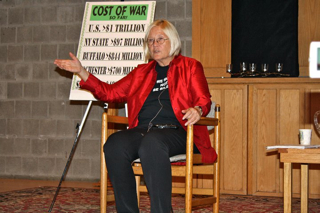
disgusting, disgusting, disgusting. americans have totally lost the moral high ground, nay the mere ability, to talk about justice anywhere in the world!
Dr Aafia Siddiqui has been sentenced to 86 years of imprisonment by the federal court in Manhattan on Thursday, for allegedly firing at US troops in Afghanistan. A jury found Aafia Siddiqui guilty in February of trying to kill U.S. agents and military officers, after Afghan police detained her in 2008. During Siddiqui’s three-week trial, FBI agents and U.S. soldiers testified that when they went to interrogate Siddiqui, she snatched an unattended assault rifle. They claimed that the neuroscientist allegedly shot at them after abusing America. Full article.
Industrialized nations, the source of most pollutants now warming the earth, have a clear responsibility for the flooding, and thus have a powerful additional reason, beyond ordinary human compassion, to give assistance. These are connections that count, and they have nothing to do with terrorism or anyone’s image. Full article.
Google and Verizon want the FCC and Congress to allow media giants to transform wireless communications into a digital version of a bad cable TV package. Instead of a free and open Internet that will take Americans where they want to go—thanks to the longstanding neutrality principle, which guarantees equal access to all websites and applications—the Google-Verizon deal would permit Internet service providers to speed up access to some content while leaving the rest behind. Such “pay for priority” would allow big business to buy speed, quality and other advantages—which would not be merely commercial. Now that the Supreme Court has afforded corporations electioneering rights equal to those of citizens, decisions about how we communicate have a profound political component to them. Full article.
Early this morning (September 22, 2010) an Israeli security guard working for the Silwan settlers shot and killed a Palestinian resident of Silwan and wounded two others, one seriously. Riots broke out in Silwan following the shooting and continue as of this writing. Reportedly the Israeli police fired tear gas at Palestinians heading from the Haram al Sharif, where they had gathered following the shooting, to the Bab al-Rahma cemetery. There are Palestinian reports that settlers fired on the funeral procession and other reports of settlers attacking Palestinians. Israeli vehicles have reportedly been stoned and burned. In short, the situation on the ground is extremely volatile. Full article.
interview with omar barghouti – everything that u ever wanted to know about BDS.
Too frequently ignored or overlooked in the great ground zero mosque debate is the attribution of irrational violence to Islam, which effectively subdues acknowledgment of the profound violence perpetrated by the American state (military intervention, police brutality, labor exploitation, torture, legislative racism). The debate is fundamentally incomplete: it begins with the assumption that all Muslims are subsumed in a religious violence that is somehow nonexistent in Christian modernity. Muslim Americans are thus endowed a historical burden that no community could ever possibly overcome. Full article.
most interesting lecture by john mearsheimer.
What about the Palestinians? I believe that the two-state solution is the best outcome for them as well as the Israelis. However, the Palestinians have little say in whether there will be two states living side-by-side, because they are presently at the mercy of the Israelis, who are the lords of the land. This means that the Palestinians are going to end up living in Greater Israel, which will be an apartheid state. Again, one might even argue that they have already reached that point. Regardless, the Palestinians will obviously have a vested interest in moving away from apartheid and toward democracy as quickly and painlessly as possible. Of course, that will not be easy, but there are better and worse ways to achieve that end. Full article.
this is dr finkelstein’s answer to my email wherein i asked him to clarify his stance on BDS:
September 22, 2010
Thank you for requesting a clarification. IF the supporters of BDS stated clearly and unambiguously that their goal was to end the occupation of the West Bank, including East Jerusalem, and Gaza, and a just resolution of the refugee question based on the right of return and compensation, I would support a comprehensive boycott and comprehensive sanctions. But the BDS movement does NOT clearly define its goals. For this reason, it is EASY to interpret its goal as the destruction/dismantling of Israel — a demand that has no support in international law and has no chance of success politically. So long as the goals of BDS are not clearly defined, I will only support a targeted BDS campaign of Israeli violations of international law, such as marketing products from the settlements, or arms transfers to Israel.
dr norman finkelstein spoke at le moyne college, in syracuse, last thursday. it’s a miracle he got to do so in view of the pressure that was put on le moyne to cancel the event. when an outright cancellation could not be achieved, the idea was floated that a panel should be set up to “discuss” finkelstein’s arguments. both those attempts at sabotage were foiled by local activists, thankfully, and we got to hear the man.
what i like about norman finkelstein is how he builds his case – deliberately, factually, with scientific precision and logic, with specific references and quotes, he constructs an argument that is solid and seems self-evident by the time he’s finished.
finkelstein began his lecture with the election of hamas in gaza, in what were unanimously believed to be fair and open elections. however, since the “wrong” party won, the united states and israel tried to back up a coup, which failed, and then imposed a blockade.
all military activities were halted on june 19, 2008 when a cease-fire was brokered by egypt under which hamas was to stop rocket and mortar attacks and israel was to lift the blockade on gaza. hamas stopped the attacks but israel reneged on its obligation.
on nov 4th, american election day, israel attacked and killed 6 palestinians inside the gaza strip thus ending the cease-fire.
hostilities resumed and israel initiated operation cast lead on december 27, 2008. finkelstein is particular about how the world should describe what happened in the following 22 days – it wasn’t a “war” but a “massacre”. why? finkelstein asked the audience to google “breaking the silence” and to read the testimony of israeli soldiers. time after time the soldiers repeat that they didn’t see anyone – there was no enemy, there were no battles, there was no fighting. of the 3,000 air missions flown into gaza, each and every plane came back to base. no plane was damaged. some of the soldiers’ metaphors: it was like playing video games, it was like hunting season, it was like a child burning ants with a magnifying glass. the word “insane” comes up over and over again: israel used insane fire power – the ground shook, soldiers were asked to exit the houses they were operating from lest they collapse. insane fire power. white phosphorous, which had been used before in 1982 in lebanon, was also used in gaza. white phosphorous burns at a temperature of 1,500 degrees F.
how about some stats to back up the claim that it was a massacre? ratio of israeli to palestinian deaths: 1 to 100 including soldiers, 1 to 400 when looking at civilians only. what about israel’s claim of hamas using human shields? more than 300 reports have been written about what happened in gaza by various human rights organizations. no evidence of human shields was found by any of them. autopsy reports confirmed that palestinians were not killed because they got caught in cross fire. rather they were bombed while they slept in their beds or they were air-targeted while they were at home.
after the 22 day-long gaza massacre, the blockade was not lifted. it became more insidious. gaza’s infrastructure had been completely destroyed (including its schools and hospitals, its only flour mill and its cement mixing plants) and there was no way to repair it.
we then come to the gaza aid flotilla which was the 8th or 9th attempt to break the blockade. finkelstein refuses to believe that israel’s motive was anything but violence.
why did israel not disable the ship’s propeller or engine? why didn’t they block the flotilla with their ships? if they didn’t expect any resistance, why did they launch a commando raid at 4 am? why did they use a unit that’s trained to kill? why didn’t they bring journalists along to document everything?
finkelstein believes that the answer is two-fold:
1) israel wanted to restore its deterrence capacity. what does that mean? they wanted to re-instill “fear” in the arab world after their defeat in lebanon.
2) israel wanted to cut turkey down to size. let’s not forget that 60% of the passengers on the mavi marmara were turkish. 95% were muslim.
one of finkelstein’s most ominous predictions is that israel will launch a highly spectacular attack against lebanon in the next 12-18 months, in order to make up for a string of failures (israel’s defeat in lebanon in 2006, the invasion of gaza which was seen as cowardice rather than a show of strength, and the assassination of a hamas leader in dubai which created innumerable diplomatic embarrassments). such an attack would be in line with israel’s fear of a new encirclement (hamas, hezbollah, syria and iran). israel is likely to initiate such an attack. syria and iran are likely to join the fray for they know that if lebanon is destroyed, they will be next. finally, the united states will be pulled into such a war in order to support its ally in the middle east. a terrifying scenario.
finkelstein emphasized the historic achievement of the gaza aid flotilla. that the words “the israeli siege of gaza is unsustainable” have now become common currency, is on account of the heroism of activists. he urged the movement for palestinian rights not to be distracted by “side shows” such as the peace process – which has allowed the gradual annexation of the west bank (42% of it is now occupied). the peace process is just a facade for an annexation process.
during Q&A, finkelstein was obviously confronted with the “one-sidedness” of his arguments. his answer was simple:
1) don’t blame the messenger for the message. there are over 300 human rights reports on the gaza massacre. finkelstein has read up to 10,000 pages of them. they r all consistent. he just quoted from them.
2) look at some stats: 100 to 1 dead, 6,000 to 1 homes destroyed – yes, that is one sided.
the metaphor of a child burning ants with a magnifying glass was critiqued. also, it was observed that maybe the “magnifying glass” was being used to look for gilad shalit. finkelstein’s answer:
1) ur beef is with the israeli soldier who used this expression. he was in the field and this was his metaphor. u should argue with him.
2) the ratio of prisoners held by each side: one gilad shalit to 8,000 palestinians. finkelstein challenged the audience to come up with the name of just one palestinian prisoner. silence. he also questioned the motive of bombing flour mills, cement plants and hospitals all the while looking for shalit. it doesn’t compute.
the only thing i didn’t agree with was finkelstein’s stance on BDS. he said that it was appropriate to boycott products made in the settlements (in the occupied territories) but a broad boycott of everything israeli didn’t make sense. his view is that israel is as legitimate a state as any other and therefore such a broad boycott would be discriminatory. i found this to be a weak argument. south africa, india, pakistan, cuba, iraq and iran are all legitimate states just like any other, yet they have all faced sanctions at different times. thus, sanctions do not imply state illegitimacy. in the case of south africa, BDS was proven to be an effective tool against apartheid. i refuse to believe that israel is “unique” in this regard. what worked for south africa, should work for israel. countries that view themselves as first world democracies don’t like to be treated like pariahs. BDS is a powerful, non-violent, international citizens’ movement that bypasses complicit governments and demands change. it gives one hope.
finkelstein finished on an optimistic note. he said that the pace of change is always glacial. it doesn’t happen overnight. it takes place through the slow accretion of knowledge. he talked about facebook. he said he had heard wonderful things about it and activists should use all the media now available to them to organize and educate. he said that activism didn’t have to involve self-sacrifice. to be part of something bigger than oneself is not a sacrifice. it’s a thrill.
well, the fact that 400 people turned up to listen to finkelstein on a rainy thursday evening was a small sign that things might be changing.