The bodies of the dead were found against one wall in one room, all handcuffed in white plastic handcuffs according to neighbors. There were five children under the age of five, the youngest being five months old. Then there was a mother, her sister, the grandmother and a visitor — four women in all. The father, in his 20s, was killed as well. More here.
Category: politics
Pro-Palestinian activists disrupt Israel Philharmonic Orchestra concert in London
The protesters included a core group of professional musicians, who gave what amounted to a counterconcert, breaking into vocal choruses in a bid to drown out the orchestra. The protesters said that they were members of “a new vocal ensemble” called Beethovians for Boycotting Israel, and described their behavior during the concert as a “debut performance.” More here.
Mallika Kaur: Grave Lessons from Kashmir
Enforced disappearances have been recorded in Kashmir since the early 1990s and local civil society groups estimate about 8,000 enforced disappearances and about 1,500 “half widows” in Kashmir.
Now the State Human Rights Commission has announced the existence of “mass graves” in the Indian-administered Kashmir Valley: it has recorded multiple graves containing 2730 bodies.
…
The conflict in Kashmir, which has its roots in the 1947 decolonization and partition between the current states of India and Pakistan, entered its bloodiest phase in 1989. Popular disenchantment with the Indian electoral system spurred a groundswell movement for Kashmiri secession from India. Simultaneously, armed militants, some backed by Pakistan, became the violent face of the self-determination movement. Indian government passed security legislation giving armed forces sweeping powers to suppress insurgency and significantly fortified military presence in the region. The exceptional legal and militaristic treatment of Kashmir continues even today, though by the government’s own estimates, the number of active militants in the Valley does not surpass 500. The past 22 years of conflict have seen more than an estimated 70,000 dead.
…
In her assessment of the situation, Haseena does not comment on the armed militancy, which continues even today, at a comparatively miniscule scale. But her omission is not out of fear or even strategy, but rather honesty. In Srinagar, and now most of Indian-administered Kashmir, the conflict is not between armed militants and government forces. It is in a large part between Kashmiri civilians, disgruntled men, women, and children, and the government’s deployed forces.
…
More here.
We can’t let unscrupulous banks off the hook
The Obama administration and federal banking regulators are pressuring Attorney General Schneiderman to back down and accept a settlement with the major mortgage firms that would impose no criminal penalties for breaking the law. More here.
the construction of the other begins with the deconstruction of a human
the construction of the other begins with the deconstruction of a human. (kat rodriguez, derechos humanos)
Letter from Gaza – Granta Magazine
It is difficult not to see the assassination of Ghassan Kanafani as yet another attempt to obliterate the Palestinian narrative, to make true the claim, made by the Israeli politician Yigal Allon after 1967, that Palestinians no longer exist, for if they did they would have produced a literature.
…
The Israeli National News published an article written by an Israeli soldier, calling it, ‘Letter To Gaza’. The author had chosen to withhold his last name; all we have is ‘Yishai (Reserve Soldier)’. In an Orwellian maneuver, Yishai addresses the Palestinians whose house he had recently ransacked and occupied with a simple and solitary: ‘Hello’. At one point he explains that ‘despite the immense disorder you found in your house … we did our best to treat your possessions with respect… I even covered the computer from dust with a piece of cloth’. Yishai wants his nameless victims to know: ‘I am 100% at peace with what my country did, what my army did, and what I did. However, I feel your pain.’
…
The soldier’s letter is there only to serve the soldier. In it he tries to brush away his crimes under a feigned humanity, but in doing so exposes the narcissistic jealousy every oppressor feels: one of the most disturbing qualities of the subjugator is that he is rarely content with dispossessing his victims of their rights and property, but desires to also undermine the private nature of their grief.
…
More here.
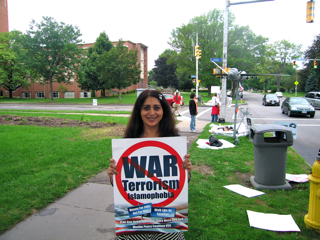
peace vigil at east and goodman
august 21, 2001: peace vigil organized by rochester peace groups at east and goodman. many who participated have been protesting at this spot every week, for the past 5 years. bravo.
Letter From Gaza by Ghassan Kanafani
just read ghassan kanafani’s brilliant short story “letter from gaza”. was incredibly moved by it – on many different levels. here is john berger reading “letter from gaza.” pls listen.
Breaking Our Addiction to War by S. Brian Willson
We are addicted to war because we are addicted to a materialist way of life, which requires obedience to an infrastructure of imperialism that enables business as usual. That it is totally unsustainable is only now being realized.
…
First, let’s look at US history. The record reveals a chronic, depressing pattern of war making – 550 direct military interventions since 1799 in more than 100 countries. More than 300 of these have occurred since World War II, including bombing of 28 countries. In addition, the US has conducted thousands of covert interventions, mostly in “Third World” countries.
…
“Civilization” is marked by a dramatic shift from long-standing decentralized, horizontal, matriarchal societies, to centralized, vertical/class-oriented, patriarchal societies, in which obedience to a King was required, and slave labor utilized to construct massive projects like tombs, irrigation and grain storage systems. Class and stratification ripped people from their historical roots as autonomous beings living in small cooperative tribal groups.
…
In essence, by being conditioned to obey the laws and mores of modern society dictated and shaped by vertical political-economic systems, we have been living contrary to our authentic nature as cooperative beings capable of self-governance in small communities without authority from above. In addition, in the West, with but 20 percent of the world’s population, we have materially benefited from 500 years of colonial exploitation at the expense of the remaining 80 percent. This is not only immoral, it is ecologically unsustainable. In the US, with but 4.6 percent of the world’s population, our insatiable consumption devours more than 30 percent of the globe’s resources. Habits of obedience to our system have historically been reinforced by our personal addiction to consumer goods, fed by the myth that our material well-being derives from our “exceptionalism” as US Americans. Our allegiance to this myth and our addiction to its benefits are what enable those dreadful wars – these are nothing more than imperial projects to assure, at gunpoint, continuation of our American Way Of Life, not to mention endless profits for the “emperor” and his entourage.
…
The prescription: Re-discover the eco-consciousness that already resides in our visceral genetic memory outside our brains. Choosing to live with less stuff in locally sufficient, food producing and simple tool making/artisan cultures can be joyful, and pockets of such revivalist cultures are cropping up in many places as people strive to re-establish their local autonomy. We are coming full circle…
…
More here.
some non-msm context on libya
The Truth About the Situation in Libya
…
Luis Rumbaut – NATO’s Rebel Forces
The fighting is not over in Tripoli, but the scramble to secure access to Libya’s oil wealth has begun… Western nations, especially the NATO countries that provided crucial air support to the rebels, want to make sure their companies are in prime position to pump Libyan crude.
Why Iceland Should Be in the News, But Is Not
The belief that citizens had to pay for the mistakes of a financial monopoly, that an entire nation must be taxed to pay off private debts was shattered, transforming the relationship between citizens and their political institutions and eventually driving Iceland’s leaders to the side of their constituents. More here.
on occupation…
lance cpl. kristi baker on jan 31, a photograph by rita leistner, an “embedded” photographer who took pictures from the heroic standpoint of the troops. i see something else. i see the offensive, condescending, violent and surreal face of occupation. occupation is effed up, by its v definition. get out of afghanistan, pakistan, iraq, yemen, somalia, the west bank and gaza and now libya. spend the money at home, to feed and house people. it’s a win win.
on libya…
from emma rosenthal: “love that ghaddafi is going down, but i don’t trust ANYTHING with u.s./cia and nato fingerprints on it.”
Barbara Ehrenreich: Turning Poverty Into an American Crime
The most shocking thing I learned from my research was the extent to which poverty has been criminalized in America. Perhaps the constant suspicions of drug use and theft that I encountered in low-wage workplaces should have alerted me to the fact that, when you leave the safety of the middle class, you might as well have given up your citizenship and taken residence in a hostile nation.
…
In defiance of all reason and compassion, the criminalization of poverty has actually intensified as the weakened economy generates ever more poverty. So concludes a recent study from the National Law Center on Poverty and Homelessness, which finds that the number of ordinances against the publicly poor has been rising since 2006, along with the harassment of the poor for more “neutral” infractions like jaywalking, littering, or carrying an open container.
…
The viciousness of the official animus toward the indigent can be breathtaking. A few years ago, a group called Food Not Bombs started handing out free vegan food to hungry people in public parks around the nation. A number of cities, led by Las Vegas, passed ordinances forbidding the sharing of food with the indigent in public places, leading to the arrests of several middle-aged white vegans.
…
For the not-yet-homeless, there are two main paths to criminalization, and one is debt. Anyone can fall into debt, and although we pride ourselves on the abolition of debtors’ prison, in at least one state, Texas, people who can’t pay fines for things like expired inspection stickers may be made to “sit out their tickets” in jail.
…
The second — and by far the most reliable — way to be criminalized by poverty is to have the wrong color skin. Indignation runs high when a celebrity professor succumbs to racial profiling, but whole communities are effectively “profiled” for the suspicious combination of being both dark-skinned and poor. Flick a cigarette and you’re “littering”; wear the wrong color T-shirt and you’re displaying gang allegiance. Just strolling around in a dodgy neighborhood can mark you as a potential suspect. And don’t get grumpy about it or you could be “resisting arrest.”
…
In what has become a familiar pattern, the government defunds services that might help the poor while ramping up law enforcement. Shut down public housing, then make it a crime to be homeless. Generate no public-sector jobs, then penalize people for falling into debt. The experience of the poor, and especially poor people of color, comes to resemble that of a rat in a cage scrambling to avoid erratically administered electric shocks. And if you should try to escape this nightmare reality into a brief, drug-induced high, it’s “gotcha” all over again, because that of course is illegal too.
…
More here.
nivea’s racist ad campaign
is this ad racist or what?