remembering sabra and shatila (sept 16-18, 1982)

Ellen Siegel is Jewish American. She worked as a nurse in Beirut during the massacre in 1982 and testified before the Kahan Commission in Jerusalem. She is a founding member of the Jewish Committee for Israeli-Palestinian Peace. She lives in Washington, D.C.

For many years I did solidarity work. In 1980 I returned to Beirut for a short period to work with Palestinian women who had established embroidery workshops in order to support themselves and lead as much of a productive life as possible.

The Israeli invasion of Lebanon in 1982 horrified me. American weapons were being used to maim and kill helpless Palestinian and Lebanese civilians and refugees. Israeli soldiers were preventing food, water, and much-needed medical supplies from entering West Beirut. The hurt and suffering of those in pain was unattended to; no dignity was even given to the dead.

I arrived in Beirut on September 2, 1982. The ashes were still smoldering. The invasion was over, the PLO fighters and administration had been evacuated, the Israeli forces had pulled back from the city.

I was assigned to a hospital, called “Gaza,” in Sabra camp. The Sabra and Shatila camps of the UN Relief and Works Agency (UNRWA) lie side by side in West Beirut. They are two of the 12 camps established in Lebanon since 1948 by UNRWA to shelter Palestinians exiled from their homes because of the creation of Israel. Before the 1982 invasion about 90,000 people lived there, a fourth of them poor Lebanese. The houses were mainly one-storey concrete dwellings with corrugated iron roofs. Camp buildings and homes were tightly packed together, separated by numerous narrow alleyways.

The camp inhabitants lived and worked together. A welfare and educational system, municipal councils, and trade unions existed. Committees organized vocational training in such areas as embroidery and carpentry and operated kindergartens. By the time I arrived in Beirut, the camps’ population had shrunk to about 10,000.

The Israeli army had left behind the effects of the U.S. implements of war. Shrapnel, ammunition, rocket casings, and other such armaments, many of them “made in USA,” were everywhere. Because of them, the hospitals were filled with victims of chemical burns, with dehydrated babies, with recovering amputees. Supplies were limited, conditions poor. For example, because the electrical supply was irregular, we sometimes had to hold flashlights to finish an operation.

On September 14, the newly elected president of Lebanon, Bashir Gemayel of the Phalange Party, was assassinated. The next day Israeli war planes flew over West Beirut. Machine-gun fire increased as the day went on. On September 16, Israeli planes again flew over the camps; light artillery fire continued, but it was now accompanied by heavy artillery. Thousands of refugees sought security in and around the hospital. They were panic-stricken; they screamed, “Israel! Phalange!” and made a slashing motion across their throats. That evening, I watched from the tenth floor of the hospital as flares were shot into the air, lighting up neighborhoods of the camp. Sounds of machine-gun fire followed each illumination.

On the morning of the 17th, those who had sought refuge at the hospital disappeared and all the patients who could walk fled. By afternoon, all of the Palestinian and other Arab staff members were gone; their administrator had told them that the hospital was no longer safe for them.

The high explosives were coming so close that we had to move the remaining patients to the lower floors. Smoke poured in the windows, windows cracked, doors slammed, equipment reverberated. Everything was shaking. By evening, we heard only the sounds of machine-gun fire. Tending to the very ill was more difficult than usual; to some, the bombardment made the difference between life and death.

That evening a few severely wounded people managed to be brought to the hospital. Among them was a child of 12 who was suffering from shock, a bullet injury in his leg, and an open wound on his hand where a finger had once been; his name was Mounir. Treatment of his leg began immediately to prevent amputation. Later that evening, the International Committee of the Red Cross (ICRC) was allowed to evacuate a small number of wounded children to a hospital outside of the camp area; Mounir was chosen.

Early the next morning, all the health care workers were told that the “Lebanese Army” was downstairs and that we must assemble at the hospital entrance. The armed militia we found below were in fact not the Lebanese Army but Phalangists. (These were the military wing of the Phalange Party, a nationalist Christian party founded in the 1930’s on the model of European fascist groups.) They allowed us to leave one medical student and one nurse behind in the Intensive Care Unit. They marched the rest of us down the main street of Sabra and Shatila, past dead bodies and hundreds of camp residents guarded by armed militiamen. One woman tried to pass her baby to one of the physicians, but the militiamen stopped her. Sporadic machine-gun fire could still be heard as we marched. Bulldozers, at least one marked with a Hebrew letter, were busy: homes that had stood at the edge of the camp were now rubble. As we walked along, our captors called us names — “dirty people,” “un-Christian” (because we were treating “terrorists who kill Christians”), “Communists,” “Socialists.”

The militiamen lined us up against a bullet-riddled wall just outside the camp. Rifles ready and aimed towards us, they paused, then filed back into the camp.

Other militiamen came and took us to a courtyard on the road to what had been a United Nations building. The courtyard was littered with Israeli products and newspapers. There they questioned us about why we had come and who had sent us. Afterwards, they marched us over to a building occupied by the Israeli Defense Force (IDF). From its roof, Israeli soldiers with binoculars were looking down on both Sabra and Shatila. Here the Lebanese turned us over to the Israelis.

Israeli soldiers drove us into West Beirut and dropped us off near the American Embassy. I went in and reported to an embassy official that “something wrong was going on in those camps.” He said the man in charge was out: “Come back later.”

That afternoon, many of the health care workers began searching for our patients. We found that the ICRC had eventually been able to evacuate all of them to other medical facilities around Beirut.
The next day I returned to the American Embassy and gave an accounting of what I had seen.
Prose of a Growing Movement

In late March, the MC better known as The Narcicyst released his first book. The Diatribes of a Dying Tribe is a manifesto of sorts: on bicultural identity, on globalization, on hip-hop, on hip-hop culture, on politics, on poetics, on resistance, on peace, on war, on frustration, on calm, on family, on adolescence, on Arabs in the West.

Resistance is to be found not in one political issue but in a collective reclamation of dignity. This comes differently for each artist. The solo albums of Omar Offendum, Lowkey, KhaledM, and Arabian Knightz represent a range of identities and experiences and differ very much from each other: not just in the lyrical approaches of each artist, but in where and how each poet locates and articulates strength or pride. Offendum wraps himself in an Arabesque mystique, much of it informed by classic twentieth-century poets like Nizar Qabbani; Narcy tends towards the more ostentatiously confrontational:

“Word, I’m cocky/ the Iraqi Rocky/ Trying to shake the terror off me/ Truth I see it rarely, achi…” (from “Good Night!!!” on the self-titled album);

and Shadia Mansour, one of the most prominent female MCs in this genre, combines R&B and verse to terrific effect.

?”Arabs and Muslims worldwide were forced to defend their stance of being. No longer were we allowed to exist without first discrediting the angst in our war-torn cities and nations, or even disassociating our thoughts from those who are less fortunate in their will to be ‘free.’”

More here.

WikiLeaks in Baghdad – The Nation

Soldiers involved in the “Collateral Murder” video have come forward to tell their story: “From my experiences in Iraq, we shouldn’t even be in these countries fighting wars. This is a war of aggression, of occupation. There is nothing justifiable to me about this war. And this isn’t someone sitting back saying ‘I think’ or ‘I believe.’ This is from someone who was there.”

All three soldiers say they hope Americans will learn the right lessons from the WikiLeaks video. “We acknowledge our part in the deaths and injuries of your loved ones as we tell Americans what we were trained to do and what we carried out in the name of ‘god and country,'” write McCord and Stieber in their open letter. “The soldier in the video said that your husband shouldn’t have brought your children to battle, but we are acknowledging our responsibility for bringing the battle to your neighborhood, and to your family. We did unto you what we would not want done to us.”

“Our heavy hearts still hold hope that we can restore inside our country the acknowledgment of your humanity, that we were taught to deny.”

More here.

Peace Activist Kathy Kelly On the Secret U.S. War in Pakistan

In Pakistan, where the undeclared US war continues to expand, armed fighters attacked a convoy carrying military vehicles for NATO forces in Afghanistan, torching 50 trucks, killing 7 and injuring another 7. Last week a senior United Nations official formally asked the Obama administration to halt or scale back CIA drone strikes on alleged militant suspects in Pakistan. For a perspective on what US policy towards Afghanistan and Pakistan looks like on the ground, we’re joined now here in New York by longtime activist Kathy Kelly. She just returned from a trip to Pakistan and Afghanistan where she met with those she describes as “the impoverished and war-weary.”

NAACP – Sign the petition to DA Larry Chisolm

The Georgia Board of Pardons denied Troy’s appeal for Clemency and his execution is scheduled for tomorrow at 7pm. Here’s what we can do now: call District Attorney Larry Chisolm at 912-652-7308 and ask that he withdraw the death warrant. There is also a petition being circulated to the same effect by the NAACP. Sign here.

kathy kelly in rochester – sept 13, 2011

“The Cost of War, The Price of Peace” with Kathy Kelly and David Smith-Ferri was held at Downtown Presbyterian Church, Rochester, NY – September 13, 2011.

while the city of rochester flocked to see bill clinton at the u of r, some of us made a beeline to hear kathy kelly. as clinton’s govt imposed murderous sanctions on iraq, kathy kelly traveled to that country with food and medicine in violation of the sanctions. she and other activists were threatened with separate 12-year prison sentences and fines of one million dollars each. but they persevered. kathy now travels to afghanistan and pakistan and brings back first hand knowledge about the wars.

she is a light. was completely entranced by her emotive description of the wars in afghanistan and pakistan.

bought david smith-ferri’s book of poetry called “with children like ur own”. he accompanied kathy and read poigant poems from his book. one of them was called “something to say” – it’s written in the voices of drone victims:

“we have something to ask people in the US:
do u think we r animals
to be hunted and killed?
did the murder of our sisters and brothers and children
cause even a ripple
in the smooth pool of ur conscience,
even a small interruption
in ur routine,
in ur pursuits?”

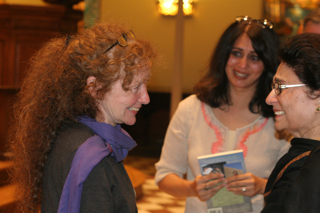
kathy insisted on meeting my mother. she told her she loves lahore.

kathy kelly has been nominated three times for the nobel peace prize. but obama got it instead.

photograph by al brundage.

with kathy kelly

A reality check on Somalia

Doctors w/o borders on Somalia: But only blaming natural causes ignores the complex geopolitical realities exacerbating the situation and suggests that the solution lies in merely finding funds and shipping enough food to the Horn of Africa. Unfortunately, glossing over the man-made causes of hunger and starvation in the region and the difficulties in addressing them will not help resolve the crisis. More here.

Race, Religion, and Diversity in London After 9/11

perhaps ms zadie smith is trying to be helpful by insisting that all muslims r not monsters but i find her essay offensive – not only does it pander to the lowest common media denominator but it’s just plain dumb. “The 9/11 perpetrators wanted a world in which (their version of) religious belief trumped all other concerns.” — wha? go read some non-fiction lady.

“It’s to be noted that class meant little to the terrorists: they saw only two human categories, believer and heathen.” — she casts her entire argument as a “clash of civilizations” which is embarrassing, today 10 yrs after 9/11.

btw what is the war on terror about? isn’t it about believer vs heathen? is it just a coincidence that the victims of the war (99% of them) r muslim civilians and those bombing/raiding/invading them (99% of them) r “judeo-christian”? interesting how that never comes up.

and what if class did mean something to the terrorists/imperialists – would that make them more evolved? it’s true that imperialists invade the poorest countries of the world and even within those countries they drone the most economically disenfranchised. is that supposed to be a better approach – i.e. seeing only two human categories, monied and indigent?