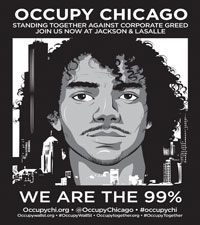
the always brilliant naomi klein.
Category: politics
Guernica / Postcards from Karachi
not sure this short film says anything new but love the footage shot in karachi. watch film here.
Muslim Jummah @Occupy Wall Street
Where: Zuccotti Park, New York City
When: Friday, Oct. 21, 1 p.m. to 2 p.m.
Khutbah given by Imam Ayyub Abdul Baki of the Majlis Ashura’s Leadership Council’s Justice committee. The Imam asks Muslims present to wear white for the occassion. “We will be feeding protestors and the hungry with the collaborative efforts of invited Muslim charities.” For more info: eccmajlisshura@gmail.com.
I Came to Testify, Women War and Peace (PBS series)
“In the 1990s war in Bosnia, thousands of Muslim women were systematically raped as a tactic of ethnic cleansing. I Came to Testify is the story of 16 women who took the witness stand in an international court of law and changed the rules of war forever.” Watch here.
we the people have something to say
Christine Tylee, college student, Farmingville, New York. (Photograph by Martin Schoeller). More portraits from Occupy Wall Street here.
am reading samir amin’s “eurocentrism”
i like the idea of moving away from a cultural particularism (any monoculture) that is exclusionary and therefore violent and think of modernity as a global project, with all its attendant complex cultural diversity. culture (whether european or eastern) is not something that falls out of the sky. it is a multi-layered, lived, human process with infinite genetic and civilizational strands. cultural hubris is therefore, by definition, a scam.
…
The strength of Amin’s theory of eurocentrism lies in his ability to demonstrate that ‘Europe’ is a culturalist construction that masquerades as universal. That is, rather than presupposing that the binary of West/East––or Europe and its Other––existed in the pre-modern world, he argues that European civilization is an ideology that developed after 1492, the epoch of modern colonialism. Since the nation-states of the European continent were the colonial masters, eventually they began to conceive of themselves as a superior and united civilization. Eurocentric thought emerged when scholars in this continent began to mine the past and construct precedents for their supposedly superior civilization. This led to the invention of ‘an eternal West, unique since its moment of origin. This arbitrary and mythic construct had as its counterpart an equally artificial construction of the Other (the Orient), likewise constructed on mythic foundations’.
…
Amin further bolsters his position by examining the historical development of European capitalism and the Enlightnment break from metaphysics. Although he remains a staunch advocate for modernity, he points out that capitalist modernity is flawed by European culturalism. Rather than seeing modernity (the understanding that humans rather than supernatural forces make history) as a world project, the eurocentric position holds that European culture is the universal grounds for modernity. In fact, eurocentrism is a cultural particularism that masquerades as universal. Once again, Amin sets himself against the postcolonial position by rejecting the idea that universal values are exclusionary and violent. Rather, he asserts that the culturalisms that masquerade as universal are exclusionary in that they promote difference. The solution is to pursue a universal project free from European particularism, a ‘modernity critical of modernity’.
…
Therefore, the progressive response to eurocentrism should not be based on a flight back into cultural difference, where one embraces particular ethnic identities and metaphysical notions of the world, but the pursuit of a modern project premised on universal values freed from the eurocentric vision of the world. The strength of this argument rests on Amin’s historical exposition of how European capitalism developed against the backdrop of other non-European cultures that, at that period of time, formed different centres of human civilization. Thus, although the values of modernity would eventually emerge in a European context, intrinsically connected to the birth of capitalism, the seeds of these values were evident elsewhere. The eurocentric annexation of the world, however, created the culturalist myth that modernity was a product of some Platonic European essence.
…
More here.
America’s growing anti-intellectualism
In his op-ed, “Occupy Wall Street rediscovers the radical imagination”, David Graeber wrote: “We are watching the beginnings of the defiant self-assertion of a new generation of Americans… Just as in Europe, we are seeing the results of colossal social failure. The occupiers are the very sort of people, brimming with ideas, whose energies a healthy society would be marshaling to improve life for everyone. Instead, they are using it to envision ways to bring the whole system down.”
…
America has always had a critical thinking deficit, in that it has a long tradition of anti-intellectualism. This is particularly perverse, maddening and contradictory, since America’s Founders were the most intellectual group that ever founded any nation we know of, and the desire to foster free and critical thinking, both in government and in the society at large, was one of their notable goals, as a direct consequence of the Enlightenment heritage on which America’s Founders depended.
…
Our imagination deficit is closely tied to our critical thinking deficit. Minds that are perpetually muddled in uncritically accepted ideas and psuedo-facts, incapable of grasping clear-cut truths are hardly prepared to grasp projected possibilities and judge them soundly. This was strikingly obvious in the aftermath of the 9/11 attacks, for example. Calls for critically examining the reasons behind the attacks were quickly demonised, with a leading role played by a centre-right organisation – the American Council of Trustees and Alumni (ACTA) – that pretended to stand for academic excellence.
…
The Democracy Deficit: A 2010 paper, “A World Upside Down? Deficit Fantasies in the Great Recession”, by political scientist Thomas Ferguson and economist Robert Johnson, identifies three oligopolies in particular – the military-industrial complex, the medical-industrial complex, and the financial sector. However, at a deeper level of analysis, Ferguson had earlier explained how organised economic special interests largely control American democracy, creating a constant condition of democracy deficit, regardless of outward appearances, and our constant pretension to be the foremost democracy in the world.
…
More here.
Hip Hop Awards ’11: Rebel Without a Pause – Lupe Fiasco
love love love – the palestinian flag, the burka and lupe fiasco! watch here.
Children of Agent Orange
Fifty years ago, in the early stages of the Vietnam War, the US military began spraying rural areas of the country with the herbicide, Agent Orange. The goal was to defoliate forested land, depriving the enemy Viet Cong of cover and driving peasants to the cities, thus destroying the Viet Cong’s support base and food supply. Over the next 10 years more than 80 million litres were deployed across 7.4 million hectares of Vietnam, eastern Laos and parts of Cambodia. There is strong evidence that the deadly dioxins contained in Agent Orange also had a catastrophic effect on the health of millions of Vietnamese – killing hundreds of thousands and causing dreadful diseases and birth defects in subsequent generations right up to this day.
…
Thousands of US servicemen – men who handled the herbicide and who operated in areas where it was deployed – were affected too, and they and their families eventually won compensation through the courts. But attempts to get similar US financial aid for the Vietnamese victims, or even much help with a clean up of polluted land, have been less successful.
With many areas of Vietnam still poisoned by the dioxin and the country’s hard pressed health and welfare services struggling to support those suffering, this film by Risto Vuorinen tells the remarkable story of the children of Agent Orange and a group of US veterans in Vietnam who are trying to atone for the mistakes of the past.
…
More here.
william buckley threatens to punch noam chomsky in the face
hey, william f. buckley, what up with the fake british affectation? geez.
Once enemies, now they march together: Organized labor expected to join Wall Street protest
Establishment critics of the Zuccotti Park events have no clue what is happening. By setting up camp near the scene of Wall Street’s still-unpunished crimes, and by persevering round the clock for nearly three weeks, these kids have created a boot camp for social change. More here.
Noam Chomsky on Occupy Wall Street protests
noam chomsky on occupy wall street: [america] v much like a third world country.
On Orientalism – Edward Said
the incomparable edward said. a series of interviews organized by umass.
CIA contractor charged in Pakistan deaths arrested in Colorado
the man has obvious issues. he should be in jail for murder. more here.
we are the 99%