plymouth breakwater

today walked along plymouth breakwater (it protects plymouth sound/anchorages). not interested in plymouth rock, settler colonial myths, or all the pilgrim museums/statues but enjoyed walking along jenney pond all the way to the grist mill. this area is beautiful no doubt, but the blue lives matter flags are disturbing. the arrival of the colonizers is commemorated endlessly with no mention of the indigenous peoples who lived/live here and own this magnificent land. this historical narrative needs to be corrected. we know better.

On indigeneity

Language is important. It can help us clarify our thinking, by crystallizing ideas and making grounded analysis possible, or it can befuddle, disorient, and completely disengage with reality – not only our own but also that of our human family. I will try to be as clear as possible in this post.

I agree with Mary Adams that it’s good Brighton is being exposed for what it is. I have heard stories about how hard it is for Black kids at the town’s high school and how they’re frequently harassed by police, so I never understood the charms of Brighton’s so-called success with diversity.

It’s unfortunate that this unravelling of the Brighton myth is happening at the expense of Robin Wilt, the only Black woman on their town board. She is being persecuted by a large (and extremely loud) portion of Brighton’s Jewish community for posting a picture with Linda Sarsour and saying the words, “Free Palestine.”
That Linda and Robin are both women of color is no accident. Zionism is a European, ethnonational, Jewish-supremacist ideology. How is it supposed to treat people of color or women for that matter?

Amidst all the brouhaha and surreal accusations, the word “indigeneity” has been thrown around by Robin’s attackers. It’s also incorporated into some of the softer liberal Zionist discourse coming from people who support Robin. So let’s be linguistically precise.

Israel is a settler colony. It is justified by the same kind of self-righteous, racist propaganda as America’s Manifest Destiny, “a phrase coined in 1845 and the idea that the United States is destined—by God, its advocates believed—to expand its dominion and spread democracy and capitalism across the entire North American continent.” At the last Brighton town meeting, one of Robin’s detractors used the words “Gospel-given right” to claim indigeneity to Middle Eastern land. It fits.

Palestinian Jews are indigenous, of course, but the white people ranting against Robin and harassing Palestinian Muslim families in the audience are not. Neither were the founders of Israel. They were white European settlers with generational links to European lands, not Palestine.

What is indigeneity? See this document from the United Nations Permanent Forum on Indigenous Issues, but here are some ways to understand “indigenous”:

• Self- identification as indigenous peoples at the individual level and accepted by the community as their member.
• Historical continuity with pre-colonial and/or pre-settler societies
• Strong link to territories and surrounding natural resources
• Distinct social, economic or political systems
• Distinct language, culture and beliefs
• Form non-dominant groups of society
• Resolve to maintain and reproduce their ancestral environments and systems as distinctive peoples and communities.

The settlers who moved to Israel cannot claim any of these continuities. Neither can they be called a non-dominant group by any stretch of the imagination. Their military, economic, and political power and privilege are obvious. They (Jews with European ancestry in particular) occupy the highest echelons of an apartheid system where the Palestinians are so savagely oppressed even their food and water are controlled.

From the same UN document: “Indigenous peoples often have much in common with other neglected segments of societies, i.e. lack of political representation and participation, economic marginalization and poverty, lack of access to social services and discrimination. Despite their cultural differences, the diverse indigenous peoples share common problems also related to the protection of their rights. They strive for recognition of their identities, their ways of life and their right to traditional lands, territories and natural resources.” — almost a word for word description of the Palestinian struggle.

To co-opt the word “indigenous” and apply it to colonizers is a stunning bastardization and corruption of language.

If 2,000-year-old connections to land define indigeneity, then we are all indigenous to Africa. But I doubt it means that we can (or should) walk into an African country, move into someone else’s house, and resort to ethnic cleansing and genocide in order to be able to return home.

Let’s be careful and intentional with our words. Otherwise “War is peace,” “Freedom is slavery,” and “Ignorance is strength.”

Remembering Bob Moses

Bob Moses passed away on July 25th. Here are powerful words from Margaret Burnham’s excellent tribute, Remembering Bob Moses, 1935–2021:

“In telling this personal anecdote, I violate what Bob Moses taught us—not didactically but by his example. The first-person singular pronoun, a dangerous thing, should be used sparingly by those who seek to break the deafening silence of the subordinated.

Bob Moses’s storied life is the stuff of myth, told in scores of books, films, and archives, and crowned with a “genius” award. Perhaps less well-rehearsed is what he imparted to those of us who worked with him about how to move around in communities that were not ours but were of us, how to learn from the unschooled, how to be a charismatic follower rather than an acclaimed leader.”

imaginary man

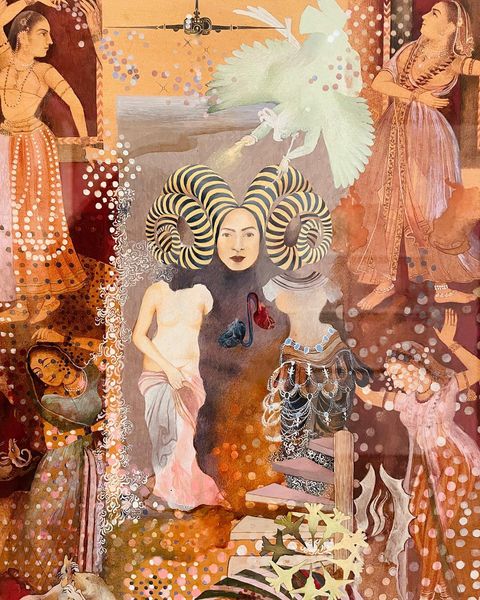
shahzia sikander. miniature in mughal style: imaginary man, 1991 (vegetable color, watercolor, tea, and gold leaf on wasli paper, 11 x 8 inches). this piece made me tear up. its exquisite detail, the subdued color palette, the delicate hands and fingers, the otherworldly beauty of this serene male figure — a bearded, muslim figure and all that it has come to mean in the western imaginary, yet here it is, portrayed as something distinguished and light, frail rather than threatening, gossamer rather than immovable. i stood there for a long time, coming close to the piece and connecting with the arduous, detail-oriented work that went into creating this dazzling art. it took sikander years to complete it.

shahzia sikander: extraordinary realities

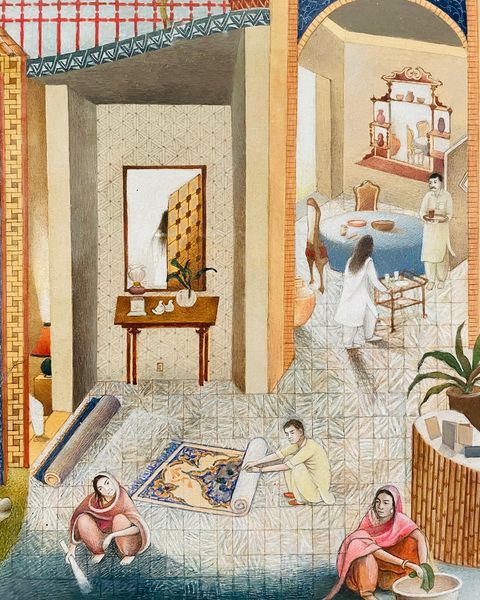
this past weekend, my sister, daughter and i went to see ‘shahzia sikander: extraordinary realities’ at the morgan library and museum in nyc. a tremendous exhibition even though it spans the first 15 years of her work only. she moved to the US the same year i did, in 1993, and i’ve been following her work since the 90s. rooted in rigorous research, filled with symbolism and iconography, unafraid to engage with the politics of empire, race and patriarchy, bent on creating a unique and personal vocabulary, sikander’s work is bold, original, and always ahead of its time. it is also beautiful – many pieces painted painstakingly over years. the details are astonishing, the overall impact of her images almost mystical (in how they simultaneously activate the mind and enchant the eyes), and the narrative intricacies of her work (with its rich subtext and references) demand attention. that she is an artist from lahore, educated at the national college of arts (NCA), who studied miniature painting under the tutelage of professor bashir ahmad, makes her all the more special to pakistanis. my daughter read every art label and took pictures of every artwork. she told me it was the best exhibition she’d ever been to. it’s moving to encounter extraordinary art. it’s sublime to recognize bits and pieces of oneself in it. i will be sharing images in several posts. as molly crabapple has said: if u are in ny, u owe it to yourself to see this exhibition.

Islamophobia is Racism

always hated the term ‘islamophobia’ although i’ve used it in presentations (in order to then unpack it). i speak about anti-muslim racism but it’s frankly exhausting. many times it feels like one is repeatedly hitting one’s head against a wall. here are some amazing resources to learn and teach more.

‘This syllabus reframes “Islamophobia” as “anti-Muslim racism” to more accurately reflect the intersection of race and religion as a reality of structural inequality and violence rooted in the longer history of US (and European) empire building. Conceptually, a focus on anti-Muslim racism is connected to an analysis of history and forms of dominance – from white supremacy, slavery and settler colonialism, to multiculturalism and the security logics of war and imperialism – that produce various forms of racial exclusion as well as incorporation into racist structures. Our primary focus is on the manifestation and impact of anti-Muslim racism in the United States. At the same time, this syllabus insists on thinking about anti-Muslim racism as a global project that overlaps and intersects with the exclusion of other marginalized groups (e.g. Black, queer, Latinx, immigrant, indigenous, etc). It also connects the histories of various racial logics that reinforce one another, including anti-Muslim racism, anti-Black racism, anti-Latinx racism, anti-Arab racism, and anti-South Asian racism.’ more here.

goodbye dear david

rochester has lost David Dornford, an anti-war activist who showed up at every community discussion, rally and protest. i remember how he would always sit in the back and catch up personally at the end. he was soft-spoken, a gentle presence, yet consistently there to validate and uplift social justice work. in a world where we are taught to compete against one another to merely survive, where steve jobs and jeff bezos represent ultimate success, where selling products and selling ourselves have become a way of life, and preemptive aggression is thought to be the only way to be ‘safe,’ david exemplified an alternative ethos. kindliness, composure, sagacity and humility. however ruthless the systems we live under, the qualities david embodied will outlast all the machismo and sales spiels. they will continue to shine. rest in power dear david. thank u Anna-Kristina Pfeifer for capturing him so beautifully.

David from Visions and Voices on Vimeo.

Free Khalida Jarrar

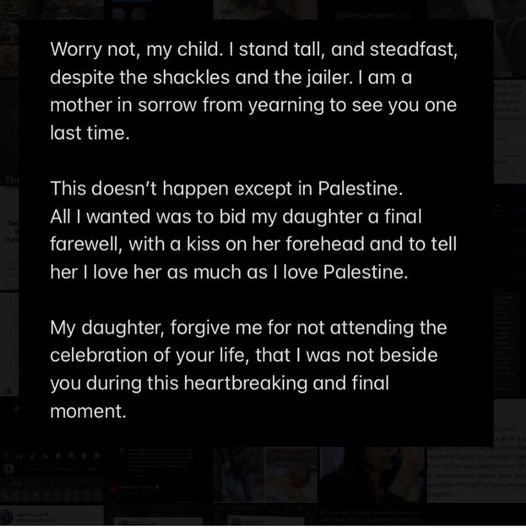
The sudden loss of one’s 31-year old beautiful, vibrant, activist daughter is pain that’s hard to even imagine. And then not be able to see her, hold her one last time, bid her farewell. To be imprisoned by the settler colony, once again, and be at the mercy of its occupying military. Cruelty, inhumanity, violence. Words are not enough.

Najwan Berekdar: At this horrendous moment of the tragic loss of her daughter, Khalida Jarrar, Palestinian revolutionary, parliamentarian & organizer, remains imprisoned in Israeli jails denied the last chance to kiss her daughter goodbye & the comfort of her loved ones. #FreeKhalidaJarrar

Watch The Muslims I Know Online Vimeo On Demand

Friends, since people don’t buy DVDs as much anymore, The Muslims I Know (2008) is now available to watch online. Give it a try and let me know what you think of the film. There’s also bonus footage you can watch from interviews I conducted back then with Thomas Gibson and Ruhi Maker, Gwendolyn Zoharah Simmons, and Edward Kannyo.

Peterson Kamwathi

Born in 1980 in Nairobi, Peterson Kamwathi is part of a generation of young East African artists whose break with the colonial tutelage that for decades defined the region’s art has afforded the exploration of topics both deeply rooted in Africa’s cultural background and engaged with global contemporary issues.

Peterson’s highly codified, symbolic, conceptual works, whose content and concepts go far beyond local relevance, distance themselves from the usual patterns of reception of figurative art from Kenya. Rendered in thick layers of charcoal, pastel, watercolor, stencils and more recently collage, Peterson’s figures are anonymous, static, almost abstract, a physical presence powerfully pushed to the forefront of the picture plane and the viewer’s attention by dense backgrounds devoid of vanishing points.

His practice, fostering the idea of art as a process-based and time-based project, often creates encapsulated visual archives by exploring contemporary themes in series and in layers, each group of works exploring social, political, personal and institutional structures symbolized through the depiction of the human figure.

Frederick Douglass’ 4th of July Speech is Today’s Must-Read

From Roxanne Dunbar-Ortiz: Every 4th of July, my liberal and left friends and family on Facebook, who as I do dislike the patriotic gore, and especially that it celebrates the Declaration of Independence with its vicious slur of the “savages,” meaning Indigenous nations, the Anglo elite and settlers alike barrier to acquiring land and more land with their horizon being the Pacific, invoke Frederick Douglass’s 1852 scalding attack on the celebration.

But, Douglass wasn’t criticizing the concepts written in the Declaration, rather calling out the hypocrisy of the call for freedom while hundreds of thousands of people of African descent lived under chattel slavery, their very bodies viewed as commodities to be traded on the market. He spoke differently, as a patriot, after emancipation, although still fighting for Black inclusion and voting rights.

From Teen Vogue, July 4, 2018:

“Douglass professed striking racism toward indigenous peoples in America. Despite being a staunch abolitionist, Douglass used a kind of racialized othering against indigenous peoples similar to what white supremacists had used against him. In an 1866 speech titled “We Are Here and Want The Ballot-Box,” Douglass spoke to a Philadelphia audience regarding the differences between black Americans and what he called “the Indian.” In an 1866 speech titled “We Are Here and Want The Ballot-Box,” Douglass spoke to a Philadelphia audience regarding the differences between black Americans and what he called “the Indian.”In one particularly brutal section, the abolitionist said, “There is no resemblance in the elements that go to make up the character of a civilized man between the Indian and the negro…[the Indian] sees the ploughshare of your civilization tossing up the bones of his venerated fathers, and he retreats before the onward progress of your civilization…he abhors your fashions, he refuses to adopt them. But not so with the negro.”

This is not to “cancel” Douglass or degrade his contribution to abolition, rather to remind that, as one important book title puts it, “Why You Can’t Teach United States HIstory without American Indians.” Race, racialism explains a great deal about US history and the present crisis of looming white nationalism, but it does not explain US militarism and imperialism. The US hundred years of war against Indigenous Nations to take the continent created the US imperialist armed forces.
Race, then, does not explain why we do not and have never really had an antiwar movement in the US, yes opposition to some specific wars, but anti-war, anti-imperialist mass movements do not last past the specific war. Race and racialism/slavery explain half of the origins of US capitalism, but is incomplete without land, land theft, land sales, real estate, settler-colonialism.