‘I have been lucky so far. I have not lost anyone in my immediate family, although I have lost most of my aunts and uncles – my parents’ siblings. Living in the U.S., away from extended family, it is difficult to mourn loved ones back in Pakistan and make such losses real. It’s like being in a state of suspension – unmoored and unsubstantial. Like you, I have lost cities, continents, friends, homes, communities, and languages. Always there is this ache in one’s heart. A sorrowful mourning. Recently, I lost Rochester, New York, a city I knew and loved for 18 years. A city where my kids grew up and where I became an activist filmmaker.’
From Lost or Found, my collab with art historian Claudia Pretelin, published in Mason Street Literary Magazine.
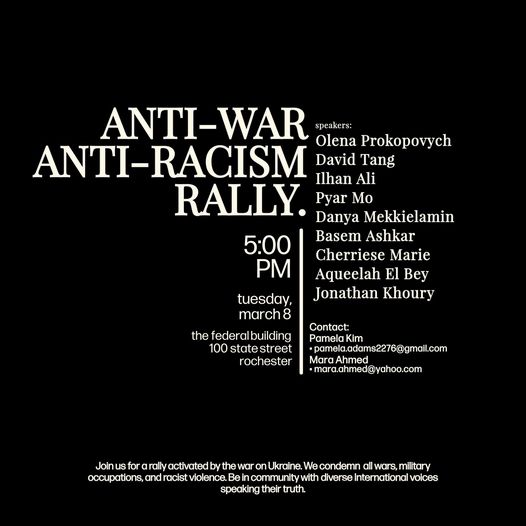
Grateful for all of the organizers and speakers who helped to put together the “War Hurts Everyone” rally tonight in front of the Federal Building. So many powerful stories of the intersections of the situation in Ukraine with so many other situations of injustice, displacement, occupation, oppression, human rights violations and war – all sharing threads of the abuse of power, racial capitalism and forms of imperialism.
Places like Ukraine, Syria, Yemen, Myanmar, Palestine, Somalia, the strees of the United States (and so many other places) all require our activism and outcry. In so many places, it is our government, our multinationals, our weapons manufacturers, our fossil fuel industry and our military suppliers who have vested interests in these conflicts and displacements.
I know that Mara and Pamela were named organizers of today (thank you!) and I know that many, many others helped to put it together and took risks in speaking their truths so that we might witness the intersections and rise up collectively. War hurts everyone, yes, but it does not hurt everyone in the same way or to the same extent.
This is happening today with a list of brilliant speakers headed by Olena Prokopovych. At 5:00 PM, Federal Building in Rochester. Pls join us!
From our Press Release:
This rally will bring together frontline organizers, activists, and community members to highlight Rochester’s solidarity with Ukraine. Horrified by the atrocities perpetuated against the people of Ukraine and the discrimination and violence inflicted on African, Asian, and Caribbean students and citizens attempting to flee the war, activists will recognize that the struggle against war, militarism, and racism, transcends national boundaries be it in Ukraine, the United States, Yemen, Somalia, Syria, or Palestine.
Their inspiration will be drawn from movements advocating for a more just and equitable world, including the thousands of anti-war activists in Russia and Ukraine calling for an end to state-sponsored violence, the movements advocating for Black Liberation here in the US and around the world, and the Boycott, Divestment, and Sanctions movement against Israel’s occupation and colonization of Palestine.
As the voices of those who have been directly affected by war, militarism, and racism must continue to be centered, a diverse group of speakers will share their experiences about how both war and resistance to invasion and occupation are presented through a racist lens. Western media and politicians have described Ukrainian refugees as intelligent, car-owning Europeans, distinguishing them from “migrants” from the Global South who are seen as a threat to European safety. This contrast in terminology plays out in real life when people of color are allowed to drown rather than reach fortress Europe.
Activists will locate the war on Ukraine within the broader context of imperial interventions, military adventurism, and the lucrative business of war. They will seek to draw attention to the defense industry raking in obscene profits by manufacturing weapons. In short, this rally aims to deepen the scope of discussions about what’s happening in Ukraine. Rather than a disconnected narrative that fails to make connections between global power structures and their violence on some of the most vulnerable people in the world, this rally will endeavor to model a cohesive and inclusive position that’s both explicitly anti-war and anti-racism.
For questions, pls contact Pamela Kim, Elora Kang, or myself.
a profile of @rashidatlaib by the brilliant rozina ali in the @nytimes. we are on the cusp of change.
‘During the 1990s the Israeli government and the Palestine Liberation Organization, along with the United States, agreed that the best solution to the conflict was the establishment of two states: a sovereign Palestine and a sovereign Israel coexisting side by side. Though the borders have never been agreed upon, the two-state outcome remains a “core U.S. policy objective,” according to the State Department. But since then, settlements have grown steadily, while military occupation of the Palestinian territories continues. Today, nearly 700,000 Jewish settlers occupy land in East Jerusalem and the West Bank, which has not only cut off some residents’ access to water and electricity but also left Palestinians with less — and more fragmented — territory for a Palestinian state in any hypothetical future negotiation. This has led Middle East experts like Zaha Hassan from the Carnegie Endowment for International Peace and Steven Cook from the Council on Foreign Relations and commentators like Peter Beinart to publicly give up on a two-state solution as a fair or realistic outcome and turn toward what was once considered a radical prospect in the debate: a single democratic state with equal rights for Arabs and Jews.
Tlaib didn’t seem to have a firm view on the best road to peace before her election. During her 2018 campaign, the liberal pro-Israel group J Street endorsed her candidacy based on a meeting and a policy paper that her team submitted, which argued that a two-state outcome, while increasingly difficult to achieve, was the best aim. Soon after, in an interview with the left-wing magazine In These Times, she reversed herself, questioning the two-state solution. After seeking clarification from Tlaib about her position, J Street pulled its endorsement. By the time Tlaib reached Washington, she was the only member of Congress to publicly back a single, fully democratic state.’
it’s hard to be a person of color, someone whose identity’s foundational stone was set in the non-western world and engage with media, history, or culture produced by the west. one is constantly negotiating a minefield. with all its politico-historical analysis and feeling, the russian invasion of ukraine is not a global south problem. it does not, for the most part, involve people of color. yet western commentators, media and politicians found ways of dragging in the other and raising their glass to racism.
first the bulgarian PM said something like: ‘these are not the refugees we are used to. they are european, intelligent, educated people, some are IT programmers…this is not the usual refugee wave of people with an unknown past. no european country is afraid of them.’
in the british telegraph, daniel hannan wrote emotionally: ‘they seem so like us. that is what makes it so shocking. war is no longer something visited upon impoverished and remote populations. it can happen to anyone.’
on france’s BFM TV, a commentator pontificated: ‘we’re not talking here about syrians fleeing the bombing of the syrian regime backed by putin, we’re talking about europeans leaving in cars that look like ours to save their lives.’
and on america’s CBS news a world-weary guy declared: ‘this is not a place like iraq or afghanistan…’ he was generous enough to call ukrainian cities ‘relatively civilized’ and ‘relatively european,’ confessing how he had to choose those words carefully.
to hell with these people and their parochial, racist worldview. posting this graphic to remind everyone that folx are the same everywhere, war is always repugnant, and some of the most grotesque violence in the world is funded and wielded by the ‘civilized’ west.
stop wars everywhere. and let people move freely and safely.
finished reading ‘south of the border, west of the sun’ last night, my second book by haruki murakami. i’ve also read ‘norwegian wood’ which my daughter and i agreed was uncomfortably cringy on account of the graphic, borderline pushy sex the male narrator has with women who are mentally and emotionally fragile, depressed or broken. it reads like abuse.
‘south of the border’ follows the same pattern in that the female characters are poorly drawn. they are tragic victims of hormone-driven male misadventures and blend inelegantly into background noise, or they’re mysterious sex goddesses dedicated to male pleasure in its oddest configurations (they disappear soon after the male narrator has climaxed), or they are the good girlfriends and wives who endure unimaginable pain and humiliation but remain devoted to whatever relationship the male narrator can manage.
according to katarina kio, murakami’s work is ‘incredibly gendered’: ‘The perniciousness of… women as “mediums” becomes evident in Murakami’s novels. Women in his work are often constructed as solely vessels for the self-actualisation of men. One-dimensional female characters orbit around existentially challenged male leads, experiencing relatively little character development of their own.’
murakami is not alone. sex, its depiction and language, and the power dynamics it inscribes are equally unsettling in other universally admired writers such as gabriel garcia marquez, v. s. naipaul, philip roth and michel houellebecq.
they make me feel like i’ve stepped into an outdated, highly misogynistic male fantasy. it’s alienating and unpleasant. makes me realize how grateful i am for writers like elena ferrante whose work i devoured as soon as it became known to the english-speaking world. it was like stepping into another dimension. a place were women were central and in focus, where their thoughts, desires and relationships could begin to be articulated and made real, where they were flesh and blood rather than hollow specters subservient to the quirks of male psychology and anatomy.
to women writers and an alternative literary canon.
so relieved that the hostage situation at the colleyville synagogue ended without any hostages being hurt. the captor was killed, not sure how, but the hostages escaped or were let go and are safe. thank god.
bringing violence and terror into a house of worship is a special kind of horror, whether in texas, pittsburgh, christchurch, quebec city, charleston or birmingham, whether within the purview of what we mourn and condemn officially or further away in the darkest recesses of empire and settler colonialism (remember the house to house killings in fallujah including shootings inside a mosque during the US siege, or more recently, the brutal raid on al-aqsa mosque).
a special kind of horror.
don’t know if we will ever learn the truth about the texas hostage-taker (msm will agitate, jumble together and churn out its own political fantasies), but i wish he hadn’t dragged aafia siddiqui into his delusions.
aafia siddiqui is living her own horror, the kind where one is reduced to sub-human chaff, a by-product of the war on terror’s systems of annihilation – bleeding, screaming, squashed waste stowed away in guantanamo or miscellaneous black sites and prisons. she was disappeared in 2003, near islamabad, along with her 3 children (the youngest was 6 months old at the time and is still missing, presumed dead). she has been detained, tortured, kept in solitary confinement for almost 20 years. it’s beyond comprehension, perhaps beyond human empathy or compassion. a lot of what was ‘churned out’ to justify her destruction, reads like lurid accusations of witchcraft back in the 1600s. her family has nothing to do with what happened. her brutalization started a long time ago. her nightmare needs to end.
recently i finished reading ‘the plague’ by albert camus, a meticulously crafted, philosophical novel, written with scientific clarity as well as breathtaking lyricism.
one of my favorite conversations, towards the end of the book, is between tarrou and the book’s protagonist, dr rieux. it’s a masterpiece.
first the convo itself. it’s a personal side of tarrou we’ve never seen before. there is an unsentimental, uncomplicated common decency/sense of justice to him that i find beautiful. here’s tarrou:
..So that is why I resolved to have no truck with anything which, directly or indirectly, for good reasons or for bad, brings death to anyone or justifies others’ putting him to death.
…The good man, the man who infects hardly anyone, is the man who has the fewest lapses of attention. And it needs tremendous will-power, a never ending tension of the mind, to avoid such lapses.
…I’d come to realize that all our troubles spring from our failure to use plain, clean-cut language. So I resolved always to speak, and to act, quite clearly, as this was the only way of setting myself on the right track.
…After a short silence the doctor raised himself a little in his chair and asked if Tarrou had an idea of the path to follow for attaining peace. “Yes,” he replied. “The path of sympathy.”
then rieux says:
…I feel more fellowship with the defeated than with saints. Heroism and sanctity don’t really appeal to me, I imagine. What interests me is being a man.
a brilliant exchange after which they go for a swim, to get away from the pestilence and its ravages, and camus describes the vast, velvety, moonlit expanse of the sea heaving gently.
one of the most defining, unforgettable, stunning moments in cinema. and history. sidney poitier. a life of firsts. one of the most beautiful and elegant actors to grace the screen. proud. masterful. charming. electric. with a spine of steel. a giant. no one can ever fill his shoes. a staggering loss. may he rest in power.
Palestine and Kashmir are the moral litmus test of our times. It’s not just that these occupations have lasted more than 70 years, or that generations of indigenous peoples have been exposed to extreme oppression and violence, it’s also the systemic censorship imposed on any call for justice and human rights. Those who speak up are ruthlessly silenced and punished.
Archbishop Desmond Tutu spoke up and compared the apartheid in Palestine/Israel to the structural racial segregation that existed in South Africa.
He wrote:
“Those who continue to do business with Israel, who contribute to a sense of ‘normalcy’ in Israeli society, are doing the people of Israel and Palestine a disservice. They are contributing to the perpetuation of a profoundly unjust status quo.” Rest in power Desmond Tutu.
Solmaz Sharif: “I felt a need to interrogate the violence that is happening as a result of war by using the very language of war. I think any violence that’s committed against human beings is premeditated in violence against language itself.”
In a series of poems called “Personal Effects,” Sharif writes:
Daily I sit with the language they’ve made of our language to NEUTRALIZE the CAPABILITY of LOW DOLLAR VALUE ITEMS like you.
“It is essential to our struggle for self-determination that we speak of love. For love is the necessary foundation enabling us to survive the wars, the hardships, the sickness, and the dying with our spirits intact. It is love that allows us to survive whole.”
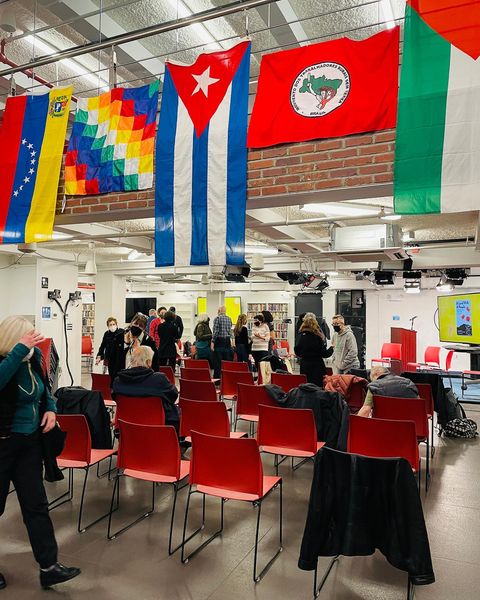
at the people’s forum in manhattan, for the first time ever, to attend the book launch of ‘a land with a people: palestinians and jews confront zionism.’ brilliant space (look at the books and posters) and brilliant event. congrats sarah sills, esther farmer and ros petchesky.
i am reading the book right now and i recommend it strongly. it uses personal stories to deconstruct racist myths and make visible the violence of zionism. as one of the contributors said: it’s not about ethnicity or religion, it’s about supporting colonial regimes or decolonization.
pls read the book and share with others. name and confront zionism just like we name and confront racism, settler colonialism, and white supremacy. imagine a just and hopeful future for all.
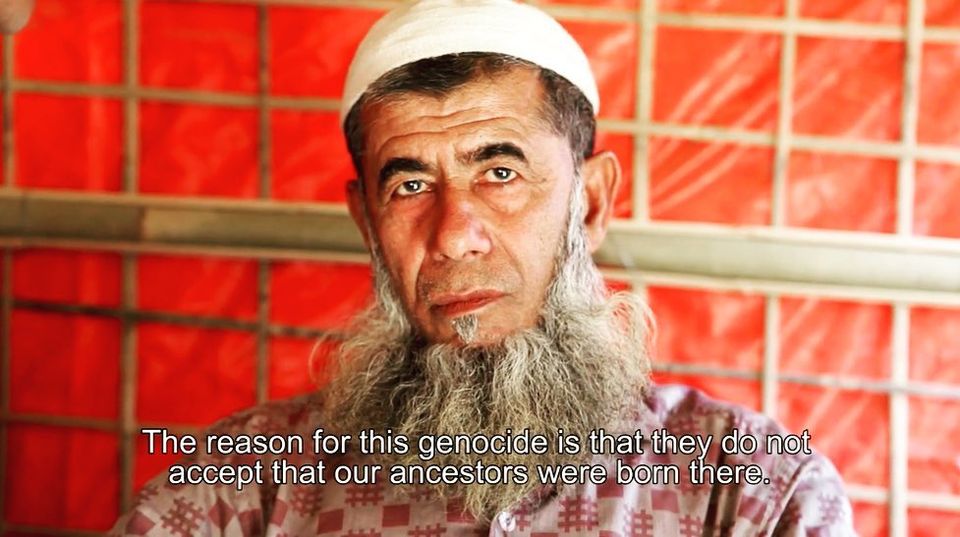
this fall, i was honored to be one of the jurors for the south asian film festival of montreal, and i got to see some powerful documentaries. one of them is called ‘the ice cream sellers’ by bangladeshi filmmaker sohel rahman. it follows two children in a rohingya refugee camp in bangladesh, and tells the stories of many of its uprooted residents. the opening shots create this sharp contrast between the stunning beauty of the fields and hills in bangladesh and the destitution of people who have witnessed hideous violence. the film’s cinematography is beautiful. its quiet, long shots allow us to take in the immensity of the situation. it’s not manipulative, with no music or fancy editing. rather it’s a sobering ethnographic portrait of royingya refugees. the film is raw, truthful, moving.
the little boy, ayas, at the center of the film (the ice cream seller), seems much older than his years. there is a sadness and anger in him. he and asia, his sister, are deeply traumatized by what they have experienced and by the absence of their father. genocide does not just affect those who are exterminated, it produces ongoing generational trauma.
the festival ends on november 28th so there are still a few days left to watch a large number of new films, many of them for free. google south asian film festival of montreal.
Keeanga-Yamahtta Taylor on the Rittenhouse verdict: White power. A declaration of “open season” on opponents of racism. For those of you who think anti-racism or woke politics is the problem, I hope you drag your head out of your ass and see the light of day.