A convo with Uzma Aslam Khan at McNally Jackson Seaport

I am honored to engage in conversation with the brilliant Uzma Aslam Khan about her new book, The Miraculous True History of Nomi Ali, on June 28th (7pm) at McNally Jackson Seaport (4 Fulton St) in NYC.

Beautifully written and part of the important process of decolonizing history and literature, Uzma’s book brings to life revolutions that have been erased and forgotten, and exposes (oh so eloquently) the mechanics of colonial oppression. It’s a stunning book that demands a rich convo.

Pls join us for a discussion, reading and book signing in NYC. Tickets are available here. Pls invite others and share widely!

The Amber Heard-Johnny Depp trial was an orgy of misogyny

Moira Donegan: For their part, Depp’s fans seem to not so much deny Depp’s alleged violence against Heard, but to approve of it. “He could have killed you,” says one viral Tiktok supporting Depp, the text superimposed over photos of Heard’s bruised face. “He had every right.” The post has more than 222,200 likes.

The backlash to #MeToo has long been under way. Critics of the movement painted women’s efforts to end sexual violence as excessive and intemperate from the start, claiming #MeToo had “gone too far” before it really got under way at all. And yet the Heard trial does feel like a tipping point in our culture’s response to gender violence. The forces of misogynist reaction are perhaps even stronger now for having been temporarily repressed. Where once women refused, en masse, to keep men’s secrets, or to remain silent about the truth of their own lives, now, a resurgence of sexism, virulent online harassment, and the threat of lawsuits, all aim to compel women back into silence – by force.

In some ways, one could see the defamation suit itself as an extension of Depp’s abuse of Heard, a way to prolong his humiliation and control over her. The only difference is that now, the legal system and the public have been conscripted to take part. This seems to be at least partly how Depp sees it. In 2016, as their marriage broke apart, Depp texted his friend Christian Carino, vowing revenge against Heard. “She is begging for global humiliation,” Depp wrote. “She is going to get it.” From the Guardian.

Rest in Power Shireen Abu Akleh

Repost from @shirien.creates

Shireen Abu Akleh was shot on Wed May 11 by Israeli forces while reporting on their raid on the occupied Palestinian city of Jenin.

Shireen was wearing a press vest, which is a recognized symbol and way to identify her as press and provide a level of protection. She was also wearing a helmet. Shireen’s colleagues and eyewitnesses described that she was directly targeted by an Israeli sniper and shot with precision.

Shireen was a well-known Al Jazeera journalist that so many of us grew up watching as she covered the news on the ground in Palestine for decades. She was a household name for Palestinians across the diaspora, glued to their TVs to know what is happening in the homeland in times of crisis.

The fact that Israeli forces can kill such a famous reporter with impunity speaks volumes about the state of what’s happening in Palestine. Not even those trying to shed light on the situation are safe.

I couldn’t sleep last night when I heard the news of Shireen’s murder, so I drew this portrait in her honor. My thoughts and prayers are with her family, loved ones, and colleagues. Her voice will not be forgotten.

Allah yir7amha. Justice for Shireen. Free Palestine.

The Reassuring Hand Gestures of Big Men, Small Men, All Men

‘Berlin-based Pakistani artist Bani Abidi’s photographic work, The Reassuring Hand Gestures of Big Men, Small Men, All Men (2021), is one that gently chips away at longstanding mythologies of male power. And like those myths, it works by endless repetition, in this case, and as the title suggests, of the hand gestures that have, for millennia, been an essential component of the performance of politics.’
Some of the individuals featured in this work: Muhammad Zia-ul-Haq, Ronald Reagan, Mahmoud Ahmadinejad, Alexander Lukashenko, Jair Bolsonaro, Tony Blair, Imran Khan, Narendra Modi, Vladimir Putin, Donald Trump, Joseph Stalin, Hun Sen, Robert Mugabe, Kim Jong-un, Idi Amin, Benjamin Netanyahu, John F. Kennedy, Barack Obama, Abdel Fattah el-Sisi, Omar Al-Bashir, Fidel Castro, Boris Johnson, Bill Clinton, Saddam Hussein, Haile Selassie, Jorge Rafael Videla, Pervez Musharraf, Muhammad Ayub Khan, Augusto Pinochet, Than Shwe, Kim Jong-un, Mohammad Reza Pahlavi, Muammar Gaddafi, Jean-Bédel Bokassa, etc

The Man Who Talked Until He Disappeared

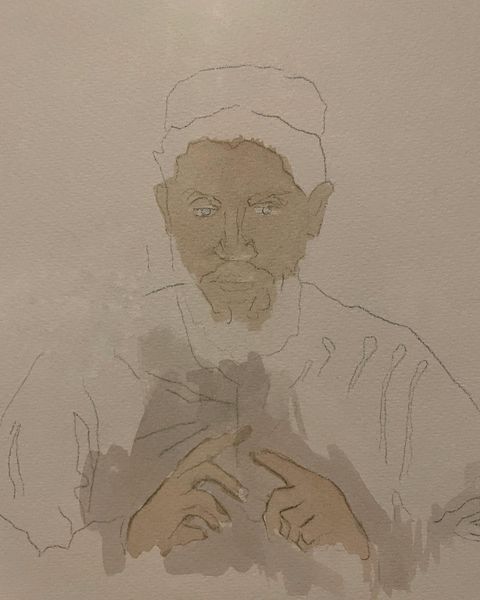
The exhibit at MCA takes its name from Bani Abidi’s watercolor series “The Man Who Talked Until He Disappeared” which depicts writers, political leaders and bloggers from Pakistan who have been disappeared on account of their activism over the past decade. In this minimalist delicate series, we see them disappear gradually on paper with the last watercolor portraying threadbare, eyeless, bodiless specters that continue to haunt us.

#baniabidi #mca #museumofcontemporaryart #chicago #pakistan #pakistaniartist #disappearances #politicaldisappeared #politicalviolence #stateviolence #militaryviolence #thedisappeared #themanwhotalkeduntilhedisappeared

Memorial to Lost Words

This sound installation by Pakistani artist Bani Abidi at MCA brought me to tears. A powerful memorial to the one million South Asian/Indian soldiers who fought in WW1 but have been completely erased. My own great grandfather fought in France, under British colonial rule.

Bani Abidi’s Memorial to Lost Words is a song installation based on letters and songs from the First World War. They are not the well archived memoirs of European and British soldiers, but the words of Indian Soldiers and their womenfolk back home in India. Even a hundred years after the fact, it is a little known fact of WWI history that more than a million Indian soldiers fought in this war. So, clearly, official accounts and memorials are very rarely truthful transmitters of history. This memorial draws from letters that were written home by Indian Soldiers and folk songs that were sung by their wives, mothers and sisters at the time but were censored or forgotten because of their candid condemnation of the war.

#baniabidi #pakistaniartist #mca #museumofcontemporaryart #chicago #worldwar1 #indiansoldiersinww1 #southasiansoldiers #soundinstallation #memorial

The Miraculous True History of Nomi Ali

What I’m reading right now: ‘The Miraculous True History of Nomi Ali’ by the brilliant Uzma Aslam Khan.

Caught between British and Japanese colonialism, the Andaman Islands (a penal colony often referred to as Kala Pani) in the early 1940s are the setting for Uzma’s fifth novel.

“How is history handed down to us? Who narrates it? And what role does perspective play in shaping facts? Uzma Aslam Khan’s latest novel, The Miraculous True History of Nomi Ali, is a vibrant defiance of traditionally accepted histories. Through a rejection of historically privileged perspectives, well-rounded and responsible research, and a lyrical narrative that a reader can effortlessly float through, Khan gives a voice to the marginalised and oft forgotten.”

#uzmaaslamkhan #novel #books #bookstagram #themiraculoustruehistoryofnomiali #adamanislands #kalapani #penalcolony #britishcolonialism #japanesecolonialism #prison #colonialprison #colonialhorrors #india

Iqbal Masih – Pakistan’s child hero

It is often said that Pakistan is a hard country. That it demands too much of its people. Even its children…

Repost from @purana_pakistan:

Iqbal Masih was born in 1983 to a low-income Christian family in Muridke, a commercial city outside of Lahore.

At age four, he was put to work by his family to pay off their debts. Iqbal’s family borrowed 600 rupees ($3.23) from a local employer who owned a carpet weaving business. In return, Iqbal was required to work until the debt was paid off. The work was intensive. Child labourers were bound with chains to carpet looms to prevent escape.

Iqbal worked 14 hours a day, six days a week, with only a 30-minute break. He made 1 rupee a day, but the loan continued to increase due to interest and his family’s need to take on more loans.

At the age of 10, Iqbal escaped his slavery, after learning that bonded labour had been declared illegal by the Supreme Court of Pakistan. He went to the police to report his employer, Arshad, but the police brought him back to Arshad. Iqbal managed to escape a second time. He attended the Bonded Labour Liberation Front (BLLF) School for former child slaves where he acquired his education in two years.
Iqbal went on to help over 3,000 Pakistani bonded laborers get freedom and made speeches about child labour throughout the world.

He expressed a desire to become a lawyer and began to visit other countries including Sweden and the United States to share his story and encourage others to join the fight to eradicate child slavery.

Iqbal was fatally shot by Ashraf Hero, a heroin addict, while visiting relatives in Muridke on 16 April 1995, Easter Sunday. He was 12 years old. His mother said she did not believe her son had been the victim of a plot by the “carpet mafia”. However, the Bonded Labour Liberation Front disagreed because Iqbal had received death threats from individuals connected to the Pakistani carpet industry.

His funeral was attended by over 800 mourners. ‘The Little Hero: One Boy’s Fight for Freedom’ tells the story of his legacy.

Meet the Storytellers Behind The Warp & Weft

Last week on April 21st, 11 writers and artists from the Warp & Weft met one another on Zoom and shared important insights about their stories. We had storytellers joining us from Gaza/Palestine, the Gambia, Ireland, California and New York. It was a rich and dynamic discussion. Multidimensional – for the personal is always political. Pls check it out and visit the Warp & Weft [Face to Face] at Rochester Contemporary Art Center. It will be on until May 7th.

bilquis bano edhi – the mother of orphans

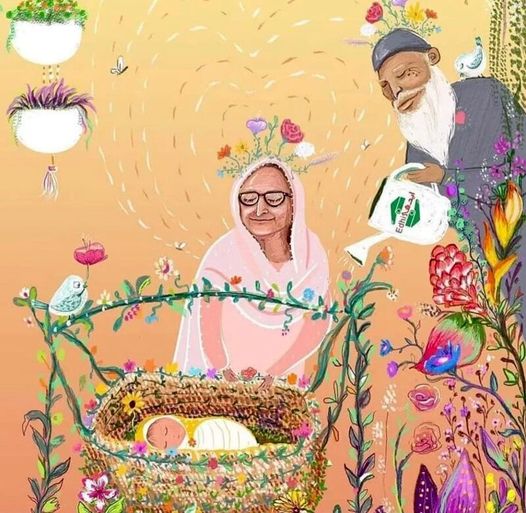
a tribute to bilquis bano edhi (august 1947 – april 2022), the mother of orphans, who together with her husband abdul sattar edhi created the edhi foundation, pakistan’s largest welfare organization. the stats are incredible: 50,000 orphans and 20,000 abandoned infants rescued, more than 40,000 nurses trained, a fleet of 1,800 ambulances, 28 rescue boats, and a helicopter for air ambulance service. it all started with Rs 5,000 and the drive to do god’s work and help others. no nobel prize for empowered people from the global south, but today i read a tribute to bilquis edhi by a young woman who was abandoned as an infant, was raised by bari amman (bilquis edhi as she was called by her many adopted children), went to school and won scholarships, studied law and is now a successful executive. thank u bilquis ji for all u have done. the stars will shine brighter as u are welcomed to eternal life. inna lillahi wa inna ilayhi raji’un.

[artwork by @maria_riaz_illustrates]

#biquisedhi #bilquisbanoedhi #abdulsattaredhi #edhifoundation #godswork #helpingothers #motheroforphans

opening of the warp & weft [face to face] at roco

the opening of the warp & weft [ face to face ] at @roco137 was all about community. and the rochester community did not disappoint. so many people i love gathered in one space to listen to and connect with an archive of stories in all its splendid human diversity. thank u rochester <3 more pictures on instagram @mara__ahmed

#warpweft #warpweftf2f #thewarpweft #archiveofstories #audioarchive #storytelling #oralstorytelling #multilingualarchive #community #artandcommunity #rochestercontemporaryartcenter #rochesterny #artandactivism #wearethearchive

Meet the storytellers behind The Warp & Weft

On April 21st at 6pm EST, join Rochester Contemporary Art Center for a virtual conversation with The Warp & Weft writers, artists and activists. They will share their reflections about 2020 and the inspiration/process behind their stories. Together they will help highlight the importance of archiving diverse voices and the crucial role storytelling can play in times of uncertainty and upheaval.

Our speakers will connect with us from Gaza (Palestine), the Gambia, Ireland, Oakland (California), Rochester (New York) and Long Island. Registration is necessary. Pls register at the RoCo website.

Speakers (in alphabetical order):

Ashwaq Abualoof
Darien Lamen
Deema K. Shehabi
Erica Bryant
Ian Layton
Kaddijatou Fatty
Karen Faris
Quajay Donnell
Rose Pasquarello Beauchamp
Selena Fleming
Zoë Lawlor

The Warp & Weft [Face to Face] at RoCo

In 2020 and later in early 2021, I was honored to work with an international group of truth-tellers, writers, poets, artists and activists who shared their personal stories and reflections. We built a multilingual archive together called the Warp & Weft, because it wove the threads of our thoughts and emotions together. Now a year later, the Warp & Weft [Face to Face] is coming to Rochester Contemporary Art Center as a multimedia exhibition. It opens on April 1st with an artist’s talk at 6:30pm. You will be able to meet some of the brilliant storytellers at a Zoom event on April 21st starting at 6pm. And you will have a chance to see the exhibition at RoCo until May 7th. This is beyond exciting – I hope that you can join us!

‘Visit The Warp & Weft [Face to Face] at RoCo and immerse yourself in a colorful tapestry of stories. You can social distance, yet walk through the material expression of the archive and experience the beauty of human ideas and kinship.’

Thank you Bleu Cease, Rajesh Barnabas, and the RoCo team for all the hard work in bringing this project to life.

#thewarpandweft #thewarpweft #thewarpweftfacetoface #thewwf2f #multilingualarchive #archive #storytelling #oralhistories #yearofthepandemic #roco137 #multimedia #multimediaexhibition #maraahmedstudio #maraahmed