steven salaita in rochester

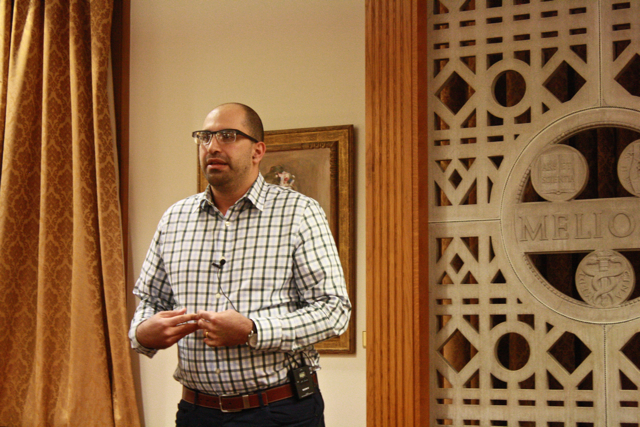
oct 30, 2014: met steven salaita this evening after his talk at the university of rochester. the topic was “digital means, political ends, and academic freedom in the new gilded age.” before steven took the stage, ted brown (u of r) talked about his work on the use of x-rays to treat skin conditions and his collaboration with israeli doctors. that research has opened his eyes to aspects of zionism he was unfamiliar with. lisa cerami (nazareth college) discussed the corporatization of american universities and the focus on profits. increasingly students are seen as the consumers of a certain “brand” which must be protected at all costs. the inequities that exist within that corporate system and the vulnerability of 75% of those who teach and who are non-tenure track faculty, mirror the inequities and labor class vulnerabilities which exist in american society at large. tom gibson (u of r) spoke about a long history of attacks on academic freedom starting with world war i. steven began his talk with palestine/israel, which is central to his present travails. he said he didn’t mince his words: the so-called conflict is about colonization and it will end with decolonization. he had no doubts about that. he talked about the importance of activism and the right to be compassionate as an academic who studies marginalized communities. it wasn’t enough to observe and document like a detached nature photographer. one of the points he made truly resonated with me. the idea of “civility” (his tweets were deemed “uncivil” and that’s one of the reasons he was fired by the university of illinois) and how it applies to his area of specialization, native american studies. the sheer violence meted out to indigenous peoples has always been expressed in very polite language, which makes that barbarity all the more insidious. civility is about toeing the neoliberal line, it’s about kowtowing to power and maintaining the status quo. the evening ended with excellent Q&A. great questions from a wide spectrum of political affiliations, and from steven: absolute respect, considered engagement and complete honesty. any university would be lucky to have him on their faculty – if education/learning is what matters in the end.

steven salaita at the university of rochester

liberty screams: reflections in poetry and prose on mass incarceration and parole reform

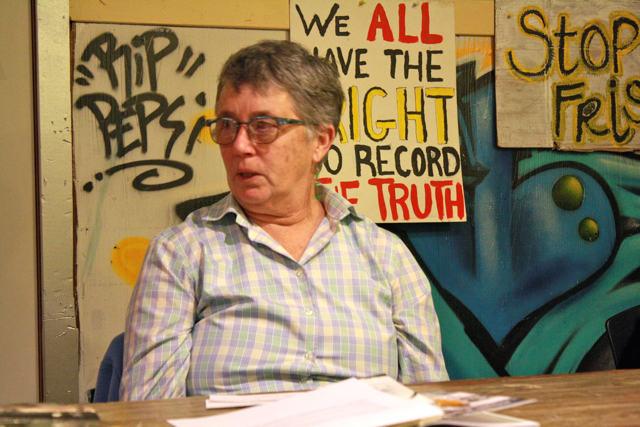
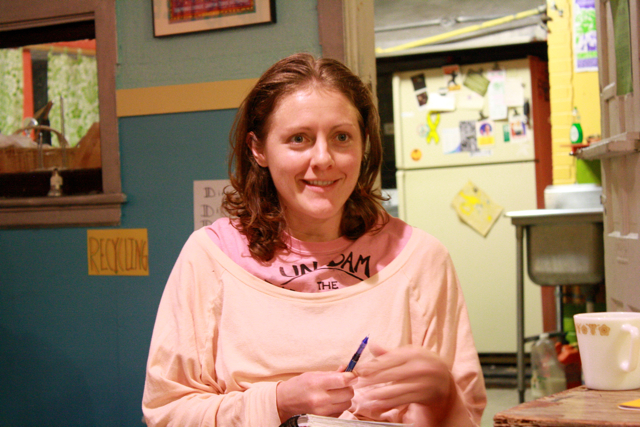
oct 25, 2014: the flying squirrel’s “stop mass incarceration” programming continued today with “liberty screams: reflections in poetry and prose on mass incarceration and parole reform.” the panelists were poets paulette swartzfager and pat schwartz (co-founder, with jalil muntaqim, of the auburn correctional poetry group) and activists jean douthwright, emily good and michael argaman. agape towns and his friend dave were able to participate on the phone from attica. so lovely that i received a letter from jalil today telling me about a new, expanded collection of poems to be published in canada, with a 20 page intro by ward churchill. i got to listen to some of his poems this evening and they blew me away with their brilliance and power. free jalil muntaqim! more about jalil’s case here.

poet pat schwartz
poet pat schwartz
activist michael argaman
poet paulette swartzfager
activist jean douthwright
activist emily good
activist emily good

A Conversation With Steven Salaita

this is an incredibly important event both for free speech and palestinian solidarity. hope u can join us!

“Digital Means, Political Ends, and Academic Freedom in the New Gilded Age: A Conversation With Steven Salaita”

Steven Salaita received his PhD in 2003 in Native American Studies at the University of Oklahoma. In the decade since, he published six books on topics ranging from Arab literature, to Anti-Arab racism in the United States, to the politics of Israel and Palestine. As a scholar, Salaita is not the sort to remain cloistered within the ivory tower. He is an activist. A Palestinian-American by heritage and identification, Salaita has been active in efforts to mobilize scholars to fight for justice for Palestinians.

In August, when Dr. Salaita was poised to begin a tenured professorship in the American Indian Studies Program at the University of Illinois at Urbana-Champaign, he was preemptively fired. His apparent offense? A series of provocative tweets that he authored during the then still ongoing war in Gaza.

Across the humanities and social sciences, faculty was outraged. Over 5,000 scholars from a range of disciplines and at various levels of professional advancement signed petitions pledging to boycott the University of Illinois until the situation had been rectified. Regardless, on September 11th, by an 8-1 vote, the University of Illinois’ Board of Trustees rejected Salaita’s appointment.

Both for scholars seeking to change the world and for scholars concerned merely with keeping their jobs, the Salaita affair is a parable for the academy in these trying times. The questions it raises are many: how might scholars with political commitments best advocate and organize? What opportunities and perils do digital media present? Does what one writes on social media belong to one’s private life or does it become part of one’s scholarly portfolio? What sorts of speech does the principle of academic freedom protect? What speech is exempt? Or, maybe, whose speech is exempt? And perhaps most crucially, in an era of the academic precariat, weakened public sector institutions, and hyper-empowered economic elites, just how sacred a principle does academic freedom remain?

On October 30th, come to the University of Rochester to see Professor Salaita discuss these issues and more. Framing commentary will be offered by Ted Brown and Tom Gibson of the University of Rochester, and Lisa Cerami of Nazareth College.

This event is generously cosponsored by the following departments, programs, and institutes at the University of Rochester: American Studies, Anthropology, Art and Art History, English, Film and Media Studies, The Frederick Douglass Institute for African and African American Studies, History, The Humanities Project, Philosophy, Religion and Classics, The Susan B. Anthony Institute for Gender and Women’s Studies, and Visual and Cultural Studies.

cultural competence panel at summit business conference

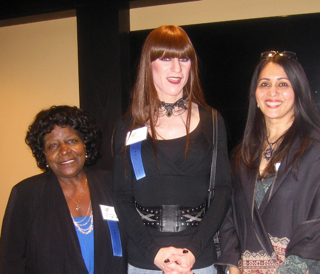
attended a business conference organized by rochester women’s network today. i was on a panel that discussed cultural competence. it was amazing to me how much overlap there was in what i had to say as a muslim woman, what gabrielle had to say as a trans-woman and what margie had to say as an african american woman. the things that we stressed were: openness, respect, immense diversity within any group and therefore the irrelevance of stereotypes, the toxic nature of dehumanization and condescension (i quoted wade davis: every culture that’s different from u is not a failed attempt at being u) and the richness of learning by allowing new information to seep in and affect beliefs and behavior.

i reminded everyone that identity is too porous and complex to contain w/i the narrow confines of religion, ethnicity or culture. the words that i liked most in the definition of cultural competence were suspension of judgment and discomfort. only if we’re willing to be intellectually and emotionally uncomfortable, do we find it possible to be truly open to other human beings. it’s much riskier than staying put, in one’s comfort zone.

of course, i had to make it broader and asked people to think about openness, respect, risk-taking and growth and apply these to nation-states: what kind of interruptions should we allow to our sovereignty, how can we rethink our politics on immigration and national borders, on the meaning of citizenship and universal human rights, on the narrative of us vs them, and the assumption of immutable identities that we are supposed to be at war with. discomfort is good if it can help us open up to our fellow human beings and our environment. more about the conference here.

here i am with fellow panelists margie lovett scott (left) and gabrielle hermosa (center).

margie lovett scott, gabrielle hermosa and mara ahmed

diaghilesque in rochester

sept 26, 2014: “diaghilesque” (part of fringe fest at geva theatre) showcases gems of diaghilev’s ballet russe by giving them a post modern/burlesque treatment. i have to think more on my reaction to the show. yes, there were completely naked dancers, lots of uncensored vulgar sex talk, transgenderism, and some beautiful ballet, but i’m not sure it made a long-lasting impression on me. it did make me think about nakedness, the human body, art and eroticism but when it comes to evaluating the show itself i think i lean more towards gimmicky rather than high art. maybe high art is not even what ny-based kinetic architecture dance theatre is going for. it’s definitely fringe. my favorite piece was scheherazade in which the female dancers were clothed in glittery, extremely sheer fabric. it made them look ethereal. it was the first time i noticed their faces. they danced most beautifully.

From the Democrat & Chronicle: In the early 20th century, there was no figure more influential in the world of dance than the legendary impresario Sergei Diaghilev, whose company Ballets Russes set the tone of modern dance for years to come with works choreographed by such artists as Michel Fokine and Vaslav Nijinsky, with original music by the likes of Claude Debussy, Igor Stravinsky and others.

On Thursday, September 25, transgender dancer and choreographer Arrie Fae Davidson led her small troupe of dancers comprising the KineticArchitecture Dance Theatre in Diaghilesque, a 21st-century recontextualization of these seminal and storied ballets in the second of a four-night run at Geva Theatre as part of the 2014 First Niagara Rochester Fringe Festival.

This reimagining by Davidson–who is sometimes referred to as Faux Pas le Fae–features a veritable mélange of styles in which classical ballet technique and abstract contemporary movement commingle together with the twin spirits of burlesque and performance art. At the outset, six dancers converged on the stage wearing nothing but white, button-down dress shirts and black masks with protruding beaks, à la Pulcinella of commedia dell’arte lore. Davidson then proceeded to welcome the audience–“ladies and gentlemen in all manners of gender”–briefly cataloging the variations of nudity one could expect during the dance vignettes that were to follow.

And while the pervading mood of the evening was one of mischievous play–a tongue-in-cheek ode of optimism to self-expression and liberated sexual and gender identities–it was always grounded in the experiential knowledge that such freedom often comes only after intense struggle.

This was especially apparent during Davidson’s own solo interpretation of “The Dying Swan,” a role originally created for and performed by Ballets Russes dancer Anna Pavlova. Davidson prefaced this melancholic yet triumphant performance with a moving testimonial detailing times in which her transgender identity was met with opposition from societal conventions and people espousing “gender norms.” For the artist, these moments of harsh reality were analogous to dying, but it seemed that the dance itself signaled a kind of rebirth.

Later on in the evening, two topless “Firebirds” engaged in a sensual pas de deux, initially accompanied by Stravinsky’s original ballet score before accumulating sound clips of Johnny Cash’s “Ring of Fire,” The Doors’ “Light My Fire,” and other ubiquitous pop culture references piled on top of one another with a cacophony that was made all the more poignant in contrast to the intimate dance combining softness, strength, and emotional chemistry. In this selection, as well as in the company’s truncated version of “The Rite of Spring,” music editor Mark Schaffer’s keen ear for compelling mashups played a significant role in the communicative power of the dance.

Taking liberties with Fokine’s ballet Les Syphides, in which a poet encounters ethereal spirits of the air known as sylphs, Davidson and company presented a satirical yet serious-minded pantomime depicting an unhealthy sexual relationship characterized by deceit and abuse, of which the emotional and psychological aftermath was articulated beautifully in a solo by dancer Koryn Wicks.

As mentioned in the festival’s promotional materials, due to the performance’s consistent rejection of clothing and its frank handling of the subject matter, Diaghilesque is only suitable for mature festival-goers. That said, it is important to note that KinectArchitecture succeeds in making the nudity less about titillation and much more about establishing a clear conduit between body and emotion. It was as if the dancer’s inner psychological workings were projected in the movements.

And though a reordering of the individual pieces may have resulted in a more compelling dramatic arc–particularly in the case of a well-executed, but anti-climatic closer in “Le Spectre de la Rose”–Diaghilesque is substantive yet frisky art, provocative entertainment with heart.

“the muslims i know” screened at suny brockport diversity conference

oct 2, 2014: the diversity conference at suny brockport was most excellent! enjoyed the multicultural food tasting. my favorites: south african masala pineapple, caribbean meat patties and ethiopian lamb kebabs. the screening went v well. great audience and good intro by dr james spiller, who’s the dean of the graduate school. he asked me the last question during Q&A: “what does it feel like to see extremists commit acts of violence in the name of one’s religion? isn’t it the ultimate desecration?” i told him it was a good question but it doesn’t apply uniquely to muslims. after all, violence is being committed all over the world, by all kinds of people, in the name of all kinds of ideologies. does it make us feel better if we proclaim that the violence we’re committing is in the name of democracy? i talked about iraq: one million killed, 10-12 million people displaced, chemical weapons used extensively in fallujah with devastating results to this day. is it less of a desecration because it was done in the name of democracy? or capitalism (which is a religion in america, according to naomi klein), or oil, or some kind of ethno-religious ideology (such a zionism)? shouldn’t we start being objective, ignore all the window dressing and condemn violence for what it does – inflict pain and suffering on other human beings? dr spiller thought i was being “provocative” but i was just being sincere. more about the conference here.

AAVia Foundation Launches

The AAVia Foundation for the Health of Bolivian Children is a non-profit organization based in Fairport which focuses on improving health care for children in Bolivia. They partner with Bolivian-based programs working to improve the health and well-being of children there. Pls watch this interview with the wonderful Timothy Malia and his daughter Mackenzie regarding the AAVia Foundation’s upcoming Annual Gala. Hope you can support their work. More here.

“the fever” by wallace shawn at rochester fringe

last night i went to see (obie-winning playwright and actor) wallace shawn’s one-man play “the fever.” it’s a gritty work that is more stream of consciousness than prose. loved it. could identify with shawn’s thoughts about the close connection between rich and poor and the part we choose to play in order to live with our complicity and guilt. it was an aspie works production starring roger gans.

The nameless narrator of this blistering monologue lies ill and alone in a dreary hotel room in a poverty-stricken country. A political execution is about to take place beneath his window. Far from the glib comforts of his own life, he struggles with memories and his own conscience, which are challenged by the misery and poverty he sees. ‘The Fever’ was first performed at the Royal Court Theatre, London, in 1991.

Wallace Shawn, Reading, Part 1, 15 December 1999 from Lannan Foundation on Vimeo.

Rochester Fringe Festival – My Name is Rachel Corrie

Sept 21 at 12:00pm and Sept 22 at 8:00pm: MY NAME IS RACHEL CORRIE is the story of an American peace activist who traveled to Gaza during the Second Intifada, where she worked to protect civilian homes from being demolished by Israel. On March 16th, 2003 – less than two months after arriving – Rachel was crushed to death by an Israeli Defense Forces bulldozer. All the words of the play are taken from Rachel’s own writings, and were compiled by actor Alan Rickman and journalist Katherine Viner. The Witness Palestine Film Series helped bring this event to Rochester. More here.

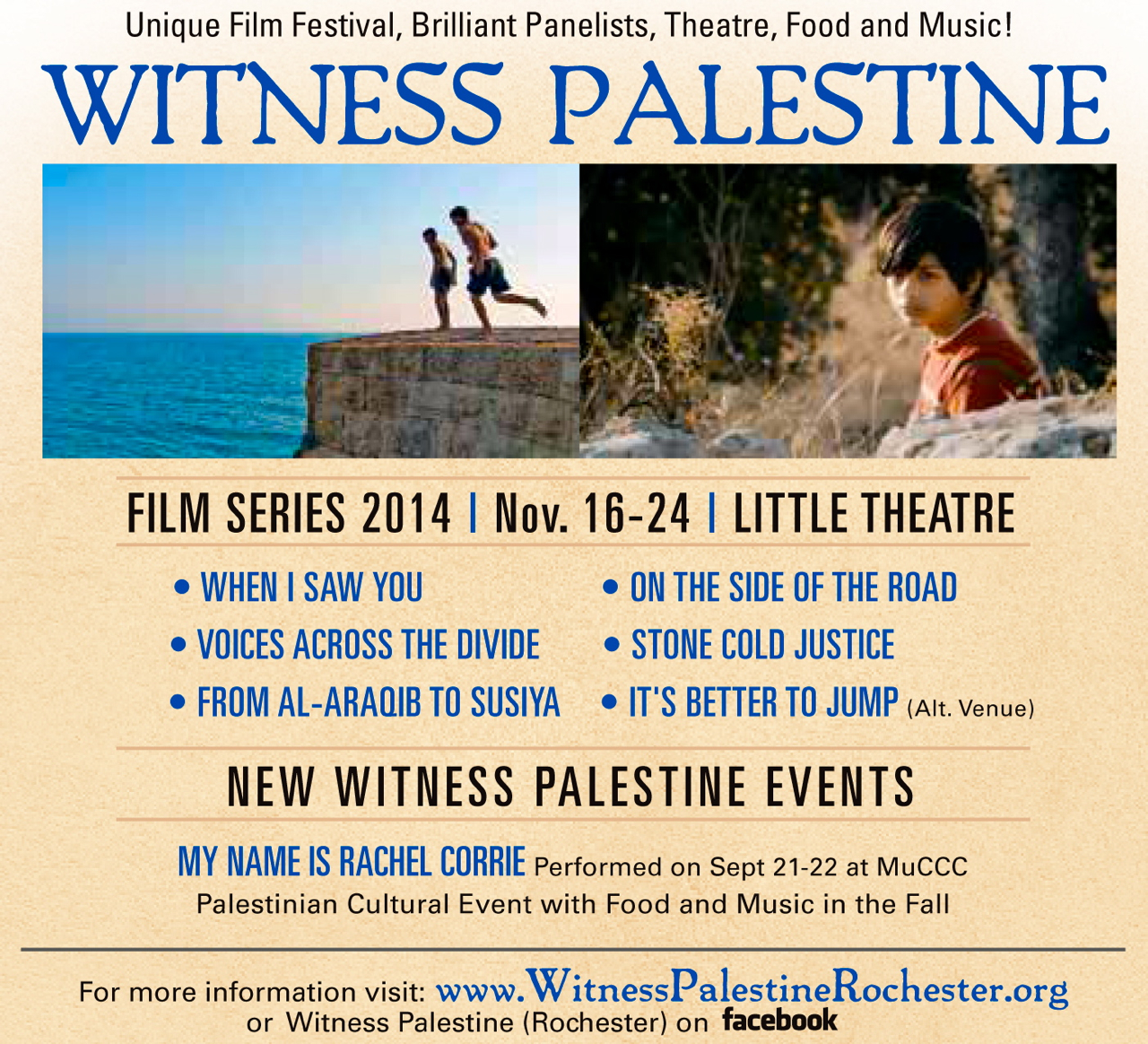
witness palestine film series & events 2014

learn more about palestine/israel. witness palestine events will start in rochester on sept 21, 2014, with the play “my name is rachel corrie,” which will be part of the fringe festival. there will be a cultural and literary event in the fall and the film series will start at the little theatre on nov 16th.

WPFS 2014
WPFS 2014