
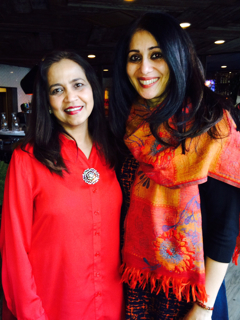
lovely lunch with a close friend. we had time to catch up while munching on delicious food at branca’s and i got to wear the beautiful cuff bracelet lia gave me.

lovely lunch with a close friend. we had time to catch up while munching on delicious food at branca’s and i got to wear the beautiful cuff bracelet lia gave me.
march 19, 2015: went to the urban forest cinema yesterday along with my friend sarita for a series of greentopia events. the discussion on THE INTERSECTION OF DOCUMENTARY FILM & JOURNALISM (something i know something about) would have been lackluster if it hadn’t been for carvin eisen who challenged mainstream media in the presence of mainstream media (yay chomsky!). “green drinks” was fun and provided an opportunity to connect with people. the MULTI-MEDIA MUSIC AND FILM EVENT “consigned to oblivion” was a great idea (live music accompanied by spoken word and film) but didn’t pan out for me. however, i loved all the locally produced short films which told the stories of wonderful activists and communities doing wonderful things in rochester. these included: Bread For All, The Sweet Bee, and Food For Thought: Seedfolk Stories. and let’s not forget the location – love high falls.
march 18, 2015: with the fabulous lia tarachansky here in rochester where her film “on the side of the road” was screened at the U of R last night and will be screened again today at school without walls and then at the islamic center of rochester at 7 pm (the event is open to the public). lia’s film was part of the witness palestine film series last year and she charmed everyone with her honesty and courage in a skype session with the audience afterwards. yesterday we checked out beale street cafe where we had po’ boys. then we almost froze to death when we walked around the high falls district. lia is studying film right now so she loved the george eastman house – excellent exhibits on the history of photography (one particular henri cartier-bresson photograph has to be seen to be believed) and on the advent of technicolor in film (those are the colors i want in my documentaries). always an honor and pleasure to finally connect with an activist friend in real life!


march 10, 2015: just taught a class at nazareth college on “religion in media and popular culture.” i chose to focus on islam as it’s particularly distorted by the use of selected images in mainstream media, which are then repeated ad nauseam. this was part of the global citizenship conference at naz which is meant for high school students. i introduced myself as an activist filmmaker and asked them the meaning of activism. they were more than familiar with the concept. one of the girls was involved with an anti-capitalist/pro-social justice group and another with indigenous peoples’ rights. they understood the meaning of media oligarchy and therefore the importance of independent filmmaking. we listened to edward said explaining orientalism, we looked at images of muslims as they appear mostly in the media and then i showed them images of the narcycist and shadia mansour. i showed them beautiful photographs from iraqi photojournalist tamara abdul hadi’s “picture an arab man” and stills from “the speed sisters.” we also discussed “american sniper” and the problematics of seeing the iraqi people (their villages and neighborhoods and streets and children) thru the scope of a loaded gun (what a perfect metaphor for racism). finally, we talked about the recent wave of killings in chapel hill, kansas city, kentucky and dallas. i wanted to end on a serious note, to show the students how the consequences of stereotyping are v real and tragic. we concluded the class with chimamanda adichie’s ted talk about “the danger of a single story.” i teach this class every year and every time i’m amazed by the responses i get from students – they’re bright, open-minded and up to any mental exercise i dare them to in order to declutter their minds. there’s hope for the future.
Transcending Loss, Tragedy, and the Impasse of Self-righteous Hatred: An Evening with Dr. Izzeldin Abuelaish, Author of “I Shall Not Hate, A Gaza Doctor’s Journey on the Road to Peace and Human Rights”
Monday, March 2, 2015, at 7:30 pm
Interfaith Chapel Sanctuary, University of Rochester
Thoughout his life, Izzeldin Abuelaish. MD, has beaten the odds: as a child growing up in a Gazan refugee camp, as an impoverished student focused on becoming a doctor, as a Palestinian medical expert treating Israeli patients, and now as a father enduring the loss of three of his children. Today, with his trademark, hopeful determination, he continues his efforts to bring Israelis and Palestinians together as people, with the unshakable purpose that his daughters, and the many other innocents on both sides, shall not have died in vain. Don’t miss this opportunity to meet and learn from someone whose life represents the best of our human ability to overcome adversity, especially that from within: our destructive desire to do unto others what has been done unto us.
Light refreshments to follow in Interfaith Chapel, River Level.
Sponsored by:
College Dean’s Office, College Diversity Roundtable, Gandhi Institute, Interfaith Chapel, Muslim Students’ Association
Paul J. Burgett Intercultural Center,President’s Office, Roman Catholic Newman Community
Student Association for Interfaith Cooperation, Vice President & General Secretary’s Office
feb 12, 2015: this morning i had a wonderful meeting with carlie from post magazine – we talked about collaborating in multi-media ways. what i didn’t know was that carlie has worked closely with the native american community in upstate ny. she offered to get me connected to local activists, which is what i’ve always wanted. as i came back from java’s, i got a call from my friend heather who gave me heartwarming feedback on my participation yesterday in tino sehgal’s “this situation,” a live-work (at the hartnett gallery) in which 6 “interpreters” compose a series of tableaux while discussing philosophy, economics, aesthetics and the difference between desire and passion (those were some of the topics that came up during our 4-hour performance). the piece is so inspiring that one cannot help but come up with other versions of it. later in the afternoon, i met chuck, the owner of NXT media and a dear friend. i handed over “a thin wall” for post production. the last time chuck polished up a film of mine was in 2011, when i saw the final version of “pakistan one on one” and almost wept with joy. on my way back i got a call from my friend michael who’s trying to figure out a date to visit the one and only jalil muntaqim. this evening we are going out for dinner to celebrate our 22nd wedding anniversary. it seriously doesn’t seem that long. i have so much to be grateful for – my family, my friends, my work, my community, and last but not least, rochester. i’ve lived here for more than a decade now and i’m still stunned daily by the awesome people who call rochester home. who cares about the snow.
first rehearsal today at the sage art center for “this situation,” a live work by contemporary artist, tino sehgal. each performance involves 6 “interpreters” or participants who produce a series of collective tableaux. the piece is meticulously choreographed yet supple in how it revolves around extemporaneous conversations between the 6 interpreters and interactions with visitors. trying to get a hang of all the quotes we are supposed to know by heart and all the positions we have to fall back into and all the rules of how this live piece works. fascinating. more here.
screened “the muslims i know” at an OASIS class today. the room was jam-packed with people who introduced themselves as christians, jews, atheists, and even “confused.” a lot of great questions. a jewish woman told me how her iranian neighbor called her after the paris attacks to tell her that she didn’t support them. “why would she think she needed to do that,” she asked, “we’re best friends.” it was a rhetorical question. i told her that is indeed the burden we must bear as muslims these days, especially those of us who live in the west. even tho we have nothing to do with free agents who sometimes claim to be muslim and have all kinds of political agendas and behave in all sorts of bizarre ways, we are supposed to identify with them, explain them, apologize for them. we didn’t elect them. there was no referendum on who we’d like to represent us, as a major world religion. but each and everyone of us is forced to speak for 1.6 billion people. it’s obscene. 14 years after 9/11, i am tired of explaining. i am tired of debating the humanity of muslims. frankly, the debate itself is offensive. another woman told me she felt heartened by the paris march: “finally, we can come together and say no more.” no more of only one kind of violence tho, i told her. “of course,” she said, “no one is going to push back against american violence.” there u go i said, u just articulated the hypocrisy of the march. all in all, it was a great audience – curious, open-minded, respectful. if only msm would cover such honest, heartfelt conversations rather than closed door tête-à-têtes with the duck dynasty.

jan 8, 2015: temperatures have been incredibly low over the past few days. there was a wind chill advisory until yesterday. thinking of the people in gaza whose homes were destroyed over the summer, of people in iraq and syria who have been displaced by civil war, and the poor and homeless right here in the united states. the world is unjust and inequitable. we must strive to make it more balanced. click here to support A Home for Sanctuary Village.
wonderful pre-birthday lunch with my gorgeous friend.
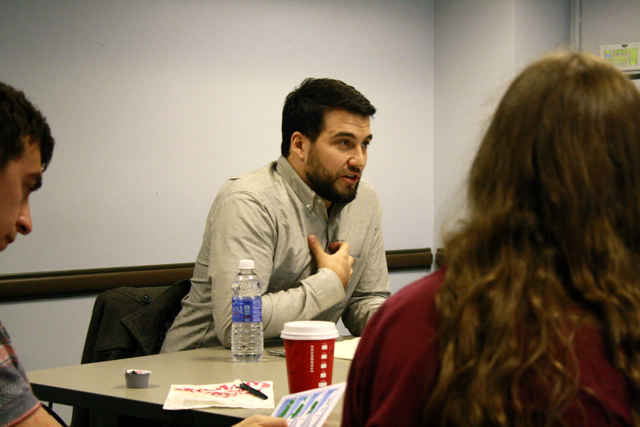
nov 24, 2014: attorney brad parker (defence for children international – palestine) at a teach-in at the u of r, talking about the rights of palestinian children under occupation.
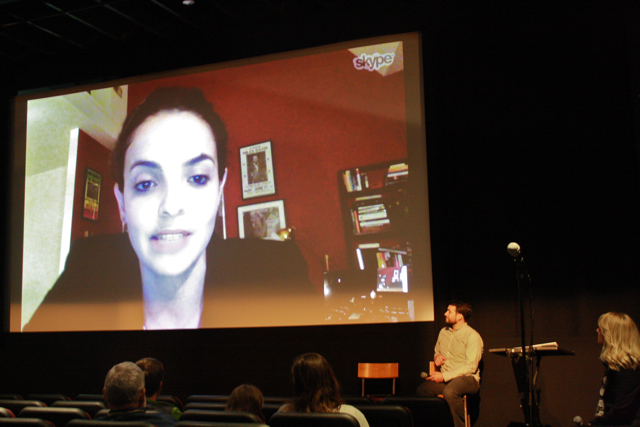
nadia ben-youssef via skype and brad parker in person at the little theatre, nov 24, 2014, discussing “from al-araqib to susiya” and “stone cold justice.”

after a wonderful screening of “when i saw u” (we skyped with director annemarie jacir) and a screening of “on the side of the road” (followed with a skyped conversation with director lia tarachansky) we have 4 more events coming up this weekend.
these are: conversation and dinner with filmmaker alice rothchild on nov 22 (organized by jewish voice for peace – rochester, ny chapter), screening of alice’s film along with Q&A on nov 23 at the little (part of witness palestine film series), teach-in with attorney brad parker who specializes in the rights of palestinian children on nov 24 at 4pm (organized by university of rochester students for a democratic society) and then screening with Q&A of two short films at the little theatre on nov 24 at 6.45pm. get all the details here and pls join us!
also, check us out on facebook: witness palestine rochester.
nov 17, 2014: a preview of partition stories’ rough cut with filmmaker friends in rochester. excellent feedback to fine-tune the film further and move to post-production in early 2015!

nov 11, 2014: attended an ayad akhtar lecture yesterday at the u of r. he’s won the pulitzer for his play “disgraced” which is on broadway right now. i am happy for his success. i haven’t read his books or seen his plays but here are some thoughts about his lecture and the themes that seem to permeate his work.
i understand that it’s an impossible burden to be the member of a minority and to be expected to represent that entire community accurately, comprehensively, perennially. as the token muslim in most situations, i understand how ridiculous and unjust it is to expect one person to speak for 100s, 1000s, millions or 1.6 billion! it’s impossible to be everything to everyone at all times. as an artist, i understand that it is not the artist’s job to represent anyone but themselves, to have free artistic rein, to be concerned solely with the perfection of their craft. however, if most of an artist’s work is centered on certain aspects of their identity (their muslimness, their pakistaniness or their pakistani-americanness) then they are taking on that burden of representation willingly.
since v few muslims/pakistanis/pakistani-americans are able to attain meteoric mainstream success and the media exposure that comes with it, the content of a successful artist’s craft, deeply rooted within one small exoticized group, becomes more significant. not only will their work be scrutinized by their own community, but they will also participate actively in creating the dominant narrative – the lens thru which this minority is viewed.
here are brief descriptions of akhtar’s work:
[His film] The War Within is the story of Hassan, a Pakistani engineering student in Paris who is apprehended by American intelligence services for suspected terrorist activities. After his interrogation, Hassan undergoes a radical transformation and embarks upon a terrorist mission, surreptitiously entering the United States to join a cell based in New York City.
To appreciate the relevance of playwright Ayad Akhtar’s work, you need look no further than two eerie coincidences that shadowed his debut drama, “Disgraced.” The play, which portrays the downfall of a Muslim American lawyer, won the Pulitzer Prize for drama in 2013. The day the award was announced, two Muslims deposited pressure-cooker bombs near the finish line of the Boston marathon. A second grisly coincidence came a few weeks later. On the day “Disgraced” opened in London two Muslims murdered and tried to behead a British soldier on a busy street in what one said was revenge for the British army’s killing of Muslims in Iraq and Afghanistan. Nobody linked these attacks to Akhtar’s play, but they were nonetheless chilling reminders of the violence that hovers at the edges of the territory he explores. “The work I’m doing is in direct dialogue with what’s happening in the Muslim world,” he said recently over dinner in New York.
[His play] “The Invisible Hand.” It’s the story of Nick, a stock and bond trader based in Pakistan who is kidnapped by Muslim extremists. Although the play examines some of the personal ramifications of the ongoing conflict between the Muslim Middle East and secular Western beliefs, Akhtar sees it as more of a story about global finance.
[His play] The Who and the What: Dark clouds appear early, as Mahwish covertly engages in some Quran-flouting canoodling to keep her fiance on the hook. Meanwhile Zarina — still resenting [her father] Afzal for breaking up her engagement to an Irish Catholic years before — is buried in an incendiary fiction project which will both personalize the Prophet as a flawed, lusting male, and indict the Muslim practice of veiling women as cruelly oppressive and theologically skewed. (Real-life activist Ayaan Hirsi Ali is evoked to point up the provocation.)
Ayad Akhtar is the author of the critically acclaimed, poignant, coming-of-age novel American Dervish. Since its debut,the book has been embraced around the world for the richness of its characters and illuminating the everyday lives of Muslim Americans, earning Akhtar a rightful place alongside today’s most compelling storytellers…The novel centers on one family’s struggle to identify both as Muslim and American, one boy’s devotion to his faith, and the sometimes tragic implications of extremism.
needless to say, akhtar is in constant dialogue with muslim-americanness. but it’s hugely disappointing that this engagement is based, almost exclusively, on stereotypes nurtured by mainstream media.
last night akhtar mentioned how his first book was a complete failure. i was interested in what kind of book that might have been and i found this information particularly enlightening. “At this time he was deep into writing a novel about a poet who worked at Goldman Sachs. Although the main character had Pakistani roots, the story line had little to do with Pakistan, or Islam — Akhtar wasn’t ready yet to explore his heritage. Instead he strove to create a generic exploration of a man’s inner life — a tale, he was certain, was destined to be the next Great American Novel. “I was convinced of that, without any irony,” he says. He completed the novel after six years and soon had to admit its failure. No publisher, no literary agent was interested. Even his friends panned it. “It was just not me,” he recalls. “I thought I was writing what I knew, but I wasn’t.”
that might explain the heavy-handed use of stereotypes in his present work. i understand that akhtar adds much more complexity and nuance to the situations and characters he creates but he’s decided to remain within certain parameters of what constitutes the accepted outside view of the american muslim experience. he made the point last night that as a stereotyped minority, we cannot continue to define ourselves in opposition to anti-muslim propaganda. i couldn’t agree more. i long to break out of that box, that suffocating framework. however, embracing anti-muslim propaganda, albeit with liberal doses of psycho-analysis and some social commentary, is hardly the best way to be free to define ourselves outside of the racist colonial frame of reference where we are expected to exist.
akhtar read from his book “american dervish”. i enjoyed the first section he read which described how spirituality once awakened can elevate day-to-day, pedestrian life to incredible levels of vividness, akin to a mystical experience. the second piece he read from the book was a conversation between a mother and son. he read the pakistani immigrant matriarch’s lines with a pakistani accent. i wanted to tell him he sounded like my kids, whose rendition of a south asian accent is completely in line with hank azaria’s apu (on the simpsons). it made it impossible for me to focus on what the woman was actually saying. her cartoonishness became overwhelming. however, what she said was important. she told her son that jewish men, unlike muslim men, know how to respect women and this was why she was raising him like a jew. this last line was certainly expected to have a comedic effect and it elicited laughter from the audience but within the context of the brutal, misogynistic muslim man oppressing his wife, it had more resonance than the casual witticism it’s supposed to embody.
here’s more from akhtar’s broadway play “disgraced”:
“Islam comes from the desert,” [the Muslim protagonist] says. “From a group of tough-minded, tough-living people who saw life as something hard and relentless. Something to be suffered.” And he speaks admiringly of the other desert-based tradition. “Jews reacted to the situation differently,” he continues. “They turned it over, and over, and over. I mean look at the Talmud. They’re looking at things from a hundred different angles, trying to negotiate with it, make it easier, more livable… It’s not what Muslims do. Muslims don’t think about it. They submit.” But as he’s further agitated, and further drunk, he also admits that he cannot escape his strict Muslim upbringing. “Even if you’re one of those lapsed Muslims sipping your after-dinner scotch alongside your beautiful white American wife and watching the news and seeing folks in the Middle East dying for values you were taught were purer, and stricter, and truer,” he says, “you can’t help but feel just a little a bit of pride.” As he did, he confesses, on September 11. Horrified, he says, but a little bit proud. […] But as much as Ayad’s terrific play is a scarily heightened portrait of the challenges of being an upwardly mobile Muslim-American in our current world, it also raises powerful questions for anyone who could be accused of having a dual loyalty.
from “the who and the what”:
“She has more power over you than she really wants,” Afzal says to Eli, accusing him of failing to treat his wife as a Muslim husband should. … And then, in a line that Mr. White [Afzal] delivers with a chilling casualness, he adds, “And she won’t be happy until you break her, son. She needs you to take it on, man.”
i wonder what the reaction to akhtar’s work would have been if he hadn’t been a muslim. i have a suspicion that we would understand his oeuvre quite differently. although i feel strongly that akhtar benefits from his native informant status, he made it quite clear last night that he doesn’t have double consciousness. he’s just american.
The funny thing is, I don’t feel like I’m writing about Muslim American life,” Akhtar explains. “I feel like I’m writing about American life.”
Akhtar acknowledges that Muslims face an especially precarious place in American society in the aftermath of Sept. 11. In the shadow of surveillance, profiling and doubt, many Muslim artists have been inspired to explore identity in their work. But Akhtar says his characters are also facing a more universal dilemma.
“The process of becoming American has to do with rupture and renewal — rupture from the Old World, renewal of the self in a new world. That self-creative capacity is what it means to be American in many ways, and I think that part of that rupture is the capacity to make fun of yourself and the capacity to criticize yourself.”
i am all for self-criticism. i am all for flawed characters with depth and complexity. i am just looking for something more than the muslim terrorist/wife beater/religious fanatic. perhaps akhtar could turn to his own life and the society he moves in for inspiration. he was born in NYC and raised in milwaukee, both his parents are physicians, he is a graduate of brown and columbia universities, he studied acting in italy with jerzy grotowski, he lives in NYC where he has taught acting along with andre gregory (my dinner with andre). his own life experience as a pakistani-american muslim might be harder to sell to the mainstream but it might sparkle with the kind of originality and truth that would make him an important, authentic voice in american culture. i’ll continue to wait for that play.