global citizenship conference

taught a class on “religion in media and popular culture” at nazareth college this morning. we focused on islam and discussed ideas such as media oligarchy, orientalism, the power of images in a primarily visual culture, the role of filmmaking and activism, the very real effects of rhetoric in public discourse and the culture we consume on how we live as a society, and the dangers of a single story.

this conference is for high school students and it was interesting to see how they were split pretty neatly along color lines – not only in where they chose to sit and with whom, but also in terms of their views on everything. the black kids spoke at length about BLM, the black panthers, american empire, stereotyping and fear-mongering. one of the white kids asked me if i’d risk eating a few poisoned M&Ms as an illustration of why syrian refugees should not be allowed into the country. i didn’t want to be flippant but i told him it was a completely false analogy. refugees are not M&Ms and we have no intentions of eating them. we talked about how very few refugees have been allowed into the US (vs the million or so being hosted by turkey) and how the context of the war in syria (and the role we continue to play there) is an important connection to be made.

wish there had been more time to bring people out of their shells and have a more meaningful and robust interchange. so sorely needed. more about the conference here.

Screening of The Muslims I Know at Women of Color Conference

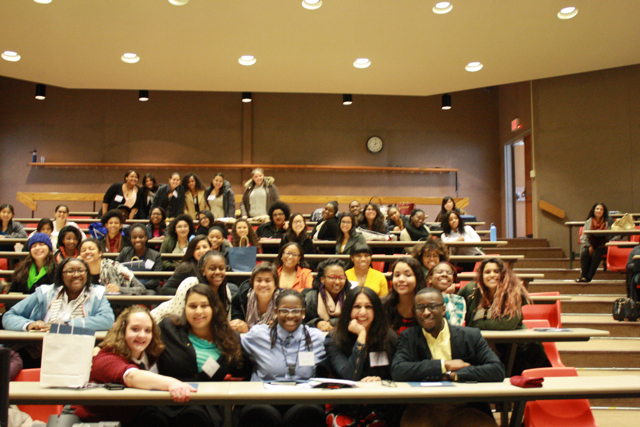
SUNY Geneseo is hosting the third annual Consortium on High Achievement and Success (CHAS) Women of Color Conference and I just presented The Muslims I Know there. What a wonderful idea for a conference and what a lively and sharp bunch of students attending it.

At one point in the film someone says: I’m worried about terrorism these days and most terrorists in the world are Muslim.” I’ve screened this documentary 100s of times and there’s never been much of a reaction to this line. Today the entire auditorium, filled with young people of color, burst into laughter. Wow, they got it. Of course they did. This kind of distortion/reversal of reality is something familiar to all people of color. It’s part of our lived-in experience.

A young woman told me she was Sikh. Her father wears a turban. She was three years old when 9/11 happened and she’s experienced bigotry and fear ever since. Even though she’s not a Muslim, the film spoke to her in a very intimate way. We discussed the overlap between Islamophobia and racism. Another young woman said she was Hindu. She asked me how to parse Western stereotypes about sexism in one’s culture along with the struggles one must initiate and carry on inside one’s own community. We discussed the overlap between feminism and imperialism. A student sitting in the front row, who watched the whole film intently, told me she wanted to be a filmmaker and we discussed the importance of telling our own stories, in our own words, so that we can empower ourselves and our communities.

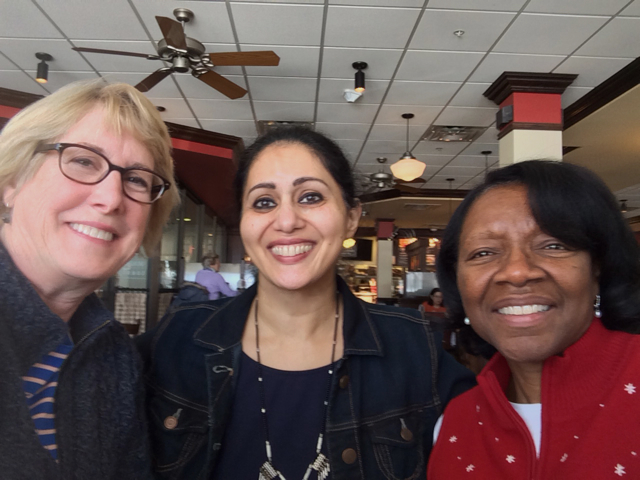
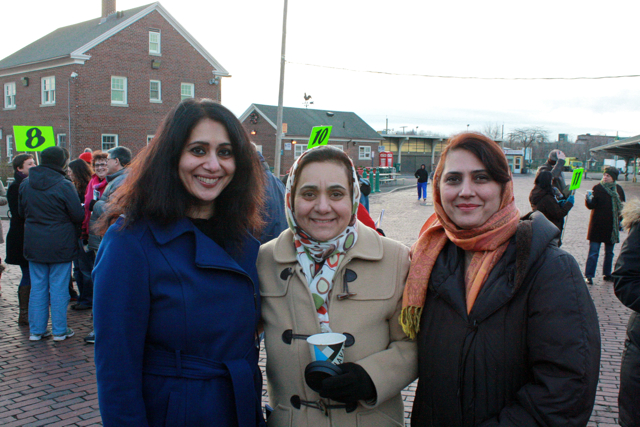
Loved every minute of it. After the screening, I joined the students in the first row. Here is a picture.

mara ahmed at women of color conference

A Thin Wall: Screening at RIT

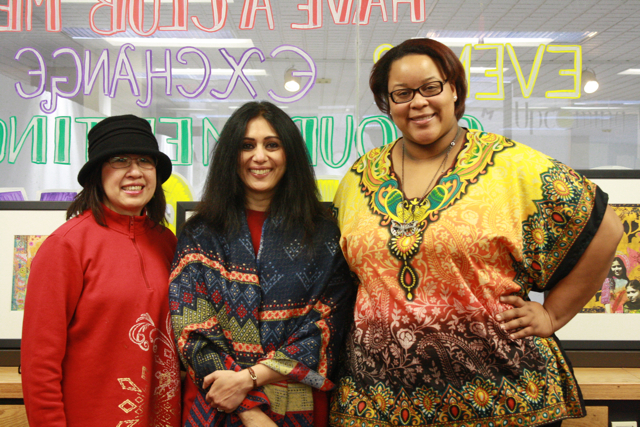
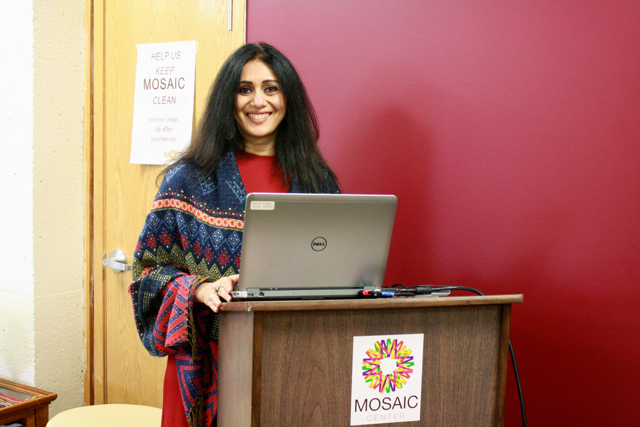
excellent screening of A Thin Wall plus discussion at RIT MOSAIC today – the kind that’s cozy, highly interactive, thought-provoking, beautifully diverse, and followed by delish desserts. there were students present but also members of the community who are involved in activism or work on cultural diversity. hey, i even met my next door neighbor who had turned up for the screening because his wife teaches at RIT. what always blows my mind are the young people though. such intelligence, yes, but also such sensitivity. the young women are particularly able to analyze, encapsulate, parse, connect, and articulate with a brilliance that is deeply satisfying and hopeful. i keep thinking to myself: if only they could lead, transform and shape our world. thank u Mimi Lee (APAA) for being such an accomplished organizer and community leader and thank u Stephanie Paredes for being the best moderator on the planet (and an avid Junot Díaz fan). some of my artwork from the series “this heirloom” will be on exhibit at RIT MOSAIC until the end of march. pls visit and enjoy at your leisure 🙂

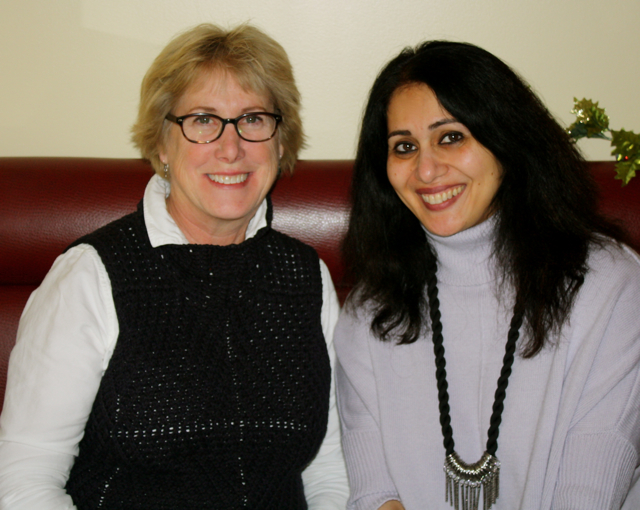
mimi lee, mara ahmed and stephanie paredes
mara ahmed at rit mosaic

Kathryn Bevier’s artwork at the Geisel Gallery

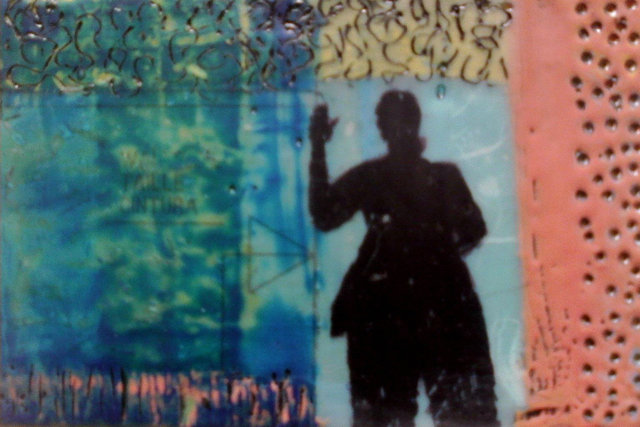
saw Kathryn Bevier‘s beautiful artwork at the Geisel Gallery yesterday (1 Bausch and Lomb Place, in Rochester). kathryn uses the encaustic technique of painting with pigmented wax to create vibrant compositions. her work has a calming, serene elegance to it and of course anything that involves image transfer, collage, texture and multiple media speaks strongly to me. i was particularly taken with her “shadow self” series. this picture (taken with a flip phone) do not do justice to her work. u can check it out until the end of january.

kathryn bevier's shadow self
kathryn bevier’s shadow self

Multiple screenings of The Muslims I Know

This week multiple screenings of The Muslims I Know, at Asbury First United Methodist Church, 1050 East Avenue, Rochester, NY 14607.

The schedule is as follows:

Monday, January 18, 6:30 pm, Dining Room
Wednesday, January 20, 10:30 am, Red Room
Wednesday, January 20, 6:30 pm, Red Room
Saturday, January 23, 10:30 am, Dining Room
Sunday, January 24, 9:45 am, Fellowship Hall (lower floor)
Discussion: Sunday, January 24, 1:00 pm, Sanctuary

talk at women’s council of RIT meeting

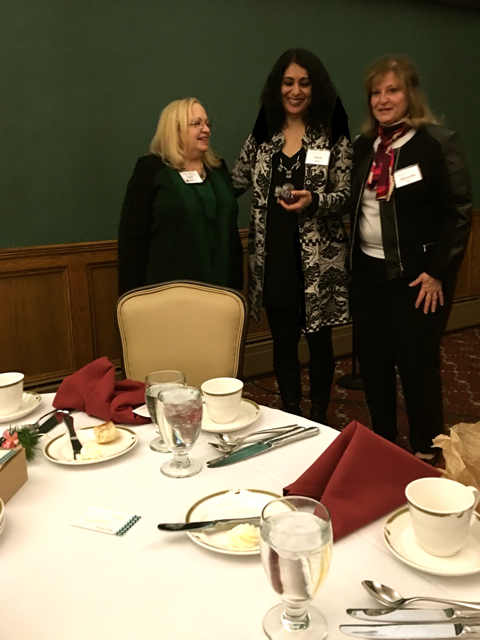
jan 20, 2016: gave a talk at the women’s council of RIT meeting, followed by a screening of the first 20 minutes of A Thin Wall. in my talk i was able to question the “exotic” nature of the indian partition by bringing up a question i was asked by Carol White Llewellyn during an interview at RCTV. she had asked me how people seemed to be living in relative peace prior to partition, but once partition was announced everything descended into chaos and horror. how could such a “switch” happen? i was still thinking about that when i came across rose hamid, the woman who was ejected from a trump rally where she stood in silence, wearing a t-shirt that said: “salam, i come in peace.” in an interview with CNN she said that it was her sincere belief that if people get to know each other, one on one, they will stop being afraid, and will be able to get rid of all the ongoing hate in the world. she explained how people around her were quite lovely initially – they were sharing their popcorn with her and she had great conversations with them. but when trump began to speak, the crowd’s mentality changed. it was a vivid example of how hateful rhetoric can incite a crowd and (pretty quickly) create a dangerous mob. that’s how the switch happens.

mara ahmed with members of women's council of RIT
mara ahmed with members of women’s council of RIT


Rochester United to Sing for Peace & Unity

Rochester United to Sing for Peace & Unity on Sunday Dec 20 (4-6 pm), starting at the Public Market, 280 N. Union St, Rochester, NY 14609.

After a season marked by violence in Rochester, our nation, and around the world, we invite you to join your neighbors as we sing out against violence and the language of hatred. We will walk together into the Marketview Heights neighborhood, sharing our songs of peace.

Sponsored by the interfaith community of Rochester. All are welcome. Pls bring candles, not posters.

“The Paris attacks: should France rain flowers?” by Mara Ahmed

my reaction to the paris attacks – the piece was published in its entirety by city newspaper today.

Mara Ahmed: “Once again we’ve seen an outrageous attempt to terrorize innocent civilians. This is an attack not just on Paris, it’s an attack not just on the people of France, but this is an attack on all of humanity and the universal values that we share.” -President Obama, November 13.

I love Paris. I was there last Christmas. The weather was mild spring weather for us Rochesterians. The city was all lit up, festive, alive. On our first day in Paris, my husband and I attended Sunday Mass at Notre Dame de Paris, then joined our kids for dinner at a Lebanese restaurant, owned by an Iranian, where we had delicious makanek and manouche.

Every day, the Eiffel Tower would begin to shimmer at dusk, and we’d head to the Christmas market along the Champs-Elysées. There’s nothing like churros and a hot drink on a cold winter night. Children would be ice-skating in a small, makeshift rink with plenty of cheerful music to induce a camel spin or two.

Our kids wanted to take a look at the elusive Mona Lisa, so we did that, as well as partake of the ostentatious gold at the Chateau de Versailles. But my favorite place continues to be Montmartre. The Sacré-Coeur is always magical and the views from the hill stunning. We met some friends at a restaurant and felt perfectly happy and at home.

Yet after the Paris attacks on November 13 and the facile discourse in mainstream media, I have to ask myself: Why is Paris the city of love and lights rather than the capital of the brutal French Empire? Why do Parisians represent humanity more than the Lebanese whose lives were extinguished in suicide attacks the day before?

Why are French values better than Turkish values? An equally horrible bombing in Ankara, just a month earlier, targeted Turkish lives and values, after all.

I am reminded of Rachid Ouaissa’s perspicuous essay “Frantz Fanon: The Empowerment of the Periphery,” in which he talks about how “the so-called globalization, with its new forms of domination and exploitation under the auspices of the IMF and World Bank as well as the speculative economy, drives masses towards a kind of chronic marginality, promoting the emergence of violent peripheries.”

In the same way, and even more dramatically, war transfers chaos and violence from the center, the fortified First World, to Third World hinterlands. It’s nothing new. The Bush doctrine aimed for this kind of transference in clear, concise words: the need to fight them over there, so we don’t have to face them here.

Before adopting the mind-numbing language of “us vs. them,” it’s essential to go back to Fanon and his apt analysis that “Europe is literally the creation of the Third World.” Indeed, let’s try and imagine France without Algeria, or the British Empire without India, or Belgium without the Congo, or the United States without genocide and slavery. The Global North exists as it is now because of the Global South and what it is now. Their histories, psychologies, and present-day realities are deeply imbricated and cannot be so easily untangled.

Unfortunately, rather than acknowledge, unknot, and begin to resolve some of the complexities of these centuries-old power hierarchies and the damage they continue to inflict, we prefer to bury our heads deeper in the sand and talk in childish binaries of good and evil or the clash of civilizations.

Whenever systemic violence, which created and sustains the current world order, spills into the First World, it is received with incredible shock and outrage. Why are we not cognizant of similar atrocities happening on a daily basis in Afghanistan, Iraq, Syria, Yemen, or Somalia – places that we invade, occupy, drone, and decimate without a second thought?

Why is the solution to any act of aggression, the reflexive bombing of civilians on the periphery, usually described in the aggregate as a “war zone” or “ISIS headquarters”? And why is this kind of generic revenge accepted, if not embraced, by all – this mind-blowing logic of bombing Syria as a solution to every problem and then refusing to shelter Syrian refugees fleeing the war?

I am Pakistani-American, and I am unceasingly stunned by the reactions I see on social media, where well-meaning Pakistani citizens ask questions like “What do you expect France to do? Rain flowers?” This detachment of France from its past and present imperial exertions, this divorcement of violence from power and empire, this split between the center and the periphery, is all the more problematic when it’s parroted by the Global South.

Yet in a way it makes perfect sense. The Third World too has its centers and peripheries. When a small group of Taliban forced their way into a school and massacred children in the Pakistani city of Peshawar in 2014, the process of mourning this incomprehensible horror became laced with bloodthirsty vengeance.

My social media newsfeed was flooded with images of lynched men. “Terror suspects must be hanged within 24 hours,” perfectly nice people declared. A Pakistani woman, holding a toddler in her profile picture, urged the Pakistani army to “kill them all, kill their neighbors, kill their friends, kill anyone who gives them bread, kill anyone who offers them shelter….” She went on for an entire paragraph. In Pakistan, too, it is okay to sacrifice the indigent, voiceless, faceless people on the periphery, in North Waziristan, in order to ensure safety for the privileged center.

And so it is with the killing of young black men in America, whom a militarized police force must “contain” to make life safer/whiter on the right side of the tracks.

I recently completed a documentary film about the partition of India in 1947. A few days ago, right after the Paris attacks, I was thinking about the parallels between the partition and what happened in Palestine in 1947-48. One overwhelming similarity was that both events are unquestionably embedded in colonialism.

I was reading about the Arab uprising against the Ottoman Empire in 1916, how it was strongly encouraged by the British, but after the war was won, the Arab people were not granted independence. On the contrary, the Sykes-Picot agreement was signed secretly, and the Middle East was divided into British and French spheres of influence. I couldn’t help but think of another, much more recent Arab uprising which was crushed by harsher dictatorships, military interventions, perpetual civil strife, and proxy wars.

As Michel Foucault would say, the past is never dead. It continues to haunt us, control us, define us. We must use it to understand our present but most importantly, most urgently, to come up with a better world.

Mara Ahmed has lived and been educated in Belgium, Pakistan and the US. An artist and filmmaker, her third documentary “A Thin Wall,” about the Partition of India in 1947, premiered at the Little Theatre in April 2015 and was subsequently screened in Bradford (UK), Seattle, Vancouver, Palo Alto, and Berkeley. She lives in Pittsford with her two children and husband.

More here.

The article was republished by the Love and Rage Media Collective. See here.