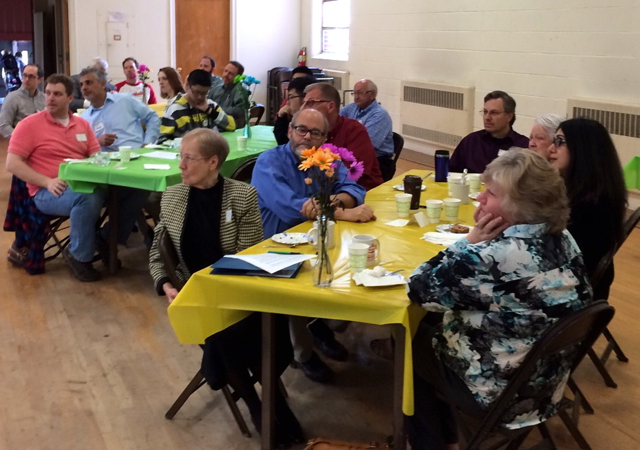
on saturday, my husband and i attended “conversations with our muslim neighbors,” an event hosted by the community of the savior. it was the brainchild of my friend peter knapp, whom i’ve known since he invited me to screen The Muslims I Know at roberts wesleyan college many years ago. the idea was to get to know our neighbors by sharing food and being involved in direct, face to face, conversations. it went exceedingly well. hope we can continue this dialogue at more venues, over the years. this is how peter described it:
“Today our church community hosted a “Conversations with our Muslim Neighbors” luncheon. After several months of planning, 49 of us gathered to share a meal and talk about what it means to be a Muslim in Rochester today. Good discussion, good food, new information, and new friends resulted. It was time well spent.”
had this conversation at a meeting where we were supposed to band together and organize workshops that educate our respective congregations about racism. i ended up at a table with people whose congregations were either missing from the meeting or non-existent. we all introduced ourselves and our religious/activist affiliations.
one lovely gentleman said that he belonged to a sufi order but followed up immediately with the qualifying statement that he was not a muslim. he said to me, “u are a muslim, but we are non-muslims.” i smiled and said, “sufism is very much rooted in islam.” he said we could argue all night about that but he had been taught by an indian man and what he believed in had nothing to do with islam.
of course, people are free to identify as they like but this strong renunciation of islam accompanied by explanations of how to practice zikr (a devotional act in islam in which short phrases or prayers are repeatedly recited, to remember god or allah) was a bit dissonant.
also, mentioning an indian guru in order to distance oneself from islam is a tad misguided, on account of the long history of sufism in south asia and its evolution into a particular strain of islam which is still practiced in that region. it ties in with the american wish to popularize rumi by de-muslimizing him and his work. when people cringe at the very idea that sufism is the mystical dimension of islam, then perhaps it is time to explore the overlap between racism and islamophobia.
The Muslims I Know: Film Screening, Q&A with Director, and Panel Discussion with Local Muslims
Join us at the opening night of the Utica Social Forum for a film screening of The Muslims I Know, a Q&A with director Mara Ahmed and a panel discussion with local Muslims and activists. This is the kick-off event of the Utica Social Forum because local activists see the need to continue our organizing and action against the rise of Islamobhobia and bigotry directed towards Muslims, refugees and immigrants, both locally and nationally.
Friday, June 3 at 7 PM – 9 PM
Cornerstone Community Church
500 Plant St, Utica, New York 13502
i saw this short at the New York Indian Film Festival (NYIFF) a couple of days ago. it’s ingenious – from the poem which is the film’s centerpiece, to the imagery, to the most excellent music.
excellent reading of “disgraced” directed by shishir kurup, with rajesh bose as the protagonist.
after the reading we discussed the impact of the play, what rang true and what didn’t. i made the point that even though ayad akhtar adds some complexity and nuance to the situations and characters he creates, he continues to remain within certain parameters of what constitutes the accepted *outside* view of the american muslim experience. he’s said that as a stereotyped minority, we cannot continue to define ourselves in opposition to anti-muslim propaganda. i couldn’t agree more. i long to break out of that box, that suffocating framework. however, *embracing* anti-muslim propaganda, albeit with liberal doses of psycho-analysis and some social commentary, is hardly the best way to be free, to define ourselves outside of the racist, colonial frame of reference where we are expected to exist.
once akhtar’s play is seen as simply a story rather than *the* story, we will move beyond a dead end. in the meantime, we have to acknowledge that largely white, affluent, and educated audiences interpreting the play as being “universal” are NOT the ones being represented on stage. we have to recognize that privilege. and we have to ask ourselves if it’s ok to drown out the pain felt by many who are part of a vulnerable minority (in an age of profiling, surveillance, and indefinite detention) with standing ovations and accusations of being too literal or too reductive or too unsophisticated to get it. it’s a sad reinforcement of existing power dynamics.
in an ideal, richly diverse, racially and culturally equitable world, where there are 1000s of plays to turn to for contrasting representations of muslim men, we will not need to tease out all these problematic issues. right now, i’m just looking for something more than the muslim terrorist/wife beater/religious fanatic (that pretty much describes akhtar’s entire body of work).
many agreed with me and told me so at the end of the play (including geva theatre artistic director mark cuddy). the best validation i got was from rajesh bose (who played the main character). he told me it was painful for him to tell the childhood antisemitism story in every performance because as a south asian man, it didn’t resonate with him. he wish he could skip it. i agree. skip the odd south asian rabidly antisemitic mother who spits at her son for liking a jewish girl (what???), the 9/11-celebrating-muslim obscenity, and the wife-beating, and the play becomes more powerful and interesting. but would it continue to be the most produced play in america? probably not…
thx to my pals Isabelle and Elaine for attending the event. love u guys!
i will be one of the panelists discussing ayad akhtar’s play “disgraced” at geva theatre this evening. it’s a free event and it should be an interesting discussion. pls join us. details here.
Monday evening, May 2nd, there was a screening of The Muslims I Know at the Irondequoit Public Library. The screening was organized by Judith Bello, facilitated by George Payne, and sponsored by Gandhi Earth Keepers International, Metro Justice Peace Action and Education, and the Fellowship of Reconciliation’s Rochester Chapter. Fifteen years after 9/11, and 8 years after the release of my film, I’ve become wary of doing post-screening Q&As. It’s mentally exhausting to answer the same basic questions about Islam and Muslims over and over again and it’s emotionally depleting to sense any kind of resistance to the film’s efforts to humanize people who are regularly stereotyped and discriminated against. But I was in for a surprise. All the questions that came my way were well-thought out and the answers I offered were used to further the discussion in deep and meaningful ways. We talked about American Empire and the War on Terror, about consumerism and capitalist greed and whether other ways of being were imminent, we talked about nationalism and industrialization, and about templates for co-existence. One young woman was particularly sharp and inquisitive. As we were trying to illustrate the long history of Muslims in America, she pointed out Thomas Jefferson’s Quran and how Islamic principles and ideas are probably inseparable from the founding of what we understand to be the American state. All in all, it was a wonderful evening that left me hopeful and energized. Thank you to the organizers and to all who attended on a Monday evening. [Photograph by George Payne] Mara Ahmed at the Irondequoit Public Library
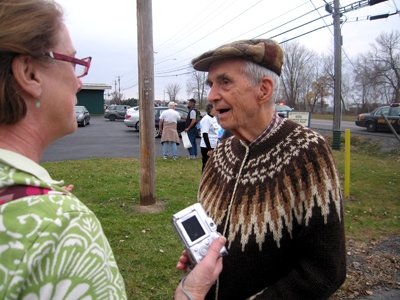
my friend sarita and i met daniel berrigan in 2009, at one of the first ground the drones protests, in front of the drone base in syracuse. an american icon. meeting daniel berrigan in 2009
Coming up on Monday May 2nd, 7pm-9pm, at the Irondequoit Library!
Judith Bello: If you are looking for something nice to do on Monday evening, Irondequoit Town Library is the place to go! Local film maker Mara Ahmed’s film, “The Muslims I Know” is a family friendly introduction to your Muslim neighbors. You can learn more at the link below which also links to an interview with the director on 1370 Connections aired shortly before the premier. A local affiliate of Fellowship of Reconciliation is the sponsor; we are hoping to grow into a full chapter soon. Come and meet Mara and her family and friends, sponsored by the next generation of Fellowship of Reconciliation in Rochester. More here.
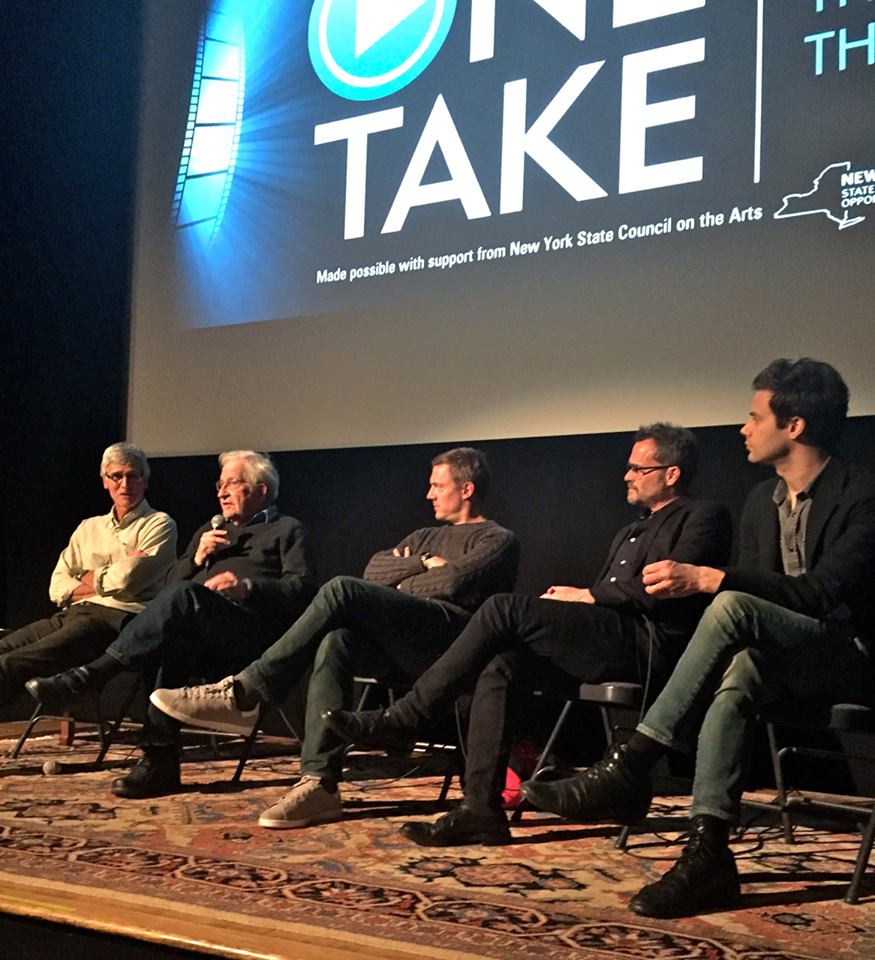
Went to see REQUIEM FOR THE AMERICAN DREAM yesterday at the Little Theatre. This was the first time Noam Chomsky saw the film himself. He was seated right in front of me. I was tempted to take a picture of the back of his head, with the film playing in front of him and post it with the caption “Chomsky watching Chomsky” or something to that effect but then I thought it would be too juvenile and with much self-discipline, I abandoned the idea.
The documentary is excellent. It parses hours and hours of interviews with Professor Chomsky and creates a clear and engaging narrative. As a filmmaker, I understand the challenge. How do you take a series of lectures by one of the most eclectic intellectuals of our time and cut them into a cogent and gripping 73 minute film? The answer: sharp editing, copious b-roll and terrific graphics and animation. The importance and urgency of what Professor Chomsky is saying helps too, of course.
He talks about the concentration of wealth and power in the hands of a few (a fraction of one percent) and puts this phenomenon in a historical context, he explains how the “rabble rousers” of the 60s and 70s were crushed, how the media and their focus on consumption have produced a “me” culture and undermined solidarity, and how this will continue to shape an increasingly ugly society. The film ends on a positive note by reminding us of Howard Zinn and his bottom-up view of history – the idea that the countless small actions of unknown people drive all great historical events. Ultimately it’s always been, and it continues to be, up to us.
In the post screening Q&A, I got to make a comment. I told Dr Chomsky that as a Pakistani American filmmaker I had shot a film in Lahore in 2009. The film was a broad survey of public opinion about issues of interest to Americans, e.g. the Taliban, the War on Terror, American foreign policy in the region, and a polling of what average Pakistanis thought about Americans. I interviewed a wide spectrum of people and most of them were quite politically astute. Many talked about the corporate nature of American media and how the American public was totally brainwashed. Yet some mentioned Dr Chomsky by name and said, “But then there are also people like Noam Chomsky in America.” The audience applauded vehemently. I concluded with how it was important for him to know that, even as a single individual, he’s an antidote to American imperialism and aggression. Again much applause.
In typical Chomsky style, he evaded the compliment completely and began to talk about international polls and how public opinions around the world are of immense consequence. He ended by complimenting me on recognizing that fact.
Nate Baldo (from Jewish Voice for Peace) asked a brilliant question about American military aid to Israel and increasing grassroots resistance to the occupation. Interestingly enough that was the issue Dr Chomsky spent most of his time discussing. Of course he did not mention BDS, but this was a full house (500 people or more) and an excellent forum for educating people on Israel/Palestine. All in all, a spectacular evening with an intellectual icon.
Thank you Tatyana Bakhmetyeva for organizing it and for getting us tickets to a sold out screening 🙂 chomsky in rochester
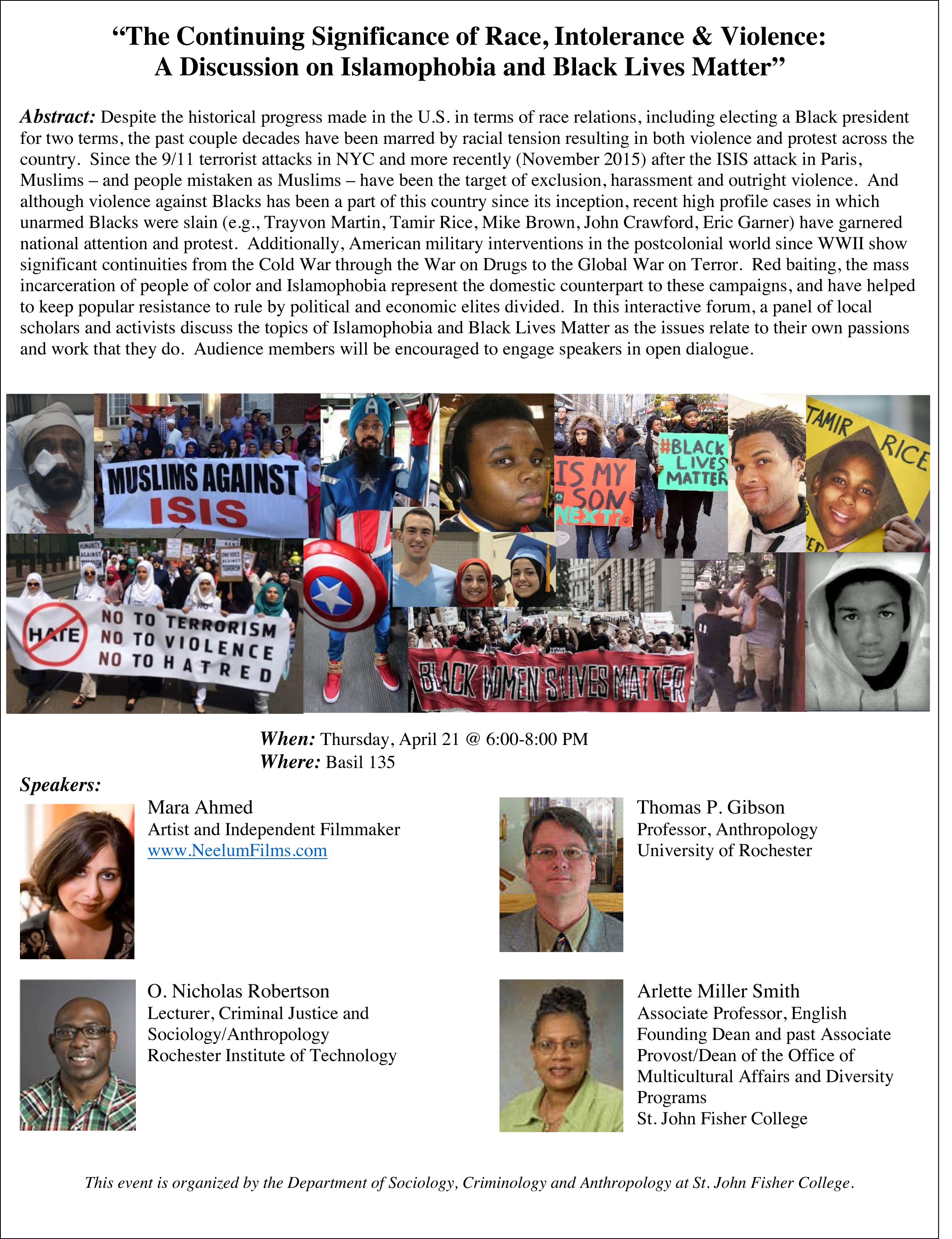
Took part in a panel discussion on Islamophobia and BLM at SJFC today. I started with an intro to the Islamophobia industry, defined the term itself by breaking it down into its components, mentioned the existence of anti-Muslim prejudice prior to 9/11 (Orientalism), and finally examined the overlap between Islamophobia and racism.
Thomas Gibson provided a broader context by tying Islamophobia and racism to American military interventions abroad, from the Cold War to the War on Drugs to the Global War on Terror.
Nick Robertson explained how BLM is a non-hierarchical movement (reminiscent of Ella Baker’s work in the Civil Rights movement) and how it aims to center those who are marginalized in the black community. He talked about mass incarceration as a caste system, a way to contain poor blacks.
Finally, Arlette Miller Smith underlined how BLM is a movement, not a moment. She talked about police terrorism and how it had galvanized a Black Spring.
Some interesting questions afterwards. The usual issue of accounting for “black on black” violence. Nick made the excellent point that no stats were available for “white on white” violence, which would lead us to believe it’s an ideological distraction more than anything else. Tom discussed Franz Fanon’s work and his observations about violence within oppressed/colonized communities. He also mentioned how when the state is absent, people develop codes of honor in order to survive.
A man who had harangued me earlier when I had shown The Muslims I Know at the same venue, was back with more accusations. He focused mostly on the Pakistani Army and their genocidal violence in East Pakistan (now Bangladesh) back in 1971. I am sadly aware of that shameful chapter in history but I don’t see what that has to do with Islam or the existence of Islamophobia in the West. I wasn’t invited to discuss the social, political, economic and military histories and peculiarities of the 57 separate countries that fall within the realm of the “Muslim World.” Tom suggested he watch “The Fog of War” and learn something about American militarism and its horrors.
Afterwards, several young women in the audience apologized to me for the man’s behavior. One of them even gave me a hug and told me she loved my films. Sisterhood!
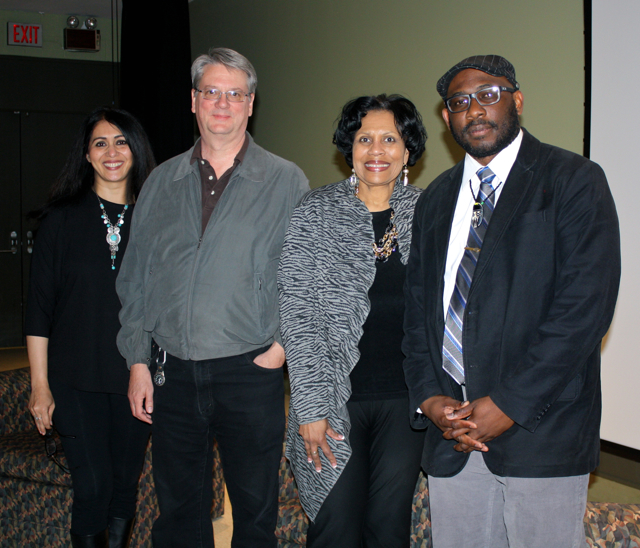
mara ahmed, thomas gibson, arlette miller smith and nick robertson
Tomorrow, April 21st, I will be taking part in a discussion about Islamophobia and Black Lives Matter along with Thomas Gibson, O. Nicholas Robertson, and Arlette Miller Smith, at St. John Fisher College, Basil 135, 6:00 to 8:00 pm. Hope u can join us.
Yesterday, the wonderful Tatyana Bakhmetyeva invited me to speak to her “Feminism in a Multicultural World” class at the University of Rochester. We discussed my article “White Feminists/Black Blobs” and Lila Abu-Lughod’s “Do Muslim Women Really Need Saving?” among other texts.
It’s always a pleasure to talk to bright young women but this class was doubly important to me on account of the many points I wanted to raise.
We talked about imperial feminism and its problematic roots in colonial history, the gendered polarity between a masculine West and a feminine East, veiling and unveiling as anchored to the same point of reference i.e. male pleasure, Kristof’s Half the Sky and its cringeworthy white savior approach, the implications of the male gaze as well as the white feminist gaze and how they both objectify the other and police public spaces, the inapplicability of “non-mixité” when it comes to Black women (Audre Lorde), Muslim women (Houria Bouteldja) and Dalit women (Anu Ramdas), the main thesis of J M Blaut’s “1492: The Debate on Colonialism, Eurocentrism, and History,” the military and financial tyrannical structures that continue to maintain world inequities, and much much more. As a way to round off the discussion, I suggested Huma Dar’s “Women and the ‘War on/of Terror’ or “Looking for Osama and Finding Mukhtaran,” a talk about how the West’s desire to save Muslim Women is used as a pretext for the war on terror.
All in all a very productive day until I ran into the following headline: France’s minister for women’s rights has compared Muslim women who wear the veil to American “Negroes” who accepted slavery, in an interview with French media. Seriously? Laurence Rossignol needs to go back to school and get some basic education.