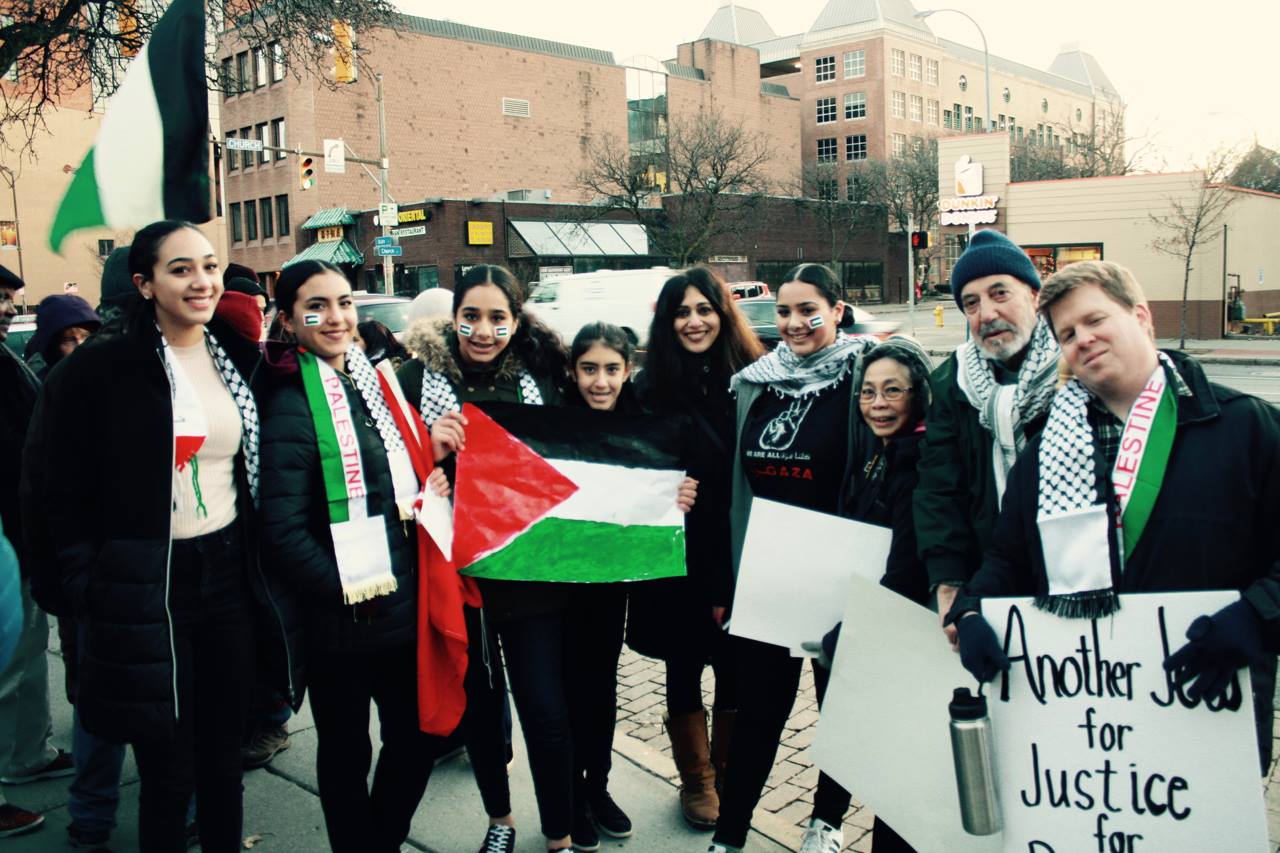
Emergency Demo: Jerusalem is the capital of Palestine

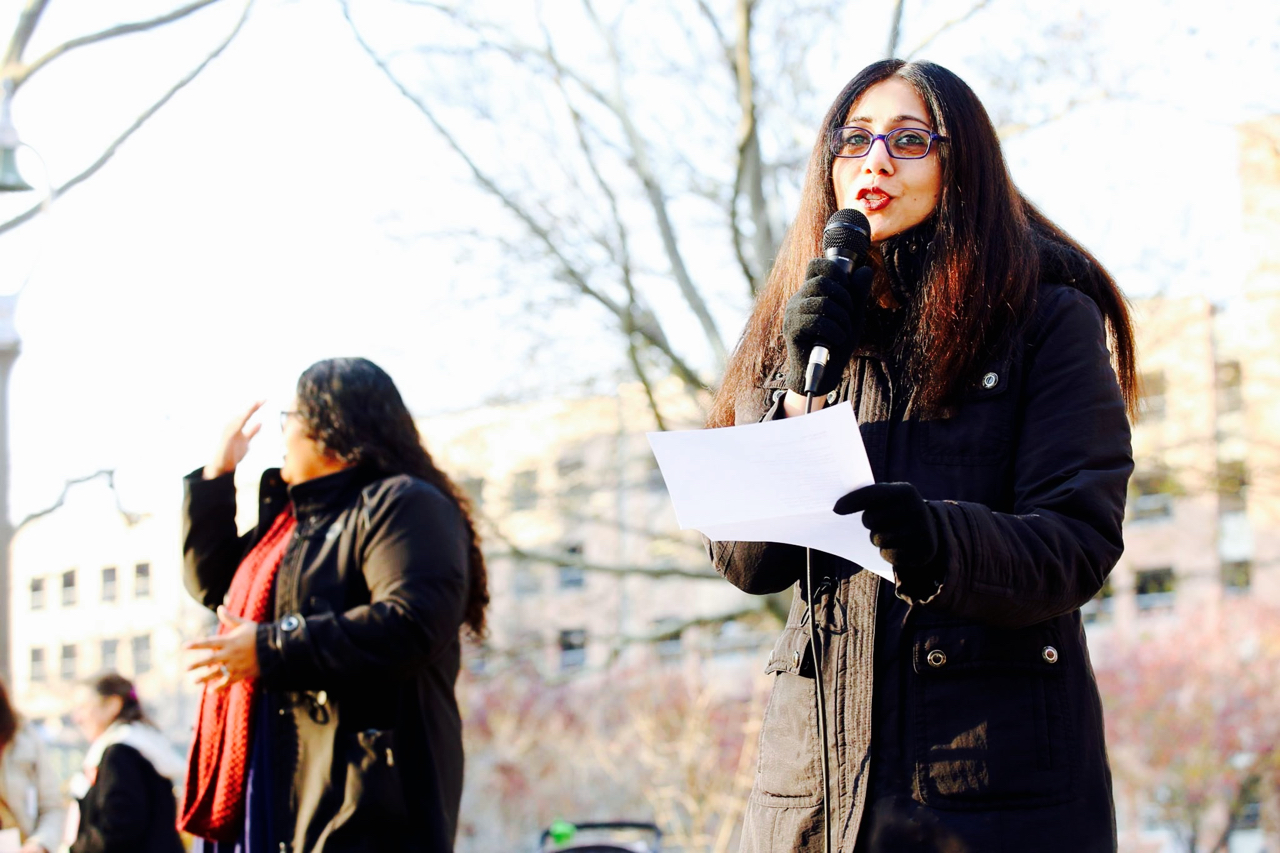
Diana Buttu: In the numerous years I have spent in Jerusalem, I have seen trends and events that have unequivocally changed it for the worse — whether the construction of Israel’s 25-foot concrete wall, the destruction of thousands of Palestinian homes for spurious bureaucratic reasons, the expulsion of friends from their homes, the construction of illegal settlements that have scarred the landscape, or the erection of countless checkpoints to control Palestinian movement. Jerusalem’s approximately 300,000 Palestinians are now squeezed — indeed suffocating — under Israeli military rule. Trump’s announcement will only serve to embolden those who wish to see Jerusalem free from Palestinians.

It is imperative that the world send a strong message to Israel that it will no longer accept Israel’s illegal actions in Jerusalem, which cause such harm to Palestinians living there and efforts to make peace in the region. Instead of turning a blind eye or rewarding Israel’s illegal acts, the international community should start imposing sanctions on Israel immediately, in order to let Israeli leaders and the world know that Israel is not above the law and that Palestinians are not beneath it.

UR whistle blowers among those awarded Time’s Person of the Year

UR academics Jessica Cantlon and Celeste Kidd drew attention to under reported sexual harassment and abuse in academia. Cantlon said that this award has demonstrated that issues of sexual harassment are finally gaining the public attention and response necessary to inflict change. “I think that this is one of the biggest civil rights issues of our time. I think one thing that has changed is people used to think about sexual harassment as an interpersonal dispute and something that should be considered private. Women were kind of left to solve that problem on their own.” More here.

‘And, Ain’t I a Woman’ conversation focuses on intersectionality

Rebecca Rafferty: While there are a limited (but important) amount of concrete things we can do to challenge racist and sexist national policies, our ability to creatively tackle inequity on local levels is just about boundless. Arts community organizer Rachel Y. DeGuzman is continuing her series of creative forums, “At the Crossroads: Activating the Intersection of Art and Justice,” on Saturday, December 9, with the audience-interactive performance “And, Ain’t I a Woman: A Long Table Conversation and Installation.”

Inspired by the “Long Table” performance-discussion hybrids by artist Lois Weaver, DeGuzman invited several WOC involved in the arts, education, and social justice — Amanda Chestnut, Reenah Oshun Golden, Tokeya Graham, Mara Ahmed, Jazzelle Bonilla, Erica Bryant, N’Jelle Gage-Thorne, Tianna Mañón, Debora McDell Hernandez, Annette Ramos, and Gaynelle Wethers — to join her in a free-form, “dinner table” discussion about the intersection of race and gender. After the first 30 minutes of talk, audience members can tap someone on the shoulder and take their place to join the continued conversation. More here.

The Agitators at Geva

Last Thursday I went to see “The Agitators” at Geva Theatre Center. It’s a play about the “enduring but tempestuous friendship of Susan B. Anthony and Frederick Douglass.”

Two actors, minimal/slick set design, and some good music. It was a full house, as expected, but I have to be honest and say I was disappointed. I found the script, by Mat Smart, to be too facile, too flat, too “glib” as one of my friends said.

The play was a crowd pleaser to be sure – it had humor and some good dialogue, especially when Anthony and Douglass slugged it out – first on the subject of the 15th amendment which was passed in 1870 (why should Black men get the vote before women?) and then on the issue of segregation within the Suffrage Movement (Black women were excluded from conventions in Southern cities such as Atlanta as well as from the 1913 parade in Washington, DC). The 19th amendment, which guaranteed all American women the right to vote, was finally passed in 1920.

During the first act, I felt like Frederick Douglass played a supporting role to the formidable Susan B. Anthony. She was the one who challenged and chided and got most of the laughs. To me Douglass has always been a towering figure, physically, intellectually, and in terms of presence and charisma. It’s incomprehensible to me that he was born into the savagery of slavery, that he not only managed to escape but was able to build from scratch immense moral and mental capital. Sadly I didn’t feel this power in the way Douglass is written. Perhaps if the script had been populated by other characters, not just two icons, there could have been a frame of reference, something to anchor but also project these historical giants in all their vivid peculiarities and complexity.

Complexity is what was missing from the play. It needed more research, more meat, a better sense of how Anthony and Douglass spoke back in the day, how they interacted with friends, how they moved and gestured, and created discomfort around them.
Although this is a great celebration of Rochester’s history, what about the inconvenient reality of what Rochester is today? Number 1 in poverty and number 4 in childhood poverty in America. What would Douglass and Anthony say about that? This could have been an interesting frame for us to explore our past. And perhaps this is why the smooth, lightweight easiness of the play sticks out like a sore thumb.

My friends and I looked around the audience. There were hardly any people of color present. One could count them on the fingers of one hand. There were no young people. It might have had something to do with the fact that tickets were, for the most part, in the $50 to $70 range and that Rochester is painfully segregated, along racial/economic lines. What an irony to produce a play about Frederick Douglass, in the city where he did some of his most important work, and exclude the vast majority of those he fought for, those who know him best?

During the Fringe Festival I was lucky to attend “Anatomy of a Black Man” by Anderson Allen and Shaquille Payne. It was anything but slick or even, it was down to earth and abrasive and real. It had substance, it had heart. This is the kind of material I’d like to see Geva pick up and Logan Vaughn direct. Let’s say it like it is. We owe it to Douglass and Anthony’s legacy.

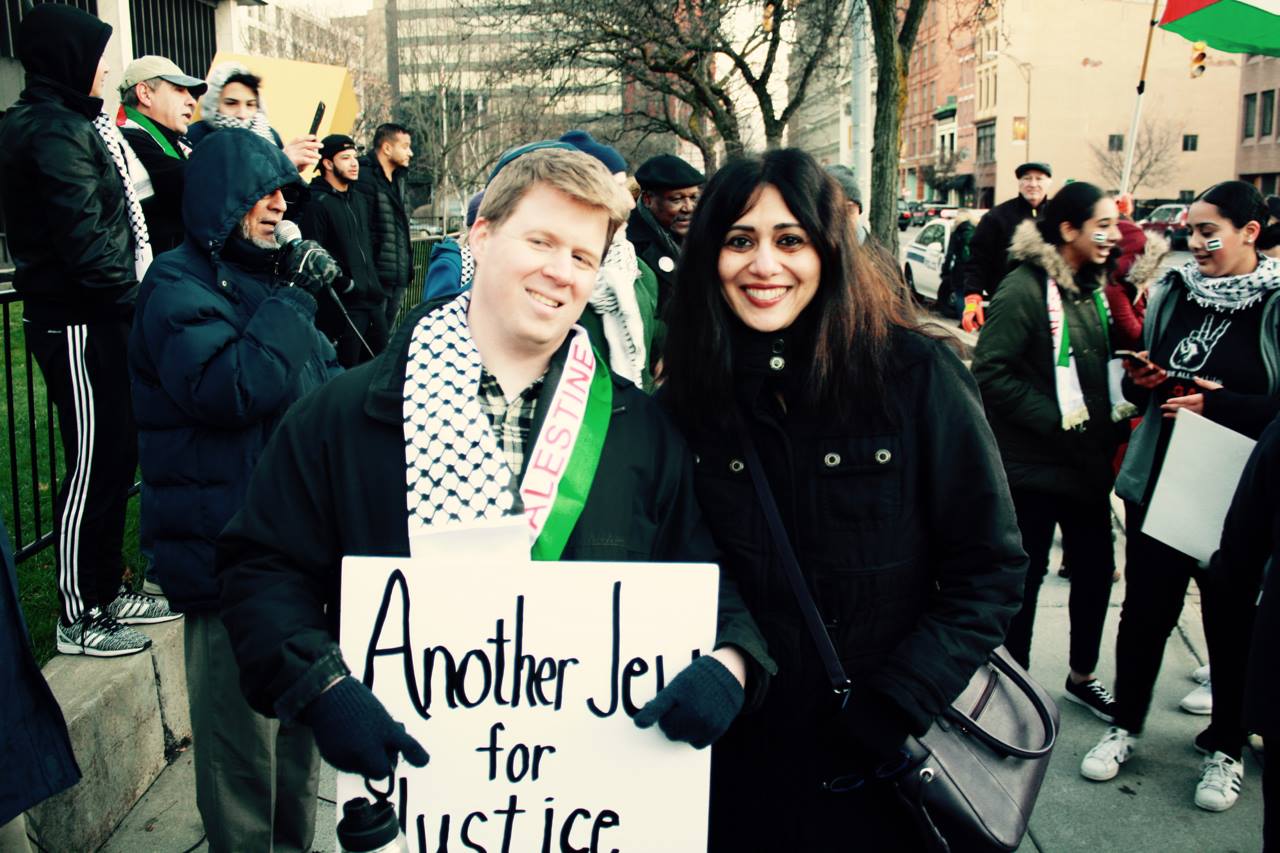
Susan Abulhawa on Writing and Activism – Witness Palestine Rochester

On Sept 10th this year, Rajesh Barnabas and I had the chance to interview Palestinian-American writer and activist Susan Abulhawa. She was here to deliver the keynote address that kicked off the Witness Palestine Film Festival. We talked about her literary writing, political commentary, as well as her activism. She even gave us a sneak peek into her upcoming novel. Pls watch and share 🙂

timely political drama plays out on stage

last night i saw this thought-provoking play directed by Nigel Maister. loved the staging – how the set is constructed (which is tied into how audiences view/experience the play), the effective use of multimedia technology including cameras, projections, sound and music, and the rotation/reversal of roles such that cast members play both oppenheimer and his accusers. the content is politically charged and relevant. i was afraid that oppenheimer would come off as some kind of socialist hero simply caught in a witch hunt but there was some discussion about the extent to which he was involved in the detonation of the atomic bomb. he didn’t just “birth” the bomb, he helped select the cities that would be targeted (to maximum effect) and opposed announcing the bomb’s completion by testing it in an unpopulated area. it’s a 3-hour play but the dialogue is fast-paced and the interchanges between the actors dynamic. projections add an element of visual intrigue and structure to a script that’s dialogue-heavy. what i loved most was the striking diversity of the cast and their captivating energy. more here.

speaking engagements

last week i spoke at two separate events – i was the keynote speaker at the annual meeting of the pioneer library system (with about 140 librarians and administrators in attendance) and i addressed congregants at the first presbyterian church of pittsford. i spoke about physical and metaphorical walls/borders and how libraries could help dismantle them and about islam and the process of othering. on both occasions, as far as i could tell, i was the only POC, the only muslim, the only immigrant present. some of the first questions i was asked: “where are u from?” and “are u from saudi arabia?” but then i got to show a clip from a conversation between edward said and bill moyers, i got to explain the meaning of orientalism, i was able to quote audre lorde and adrienne rich, describe an academic paper about the status of mary in islam, explain the taliban in purely political terms, break down racism as institutional/systemic, and provide people with a list of alternative media. sometimes one’s very presence is an act of disruption.

Nazareth’s Bethlehem exhibit depicts every day (occupied) life

thank u for this brilliant review of a unique exhibit, rebecca rafferty! u are a treasure for our community.

When Bshara Nassar moved from Bethlehem to the US in 2011, he didn’t expect to end up starting a museum. He was working on a graduate degree in Conflict Transformation at Eastern Mennonite University in Harrisonburg, Virginia, and by the end of 2014, he had plans in motion to create the Museum of the Palestinian People, which through October is co-presenting the traveling exhibit “Bethlehem Beyond the Wall” at Nazareth College. Through photographs, paintings, and artifacts, the exhibit aims to shed light on the history and enduring culture of Palestine from the perspective of Palestinians. More here.