A grant for my project

I am beyond thrilled to share that I have been awarded a NYSCA (New York State Council on the Arts) grant for my project “Return to Sender: Women of Color in Colonial Postcards and the Politics of Representation.” This project will involve a short film, an art exhibition, artist talks, and a community discussion led by three women of color. The film premiere will be at Cinema Arts Centre in Huntington, NY, on Oct 1st this year.

There are so many amazing people to thank: first of all, Patty Eljaiek at Huntington Arts Council, Inc. without whose encouragement I wouldn’t have applied for this grant and whose consistent support was invaluable; Emily Dowd, Kieran Johnson and everyone at @huntingtonarts; Stephanie Gotard at @huntingtonhistoricalsociety who is my community partner (and my biggest cheerleader); Dylan Toombs who shot the footage for the film with dazzling artistry; Boris Sapozhnikov for additional cinematography; the beautiful and talented Fatimah Arshad, Urvashi Bhattacharya, and Sumayia Islam who are the stars of the film; Rajesh Barnabas and Darien Lamen who will be helping with postproduction; Nia Adams, Madeline Churney, and Farhana Islam for agreeing to lead a post-screening discussion; Jeremy Dennis for being open to a screening at Ma’s House & BIPOC Art Studio; and finally, Dylan Skolnik and René Bouchard for a film premiere and discussion at Cinema Arts Centre in spite of many complications.

Also trying to get a student intern from Stony Brook’s Women’s and Gender Studies dept to curate the art exhibition — thank you to the faculty there.

I will write more about the film, but for now I want to thank all my people — everyone who has worked with me, believed in me, and inspired me. Love you all!

This project is made possible with funds from the Statewide Community Regrant Program, a regrant program of the New York State Council on the Arts with the support of the Office of the Governor and the New York State Legislature and administered by The Huntington Arts Council, Inc.

Editing The Injured Body: Greta Niu

Greta Niu: I just don’t want to lose sight of what makes up the microaggressions. It is implicit biases around race or ethnicity or gender or gender expression or class or size or disability. Those are the pieces that we’ve been fighting and we have always been fighting against. I don’t want people to think we are done with that. Now all we have to deal with are these microaggressions. The fact is, it’s a whole continuum of behaviors that are harmful, from a little poke to physical violence.

Photograph by Rajesh Barnabas

Editing The Injured Body: Lauren Jimerson

Lauren Jimerson: On the reservation, I didn’t think about my life past 18 or 20. It was hard to imagine being an adult. When I was 12, I saw the first young person pass away. Someone I grew up with, my cousin and neighbor. He was 19 or 20 and died in a car accident. I saw all these young people passing away. I didn’t know what the future looked like. Then I had Angel and it changed the course of my life.

Photograph by Erica Jae

Sunsets…

Etel Adnan: You know, sunsets are violently beautiful, I would say that they are so by definition, but there are lights, not even colorful in the habitual sense, lights elemental, mercurial, silvery, sulfurous, copper-made, that make us stop, then lose balance, make us open our arms not knowing what else to do, arrest us as if struck by lightning, a soft lightning, a welcome one. I wait for those lights, I know some of you do too, wherever you are, I mean when you are standing by an ocean, alone, within the calmness of your spirit. Be planetary.

[West Meadow Beach today]

some good news

this makes me sooooo happy. as i’ve said before, give me michelle yeoh all day and every day. to more films that center the stories of and performances by people of color, immigrants, refugees, minorities, marginalized communities, and women, especially older women. it will make for much better art, as is proven over and over again. we want our culture to reflect our realities. the days of the ubiquitous straight white dude are over.

my review: triangle of sadness

saw ‘triangle of sadness’ by ruben ostlund, then went back and watched ‘the square’ again. will rewatch ‘force majeure’ as well. what a brilliant, hilarious, provocative filmmaker. have been thinking about his work and how to encapsulate it. he likes to invert or complicate what is ‘normal.’ he strips away western society’s veneer of civilization, exposes its violent vulgar core, and pokes holes in what is considered the social contract.

he does this stylistically as well, by inserting sounds and visual disturbances in his scenes (an elevator door that keeps closing in the middle of an intense convo, baby cries during a marketing pitch, chairs crashing to the ground while a couple confront each other after an awkward one-night stand, etc).

he reaches for some of the mightiest, most glittery symbols of high culture (modern art, fashion, even winter sports), roots them out from their aesthetic safe place, and reveals the social rot, money, privilege, and absurdity they engender.

his films are always set in exclusive, elitist contexts – a bougie ski resort, a contemporary art museum, a luxury yacht – where the rich and beautiful prance and prevaricate about their wealth. a russian capitalist who quotes ronald reagan, a cute old couple who’ve made their fortune as arms dealers, a museum curator who is proudly liberal but couldn’t cut it without the privileges he wields, art collectors and aristos who remain paralyzed in the face of an assault on one of their own, how power hierarchies can be flipped like a switch, how the elite are completely bereft of survival skills, ideas of masculinity, the marginalization of people of color, horrors of the service industry, capitalism and homelessness, capitalism and art, beauty as trade and industry, the list goes on.

there’s always so much to unpack.

Polychromy

Saw ‘Polychromy’ at the Met. So interesting how color has been erased from “Western” history.

Carl Jennings: Color is a code, a sign, a message – we use it to communicate and in turn, it has the power to shape how we think and feel. For the last 500 years or so… to be civilized is to eschew color, to resist its temptations and its charms. As Goethe observed of his times, nearly 200 years ago, “… savage nations, uneducated people, and children have a great predilection for vivid colors… people of refinement avoid vivid colours in their dress”. And Charles Blanc, the French Minister of Culture, expressing a sentiment shared by many scholars and art historians, over the perceived opposition between line and color in art, stated in 1848 that, “…colour is the peculiar characteristic of the lower forms of nature, while drawing becomes the medium of expression, more and more dominant, the higher we rise in the scale of being”.

These quotes belie a sentiment common in Western culture and eloquently documented in David Batchelor’s fascinating book on the topic, a sentiment that sees color as “something for children, savages, minorities, and women”: a loathing and a fear of color that he calls — chromophobia.

But it wasn’t always this way. The history of the west is nothing if not colorful — but very little of that evidence exists nowadays. Color has either faded with time and the elements, or it has been purposefully removed and whitewashed. The Greek and Roman statues of antiquity, pure and ethereal in their whiteness, are an illusion. They were never white. Instead, they were painted, in great and often garish detail.

Farha on Netflix

i finally watched ‘farha,’ a film by jordanian director darin sallam, on netflix last night. i knew that it’s a film about the nakba (or the catastrophe) in which more than 700,000 palestinians were forcibly expelled from palestine in 1948, to make room for the jewish-supremacist state of israel.

i also knew that the israeli government has been applying pressure on netflix to censor/remove the film from their library. a bit funny considering the heretofore love affair between israel and netflix. you can read about it in belén fernández’s excellent piece ‘netflix and israel: a special relationship’ in which she shows how “netflix has been willingly subsumed into the israeli hasbara industry.”

the nakba is a vast and important episode in human history, yet sallam’s approach is small, specific, and spare. the story is told through the eyes of a 14-year old girl who becomes an unwitting witness to shocking atrocities committed by israeli soldiers. as we spend most of the film seeing the world through farha’s eyes, we too are called to witness and testify.

the experience transforms farha – gone are her dreams of studying in the city and investing her life in her community. the nakba was meant to destroy palestinian society, very deliberately, one bureaucratic and military step at a time, over multiple decades and generations.

israel’s war on ‘farha’ is enraging. not only because palestinians might be some of the few people in the world who are not allowed to tell the stories of their own dispossession and ethnic cleansing, but also because the facts of what we see in the film are not new. the terror (including theft, rape and massacres) wielded against palestinians during the nakba is well-known and well-documented, including testimonies by israeli soldiers who carried it out.

u’d have to live under a rock not to have heard of the deir yassin massacre, for example. many parts of tel aviv itself are built on depopulated palestinian villages.

in any case, the bots are out in huge numbers trying to sabotage farha’s ratings, so pls watch the film, ‘love’ it on netflix (two hearts), make an imdb account, give the film 10 stars, go to the film on google and letterboxd and give it 5 stars. write a review if u like.

let’s make sure we see more stories by and about the oppressed and their histories, and less state propaganda packaged as art. we can make a difference.

Editing The Injured Body: Mercedes, Erica and Tianna

Listening to a brilliant convo between Mercedes Phelan, Erica Bryant and Tianna Manon.

-Mercedes: I was brought up to be tough – don’t show your emotions, no crying, breaking down is weakness… It’s difficult to learn to express my emotions in a positive way.

-Erica: Black women carry generational trauma, personal trauma, all these micro-aggressions. And there is no healing for it. We must reverse that stigma. Taking care of yourself emotionally and psychologically is important.

-Tianna: There are institutional issues. For a long time health professionals were not trained to deal with trauma faced by Black people. So it wasn’t always good help. Also, how many can afford it? There are some free things out there. But how do you navigate that system? This is on top of how we force each other to be tough.

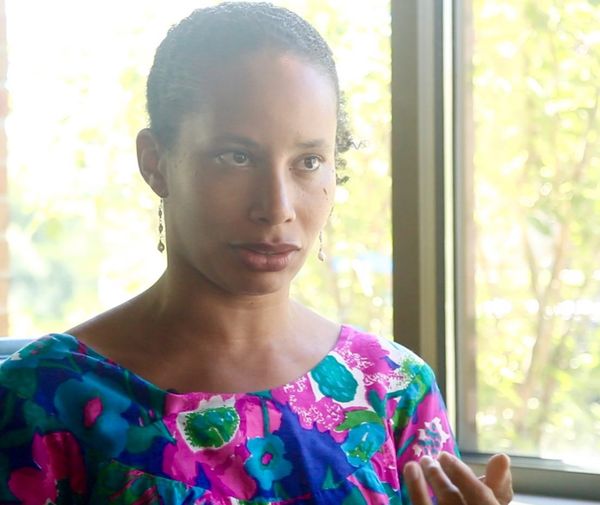
Erica Bryant

my short film – best in show

with the wonderful christophe lima, juror for the new exhibition at huntington arts council which opened today. the theme of the exhibition is the exploration of the human body. i wrote a poem called ‘the body has memory’ and created a short experimental film around it. not only was it selected for the exhibition but it won ‘best in show.’ couldn’t be more excited!

thank u Rajesh Barnabas for the beautiful cinematography and Mariko Yamada for the dance choreography. stunning dance performances by Cloria Iampretty and mariko. mostly thank u all for being who u are. sharing some of rochester’s talent and heart here on long island <3