ola mexico!

we went to mexico over christmas break 2007 and what a terrific vacation that was! the weather was perfect, the food was flavorful (and quite different from the rather tepid fare passed off as mexican at most american restaurants), the people were friendly, and the places we visited were lovely.

we landed in puerto vallarta a little after 1pm and rented a car to drive about 1 1/2 hour north to chacala, a small fishing village. just take highway 200 in the direction of tepic. we stopped at rincon de guayabitos for some lunch and found this sleepy seaside town to be charming. we ate at this small family-run restaurant where the owner sat comfortably under the shade of a colorful awning, playing cards with her friends. it looked like she had spent a good part of her day doing just that. the food was delicious but it took the longest time for it to get prepared. it was obvious that our american-style dependence on time and efficiency, units of work produced per unit of time, would look embarrassing here. it’s better to go with the flow and enjoy each languorous moment of the day.

after following a long dirt road into chacala we finally got to kate’s house, casa monarca. kate is american, her husband is mexican. they have just finished building this beautiful house in chacala – tangerine-colored stucco, a pool with shimmering spheres of mediterranean blue, friendly hammocks and colorful wicker rocking chairs. it was a feast for the eyes. the family lives upstairs and rents the lower portion of the house. after settling down a bit we decided to walk to the beach and get some dinner. the most tourist friendly restaurant with the most extensive menu is the one with all the flags on it. it sits right on the beach. but instead of eating at the restaurant we decided to try a pineapple from a little fruit stand. it was an elaborate affair.

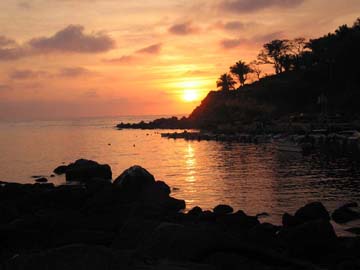
the top of the pineapple comes off first, before the fruit is cored. the core is moved to a small bowl filled with grenadine. the inside of the pineapple is then scraped and grated so as to make it drinkable. fresh lemon juice is squeezed into it and so is fresh orange juice. sea salt and chili powder are carefully stirred into the concoction. finally the fruit’s core is replaced into its center along with cucumber and orange slices. it’s a thing of beauty and perhaps the best tasting treat i had in mexico. my husband, the doctor, was praying that the chef and sous chef had duly washed their hands before embarking on this culinary project. all i can say is that it was well worth the risk! after this tasty and unconventional dinner we lingered on at the beach and experienced a stunning sunset. for the first time in months, i felt completely relaxed and carefree.

chacala pool

chacala sunset

screening of “the muslims i know” – a nywift event

on jan 10, 2008, my rough cut was screened as a new york women in film and television event, at my house. there was food and drink and a good showing of people – mostly filmmakers and some friends. we watched the film in my basement and afterwards there was some time for comments and feedback. the response was tremendous. many in the audience said that they had learned a lot during this one hour screening. others appreciated the artistic elements in the film – the lahore collage and the bucolic scenes and artsy cafes depictive of rochester and its environs. all in all, for me as the filmmaker, it was a much heartening experience. some of the suggestions that were made were good and put me in the right frame of mind to complete my final edit. after this it’s more cleaning up by my assistant editor, the addition of some animation, the finalization and re-recording of my narration, the completion and inter-cutting of an original musical score, copyright issues, and then the final professional polishing. so much to do and very little time. goal: submit documentary to highfalls film festival jury by mid february. just gotta keep slogging away at it – i’m almost there!

benazir’s assassination – my take

we were in puerto vallarta, in the middle of a sunny mexican vacation, when i turned on the tv to check out some spanish programming and found out instead that benazir bhutto had been assassinated. i was shocked. it seemed surreal. of course there had been the deadly bomb blasts in karachi, killing 140 people in a ppp (pakistan people’s party) rally, assembled to welcome her home after 11 years of self-exile. there had been all the threats against her and her insistence on getting better protection from the government. but it still seemed unreal. my friend sue once described benazir bhutto as a rock star – she certainly had the entourage and that dramatic “big production” feel about her. she was also strongly backed by the u.s. it was galling to see her negotiate her party’s “package” with musharraf from the safe confines of the united states, like the exacting ceo of an american multi-national (so much for pakistan’s sovereignty). all of this made her seem untouchable, impervious to danger. yet, there it was. she had been shot. benazir bhutto was gone.

let me start by saying that benazir bhutto was not liked by most pakistanis. she was prime minister twice and both times she disappointed, monumentally. i remember the first time she was elected prime minister in 1988. this was after 11 years of oppression at the hands of general zia ul haq. the country was ready, no desperate, for change. we were suffocating. and benazir seemed to be the answer to our prayers. she was 35 years old. she was a woman. she was well-educated. and yes, she was zulfiqar ali bhutto’s daughter. we were glued to our televisions as she was sworn in – we could hardly contain our joy. democracy was finally working. we the people had elected benazir and we had high hopes for her. this euphoria lasted about a week. as soon as benazir came into power she made it clear that she intended to run pakistan like her ancestral fiefdom, back home in sind. this was her turn to loot the country and no one was going to tell her otherwise. the corruption charges just kept piling up. her husband was her front-man and they were making out like bandits. in 20 months, she went from being the darling of the people to pakistan’s most brazen plunderer. she thought that she had the power and pizazz to pull it off until she was removed from office by the president. she got re-elected in 1993 to be booted out once again in 1996, under similar circumstances. what a waste! what a gargantuan, wretched, miserable waste of an opportunity. this had been her moment in history. she could have changed the nature of pakistan’s military-dominated politics but she squandered every opportunity, twice.

were things going to be different this time around? not a chance. in the minds of many americans, benazir had bravely stood up to musharraf and asked for freedom and democracy. not so. while she had been busy outlining the demands of her executive package and finding mutually beneficial ways of working with musharraf, it was the lawyers, journalists and activists of pakistan who had shown astounding courage and stood up to a military dictator. they were the ones who were putting their lives on the line for the restoration of freedom and justice. when benazir realized that musharraf had no political currency in pakistan she conveniently latched on to this grassroots movement and began to talk the talk. yet the major political parties in pakistan did NOT lend their support to this movement. so while benazir was being portrayed as a righteous, house-arrested, populist heroine of pakistani democracy by american media, her party was not fighting that fight on the ground. the real heroes, lawyers like ali ahmed kurd, tariq mahmood, atizaz ahsan and munir a. malik, were on their own, left to cope valiantly with jail time and torture.

after musharraf sacked the supreme court and appointed his own cronies to legitimize his bid for “elected” head of state, instead of boycotting this sham election and asking for the restoration of the supreme court, benazir was more than happy to participate. these were the so-called elections she was campaigning for when she died. her death has come as a shock to the world but let’s not indulge in a diana-style romanticizing of her life. let’s not compare the bhutto dynasty to the kennedys. let’s not disneyfy her legacy. like william dalrymple has said: “bhutto was no aung san suu kyi”.

although i did not like benazir bhutto and had no confidence in her abilities as a leader or her intentions to govern pakistan in an honest and fair manner, i am deeply disturbed by her assassination. i am mortally afraid that this might have opened a pandora’s box. i do not want the politicians of pakistan to contest elections by having their opponents assassinated. i do not want the people of pakistan to live with the fear of being bumped off for any anti-establishment statement they might make. this is what frightens me – this sense of absolute power concentrated in the corrupt hands of a few. and this is why it is crucial that benazir’s death be investigated in the most meticulous fashion, by an impartial, international team. the perpetrators must be found and held to account. american aid must be contingent upon such an investigation. the stakes are huge. if we want stability in pakistan, and this is the refrain we keep hearing in the media, then we must make it clear that assassinations cannot become a political strategy, our faith in and adherence to realpolitik aside.

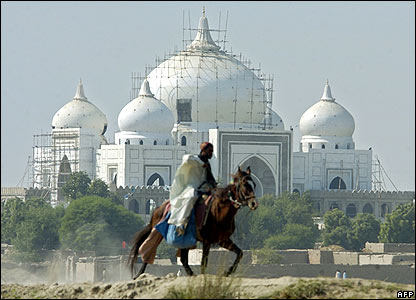
benazir’s father’s mausoleum in the village of garhi khuda bakhsh

benazir’s assassination – william dalrymple and tariq ali’s excellent articles

Pakistan’s flawed and feudal princess
It’s wrong for the West simply to mourn Benazir Bhutto as a martyred democrat, says this acclaimed south Asia expert. Her legacy is far murkier and more complex
William Dalrymple
Sunday December 30, 2007, The Observer

One of Benazir Bhutto’s more dubious legacies to Pakistan is the Prime Minister’s house in the middle of Islamabad. The building is a giddy, pseudo-Mexican ranch house with white walls and a red tile roof. There is nothing remotely Islamic about the building which, as my minder said when I went there to interview the then Prime Minister Bhutto, was ‘PM’s own design’. Inside, it was the same story. Crystal chandeliers dangled sometimes two or three to a room; oils of sunflowers and tumbling kittens that would have looked at home on the Hyde Park railings hung below garishly gilt cornices.

The place felt as though it might be the weekend retreat of a particularly flamboyant Latin-American industrialist, but, in fact, it could have been anywhere. Had you been shown pictures of the place on one of those TV game-shows where you are taken around a house and then have to guess who lives there, you may have awarded this hacienda to virtually anyone except, perhaps, to the Prime Minister of an impoverished Islamic republic situated next door to Iran.
Which is, of course, exactly why the West always had a soft spot for Benazir Bhutto. Her neighbouring heads of state may have been figures as unpredictable and potentially alarming as President Ahmadinejad of Iran and a clutch of opium-trading Afghan warlords, but Bhutto has always seemed reassuringly familiar to Western governments – one of us. She spoke English fluently because it was her first language. She had an English governess, went to a convent run by Irish nuns and rounded off her education with degrees from Harvard and Oxford.

‘London is like a second home for me,’ she once told me. ‘I know London well. I know where the theatres are, I know where the shops are, I know where the hairdressers are. I love to browse through Harrods and WH Smith in Sloane Square. I know all my favourite ice cream parlours. I used to particularly love going to the one at Marble Arch: Baskin Robbins. Sometimes, I used to drive all the way up from Oxford just for an ice cream and then drive back again. That was my idea of sin.’
It was difficult to imagine any of her neighbouring heads of state, even India’s earnest Sikh economist, Manmohan Singh, talking like this.
For the Americans, what Benazir Bhutto wasn’t was possibly more attractive even than what she was. She wasn’t a religious fundamentalist, she didn’t have a beard, she didn’t organise rallies where everyone shouts: ‘Death to America’ and she didn’t issue fatwas against Booker-winning authors, even though Salman Rushdie ridiculed her as the Virgin Ironpants in his novel Shame.

However, the very reasons that made the West love Benazir Bhutto are the same that gave many Pakistanis second thoughts. Her English might have been fluent, but you couldn’t say the same about her Urdu which she spoke like a well-groomed foreigner: fluently, but ungrammatically. Her Sindhi was even worse; apart from a few imperatives, she was completely at sea.

English friends who knew Benazir at Oxford remember a bubbly babe who drove to lectures in a yellow MG, wintered in Gstaad and who to used to talk of the thrill of walking through Cannes with her hunky younger brother and being ‘the centre of envy; wherever Shahnawaz went, women would be bowled over’.

This Benazir, known to her friends as Bibi or Pinky, adored royal biographies and slushy romances: in her old Karachi bedroom, I found stacks of well-thumbed Mills and Boons including An Affair to Forget, Sweet Imposter and two copies of The Butterfly and the Baron. This same Benazir also had a weakness for dodgy Seventies easy listening – ‘Tie a Yellow Ribbon Round the Old Oak Tree’ was apparently at the top of her playlist. This is also the Benazir who had an enviable line in red-rimmed fashion specs and who went weak at the sight of marrons glace.

But there was something much more majestic, even imperial, about the Benazir I met when she was Prime Minister. She walked and talked in a deliberately measured and regal manner and frequently used the royal ‘we’. At my interview, she took a full three minutes to float down the 100 yards of lawns separating the Prime Minister’s house from the chairs where I had been told to wait for her. There followed an interlude when Benazir found the sun was not shining in quite the way she wanted it to. ‘The sun is in the wrong direction,’ she announced. Her hair was arranged in a sort of baroque beehive topped by a white gauze dupatta. The whole painted vision reminded me of one of those aristocratic Roman princesses in Caligula.

This Benazir was a very different figure from that remembered by her Oxford contemporaries. This one was renowned throughout Islamabad for chairing 12-hour cabinet meetings and for surviving on four hours’ sleep. This was the Benazir who continued campaigning after the suicide bomber attacked her convoy the very day of her return to Pakistan in October, and who blithely disregarded the mortal threat to her life in order to continue fighting. This other Benazir Bhutto, in other words, was fearless, sometimes heroically so, and as hard as nails.

More than anything, perhaps, Benazir was a feudal princess with the aristocratic sense of entitlement that came with owning great tracts of the country and the Western-leaning tastes that such a background tends to give. It was this that gave her the sophisticated gloss and the feudal grit that distinguished her political style. In this, she was typical of many Pakistani politicians. Real democracy has never thrived in Pakistan, in part because landowning remains the principle social base from which politicians emerge.

The educated middle class is in Pakistan still largely excluded from the political process. As a result, in many of the more backward parts of Pakistan, the feudal landowner expects his people to vote for his chosen candidate. As writer Ahmed Rashid put it: ‘In some constituencies, if the feudals put up their dog as a candidate, that dog would get elected with 99 per cent of the vote.’

Today, Benazir is being hailed as a martyr for freedom and democracy, but far from being a natural democrat, in many ways, Benazir was the person who brought Pakistan’s strange variety of democracy, really a form of ‘elective feudalism’, into disrepute and who helped fuel the current, apparently unstoppable, growth of the Islamists. For Bhutto was no Aung San Suu Kyi. During her first 20-month premiership, astonishingly, she failed to pass a single piece of major legislation. Amnesty International accused her government of having one of the world’s worst records of custodial deaths, killings and torture.

Within her party, she declared herself the lifetime president of the PPP and refused to let her brother Murtaza challenge her. When he persisted in doing so, he ended up shot dead in highly suspicious circumstances outside the family home. Murtaza’s wife Ghinwa and his daughter Fatima, as well as Benazir’s mother, all firmly believed that Benazir gave the order to have him killed.

As recently as the autumn, Benazir did and said nothing to stop President Musharraf ordering the US and UK-brokered ‘rendition’ of her rival, Nawaz Sharif, to Saudi Arabia and so remove from the election her most formidable rival. Many of her supporters regarded her deal with Musharraf as a betrayal of all her party stood for.
Behind Pakistan’s endless swings between military government and democracy lies a surprising continuity of elitist interests: to some extent, Pakistan’s industrial, military and landowning classes are all interrelated and they look after each other. They do not, however, do much to look after the poor. The government education system barely functions in Pakistan and for the poor, justice is almost impossible to come by. According to political scientist Ayesha Siddiqa: ‘Both the military and the political parties have all failed to create an environment where the poor can get what they need from the state. So the poor have begun to look to alternatives for justice. In the long term, flaws in the system will create more room for the fundamentalists.’

In the West, many right-wing commentators on the Islamic world tend to see the march of political Islam as the triumph of an anti-liberal and irrational ‘Islamo-fascism’. Yet much of the success of the Islamists in countries such as Pakistan comes from the Islamists’ ability to portray themselves as champions of social justice, fighting people such as Benazir Bhutto from the Islamic elite that rules most of the Muslim world from Karachi to Beirut, Ramallah and Cairo.

This elite the Islamists successfully depict as rich, corrupt, decadent and Westernised. Benazir had a reputation for massive corruption. During her government, the anti-corruption organisation Transparency International named Pakistan one of the three most corrupt countries in the world.

Bhutto and her husband, Asif Zardari, widely known as ‘Mr 10 Per Cent’, faced allegations of plundering the country. Charges were filed in Pakistan, Switzerland, the United Kingdom and the United States to investigate their various bank accounts.

When I interviewed Abdul Rashid Ghazi in the Islamabad Red Mosque shortly before his death in the storming of the complex in July, he kept returning to the issue of social justice: ‘We want our rulers to be honest people,’ he said. ‘But now the rulers are living a life of luxury while thousands of innocent children have empty stomachs and can’t even get basic necessities.’ This is the reason for the rise of the Islamists in Pakistan and why so many people support them: they are the only force capable of taking on the country’s landowners and their military cousins.

This is why in all recent elections, the Islamist parties have hugely increased their share of the vote, why they now already control both the North West Frontier Province and Baluchistan and why it is they who are most likely to gain from the current crisis.

Benazir Bhutto was a courageous, secular and liberal woman. But sadness at the demise of this courageous fighter should not mask the fact that as a pro-Western feudal leader who did little for the poor, she was as much a central part of Pakistan’s problems as the solution to them.

William Dalrymple’s latest book, The Last Mughal: The Fall of a Dynasty, Delhi 1857, published by Bloomsbury, recently won the Duff Cooper Prize for History

My heart bleeds for Pakistan. It deserves better than this grotesque feudal charade

By Tariq Ali, Pakistan-born writer, broadcaster and commentator
31 December 2007, The Independent

Six hours before she was executed, Mary, Queen of Scots wrote to her brother-in-law, Henry III of France: “…As for my son, I commend him to you in so far as he deserves, for I cannot answer for him.” The year was 1587.

On 30 December 2007, a conclave of feudal potentates gathered in the home of the slain Benazir Bhutto to hear her last will and testament being read out and its contents subsequently announced to the world media. Where Mary was tentative, her modern-day equivalent left no room for doubt. She could certainly answer for her son.

A triumvirate consisting of her husband, Asif Zardari (one of the most venal and discredited politicians in the country and still facing corruption charges in three European courts) and two ciphers will run the party till Benazir’s 19-year-old son, Bilawal, comes of age. He will then become chairperson-for-life and, no doubt, pass it on to his children. The fact that this is now official does not make it any less grotesque. The Pakistan People’s Party is being treated as a family heirloom, a property to be disposed of at the will of its leader.

Nothing more, nothing less. Poor Pakistan. Poor People’s Party supporters. Both deserve better than this disgusting, medieval charade.
Benazir’s last decision was in the same autocratic mode as its predecessors, an approach that would cost her – tragically – her own life. Had she heeded the advice of some party leaders and not agreed to the Washington-brokered deal with Pervez Musharraf or, even later, decided to boycott his parliamentary election she might still have been alive. Her last gift to the country does not augur well for its future.

How can Western-backed politicians be taken seriously if they treat their party as a fiefdom and their supporters as serfs, while their courtiers abroad mouth sycophantic niceties concerning the young prince and his future.

That most of the PPP inner circle consists of spineless timeservers leading frustrated and melancholy lives is no excuse. All this could be transformed if inner-party democracy was implemented. There is a tiny layer of incorruptible and principled politicians inside the party, but they have been sidelined. Dynastic politics is a sign of weakness, not strength. Benazir was fond of comparing her family to the Kennedys, but chose to ignore that the Democratic Party, despite an addiction to big money, was not the instrument of any one family.

The issue of democracy is enormously important in a country that has been governed by the military for over half of its life. Pakistan is not a “failed state” in the sense of the Congo or Rwanda. It is a dysfunctional state and has been in this situation for almost four decades.

At the heart of this dysfunctionality is the domination by the army and each period of military rule has made things worse. It is this that has prevented political stability and the emergence of stable institutions. Here the US bears direct responsibility, since it has always regarded the military as the only institution it can do business with and, unfortunately, still does so. This is the rock that has focused choppy waters into a headlong torrent.

The military’s weaknesses are well known and have been amply documented. But the politicians are not in a position to cast stones. After all, Mr Musharraf did not pioneer the assault on the judiciary so conveniently overlooked by the US Deputy Secretary of State, John Negroponte, and the Foreign Secretary, David Miliband. The first attack on the Supreme Court was mounted by Nawaz Sharif’s goons who physically assaulted judges because they were angered by a decision that ran counter to their master’s interests when he was prime minister.

Some of us had hoped that, with her death, the People’s Party might start a new chapter. After all, one of its main leaders, Aitzaz Ahsan, president of the Bar Association, played a heroic role in the popular movement against the dismissal of the chief justice. Mr Ahsan was arrested during the emergency and kept in solitary confinement. He is still under house arrest in Lahore. Had Benazir been capable of thinking beyond family and faction she should have appointed him chairperson pending elections within the party. No such luck.

The result almost certainly will be a split in the party sooner rather than later. Mr Zardari was loathed by many activists and held responsible for his wife’s downfall. Once emotions have subsided, the horror of the succession will hit the many traditional PPP followers except for its most reactionary segment: bandwagon careerists desperate to make a fortune.

All this could have been avoided, but the deadly angel who guided her when she was alive was, alas, not too concerned with democracy. And now he is in effect leader of the party.

Meanwhile there is a country in crisis. Having succeeded in saving his own political skin by imposing a state of emergency, Mr Musharraf still lacks legitimacy. Even a rigged election is no longer possible on 8 January despite the stern admonitions of President George Bush and his unconvincing Downing Street adjutant. What is clear is that the official consensus on who killed Benazir is breaking down, except on BBC television. It has now been made public that, when Benazir asked the US for a Karzai-style phalanx of privately contracted former US Marine bodyguards, the suggestion was contemptuously rejected by the Pakistan government, which saw it as a breach of sovereignty.

Now both Hillary Clinton and Senator Joseph Biden, chairman of the Senate Foreign Relations Committee, are pinning the convict’s badge on Mr Musharraf and not al-Qa’ida for the murder, a sure sign that sections of the US establishment are thinking of dumping the President.

Their problem is that, with Benazir dead, the only other alternative for them is General Ashraf Kiyani, head of the army. Nawaz Sharif is seen as a Saudi poodle and hence unreliable, though, given the US-Saudi alliance, poor Mr Sharif is puzzled as to why this should be the case. For his part, he is ready to do Washiongton’s bidding but would prefer the Saudi King rather than Mr Musharraf to be the imperial message-boy.

A solution to the crisis is available. This would require Mr Musharraf’s replacement by a less contentious figure, an all-party government of unity to prepare the basis for genuine elections within six months, and the reinstatement of the sacked Supreme Court judges to investigate Benazir’s murder without fear or favour. It would be a start.
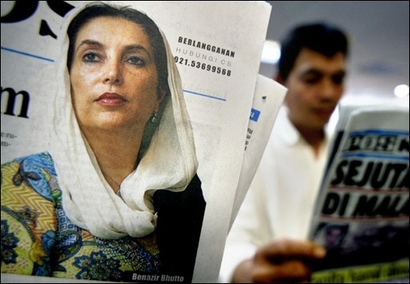
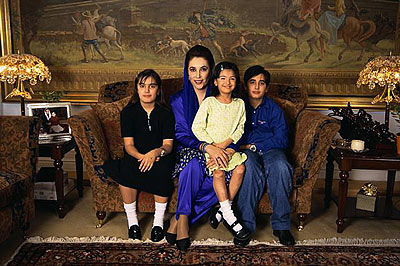
benazir bhuttothe bhutto dynasty

another response to hirsi ali

here’s a good response to hirsi ali, by jill, on her blog “feministe”:

12.8.2007
Where are all the moderate Muslims?
Posted by Jill @ 10:31 am

Ayaan Hirsi Ali has an op/ed up in the Times about “Islam’s silent moderates,” arguing that if Islam is really a religion of goodness then moderates should be pushing that vision, and simultaneously insisting that Islam can’t be a good religion and so there is no such thing as a moderate Muslim. I have a lot of respect for Hirsi Ali — she’s a smart, brave woman, and she certainly has valid personal reasons for disliking Islam. But what bothers me about this op/ed, and other op/eds like it, is that the argument is circular and unfair, and it holds Islam and Muslims to a standard that other mainstream religious groups are exempt from. For example, she starts the op/ed out with this passage from the Quran:

The woman and the man guilty of adultery or fornication, flog each of them with 100 stripes: Let no compassion move you in their case, in a matter prescribed by Allah, if you believe in Allah and the Last Day. (Koran 24:2)

and eventually uses it to make the point that:

If moderate Muslims believe there should be no compassion shown to the girl from Qatif, then what exactly makes them so moderate?

Selecting one section from a centuries-old religious text and then drawing the conclusion that most followers of that religion follow that text to the word is ridiculous. There are certainly a lot of religious people who do claim to follow the exact word of their religious text, but they’re usually either lying or ignorant. Religion may be the province of God, but how we live religion every day is entirely man-made. Men recorded the word of God onto paper. Even way back then, human beings selected which sections of religious law they wanted to live by; today, we still pick and choose. Notions of human rights and justice have evolved, and along with it, so has our religious understanding. To claim that every single passage in the Quran or the Bible is somehow “proof” of its moderate followers’ mindset is incredibly dishonest. You’d be better suited to see which passages the followers pick and choose themselves — that’s a whole lot more telling. And I guarantee that just as Pat Robertson and Mike Huckabee would pick very different Bible verses than I would to explain my faith, Muslim extremists would pick very different Quranic verses than your average, moderate Muslim person.

Hirsi Ali focuses on the horrendous rape punishment leveled at “the Qatif girl” in Saudi Arabia to make the point that moderate Muslims aren’t actually moderate. She writes:

It is often said that Islam has been “hijacked” by a small extremist group of radical fundamentalists. The vast majority of Muslims are said to be moderates.

But where are the moderates? Where are the Muslim voices raised over the terrible injustice of incidents like these? How many Muslims are willing to stand up and say, in the case of the girl from Qatif, that this manner of justice is appalling, brutal and bigoted — and that no matter who said it was the right thing to do, and how long ago it was said, this should no longer be done?

She comes to the conclusion that Muslims are silent about this. Which is kind of a funny conclusion — who does she think raised the issue in the first place? The New York Times?

The girl’s lawyer is a Saudi Muslim. She has been helped by human rights activists across the Middle East. Her story was promoted by Arab journalists. The case has outraged people around the world, including in Saudi Arabia. If moderate Muslims were actually silent, we would have never heard about this case to begin with.

I’m in the middle of finals and so I don’t have time to do an extensive research project on this either, but here’s what a quick google search turned up:

Ruling Jolts Even Saudis: 200 Lashes for Rape Victim
Arab View — Rape: Who Gets Punished And Who Does Not?
Saudi Jeans blog — The Qatif Girl, Again and Justice and Common Sense
Saudi Gazette – The Agony of Qatif Girl
Progressive Muslima News
Arab News: How Culture is Defined in a Global World
Hafeez Anwar’s Website: Lashing Out at the Media Over the Qatif Girl Case
Khaleej Times Online: Saudi Women Furious at Gang-Rape Ruling
Arab News: Violence Against Women is Still a Problem

That just took me all of 10 minutes. And there are dozens of articles and blog posts that I’ve read this week — including posts from very conservative Muslim writers who often make me want to throw something — that have all expressed disgust and outrage over this verdict. Further, the verdict has started a conversation about reforming the Saudi justice system — and the conversation is happening within Saudi Arabia.

There are a whole lot of problems with the way religion is exercised and carried out on all levels. But it’s the most dangerous when people in power use it to uphold their bigotries and to keep themselves at the top of the food chain. That’s what’s happening here — and moderate people of faith are speaking out against it, and against that power structure. This is not a phenomenon that’s inherent to Islam.

Finally, if we actually want moderate Muslims to feel safe speaking out, we have to can the “Islam is horrible” line. Because the more we say that things like female genital surgeries or punishing rape victims are Islam, the more that violent vision of Islam becomes emboldened and strengthened, and the more difficult it becomes for Muslim people to argue, “Wait a minute, that isn’t Islam as I’ve lived it.” And it’s really not the responsibility of Muslim people to be on the constant defensive in the first place — criticize the radicals, but don’t pin their actions on the millions of people who are horrified by them. And certainly don’t draw hasty conclusions about who is and isn’t speaking out when you haven’t even bothered to listen.

after i read hirsi ali’s article i looked her up on the web. it’s useful to see where a commentator is coming from. what i found is that she is not qualified to make an objective argument about islam and muslims because in her own words “islam is bad” – she is not looking for the truth but propagandizing her own views for the benefit of the ultra-conservative american right – let’s not forget that she lied on her citizenship application in the netherlands and was on the verge of being kicked out of that country when she was given refuge (and a lucrative paycheck) by the right-wing american enterprise institute. 

islam’s silent moderates – if you repeat it often enough…

hitler’s chief propagandist joseph goebbels was a firm believer in the “big lie”. he understood that if you repeat a lie often enough, people start to believe it. and so it goes with the relentless accusations levelled at moderate muslims. to tell you the truth, i’m sick of the label. by identifying ourselves as moderate muslims we fall into the trap of defining ourselves in language designed to reduce us to a stereotype. yet, here i am, a muslim in america, and therefore under constant pressure to explain myself. not only that but i am also accountable for the actions of more than a billion muslims in countries as diverse as saudi arabia, bangladesh and sudan.

a friend of mine sent me an article by ayan hirsi ali, imaginatively titled “islam’s silent moderates” in which she holds the moderates responsible for human rights abuses committed by the saudi, bangladeshi and sudanese governments.

here is what i think of all three cases.

as far as the saudi government, human rights abuses there have very little to do with islam and everything to do with the fact that the country is controlled by a single family, the sauds, who keep a tight lid on dissent by using religion to repress and restrain. i have very little tolerance for the saudi government and am more than happy to condemn the many human rights abuses that occur in that country. it is one country in the world where i would flatly refuse to live. even though saudi arabia is the birth place of islam, it is anything but islamic. there is no concept of hereditary rule in islam and saudi arabia (the “arabia of the sauds”) fails that basic test. however, my condemnation, and that of other muslims, cannot be as effective in dissuading the saudis from committing crimes against their own citizens as a few harsh words from the american government (the self-proclaimed policeman of the world). interestingly enough, saudi arabia remains america’s biggest muslim ally in the world – the saudi dictators being best friends with their american counterparts, the bushes. being a pakistani-american muslim, i think that the part of my identity that is most sickened by saudi arabia’s human rights trespasses is the reality that my country openly supports such an illegitimate and brutal government.

as far as the gillian gibbons case, hirsi ali jumped the gun. her op-ed piece was published on december 7, 2007, when gillian gibbons had already been free for 4 days. i won’t get into the ny times sloppy fact checking – that’s a whole other story! what makes hirsi ali’s damning of the moderates even more ironic is that gibbons’s release was secured by moderate muslims. lord ahmed and baroness warsi of the house of lords, successfully lobbied the sudanese government and obtained her early release. check out the story.

apparently british foreign secretary david miliband tried to halt the mission but lord ahmed and baroness warsi defied the foreign office and flew to sudan at their own expense to win gibbons’ release. the foreign office warned them they were doing so at their own risk and that the british government would not bail them out if things went awry.

but can we expect to see an oped piece in the ny times based on this turn of events – a story that turns hirsi ali’s argument on its head? somehow i’m not holding my breath.

hirsi ali’s final accusation against muslims involves taslima nasreen, whom i frankly don’t know much about. it seems that she is being threatened and her freedom of speech is being curbed. i am against any kind of intimidation, from any quarter, which means to control free thought and free speech. what i don’t understand is why should these human rights abuses be more important to me than what is happening in my own country (like the orwellian home-grown terrorism prevention act which makes it convenient to define any form of dissent as a means to incite violence and therefore punishable by law – i posted the details of the act on 12/2/07).

as luck would have it i was browsing through the amnesty international web site a day before i was sent hirsi ali’s article. i am an amnesty international partner of conscience and support their efforts to protect human rights all over the world. the first case hirsi ali talks about was a major story on amnesty’s web site. but there are other stories hirsi ali’s skipped over. many of them involve the u.s. government (destruction of cia interrogation tapes, salim hamdan before a military commission for a second time, guantanamo, lethal injection, illegal detention). in fact, of all the countries cited for human rights infringements on AI’s news/reports page, the united states is mentioned with the most regularity.

definition of propaganda from wikipedia: propaganda presents facts selectively to encourage a particular synthesis, or gives loaded messages in order to produce an emotional rather than rational response to the information presented.

i see myself as a human rights advocate and feel equally appalled by all human rights violations, everywhere in the world. for me personally, america and pakistan are the two countries i can most relate to and am most concerned with. you have to only read a few posts on my blog to realize that i am not shy about criticizing human rights abuses by either country. through amnesty international i try to be a force for good in the rest of the world. yet why do i have to defend myself – my integrity, my humanity? why can we not ask the same question of other americans for example? do they constantly condemn and apologize for the unprovoked barbarity in iraq? do they perpetually agitate to end guantanamo? do they raise their voices against torture and illegal detentions? do they regularly campaign for and support equal rights for alaskan and native american women? the list goes on. why do we hold the american people innocent of crimes committed by their government when they, unlike most other people in the world, have the privilege of electing their representatives? let’s remember that george w bush was re-elected after iraq! should we not be asking the question: where are the american moderates? six years after 9/11, why haven’t these well-known, well-documented injustices been stopped?

who decides what crimes, against what victims, perpetrated by which governments are more egregious than others?

anti-communism propaganda

is there no accountability?

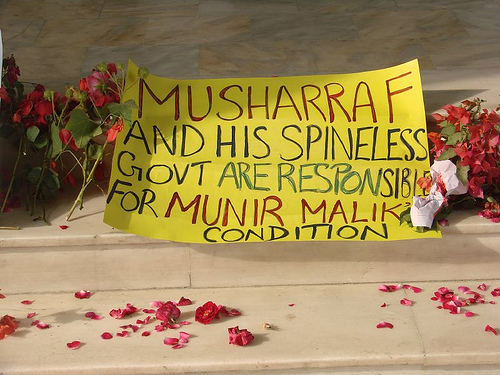
munir a. malik, former president supreme court bar association of pakistan (scba), has been at the forefront of the the judiciary’s confrontation with the pakistani dictatorship.

then there is munir a. malik now, after he was mistreated in jail (and possibly poisoned) and then quickly rushed to the hospital when he suffered renal failure.

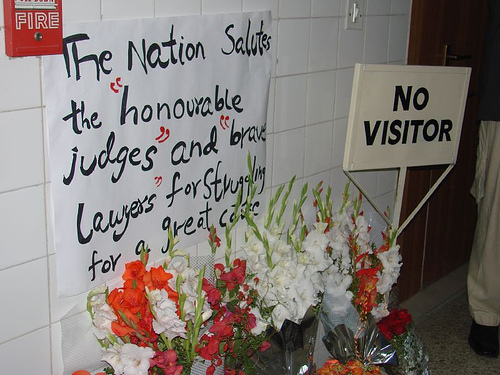
flowers for mr malik
who will be accountable?

many lawyers arrested under martial law are still in jail or missing, but now that musharraf has taken off his uniform the world has lost interest.

homegrown terrorism prevention act raises fears of new government crackdown on dissent

attention all dissenters, protesters, anti-war activists, animal rights advocates, environmentalists, and muslims: this bill has already passed the house with flying colors (400 to 6) and is sure to sail through the senate. i found out about it at a rochester against war meeting today.

is human rights a “western” idea?

through the process of organizing a rally asking for democracy and the restoration of justice in pakistan i have come to a new understanding of how “human rights” are viewed by many in the pakistani community. it is astounding to me that those who have immigrated to the united states and enjoy freedom and at least some recourse to a somewhat independent judiciary in their new country, can rationalize that people back home might not need similar freedoms. i am shocked to hear statements such as “many in the community support martial law” or “if musharraf goes the taliban will take over, therefore let him stay”.

how easy it is for us, sitting here in our half-a-million-dollar suburban homes and driving our mercs and oversized SUVs to dismiss a grassroots movement asking for justice and human rights, halfway across the globe in pakistan, where we only go to attend lavish weddings and shop for clothes and jewelry. are we not guilty of the same racism immensely popular with western governments? that human rights and democracy are only good for people with a certain skin color. that in countries like pakistan military dictatorships are more conducive to stability – even if it is always at the cost of human rights. that the people of pakistan cannot be trusted to make their own decisions and therefore decisions must be made for them by the likes of musharraf – kept in power by american military aid and so answerable to america, not the people of pakistan. i guess that we ourselves have bought into the ridiculous idea that human rights are not for us – we can’t handle them.

in the letter we sent to our senators and congressmen (posted 11/21/07) my husband and i talk about the people being sent to jail and house arrested by the pakistani government. we describe the lawyers, retired justices, journalists and activists who have been musharraf’s prime targets as “secular-minded, liberal, tolerant, middle class professionals”. one pakistani found that offensive and asked what we meant by that label. three words: muhammed ali jinnah! the founder of pakistan was a secular-minded, liberal, tolerant, middle class professional so what’s so repugnant about it? why do we translate these words to mean “american sellout”? since when has education, professionalism or tolerance become counter-culture in pakistan? the same man then takes a jab at pakistanis asking for human rights in pakistan by proclaiming that they have “misplaced identities”. since when has religious radicalism, conservatism, intolerance and being either lower class or upper class (as opposed to middle class) been more in line with being pakistani? that’s absolute bullshit.

for those who think that it’s all about american sellouts pandering to the west’s spiel about democracy, watch this documentary by ziad zafar called “missing in pakistan”. a lot of the confrontation between the judiciary and musharraf started with a case filed by amina masood and others demanding that their disappeared husbands and sons be accounted for. shockingly enough, the case was taken up by the supreme court chief justice iftikhar chaudhry. this is when musharraf summarily fired him and the country, led by its legal community, erupted in violent protest. look closely at amina masood’s face – that’s the face of pakistan and that is who we should be siding with. amina masood is a teacher. she is middle class, educated, articulate, strong and in your face. in the west she would be called an activist, a feminist. yet should we turn away from her because she embodies all the great ideals we absurdly attribute to the west? is she an american sellout too?

granted the west’s spiel about democracy, as it applies to less developed countries, is insincere and used to window dress its own selfish economic and political interests, but there is nothing wrong with the ideology itself. there is nothing wrong with human rights, individual freedoms, democracy or justice. people in pakistan know that and they are fighting for it with their lives. we don’t have as much to lose, sitting comfortably on our asses out here in the land of plenty. is simply supporting that struggle from your leather armchair too much to ask?

speech at the rally

thanks to my friend, filmmaker rehema trimiew, who came to the rally on a cold windy sunday, filmed the event and put it on youtube. check out her film sticks and stones.

my speech:

We are here to show our support for the people of Pakistan in their struggle for freedom and democracy.

Civil society in Pakistan is being dismantled by the present dictatorship. Thousands of lawyers, human rights activists, judges and academics have been put under arrest. Hundreds of people who have committed no crime have mysteriously disappeared.

Shameful instances of torture against prominent lawyers have occurred and the government has even arrested the sisters of opposition leaders. Freedom of speech has been curbed and independent media have been shut down.

Martial law has been declared to supposedly fight terrorists yet the government is actually negotiating with them and every day they grow stronger. The laws of the country no longer apply in many places and people have been left to the mercies of the Taliban.

And all this after six years and billions of our tax dollars sent to the Pakistan army in the name of fighting extremism. 

What is happening today in Pakistan is NOT to fight terrorists, NOT to preserve law and order, NOT to make Pakistan or the world safer – it is a naked power grab.

I ask you to send a clear message to your congressmen, senators, the US administration and the whole world: Americans will not stand for what is happening in Pakistan. Human rights violations must be stopped. Those arrested must be released, the constitution must be restored, the judiciary must be restored, the media must be freed, and no more dictatorship.

open letter to our senators and congress people about the crisis in pakistan

To: Ours Senators and Congressional Representatives

Dear Representative,

We are Americans who support freedom and democracy. We are writing to share our concerns with you regarding recent events in Pakistan.

We are greatly disturbed by General Musharraf’s crackdown on civil liberties, decimation of judicial independence, muzzling of the media, indiscriminate arrests and reported torture of lawyers, human rights activists and politicians.

As Americans we cherish the values of civil liberties, an independent judiciary, freedom of speech and freedom of association, and when we see these values being trampled on in Pakistan we feel we must speak out. This is especially so since General Musharraf’s continued hold on power and the acts committed by his government are supported in no small part through lavish aid and funding provided by us, the American taxpayers.

We feel that for too long the United States has shirked its responsibility toward promoting freedom and democracy in Pakistan by expedient alliances with a string of unpopular military dictators for short term objectives, while ignoring the long term dangers of such unsavory alliances. The history of our foreign policy is replete with instances of our support for dictators of all stripes coming back to haunt us in the long run. We say that for once America should side with the people of Pakistan, not their oppressors.

We recognize that the United States has great strategic interests in ensuring the stability of Pakistan, especially regarding the specter of the government falling under the influence of radicals and militants. We wish to point out the great irony that in fact General Musharraf’s biggest supporters in the current Pakistani parliament are the very same religious parties that make no secret of their support for the radical militants. On the other hand, the people being oppressed by the General are secular-minded, liberal, tolerant, middle class professionals who would be our best bulwark against the further spread of radical religious ideology in Pakistan.

We hear that General Musharraf is a key ally in our war against the Taliban and Al-Qaeda, yet we would submit to you that in fact the very survival of General Musharraf in perpetual power is contingent upon the existence of the Taliban and Al-Qaeda. We are aware of the US Government’s unhappiness at the Pakistani government’s performance in the fight against terrorism. Yet we wonder why no one in our government sees that it is in General Musharraf’s own best interest never to wipe out the terrorists completely, because he knows once that happens there will be no reason for him to continue receiving US support to stay in power.

We support ongoing help given by the US to Pakistan, NOT to buy more F-16 fighters or line the pockets of army generals but to fund programs to rebuild civil society in Pakistan, improve the standard of living particularly in the tribal areas, facilitate education and better healthcare, preserve human rights, and restore true democracy, free media and an independent judiciary.

US involvement in Pakistan must be uncoupled from support for dictators, who we predict will end up as major liabilities and hindrances to our foreign policy goals in Pakistan.

We are presented with doomsday scenarios of Pakistan’s nuclear arsenal falling in the hands of radical Islamists if the present military dictatorship comes to an end. These are fanciful ideas dreamed up by think tank types who live in a fantasy world. In fact quite the opposite is true. The army in Pakistan is capable of guarding the sovereignty of the country, fighting extremists, and protecting its strategic assets, if only its tasks could be refocused on purely military matters rather than having it permanently embroiled in ensuring the survival in power of an unpopular dictator.

We wish to ask you, our government and representatives, to please stop being afraid to engage with the people of Pakistan. They deserve more credit than is generally given them for their ability to elect their leaders democratically. The religious and fundamentalist parties have historically never received more than three percent of the popular vote in any free election in Pakistan. It is only under General Musharraf’s rule that they hold the second biggest share of seats in Pakistan’s parliament, because he needs them to maintain his hold on power and has systematically excluded popular political parties that represent the hopes and aspirations of the Pakistani masses.

We wish our government to deliver a clear ultimatum to the Pakistani establishment that our ongoing support for them is not open ended but is contingent upon the restoration of Pakistan’s constitution, an end to martial law, complete freedom of the media, holding of truly open and fair elections, and an end to all military dictatorships.

Above all, we wish to have the judges who bravely stood up to tyranny and dictatorship in Pakistan released and returned to their jobs, for we are all very proud of them. Notable among lawyers and judges who have been placed behind bars are Mr. Aitezaz Ahsan (Barrister and co-founder of the Human Rights Commission of Pakistan), Mr. Muneer A. Malik (President of Pakistan’s Supreme Court Bar Association), Mr. Ali Ahmed Kurd (former Vice-Chairman of the Pakistan Bar Council), and Justice (Retired) Tariq Mahmood. Pakistan’s Supreme Court Chief Justice Iftikhar Chaudhry (recent recipient of Harvard Law School’s Medal of Freedom) is still under house arrest.

We look forward to a strong, democratic and progressive Pakistan.

Thank you.

Sincerely,
Your Constituents

rally for pakistan

democracy for all!

rally to show solidarity with movement for justice in pakistan

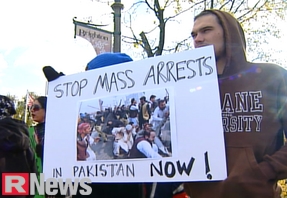
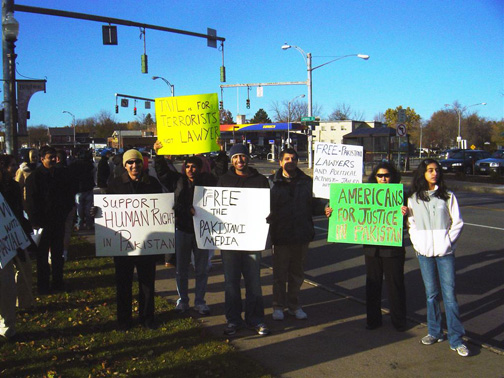
the rally to support justice and democracy in pakistan was a success last sunday, nov 18. about 50 people turned up. it was a diverse group of people from local activists to religious and interfaith groups, from lawyers to teachers and students, from pakistani americans to americans with no ties to pakistan. it was heartening to see that human rights matter to so many. there was plenty of media coverage. here is the article in the democrat and chronicle.

this is the speech i made, as main organizer and spokesperson for the rally:

“we are here to show our support for the people of pakistan in their struggle for freedom and democracy. civil society in pakistan is being dismantled by the present dictatorship. thousands of lawyers, human rights activists, judges and academics have been put under arrest. hundreds of people who have committed no crime have mysteriously disappeared. shameful instances of torture against prominent lawyers have occurred and the government has even arrested the sisters of opposition leaders. freedom of speech has been curbed and independent media have been shut down.

martial law has been declared to supposedly fight terrorists yet the government is actually negotiating with them and every day they grow stronger. and all this after six years and billions of our tax dollars sent to the pakistan army in the name of fighting extremism. obviously, this strategy is not working.

what is happening today in pakistan is NOT to fight terrorists, NOT to preserve law and order, NOT to make pakistan or the world safer – it is a naked power grab. i ask you to send a clear message to your congressmen, senators, the u.s. administration and the whole world: americans will not stand for what is happening in pakistan. human rights violations must be stopped. those arrested must be released, the constitution must be restored, the judiciary must be restored, the media must be freed, and no more dictatorship.”

rally1rally2rally3

rally4rally5rally6

rally7rally8rally9

thanks to usman for these great pictures!

americans for justice in pakistan, rally on sun nov 18, 2-3.30pm, 12 corners in brighton

Rally to Support Restoration of Judiciary and Civil Liberties in Pakistan
Date: Sunday November 18, 2007
Time: 2.00pm – 3.30pm
Place: Twelve Corners in Brighton
Contact: Mara Ahmed

SOLIDARITY

PLEASE JOIN THE PAKISTANI AMERICAN COMMUNITY IN UPSTATE NEW YORK IN A DEMONSTRATION OF SOLIDARITY WITH THE PEOPLE OF PAKISTAN IN THEIR STRUGGLE FOR THE RULE OF LAW.

WE WILL HOLD A DEMONSTRATION ON SUNDAY NOVEMBER 18 FROM 2:00 PM TO 3:30 PM AT TWELVE CORNERS IN BRIGHTON.

THE PURPOSE OF THE DEMONSTRATION IS TO EXPRESS OUR DESIRE TO PRESERVE THE INDEPENDENCE OF THE JUDICIARY AND TO RESTORE THE RULE OF LAW AND THE CONSTITUTION OF PAKISTAN.

IF YOU CHERISH FREEDOM, LIBERTY, CIVIL RIGHTS AND DEMOCRACY JOIN US TO SHOW OUR RESOLVE TO THE WORLD THAT WE WILL NO LONGER ACCEPT TRAMPLING OVER CIVIL LIBERTIES AND OVER JUDICIAL INDEPENDENCE IN OUR HOME COUNTRY.

AS A SIGN OF UNITY WITH THE LAWYERS WHO ARE SPEARHEADING THE STRUGGLE IN PAKISTAN PLEASE WEAR BLACK AND WHITE WHEN YOU COME.

RIT screening

the first part of my documentary “the muslims i know” was screened at the carlson auditorium, at rit, today. it was exciting to see the first 30 minutes of my film on screen. it was also interesting to see the audience’s reaction to it. it all went well. i got a lot of questions from the audience and some feedback from malcolm spaull, howard lester and other rit film faculty. i was extremely pleased by the interest the film generated and the many comments that continued after the screening, when many of the students and some faculty approached me to talk about it. people liked the lahore collage i had put together to show the vibrance and beauty of my hometown. they also liked the muslims i had interviewed and with whom they felt a connection – the connection was different for different people but it was definitely there.

there is still a lot of work ahead of me if i want to get the film ready by february 2008 for the highfalls film festival, but during the last 11 weeks at rit (in cat ashworth’s documentary workshop class) i have gone from 30 hours of unedited footage and transformed that hodge podge into a story. cat’s input and help have been invaluable to me. not only is she an astute filmmaker but she is incredibly generous with her time and all the resources at her disposal. it has been a very hectic, sleep-deprived but also a wonderfully productive 11 weeks.

clip from “the muslims i know” coming soon…

whose children are these?

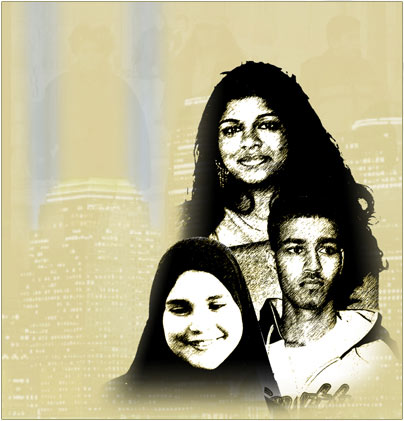
last thursday i saw theresa thanjan’s “whose children are these?” at the u of r. it is a documentary about how post 9/11 domestic national security measures have affected the lives of three muslim teenagers. the film focuses on one such program, special registration, which required male non-citizens (as young as 16) from 25 countries, to register with the department of justice. under this program, 83,000 muslim men got registered, 14,000 were deported, yet not one terrorist was found. the deportations were on account of immigration status violations, even if these constituted minor snafus.

the film follows the trials and tribulations of 3 teenagers. as we become better acquainted with them we are moved by their experiences. navila’s father is kept in a detention center for almost a year, then deported to bangladesh. all of a sudden, she becomes the father figure in her family. “i am tired”, she says later in the film, “i just want my dad back”. sarfaraz, a basketball-crazed new yorker who has already lost both his parents, is on the point of being deported to pakistan. at the last minute media attention and activism save him from being sent to a country he knows absolutely nothing about. hager, who wears the hijab, is confronted by strangers on the subway. a man calls her an arab bastard before making a quick exit. she responds to this racism by becoming an activist and educating people.

the film sheds some light on a subject that has been completely ignored by mainstream media and tells the stories of people who are lost in the deafening noise surrounding terrorism and fear. it is an admirable effort to delve into that which is not kosher by today’s standards – muslim communities in america.

what was even more heart-breaking was what many young muslim students had to tell theresa after the screening. they thanked her for making the film and for telling a small part of their stories. they talked about being held up at jfk airport every time they enter the u.s. for 6-8 hours and being harrassed in sadistic ways. they talked about being sent to a detention center in upstate ny, where they were kept for 3 weeks in spite of legal representation and without any accusation of being linked to terrorism. i found it difficult to hold back my tears. it is one thing to look at statistics and read stories in the paper. it is another to hear first hand accounts of racial profiling and the open-ended (and totally legal) persecution of communities across america. it is all the more painful and terrifying if the people being persecuted look like you and pray like you…

whose children are these?