“Filmmakers’ lenses never even blink” by Jack Garner, Democrat and Chronicle

Filmmakers’ lenses never even blink
By Jack Garner, Friday June 6, 2008

Let’s celebrate two movies by local filmmakers that are tackling important topics too often ignored elsewhere. Each film spotlights an underappreciated and misunderstood segment of our society:

The Muslims I Know by Mara Ahmed examines the lives and attitudes of the many moderate Muslims who are our neighbors, fellow workers, physicians and classmates.

American Harvest by Angelo Mancuso follows the migrant worker population as it works its way up the East Coast each season, making itself responsible for much of the food on our table.

In The Muslims I Know, Ahmed melds a series of insightful interviews, conducted largely in this area, with a good mix of archival footage. Home movies that reflect a family-next-door existence stand in marked contrast to news and propaganda footage of the Islamic extremists who, unfortunately, get the lion’s share of attention in our media.

Though she has an extensive education in a variety of fields, Ahmed was trained as a filmmaker at Visual Studies Workshop and at Rochester Institute of Technology, and worked two years compiling this important, eye-opening film about the realities of Islamic life and belief. The result is colorful and well-shot by veteran local cinematographer Thom Marini. It also features an appealing background blend of Pakistani, Islamic and Western music.

I’m grateful for the opportunity to see her hourlong film, and hope it achieves broad exposure, for it’s just the antidote we all need to the narrow-minded attitudes of the West in the post-9/11 era.

The Muslims I Know will have its world premiere at 1 p.m. Sunday at the George Eastman House’s Dryden Theatre, followed by a discussion with the filmmaker and some of the interview subjects. Admission is $10.

Mancuso’s American Harvest has had area screenings, including one at the recent Rochester High Falls International Film Festival, but now it’s earned a regular opening slot for at least a week at the Little Theatre. Mancuso, who has long been active locally as a writer, filmmaker and critic, brings considerable passion to his feature-length documentary. The film examines the undeniable importance of migrant labor to farming in America, and it raises important questions about the current hot-button topic of illegal immigration.

American Harvest opens tonight. Saturday’s 6:30 p.m. screening will be followed by a conversation with Mancuso; Jim Allen, head of the New York Apple Association Inc.; and Sister Janet Korn, social justice awareness coordinator for Catholic Charities.
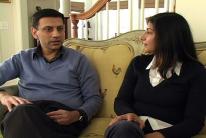

“The Muslims I Know” by Dayna Papaleo, City Newspaper

the muslims i know

FILM: “The Muslims I Know” (6/8)
By Dayna Papaleo on Jun. 4th, 2008

I hate to blow the ending of a movie, but the Muslims that local filmmaker Mara Ahmed knows are pretty much like the people of faith that you know, cherishing family, tradition, knowledge, and peace. The difference is that your Christian, Jewish, and Druid pals haven’t been subjected to intense scrutiny for most of this young century, so Ahmed’s reflective, graceful debut picks up where the press repeatedly leaves off, depicting what’s known as the moderate Muslim. In “The Muslims I Know,” Ahmed weaves vivid images of her Pakistani culture through dialogue with a cross-section of Rochester’s Muslim community about their experiences, as well as perspectives from scholars on the teachings of Islam. Ahmed also speaks to non-Muslims about their often biased preconceptions, in large part due to the American media because, as summed up by a sharp young man named Ibrahim, “Terrorism sells.”

“The Muslims I Know” has its world premiere at the George Eastman House’s Dryden Theatre, 900 East Avenue, on Sunday, June 8, at 1 p.m. Tickets cost $10, and are available at the door, or in advance at all Wegmans locations. Visit themuslimsiknow.com for further details.

bamboleho

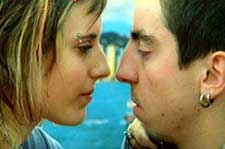
ok. this is how i found this short film. i happened to google myself one day and was interested to learn that one of the first hits on the internet was a film called “bamboleho” – two of its main characters are called mara and ahmed. i was intrigued. i found a lot of reviews on the film especially on a website called POV – a danish journal of film studies. this was a couple of years ago. i looked for the film everywhere – on netflix, blockbuster online, amazon.com. i was ready to rent it or buy it, i just wanted to see it.

about a month ago i sent an email to richard raskin in denmark. he is the editor of POV. i got an instant response. he sent me luis prieto’s email address – the spanish filmmaker who directed bamboleho. i wrote to luis and he sent me his website where i could go and view the film online. i was so excited! “do you speak spanish?” he asked. i don’t. but i’d read so much about the film i had no doubts i would be able to follow the 20 minute short. plus my french always helps a little bit with latin languages.

here is some background on the film, in an interview with luis prieto.

to see the film, go to luis prieto’s website, click on reel, then click on bamboleho on the left hand side of the screen.

loved the film’s artistic elements – the daliesque visual feel of the opening, the poetic notion of living on rooftops, and how these elements contrast with the very raw and harsh realities of the characters’ lives.

bamboleho

back from dc

after studying much american history both my kids had their own personal lists of things they wanted to see in dc, our nation’s capital. we were successful in checking out everything on their lists.

saw the white house (from a distance, never had the urge to go inside), the washington monument (hard to miss when you’re in dc – it’s always somewhere on the horizon), the world war II memorial (built in 2004, am guessing probably after “saving private ryan” and HBO’s “band of brothers” came out), the lincoln memorial (always stunning), the library of congress (had never been inside but my artistically-inclined daughter was interested in the painted ceiling – it was absolutely gorgeous with excellent exhibits about the history and significance of america’s founding documents, the uneasy relationship between native americans and early europeans and finally jefferson’s own library – his books displayed beautifully on concentric glass shelves), the u.s. supreme court, the capitol (very freaky to be surrounded by uniformed gunmen with their fingers literally and figuratively on the trigger), the national gallery of art (always a lovely retreat), the air and space museum (thronging students on school trips, long lines but still way cool flight simulator), u-street (neither hip nor hopping but good food at ulah bistro), the national aquarium (small and mediocre), the spy museum (a total commercial rip off complete with tie-in merchandise but the kids enjoyed some of it – like a tunnel that leads you back to the same room (???) and a james bondish aston martin), the nationals park (guard said people were not allowed to photograph it even from the outside (???) – he had some problems with people just looking at it even though the pope and his entourage had long been gone).

we had chinese food in chinatown, real pakistani food at ravi kebab (glebe road, arlington) and met with some family in dc and virginia. the metro was great and the people very friendly (or maybe it was just the contrast with nyc). on our way out of dc we stopped at old town alexandria to visit the torpedo factory lined with artists’ studios and an art school. the artwork was way out of my budget but i appreciated it no less.

on our way out of virginia i spotted an antique store – it was a dream. there were old doors and windows, furniture and pottery, mirrors and chandeliers – everything was timeworn and reasonably priced. the store sprawled over a large area with things scattered around in tiny houses and unassuming sheds or just on the lawn. it was such a kick to search for things i could use in my work – found objects, frames, tiles. promised myself i would return with appropriate girlfriend! have to give credit to my husband and kids though, for waiting in the car for one hour, en route to ny, ready to go but with one family member missing – someone a little tipsy from all her antiquing!

world war II memorial in dc

if all of rochester read the same book

writers and books’ initiative “if all of rochester read the same book” featured laila lalami’s “hope and other dangerous pursuits”. laila is a moroccan american writer based in california. her blog, which has been on my blog roll since day one, is a repository of information about books and writers, especially non-western writers who are mostly absent from mainstream best seller lists. laila came to rochester to talk about her book and i met her at the st john fisher college reading, a couple of weeks ago.

laila’s book is a panoramic narrative which explores the lives and hopes of four moroccans trying to make it across the straits of gibraltar into spain. the non-linear structure of the plot is a great hook. we start with a vivid scene showing complete strangers thrown into uncomfortable proximity. all the characters are here. this is our first encounter with each and everyone of them. they are cramped together into a lifeboat – illegals trying to get smuggled into spain. we can feel their anxiety, their desperation. we hear their thoughts. the landing is bungled and the characters are left to fend for themselves, struggling to make way in the dark, freezing water.

we then go back in time, pre-lifeboat. we get a peek into the lives of all four characters. we come to know them, understand them, sympathise with them. we become familiar with the realities of living in morocco – corruption, nepotism, red tape, non-existent upward mobility, political repression. many of these problems are characteristic of developing countries. i could immediately see the similarities with pakistan – the differences between various socio-economic classes, the corruption at every level of society, the dejection that comes with joblessness, the urgency to find a better life and become the hinge that pulls an extended family out of poverty. we also see the charm of simple lives unencumbered by greed. even in their most indulgent dreams, the characters wish only for basic comforts.

the final part of the book nudges us forward in time, post-lifeboat. here we see who made it and who didn’t and in the end, were they better off or not. laila’s writing is temperate, lucid, fluent. the book could have easily been three times its present size, packed with more details about the lives of its protagonists. but i like some of its open-endedness. like a great french film it lets you fill in the blanks and become part of the narrative. to me brevity and the natural, homespun quality of a story makes it all the more poetic.

in person, laila was animated and funny and refreshingly honest. she is passionate and not shy about expressing her views. she talked about morocco, the u.s., french colonialism, language and her love of words, the characters in the book and the process of writing.

geva readings: thomas repair

this last monday went to see “thomas repair” at geva. this was one of the best play readings i’ve been to so far, and i’ve been to many. truth be told, it was hardly a reading. the cast was solid and their performances absolutely electrifying.

the story unfolds mysteriously at thomas repair, a repair shop owned by jacob thomas, which advertises proudly “if it can be fixed, we’ll fix it”. it’s the middle of the night. jacob is busy tinkering with random bits and pieces of junk fashioned into a curious machine. a young girl called brenna appears at his door. she forces her way in using various pretexts but there is a sense of foreboding here. she articulates it in so many words – he should have seen this coming. she has brought her guitar with her. she painted it blue and wants the paint removed. we soon discover that she herself is literally blue, covered with splotches of blue paint all over her body. she enjoins jacob not to touch her for she infects whatever she touches with her inner “rot”. that rot is gradually revealed – a sexual relationship with a married man, an abortion, lies and deceipt, a final severance of ties with her parents. what jacob doesn’t expect is for his own family to be at the epicenter of brenna’s crisis of conscience.

her need to come “clean” is urgent and all-pervasive. slowly jacob’s daughter and son-in-law and finally his ex-wife are dragged into this emotional fray. jacob’s own life becomes more and more transparent: his hatred of his wife after she left him, the troubled relationship with his daughter whose existence he could never fully sift as disparate from the rage directed at his cheating wife or the contempt he felt for his loser son-in-law, and the self-perpetuating cycle of hate and defensive anger that his life has been reduced to since their departure.

brenna becomes the trigger that sets off this dysfunctional dynamite, to eventually create some space for truth and healing. she is an other-wordly presence with some very human problems. this touch of magic realism generates rich dramatic subtext throughout the play. similarly, recurring biblical verses speak to jacob’s religious convictions but also weave yet another fine pattern onto the play’s canvas. there are fables and edifying conclusions, mirror images and stark contrasts, metaphors, poetic prophesies, mundane realities and much humor. by electing to cast multi-racial actors in various roles the writer and director add another layer of interest.

this is the kind of play one can sink one’s teeth in. it has substance and nuance, a rich tapestry of what is humdrum and sublime, a sound dramatic arc and characters just waiting to fly off the page and walk in the door.

keith randolph smith, a terrific actor who has worked successfully both on tv and on broadway, played jacob thomas.

the 400 blows

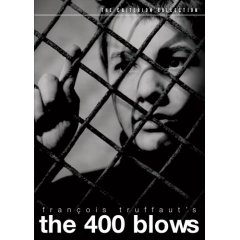
just saw truffaut’s first film “the 400 blows” – most excellent. a young boy’s lonely life gradually veers into disorder, ending at a reform school for delinquents. jean pierre leaud, the film’s 13 year old star, is absolutely stunning as antoine. through his effortless performance we experience once again the awkwardness, the bravado, the dislocation and touching vulnerability of a teenager. the “psychological profile” of the film includes interviews with leaud at 14 and much later when he collaborated again with truffaut. leaud explains that he never got any script sheets from truffaut. they discussed the facts of each scene but leaud used his own words to verbalize thoses ideas. in one of the keenest representations of cinema verite, antoine talks to a psychiatrist at the reform school. the scene is pivotal and flawless in its execution. we never see the shrink. antoine sits in front of the camera and explains matter of factly how he is not his father’s real son, how he was born to an unwed mother who considered abortion, then tried to keep her child out of sight whether it was dumping him at his wet nurse’s, or parking him with her mother, and now relegating his future to the juvenile justice system. the film is simple, elegant, fluent. it’s charming, only as a film with a child protagonist can be. but truffaut goes further. not only is antoine the focal point of the film, he also commands more gravitas than all the adult characters around him. great cinema, kudos to the french new wave.

the 400 blows

the diving bell and the butterfly

i had been dying to see this film. i had read reviews in the new yorker and other magazines and everyone seemed to agree that this was one brilliant film. for me it didn’t hurt that it was in french and directed by new york artist julian schnabel. the film is based on jean-dominique bauby’s memoir “le scaphandre et le papillon”. bauby was the editor of elle magazine – a talented bon vivant who lived a cosmopolitan life. at the age of 43 he had a massive stroke and became a victim of locked-in syndrome, an indescribably cruel condition in which the mind remains as sharp and alive as ever but the body stops functioning, becoming a trap or an oppressive “diving bell”. bauby could only blink his left eye and that became his connection to the world. he wrote his book in his head, editing and re-editing every sentence inside his mind before painfully and slowly blinking at the correct letters of the alphabet and thus forming each word of each sentence.

schnabel’s artistic coup here is that we, the audience, are in bauby’s body and together we undertake his unnerving journey into locked-in syndrome. we see the filtered light streaming into his room, the blurry edges of reality as he passes in and out of consciousness and the confusing angles of his vision as he looks up from his hospital bed into faces hovering over him. and we hear him. we hear him as he comes to and tries to orient himself, as he answers simplistic questions with increasing weariness, as he uses humor in the face of much uncertainty. and we witness the moment of truth when he realizes that the doctors cannot hear him. this is arresting filmmaking. as his paralyzed right eye begins to dry up, we see from behind it what it looks like to have your eye sewn up with needle and thread. slowly stitch by stitch, we see the lights go out. we hear his agonized, horrified pleas as he tries to drive away the jaded surgeon performing the procedure and we feel his helplessness – so completely.

for the first third or so of the film we do not see bauby, except for a quick reflection he catches of himself on some polished surface. we see how people react to him, how they try to communicate with him, stooping awkwardly to stay in his frame of vision. only later in the film do we finally see bauby in the third person. the film changes pace and fluctuates between past and present. we see his prior life, the women he loved, his children. these memories are intercut with sessions with his speech and physical therapists, the involved procedures necessary to give him a bath, change his clothes, sit him in his wheelchair. we also see the day of his stroke as he drove his convertible on picturesque french country roads, his adoring son by his side. this shift between past and present is echoed by his changing moods – depressed, sarcastic, vulnerable, emotional, angry. we can feel his pulse, the waxing and waning of his spirit.

but my favorite scenes are those of exhilaration, when bauby realizes that because his body is weighed down by a diving bell, his spirit is all the more free like a butterfly. a symphonic montage of his life’s dreams transports us, enraptures us. like so many fluid paintings whose colors and textures bleed into one momentous masterpiece, foamy waves under a surfboard are transformed into the sepia tones of a heated bullfight, only to be turned once again into a panoramic shot of a lone skier gliding perfectly down a silvery slope. this is where schnabel the artist gets a chance to create a cinematic synonym for ecstasy. scenes between bauby and his aging father are also unforgettable – their proximity, intimacy and emotion are hard to witness.

all in all, this is a great film – true to the beat of bauby’s book, true to his witty, literate yet surprisingly light touch. jean dominique bauby died just days after the publication of his book in 1997.

anti war rally in rochester

saritajudy

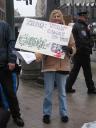
like someone said at the rally, if 70% of americans oppose the war in iraq then where were they today, the 5th anniversary of the war in iraq! organized by rochester against war and supported by numerous organizations, the rally at liberty pole in downtown rochester included some speeches, many slogans, a diversity of signs and banners and a few arrests. sarita and i weathered the rain and cold and showed up with our signs. sarita was interviewed by the democrat and chronicle. she mentioned the billions of dollars that we have paid to support this atrocious war. we marched to the little theater and back.

here are some pictures:

crowd at rallyspeechessarita with reporter

trash edenslogansmara

1984, the patriot act and eliot spitzer

few know that george orwell’s “1984” is in part a depiction of england circa 1948, when the economy was weak and the british empire was faltering yet newspapers carried upbeat stories of triumph and success. orwell had worked for the bbc and was well-acquainted with censorship. he despised totalitarianism and knew that propaganda forms its very core. “1984” was a warning, a possible metamorphosis of the anglo-saxon state (including both england and the united states). in his book orwell presents some of the ideas embedded in a totalitarian state:

1) war is essential for sustained consumption and the survival of a hierarchical society (check out my post titled “consumption – the path to happiness?”)

2) when war becomes continuous it ceases to exist – it becomes so much background noise (how many times a day do we american taxpayers think about our trillion dollar wars in iraq and afghanistan and a possible upcoming one in iran? how can a war on terror – which is an emotion, not a tangible enemy – ever be concluded?)

3) there is an emotional need to believe that big brother will succeed in the end – generally speaking, dogmatic belief eclipses rational thought

4) the separation between different economic and social classes is maintained: the system of ownership and control of the means of production and distribution by the people collectively, under the supervision of a government, doesn’t ensure equality – it only keeps wealth restricted to the upper class

5) whereas the ruling elite or party members are not allowed a single independent thought and are mentally trained to toe the line through doublethink, the common people or proles are free to think because the system guarantees that they do not have the ability to think!

an important part of living in a state where big brother is watching you, is to lose your individual rights and freedoms and be happy to part with them out of fear or ignorance. the right to privacy is one such individual right and the patriot act has gone a long way to whittle it down.

the spitzer scandal, instead of becoming another prime example of a society that “anxiously hopes for just two things: bread and circuses”, should have elicited questions about privacy and the unsettling reach of the long arm of the law. how many of us are talking about how the patriot act was used to get spitzer? do we even know that banks are spying on their own clients by using computer programs to generate “suspicious activity reports”? can we parse the conflict between the right to privacy (a necessity for free, empowered citizens) and the hope, on paper, of possibly catching terrorist money laundering? let’s focus less on the myspace.com profile of spitzer’s paramour and more on how we got here…

for more details on how the patriot act caught spitzer, check out this newsweek story.