
i like this.
Author: mara.ahmed
Free Aung San Suu Kyi
pls sign this petition if u haven’t already.
Daw Aung San Suu Kyi, a recipient of the Nobel Peace Prize, has been detained for 13 of the last 19 years, mostly under house arrest. On May 14, 2009, Aung San Suu Kyi and two of her assistants were taken from her home to Insein Prison following an incident in which an American man allegedly swam across a lake to her house and stayed there for two days. Reliable reports beginning in early May confirm that while still confined in her Yangon home Aung San Suu Kyi had been suffering from dehydration, low blood pressure and weight loss. Her medical condition makes her transfer to Insein Prison at this time doubly serious. Please call on Myanmar’s leaders to free Aung San Suu Kyi and all other prisoners of conscience.
Obama administration threatens Britain to keep torture evidence concealed
Ever since he was released from Guantanamo in February after six years of due-process-less detention and brutal torture, Binyam Mohamed has been attempting to obtain justice for what was done to him. But his torturers have been continuously protected, and Mohamed’s quest for a day in court repeatedly thwarted, by one individual: Barack Obama. Today, there is new and graphic evidence of just how far the Obama administration is going to prevent evidence of the Bush administration’s torture program from becoming public. Full Article.
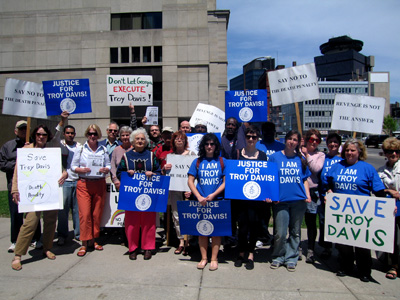
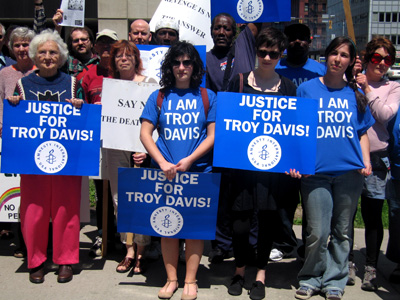
Global Day of Action for Troy Davis, Rochester, NY (May 19, 2009)
Rising Generation in Pakistan Sees Social Change as Their Responsibility
a side of pakistan you’ve never seen: activism and citizen engagement inspired by the lawyers’ movement.
Young Pakistanis Take One Problem Into Their Own Hands
by Sabrina Tavernise, NYTimes, May 18, 2009
LAHORE, Pakistan — The idea was simple, but in Pakistan, a country full of talk and short on action, it smacked of rebellion.
Skip to next paragraph
Zackary Canepari for The New York Times
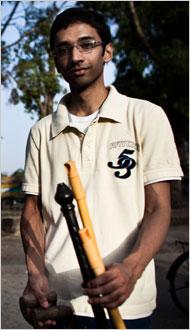
Shoaib Ahmed, 21, one of the organizers of the group, in Lahore on a recent Sunday.
A group of young Pakistani friends, sick of hearing their families complain about the government, decided to spite them by taking matters into their own hands: every Sunday they would grab shovels, go out into their city, and pick up garbage.
It was a strange thing to do, particularly for such students from elite private schools, who would normally spend Sunday afternoons relaxing in air-conditioned homes.
But the students were inspired by the recent success of the lawyers’ movement, which used a national protest to press the government to reinstate the country’s chief justice, and their rush of public consciousness was irrepressible.
“Everybody keeps blaming the government, but no one actually does anything,” said Shoaib Ahmed, 21, one of the organizers. “So we thought, why don’t we?”
So they got on Facebook and invited all their friends to a Sunday trash picking. Trash, Mr. Ahmed said, “is this most basic thing. It’s not controversial, and you can easily do it.”
Pakistan is a country plagued by problems, like Islamic extremism and poverty. But these young people are another face, a curious new generation that looks skeptically on their parents’ privilege and holds mullahs and military generals in equal contempt.
“The youth of Pakistan wants to change things,” said Shahram Azhar, the lead singer for Laal, a Pakistani rock band, reflecting an attitude that is typical of this rebellious younger generation.
“The reason the Taliban is ruling Swat,” he said referring to a valley north of Islamabad where Islamic extremists took control this year, “is because they are organized. We need to organize, too.”
“The only answer to Pakistan’s problems,” he added, “is a broad-based people’s movement.”
The trash movement, which calls itself Responsible Citizens, does not yet qualify as broad, but it still drew a respectable crowd on a recent Sunday, considering the heat (above 90 degrees) and the time (around 4 p.m.). Mr. Ahmed and his friends were doling out trash bags they had bought for the occasion. About 40 people had gathered. Some were wearing masks. All were carrying shovels.
They set their sights low. The area of operation, Ghalib Market, was modest, a quiet traffic circle in central Lahore encircled by shops, a cricket field and a mosque.
It was not one of the dirtiest parts of the city, but the group felt attached to it, as they had cleaned it in the past, and wanted to see if their actions were having any effect.
The first time they cleaned there was like raking leaves on a windy autumn day.
“We collected, like, 30 bags, but there was no visible difference,” Mr. Ahmed said.
But they talked with local shopkeepers, in a kind of trash outreach, asking them to walk their garbage to the trash bin. Those connections, Mr. Ahmed said, were actually the point of the cleaning — setting an example for others to follow.
“The major problem people have here is that there are no bins,” said Murtaza Khwaja, a 21-year-old medical student.
Actually, the problem was deeper. A long-term cycle of corrupt, weak governments interrupted by military coups has caused Pakistan’s political muscles to atrophy, leaving Pakistani society, particularly its poor, hopeless that it will ever receive the services — education, water, electricity, health — that it so desperately needs.
“People say, ‘This is nice, but things will never change,’ ” Mr. Khwaja said, pointing to a hamburger seller who he said was particularly pessimistic. “There is a hopelessness.”
That is where the trash cleaning comes in. Locals find it perplexing and helpful in equal measures. One enthusiast who met the group on its first outing in March, Muhamed Zahid, has come to every one since. One man passing by in a rickshaw dismounted to help them shovel for a while.
The men in the mosque, on the other hand, were picky, wanting the young people to clean the mosque but not the surrounding area.
“They said, ‘We already have Christians doing that for us in the morning,’ ” Mr. Khwaja said. Christians are a minority in Pakistan, and those who have no education often work in the lowest-paid jobs, like collecting trash, sweeping streets or fixing sewers.
On Sunday, Malik Waqas, a 16-year-old who was driving by on a moped, stopped to watch a cluster of young people shoveling what looked like old food.
“It’s good,” Mr. Waqas said shyly. When asked why, he said, “Because people care.”
But that also confuses passers-by, many of whom stop to gape at the young people, who, in their jeans, T-shirts and sunglasses, look more New York than Pakistan. On Sunday, three men in flowing, traditional garb leaned on a fence staring at the students while they cleaned.
Mr. Khwaja’s mother, who had also come to clean, was commanding like an army general, trying to get them to join in.
“Most of them just mock us,” she said. “ ‘What are you women doing?’ ”
But the youngsters seemed to understand the men’s perspective.
“They’re like, ‘Why are these rich people cleaning this up? It’s probably a college project,’ ” one student said.
That brought the students to the most serious discussion of the day, one that is arguably Pakistan’s biggest problem: the gap between rich and poor. Generations of poverty and a system of substandard education that keeps people in it have created fertile ground for Islamic militancy, which now poses a serious threat to the stability of the country.
“Here, if you’re poor, you’re not even a human being,” said Pavel Qaiser. “It’s the culture we have — one landlord and the peasants working under him.”
And here was a revelation: the trash picking, which the students had intended as an example for shopkeepers and residents, was actually an exercise for themselves.
“The rich don’t care, the poor can’t do anything, so it’s up to the middle class to make the change,” Mr. Khwaja said, as a group of friends standing near him nodded in agreement. “We have to lead by example. To change it from inside.”
He continued, his voice urgent, as if he were giving a speech: “We want to tell everyone, ‘You have the right. For 60 years everyone has told you that you don’t, but you do!’ ”
Then he bemoaned the small number of friends they were able to gather for the trash cleaning. For those who didn’t come, he had a message. “You want to do something? Pick up a shovel.”
Mixed messages from President Obama after 100 days
some of the people who were tortured…
day of action for troy davis
Tuesday, May 19, 2009, 12:20 – 1:00 pm at the Hall of Justice, Exchange Street at Court, downtown Rochester (immediately following the 12:00 – 12:20 vigil for Troy Davis called by the Judicial Process Commission).
For further information contact Rochester ISO at RochISO@yahoo.com.
high falls 2009: laila’s birthday
many reviews describe “laila’s birthday” as funny and humorous. some go so far as to compare the film’s lead actor mohamed bakri to buster keaton. i got a different vibe from the film.
filmed in ramallah, in the west bank, “laila’a birthday” is subtle. it cannot help but deal with life in the occupied territories and the director is not shy about exploring its grim side, but he does so with a quiet elegance that sidesteps what could have been much more heavy-handed, graphic content. at the same time, the film is immensely skilful in conveying a sense of weariness and frustration that comes from lack of control over one’s life. abu laila is a judge yet he cannot find a job, so he drives his brother-in-law’s taxi. every morning he goes to the ministry of justice to plead his case but he is met with bureaucratic inefficiency and indifference. he is devoted to his daughter laila, who is turning ten. abu laila’s mission on her birthday is to buy a cake and present and be home on time.
as his day unfolds we drive through overcrowded streets (the west bank and gaza are some of the most densely populated areas in the world), we hear about a missile attack on a car which killed the man inside, we learn about people queuing up at checkpoints where abu laila refuses to drive his passengers because he is afraid for himself and for his taxi, we see people get in line wherever they see a line in hopes of getting some food, we hear the constant sound of helicopters hovering overheard and much more. but the film is not bitter or depressing. it keeps its focus on how life continues to function under these circumstances and pokes some fun at how people cope.
being a judge, abu laila is a firm believer in the rule of law. he is moral, upright, and yearns for order. his character’s struggles are effectively contrasted with a society so dominated by unpredictability, that the pursuit of law and order become meaningless. but as the ending of the film shows, sometimes randomness can lead to a happy resolution. directed by rashid masharawi.
p.s. discovered palestinian actor saleh bakri in this movie. he’s mohamed bakri’s son and has a tiny role in the film (a passenger who travels briefly in abu laila’s taxi). he is probably one of the most stunning actors i have ever seen and (based on what i read online) is considered a heartthrob in much of the middle east!
high falls 2009: tulpan
shot in southern kazakhstan, “tulpan” has the feel of a documentary. it proceeds at a languorous pace, exploring in great detail the life of nomadic sheepherders, etched against the vastness of the kazakh steppe. tulpan means tulip. it is the name of a young girl asa wants to marry. the marriage will enable him to move out and start his life – get his own sheep, his own yurt, his own piece of heaven. there is a lot charm and humor in the film. directed by sergey dvortsevoy.

Afghan Villagers Describe Chaos of U.S. Strikes
wish we would channel the passion and energy aroused by the torture photographs into stopping the horrible war in afghanistan – thousands of civilians killed (including large numbers of children), more than 1.3 million people displaced and turned into refugees in pakistan. will it take graphic pictures to create some interest and revitalize the anti-war movement?
Afghan Villagers Describe Chaos of U.S. Strikes – NYTimes.com
more on the torture pictures
to stop torture, people who legalized it must be held accountable. to hold them accountable, civil rights lawyers must be able to build a case. to build a case, lawyers need evidence – all evidence – to prove that this was not an isolated, abu ghraib only, bunch of free lancers scenario. torture was widespread and systemic. what part of this are we finding confusing???
We wouldn’t want to inflame anti-American sentiment – Glenn Greenwald – Salon.com
YOUSSOU NDOUR: I BRING WHAT I LOVE
just saw an extraordinary documentary at the high falls film festival: “youssou ndour: i bring what i love”. visually stunning, larger than life, like africa, and infused with the beauty of ndour’s voice and personality. a work of art. a labor of love. deeply moving. directed by elizabeth chai vasarhelyi.
stop the war in afghanistan
The war in Afghanistan: “Such a war can never be won, and can only lead to tragedy, not just for the people of Afghanistan, for whom it is already that, but for American troops and ultimately for America itself. It is a war that never should have been fought, and which now should be ended as rapidly as possible.” Dave Lindorff
Dave Lindorff: Obama Channels Cheney
“The truth is always better than a cover-up, and what we now have the president advocating is a cover-up of American torture. But that’s only part of the president’s slide into Cheneyism. We have the president now calling for the possible indefinite detention of terror suspects–an idea that only insures that there will always be an incentive for recruiting more terrorists (to avenge those in captivity)–and that makes a joke of our own Constitution, which guarantees everyone–not just citizens–the right to a trial, the right to a presumption of innocence, and protection from “cruel and unusual punishment,” which indefinite detention certainly is.” Full article.
war in afghanistan
Afghanistan: 95 children among dead in U.S.-Taliban clash
KABUL (AP) — Ninety-five Afghan children are among the 140 people said to have died in a recent U.S.-Taliban battle in western Afghanistan, according to a list drawn up by Afghan officials, a lawmaker said Wednesday. The U.S. military disputed the claim.
Full article.