
brilliant interview with norman solomon, who just came back from afghanistan and talks clearly and calmly about the reality of the war. pls educate yourself, pls watch.
Interview with Norman Solomon, Institute for Public Accuracy, Exec. Dir.
brilliant interview with norman solomon, who just came back from afghanistan and talks clearly and calmly about the reality of the war. pls educate yourself, pls watch.
Interview with Norman Solomon, Institute for Public Accuracy, Exec. Dir.
At first light last Friday, in the Chardarah district of Kunduz province in northern Afghanistan, the villagers gathered around the twisted wreckage of two fuel tankers that had been hit by a Nato airstrike. They picked their way through a heap of almost a hundred charred bodies and mangled limbs which were mixed with ash, mud and the melted plastic of jerry cans, looking for their brothers, sons and cousins. They called out their names but received no answers. By this time, everyone was dead. Full article.
i believe patterns exist everywhere – in life, in art, in relationships. lovely patterns, ever-repeating, delicately wrought like lacework – patterns which crave balance and symmetry.
lately my conversations with friends have been about art – art as a radical change agent, a transformative force that can show us possibilities without reiterating the constraints of our thinking and therefore our being; art as a new language that bypasses the rigid, state-defined categories of religion, history, politics and culture; art as “the crucible within which our evolving notions of what it means to be fully human are put to the test.”[1]
at the same time i have had discussions about the necessity to see each individual as unique – unfettered by perceptions related to race, ethnicity, nationality or religion; every human being a rich and complex amalgam of thoughts, emotions and physicality, with the potential for both good and evil.
it was in this state of mind that i saw “forever.” shot mostly at the père lachaise cemetery in paris, “forever” is a truly captivating documentary. it’s directed by heddy honigmann, a citizen of the world: her parents were holocaust survivors who immigrated to peru, she studied filmmaking in rome and now works in the netherlands. honigmann is interested in exile, loss and nostalgia. maybe that’s why i was strongly drawn to the emotive pull in her work. she is an innovator. when she begins to sketch a documentary idea, she imagines certain characters and it is up to her research staff to discover them in real life. thus, the line between fiction and non-fiction becomes blurred and the documentary form, already an arresting medium on account of its spontaneity, is exalted to the perfection of true artwork.
“forever” is an ode to art, artists and the people they inspire. père lachaise is famous for the many celebrities buried there – jim morrison, chopin, marcel proust, oscar wilde, ingres, modigliani, sadegh hedayat, yves montand, simone signoret, maria callas, george méliès. however, the real stars of the film are regular people who visit these graves (and those of loved ones buried side by side with them), spruce up tombstones, and tell stories. each story is beautiful, profound and unique, yet all the more human in its reverberations.
an old woman who visits her husband’s grave talks about escaping franco’s spain. she saw prisoners being executed in cold blood and lost her faith in god when a priest walked in to finish off survivors with a final gunshot.
a man pays his respects to sadegh hedayat. he’s a taxi driver but his passion is music, traditional persian music. it’s an important release for him, a way to stay connected to his culture, the only way to survive a life of exile. honigmann prods him gently to sing for her. he hesitates, demurs then obliges. he sings a poem by hafez.
this instant hook into the past via language is something i know intimately. there is my three decades long love affair with the french language. as i lost fluency – my ability to dream in french – my sense of grief was acute. with urdu it’s another kind of relationship. i have never had an urdu vocabulary comparable to french but it’s the language i feel at “home” in – where the discrepancy between my inner life and the rest of the world disappears and there is a level of unified calmness, a certain truth. after many years of living in a pakistani cultural void, when i listened to a faiz ahmed faiz poem sung by the inimitable noor jehan, a poem about how you cannot insulate yourself with romantic love once you’ve been exposed to humanity’s terrible suffering (“there are other sorrows in this world, comforts other than love. don’t ask me, my love, for that love again”), i was astonished by my own emotion.
talking about remembering the past, one of the most visited graves in père lachaise is that of marcel proust. stephane heuet, an ardent proust admirer, explains how he was so moved by the striking visuality of “a la recherche du temps perdu” that he decided to render it into a graphic novel. he sees proust primarily as a painter. prompted by honigmann, he attempts to explain the mystique of the madeleine. he differentiates between voluntary and involuntary memory – exerting effort to recall the past vs being spontaneously transported to another time and place. the madeleine acts as a trigger and suddenly proust is enveloped by his past, as vivid and palpable as when he was a child. heuet explains how this concept endows us with immortality. if all the places and times we have ever experienced reside simultaneously within us then we become a conduit for eternity. he goes on to talk about proust’s pursuit of happiness – in relationships, in possessions, in society – and his ultimate discovery that happiness can only be found in art.
a solemn-looking man talks about modigliani’s love of the human face; the way he uses light and color to abstract and imbue with emotion. along the way we find out that he’s an embalmer. he takes his work seriously. he feels responsible. when the family of the deceased takes a final look at their loved one, they should be able to remember them as they were in life.
a guide reminisces about his childhood visits to the cemetery with his grandfather. how death used to be a part of life – funeral processions would pass through the city center. he tells a lovely story about a young woman he once knew who changed him forever. in a moment of sharp clarity, his future seemed to spread out before him and he knew that he would never know boredom, for he would always have access to art.
an older woman tells a story of true, all-consuming love. her husband of two months, the love of her life, a much younger man whom she found in her fifties, killed by a bee sting. no, he had no idea he was allergic. he had lived in africa for many years. he could never have imagined. her pain is still keen. it’s hard she says. it’s hard when it happens to you.
throughout the film there are brief musical interludes. they sometimes underscore the stories being told but there is a consistent presence – chopin’s music. a japanese young woman who moved to paris to learn to play chopin the right way, talks about her father’s untimely death. he loved chopin. for her, playing chopin’s music is a mystical experience, a way to commune with her dead father. the film starts and ends with her and chopin is a grand finale to a small, sensitive film about exalted, universal themes.
thanks to my friends: terry for making me watch “forever” and damien and christopher for our discussions about art and humanity.
[1] mark slouka, “dehumanized – when math and science rule the school”, harper’s, sept 2009
sept 11, 2009: screening of “the muslims i know” at the rochester museum and science center, giant wrap-around screen at the planetarium.
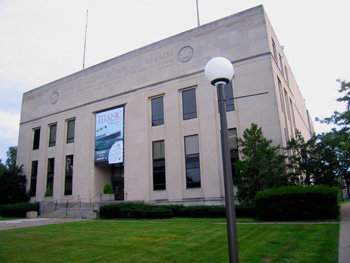
Eight years after the terrorist attacks of 9/11, Americans see Muslims as facing more discrimination inside the U.S. than other major religious groups. Nearly six-in-ten adults (58%) say that Muslims are subject to a lot of discrimination, far more than say the same about Jews, evangelical Christians, atheists or Mormons. In fact, of all the groups asked about, only gays and lesbians are seen as facing more discrimination than Muslims, with nearly two-thirds (64%) of the public saying there is a lot of discrimination against homosexuals. Full article.
The Nakbah project was led by Scottish artist Jane Frere. The artwork is a multi-dimensional installation of around 3,000 wax figures. Suspended in the air by clear nylon thread, the figures are positioned on a raked angle across the space, giving the elusion of depth and motion representing the departure of Palestinians in the 1948 exodus. Sound, video and scripted testimonies will escort the figures. Full article.
Brian Lenzo and Ream Kidane recently returned from Gaza, where they went with the Viva Palestina convoy. Join them for a presentation and slide show at the Museum for Kids Art (90 Webster Ave, Rochester, NY) this evening (Sept 9, 2009) at 7:00 pm.
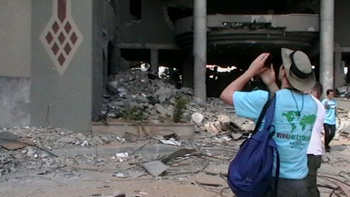
“the muslims i know” – screening and discussion at the rochester museum and science center, friday september 11, 2009 at 5.30 pm.
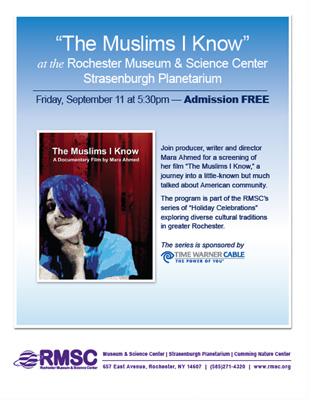
Here may be the single strangest fact of our American world: that at least three administrations — Ronald Reagan’s, George W. Bush’s, and now Barack Obama’s — drew the U.S. “defense” perimeter at the Hindu Kush; that is, in the rugged, mountainous lands of Afghanistan. Put another way, while Americans argue feverishly and angrily over what kind of money, if any, to put into health care, or decaying infrastructure, or other key places of need, until recently just about no one in the mainstream raised a peep about the fact that, for nearly eight years (not to say much of the last three decades), we’ve been pouring billions of dollars, American military know-how, and American lives into a black hole in Afghanistan that is, at least in significant part, of our own creation. Full article.
Echoing now is a speech from Martin Luther King Jr. on April 4, 1967. If we replace the word “Vietnam” with “Afghanistan,” the gist of his message is with us in the autumn of 2009:
“Somehow this madness must cease. We must stop now. I speak as a chil…d of God and brother to the suffering poor of Afghanistan. I speak for those whose land is being laid waste, whose homes are being destroyed, whose culture is being subverted. I speak for the poor of America who are paying the double price of smashed hopes at home, and death and corruption in Afghanistan. I speak as a citizen of the world, for the world as it stands aghast at the path we have taken. I speak as one who loves America, to the leaders of our own nation: The great initiative in this war is ours; the initiative to stop it must be ours.” Full article.
The goal of the Warrior Writers Project is to provide “tools and space for community building, healing and redefinition”. Through writing/artistic workshops that are based on experiences in the military and in Iraq, the veterans unbury their secrets and connect with each other on a personal and artistic level. The writing from the workshops is compiled into books, performances and exhibits that provide a lens into the hearts of people who have a deep and intimate relationship with the Iraq war.” Full article.
DEHUMANIZED – when math and science rule the school
by mark slouka
harper’s, september 2009
in this excellent analysis of american education (and its effects on america’s much touted freedoms and democracy), mark slouka talks about today’s essential drama: “the unqualified triumph of a certain way of seeing, of reckoning value. it’s about the victory of whatever can be quantified over everything that can’t. it’s about the quiet retooling of american education into an adjunct of business, an instrument of production.”
as the arts and humanities have become marginalized, we are increasingly trained in what to think but not in how to formulate our own world view. “in a corporate culture, hypnotized by quarterly results and profit margins, the gradual sifting of political sentiment is of no value; in a horizontal world of “information” readily convertible to product, the verticality of wisdom has no place. show me the spreadsheet on skepticism.”
what we teach in school is a good measure of what we value as a society. but real debate on this important subject is stifled by orthodoxy, and “whether that orthodoxy is enforced thru the barrel of a gun or backed by unexamined assumption, the effect is the same.”
“in our time, orthodoxy is economic. popular culture fetishizes it, out entertainments salaam to it, our artists are ranked by and revered for it. everything submits, everything must, sooner or later, pay fealty to the market; thus cost benefit analyses on raising children, on cancer medications, on clean water, on the survival of species, including – in the last analysis – our own.”
capitalism has been extremely successful in co-opting the educational system, but “by downsizing what is most dangerous (and essential) about our education, namely the deep civic function of the arts and the humanities, we’re well on the way to producing a nation of employees, not citizens.” our priorities have become inverted. “our primary function is to teach people, not tasks, [but how] to participate in the complex and infinitely worthwhile labor of forming citizens, men and women capable of furthering what’s best about us and forestalling what’s worst. it is only secondarily about producing workers.”
the case for the humanities is not hard to make. “the humanities, done right, are the crucible within which our evolving notions of what it means to be fully human are put to the test; they teach us, incrementally, endlessly, not what to do but how to be. their method is confrontational, their domain unlimited, their “product” not truth but the reasoned search for truth, their “success” something very much like frost’s momentary stay against confusion. they are thus inescapably, political. why? because they complicate our vision, pull our most cherished notions out by the roots, flay our pieties. because they grow in uncertainty. because they expand the reach of our understanding (and therefore our compassion) , even as they force us to draw and redraw the borders of tolerance. because out of all this work of self-building might emerge an individual capable of humility in the face of complexity; an individual formed thru questioning and therefore unlikely to cede that right; an individual resistant to coercion, to manipulation and demagoguery in all their forms.”
how can education in america produce citizens necessary for the survival of democracy when “values” have become off limits – confined to the home and church? “how does one “do” the humanities value-free? how does one teach history, say, without grappling with what that long parade of genius and folly suggests to us? how does one teach literature other than as an invitation, a challenge, a gauntlet – a force fully capable of altering not only what we believe but how we see? the answer is, of course, that one doesn’t. one teaches some toothless, formalized version of these things, careful not to upset anyone, despite the fact that upsetting people is arguably the very purpose of the arts and perhaps of the humanities in general.”
as the “market for reason” is slipping away, it is perhaps not too late to “invest our capital in what makes us human.”
Former Attorney General John Ashcroft may face personal liability for the decisions that led to the detention of an American citizen as a material witness after the Sept. 11 attacks, a federal appeals court panel ruled on Friday. In the decision, a three-judge panel of the United States Court of Appeals for the Ninth Circuit, in San Francisco, was sharply critical of the Bush administration’s practice of holding people it suspected of terrorism without charges, as material witnesses. “We find this to be repugnant to the Constitution, and a painful reminder of some of the most ignominious chapters of our national history,” said the opinion, written by Judge Milan D. Smith Jr. Full article.
with dr robert bowman, at hobart and william smith colleges, geneva, sept 3, 2009 – “war is not the answer: a personal odyssey”
Dr. Bowman, who has a Ph.D. in Aeronautics and Nuclear Engineering from Caltech, flew 101 combat missions as a fighter pilot in Vietnam, after which he became Director of Advanced Space Programs Development for the Air Force Space Division. In that capacity he oversaw the then secret program to study missile defenses, which President Reagan later turned into the Strategic Defense Initiative (SDI), or “ Star Wars.” He has become a powerful anti-war voice within the progressive community – active with Veterans for Peace, and Vietnam Veterans Against the War. He has opposed both wars with Iraq, the war in Afghanistan, as well as the military operations in Bosnia and Kosovo.
true – urdu is one of the most beautiful languages of the world ?