hey rochester, follow frederick douglass’s lead and vote for rajesh barnabas. he speaks truth to power and has solid ideas about how to implement much needed change. vote for rajesh, vote for the people’s slate.

hey rochester, follow frederick douglass’s lead and vote for rajesh barnabas. he speaks truth to power and has solid ideas about how to implement much needed change. vote for rajesh, vote for the people’s slate.
this picture broke my heart. three generations of this beautiful family, a family that looks like mine and so many other families i love, were killed violently by a white man in canada. what hatred and dehumanization have to be deployed for someone to drive their truck into human bodies, bodies made of flesh and bones just like their own. how can someone endure the sickening shock of that murderous, uneven impact? the horrible thud of it? i asked those same questions when an israeli soldier drove a bulldozer into rachel corrie’s body in 2003. she was a vibrant 24 year old, a righteous young woman protesting the demolition of palestinian homes in the gaza strip.
anti-muslim racism and palestine. the connections are unshakeable. in palestine too, the brutalization and extermination of the muslim body is systematically normalized. even the smaller, more delicate bodies of muslim children.
as this happened in canada (the land of nice people), some zionist members of the rochester community were going into overdrive, calling #freepalestine the modern-day equivalent of the swastika, going full-throttle against linda sarsour (calling her an antisemite for her anti-racism work and her palestinian american identity), organizing pro-israel rallies, and trying to derail the political careers of local leaders because they dared to speak up for the human rights of palestinians. it is surreal.
additionally, we are not allowed to talk about it. we are not allowed to talk about our own collective death. i will have to write about this in more detail. for now, i just want to send all my love and solidarity to my entire muslim community everywhere in the world. our lives are NOT disposable.
Fady Joudah: For the past few years I have rarely “submitted” my work to publications and mostly responded to editors who solicited my work. I live Palestine in English. But in my heart Palestine is Arabic. And Palestine in Arabic does not need to explain itself. Despite setbacks, disasters, revolving conspiracies against it, Palestine in Arabic is self-possessed. It is exterior to English yet born internationalist and shall remain so — neither thinking it is the center of the world nor surrendering to the imperial center as the primary source of its future liberation. Palestine in Arabic is where the overwhelming sacrifice is made. Palestine in Arabic dreams, lives in and with more than 15 hundred years of literary, intellectual, and ecumenical traditions, belongs to 10 thousand years before that. History does not end for Palestine in Arabic.
[…] Palestine in English navigates the gatekeeping English imposes on Palestine, and on itself with regards to Palestine. Gatekeeping is not just for poetry, memoirs, or novels. It affects op-eds all over the United States. The bullying surveillance in academia is endemic. Holding anti-Palestinian and anti-Arab sentiments that range between subtlety and flagrance is a career move. And since hunting Palestinians in the open is seemingly vicious in a democracy like the United States, a whispering campaign is the next best option, and ghosting them is often the honorable choice. Not infrequently the ghosting is internalized by Anglophone Arabs and Muslims who simply stop trying to keep Palestine visible, expressible. But if anyone wants to come out into the light a little, they must comply with normalized stipulations that placate hierarchical structures, editorial controls, and fact-checking rigor, which may or may not apply equally to all writers on Palestine. No wonder Bartleby killed himself.
There are so many gates to unlock that each time one gate is opened or abandoned so that Palestine can speak in English, it feels like a humanist triumph or a revolutionary breakthrough. Some Jewish Americans, softly Zionist or avowedly non-Zionist, struggle to come to terms with their privileged positions. The power dynamic they hold over Palestinian narration and presence in English is staggering. A Jewish American writer or editor who starts out with pro-Palestinian sentiments may go on to secure a powerful career through which they dominate Palestinian voices in English, no matter how progressive and fortified their pro-Palestinian stance may be. The conversation is, by and large, about American Jewry and Zionism, an internal debate in which Palestinians are most often represented, if at all, by a non-Palestinian representative. More here.
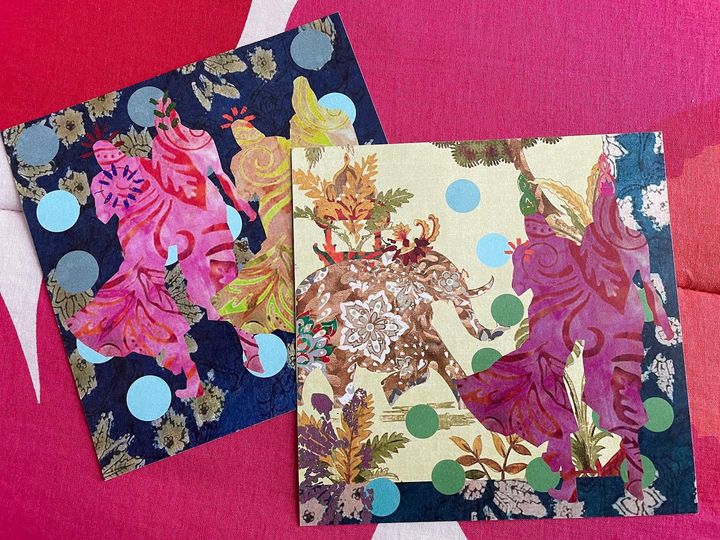
happy to share that the two digital collage prints i sent to Rochester Contemporary Art Center’s famous transnational 6×6 exhibition have been purchased! called ‘stepping into spring’ part I and II, they were created earlier this year with dreams of warmer weather, lush color, nature, and long walks on long island. the exhibition/sale is still on! visit www.roco6x6.org to buy wonderful, affordable art!
i’d like to share a new story from the warp & weft today – a story that means a lot to me personally.
on feb 1st this year, my favorite teacher left this world unexpectedly. i was heartbroken. the force of my reaction surprised me. there is so much more to us than meets the eye, even our own internal eye.
there are 30 trillion cells in the human body. there are multiplicities, temporalities, and mysteries buried inside of us. there is memory in each cell. we might not remember what someone means to us, until the body reminds us, by reviving thoughts and emotions – the messy, gelatinous stuff we’re made of.
here is a beautiful tribute to our monsieur maurer written by his best friend of 65 years, the wonderful belgian writer Paul Couturiau. pls listen to/read this story of deep friendship.
for the first time since we moved here, a little over a year ago, we met with a group of people. went on a ‘healing hike’ with the long island progressive coalition to uplands preserve, cold spring harbor, new york. so incredibly beautiful! spent 3 hours discovering how milkweed attracts monarch butterflies, what poison ivy looks like, how the white flowered mountain laurel is difficult to move or transplant on account of its sensitivity to soil chemistry, the subtle perfume of the multiflora rose (a climbing, rambling shrub), how woodpeckers communicate with one another, how the tulip poplar (also called tulip tree) is neither tulip nor poplar but closely related to magnolia trees, and how the american chestnut is super susceptible to chestnut blight, a fungus introduced to north america in the early 1900s which reduced the great american chestnut forests to a simple sucker sprout population that rarely produces any chestnuts. v cool to meet other activists as well – especially nia adams who traveled to rochester during the daniel prude uprising and knew all the brilliant women involved with free the people rochester. it was 81 F but we spent most of our time in fragrant shaded woods so didn’t really feel the heat.

I presented a paper called ‘We Do Language’ today, words from Toni Morrison’s Nobel lecture. So happy I was able to include the following voices, beauty, wisdom and poetry. I’ve gotta admit, I’m loving Zoom:)
Works Cited:
-Anam Cara by John O’Donohue
-Demain dès l’aube by Victor Hugo
-Le dormeur du val by Arthur Rimbaud
-Dasht e Tanhai (In the desert of my solitude) by Faiz Ahmed Faiz
-Light at the Edge of the World by Wade Davis
-Linguistic Imperialism: Colonial Violence through Language by Ananya Ravishankar
-Dreaming in Gujarati by Shailja Patel
-A discourse on colonialism by Aime Cesaire
-Things fall apart by Chinua Achebe
-Memory for Forgetfulness by Mahmoud Darwish
-Toni Morrison’s Nobel lecture
Videos:
-Le Mot Juste by Mara Ahmed
-Dasht e Tanhai as sung by Iqbal Bano
-Ngugi wa Thiong’o Interview: Memories of Who We Are
Images:
-A language family tree in pictures, The Guardian
-The emperor Akbar receiving Sultan Adam Gakkar, part of the Akbar-nama, illustrated late in Emperor Akbar’s reign
-Photograph from Mara’s family archive, Brussels
-Women in a Garden on a Moonlit Night, 1744 India, artist unknown, ink and watercolor on paper
-Still from Peau d’âne, a French musical film directed by Jacques Demy, with Catherine Deneuve and Jean Marais
-Abdur Rahman Chughtai (Pakistan, 1897-1975) Spinning Wheel, Etching on paper
-Abdur Rahman Chughtai (Pakistan, 1897-1975) Maiden contemplating moths at a flame, Watercolor on card
-Amrita Sher-Gil (Hungary/India, 1913-1941) Bride’s Toilet, 1937
-Jamdani sari, 20th century, the only surviving variety of muslin that uses coarser threads with traditional motifs, as woven by master-weaver Haji Kafiluddin of Rupganj, Dhaka, photo: Shahidul Alam, Drik Photographs
-Watercolor with two women from Thar (Sindh, Pakistan) by Ali Abbas
-A scene from “SpiNN,’’ Shahzia Sikander’s 2003 digital animation
-Bachi Devi (India, contemporary artist) Peacock on tree, Folk art from the Indian village of Madhubani
-Toni Morrison. Photo illustration by Lisa Larson-Walker. Photo by Bettman/Corbis.
I was planning to put a trailer together for my new film ‘The Injured Body,’ but at close to 7 min, it’s more like a preview. This is the first time that people will get a glimpse of all the interviews we did (w 17 remarkable women) and the gorgeous dance performances we shot. I will be showing this never-before-seen, brand new material at a free online conference day after tomorrow, June 3, at 8pm.
I am honored to be a part of ‘Activate, Reimagine, Transform,’ a virtual gathering hosted by the UR Institute for the Performing Arts, in partnership with the UR Office of Equity and Inclusion, the Paul J. Burgett Intercultural Center, 540WMain, Inc., Create A Space Now, and Rochester Fringe Festival.
I will be talking about The Injured Body and so much more. It will be multimedia, as usual, with clips from the documentary and the premiere of a film preview.
Will present on opening night, June 3rd, at 8pm. The conference runs June 3-6 and is completely free. Pls register.
with my sister and brother on sunday. couldn’t barbecue outdoors so we grilled burgers in our oven. first big get together since covid. taboo, heads up, dumb charades, and lots of laughter. photo by my sister in law.

March For Palestine: Jinan Shbat, national organizer for the Arab-American Anti-Discrimination Committee (ADC), which participated in the protest, told Arab News that it was a milestone for pro-Palestinian activism in the US in terms of the size and diversity of the crowd, which included Jewish, African-American, and other ethnic and religious groups.
“For so long, our tax dollars have funded the ethnic cleansing of the Palestinian people,” she said. “We came today so we can say it loud and clear to this administration that we as Americans will no longer be complicit in funding these atrocities.”
Shbat added that the protest is sending a message to the Biden administration and to Congress that they will be held accountable for their political decisions, and that “we’ll work to replace those who no longer serve our interests.”
my sister is here for the long weekend! it’s been raining everyday and it’s cold on long island, but we still managed to go to port jeff.

In early May, we went to see ‘Blindness’ at the Daryl Roth Theatre in NYC. It’s ‘José Saramago’s timely, sinister story of a world in chaos… narrated with savage rage by Juliet Stevenson.’
Blindness is no ordinary play. Its setup is designed specifically for Covid-appropriate social distancing. This is how it works: People are ‘grouped in pairs who have come together… distanced from other pairs, and, at first, each pair sits under its own spotlight. There is no stage; the show occurs only in light and sound. Above audience members’ heads are a series of glowing neon tubes in primary and secondary colors, perfectly vertical and horizontal and meeting at right angles, reminiscent of the work of the artist Dan Flavin. The story, ably delivered, in a recorded monologue, by Stevenson, comes through headphones sporting “binaural” 3-D technology.’
The neon tubes move up and down, and for vast portions of the play, we are immersed in complete darkness.
As Kate Wyver wrote in the Guardian, ‘the piece is claustrophobic by nature, but when wearing the required mask… breathing suddenly feels much harder. At these points, the lack of sight is disorienting and the binaural sound design properly takes effect as the violence of the piece crawls beneath your skin. It feels as if Stevenson is whispering right into your ear, stroking your arm, holding that dripping knife.’
Light and sound have never been used more effectively to create patterns, moods, textures, and a sense of space and time. I was not surprised to learn that this is a Donmar Warehouse (London) production. I saw ‘Julius Caesar’ set in a women’s prison, brought to pulsating life by an all-female cast in 2012. Never forgot it.
The play’s narrator, or Storyteller, is voiced by the incredible Juliet Stevenson who’s absolutely dazzling here.
One of the strongest moments for me was towards the end, when the exit door opens. At that moment, Stevenson is describing her scarred city, come to a violent halt, littered with corpses, garbage, and dogs tearing apart flesh from the freshly fallen. That hell comes to an end, like a bad dream, when the door opens. We see a swath of beautiful green, welcome respite for deprived eyes. Yellow cabs pass by in the distance, pedestrians much closer to us. We hear the faint hum of a functioning city. Such relief and emotion.
Makes one wonder how a breakdown in food systems and other services would impact New York, how the idea of modern cities in general is ridiculous – rendering people helpless, isolated, vulnerable to shocks, fragile.
I was left with some thoughts about Saramago’s book. How he uses blindness as a metaphor — the stripping away “of the mirrors to the soul,” which ‘loosens the fragility of human and psychic bonds, and divests us of the will and rationale to maintain them.’
‘Near the end of the novel, when the blind people are getting their vision back, he has one of his characters remark:” I don’t think we did go blind, I think we are blind, Blind but seeing, Blind people who can see, but do not see.”’
Although Saramago’s blindness is a ‘white disease,’ a ‘milky sea’ that spreads by visual contact, like the evil eye, an analysis of the text thru the lens of Disability Studies is important. A little surprised that in a city, where a raging, highly infectious white blindness is breaking down existing systems, people who are already blind (and adjusted) don’t play a more powerful, positive, central role. Less comfortable with the fact that Saramago’s Storyteller/protagonist (she is the all seer, leader, organizer, moral compass of the story) is the only person who has sight.
A remarkable experience all in all, and very much in line with my interest in audio storytelling (the Warp & Weft).

Beautiful writing by Nick Estes, citizen of the Lower Brule Sioux Tribe, brilliant historian, academic, and activist. He exchanged letters with PalFest co-organizer Maath Musleh and wrote about Indigenous struggles and solidarities between Palestine and Turtle Island, but also with Indigenous nations in Bolivia, Venezuela, and Aotearoa.
‘I began this letter in Mni Luzahan (Rapid City), a white-dominated settlement sitting at the base of He Sapa, the Black Hills, our sacred mountains. More than 50 Indigenous nations maintain historical ties to this place, a land stolen from us to mine gold, a metal to us that had no intrinsic value.
This is our al-Quds.
For Lakotas, we call it “the heart of everything that is.” From space, the outline of the mountains looks like a human heart. The stories tell us humanity began here, shaped from the dirt — which is red like our blood.
N. Scott Momaday, a Kiowa author, once wrote that his grandmother’s stories of this landscape “lay like memory in her blood.” Confined to the reservation most of her life, she had never visited He Sapa but recounted her people’s history of this place.
Yesterday, I read an article about the migratory birds that fly into Gaza. The quails enter and leave, if not captured by the hungry, doing what many Gazans can’t: they enter and leave the world’s largest open air prison camp.
Last week, millions throughout the world went on strike against climate change — in fear of an uninhabitable world. A young, inspiring Norwegian girl is the poster child for the movement. I wonder: What if she were a Palestinian, Syrian, or Guatemalan child? Would there be the same kind of mass support? No one seems to care that a future has already been taken from these children. They make news only when they die: their bodies wash ashore; they die in a prison camp; or they are gunned by Israeli snipers.
A European child crosses an ocean by boat for a righteous cause, embraced by millions. A Syrian child dies making a perilous journey seeking refuge in the very nations that have destroyed hers — and only harsher immigration laws are passed.
A pit sits in my stomach as I remember the beauty of our mountains, where we became human. What’s the point of saving the planet if billions are still hungry, unsafe, and under the constant shadow of war?’ More here.
Friends, I am pleased to return to the Witness Palestine Film Festival, on Sunday June 13 at 3pm, to interview filmmaker Mats Grorud and the Chair of the Centre for Palestine Studies at SOAS, Dr. Dina Matar. We will be talking about ‘The Tower.’
This is an important time to learn about Palestine and become a part of the global solidarity movement. You can watch the film on Amazon.
I was one of the activists who helped create the WPFF in 2011. Was on the organizing team for 7 years, so it’s an honor to be back. Hope to see you then!
THE TOWER: This beautifully animated film tells the story of Wardi, a young Palestinian girl who lives with her family in the Lebanese refugee camp where she was born. Her beloved great-grandfather, “Sidi,” was one of the first people to settle in the camp after being exiled from his home and homeland, Palestine, in 1948. When Sidi gives Wardi the key to his old house back in the Galilee, she fears he may have lost hope of someday returning home. As she searches for Sidi’s lost hope around the camp, she collects her family’s testimonies, from one generation to the next. An uplifting film that captures the story of Palestine through four generations.

it’s our daughter’s birthday today. we named her nermeen from ‘nerm,’ meaning softness or gentleness in urdu. lora mathis hadn’t come up with the idea of ‘radical softness’ back then, but without having the words for it, i knew it was a rejection of the cutthroat capitalist systems we live under. the survival of the fittest and all that. i was hoping for something different. happy birthday gentle one! love u forever <3