
“At times, he said, Blackwater forces cross the line from trainers or advisers and actually participated in raids. “That gives the Pakistani government the cover to say, ‘Hey, no, we don’t have any Westerners doing this. It’s all local and our people are doing it,'” said the former executive. “But it gets them the expertise that Westerners provide for [counterterrorism]-related work.” After the US soldiers were killed on Wednesday, a spokesperson for the Pakistani Taliban claimed responsibility and said the dead men worked for Blackwater. Full article.
Author: mara.ahmed
Beck – Girl
New Left Review – Tariq Ali: President of Cant
Rarely has self-interested mythology—or well-meaning gullibility—been more quickly exposed. There was no fundamental break in foreign policy, as opposed to diplomatic mood music, between the Bush 1, Clinton and Bush 2 Administrations; there has been none between the Bush and Obama regimes. The strategic goals and imperatives of the us imperium remain the same, as do its principal theatres and means of operation. Full article.
Dr Margaret Flowers on Bill Moyers Journal
dr margaret flowers – a spectacular spokesperson/activist for a govt-run single-payer healthcare system – let’s get behind her.
Cate Blanchett in “Streetcar”
love cate – amazingly intelligent, intense, beautiful. love blanche – flawed, psychologically fragile, deluded, tragic – irresistible. how can u go wrong? unfortunately the show was sold out in new york.
Blanche is the Everest of modern American drama, a peak of psychological complexity and emotional range, which many stars have attempted and few have conquered. Of the performances I’ve seen in recent years, Jessica Lange’s lacked theatrical amperage, Natasha Richardson’s was too buff, and Rachel Weisz’s, in this year’s overpraised Donmar Warehouse production in London, was too callow. The challenge for the actress taking on Blanche lies in fathoming her spiritual exhaustion, her paradoxical combination of backbone and collapse. Blanche has worn herself out, bearing her burden of guilt and grief, and facing down the world with a masquerade of Southern gaiety and grace. She is looking—as Williams himself was when he wrote the play—for “a cleft in the rock of the world that I could hide in.”
Blanchett, with her alert mind, her informed heart, and her lithe, patrician silhouette, gets it right from the first beat. “I’ve got to keep hold of myself,” Blanche says, her spirits sinking with disappointment at the threadbare squalor of the one-room apartment her sister shares with her working-class husband. “Only Poe! Only Mr. Edgar Allan Poe!—could do it justice! Out here I suppose is the ghoul-haunted woodland of Weir!” she drawls to Stella, flapping her long birdlike fingers in the direction of the window and the railroad tracks beyond. Blanchett doesn’t make the usual mistake of foreshadowing Blanche’s end at the play’s beginning; she allows Blanche a slow, fascinating decline. And she is compelling both as a brazen flirt and as an amusing bitch. When Stella explains that Stanley is Polish, for instance, Blanche replies, “They’re something like the Irish, aren’t they? Only not so—highbrow.” It’s part of Blanchett’s great accomplishment that she makes Blanche’s self-loathing as transparent and dramatic as her self-regard. She hits every rueful note of humor and regret in Williams’s dialogue. In one desperate scene, in which Blanche explains her sordid past to Stanley’s friend Mitch (Tim Richards), who has been disabused of his romantic interest in her, she takes a slug of Southern Comfort. “Southern Comfort!” she exclaims. “What is that, I wonder?” Dishevelled, sitting on the floor by the front door, she fesses up to Mitch. “Yes, I had many intimacies with strangers,” she says, in a voice fatigued by heartbreak. I don’t expect to see a better performance of this role in my lifetime. Full review.
Pakistan attack claims first-recorded US lives
i thought we were not supposed to be in pakistan!
Three US soldiers have been killed in a bomb blast as they attended the re-opening ceremony for a girl’s school destroyed in a previous attack.
The soldiers, who were killed on Wednesday in the Lower Dir district in Pakistan’s restive North West Frontier Province, are considered to be the first American fatalities in Pakistan’s lawless tribal regions.
They were also among 60 to 100 members of a Special Forces Operation team that trains Pakistan’s paramilitary troops in counter-insurgency techniques.
At least three children were also killed in the explosion claimed by the Taliban. Watch video.
Lawyers want UK public inquiry into Iraq abuse
Public Interest Lawyers will lodge a claim for judicial review on behalf of all the alleged victims on Friday. Because so many similar cases have come to light, a single inquiry should be held into the UK’s detention policy in south-eastern Iraq, the firm
says. The allegations include claims that British troops subjected Iraqi prisoners to rape, sexual humiliation and torture. The law firm is currently representing 66 Iraqis who claim they were abused by British troops. Full article.
The Powerful Testimony of Dr. Aafia Siddiqui
v interesting. i had never heard of her testimony before.
“The high drama of that day’s proceedings revolved around the question of whether or not U.S. District Judge Richard Berman would grant Aafia’s repeated demand to take the stand in her own defense.
Aafia’s lawyers appeared to be animate in their opposition to her taking the stand, while the prosecution appeared (on the surface) to be in favor of Aafia being entitled to her Fifth Amendment right. Her brother (Muhammad) was apprehensive about her taking the stand, leaning more in favor of her following the advice of her lawyers. Even Pakistani Ambassador Hussain Haqqani became involved. During a short visit he was allowed with the defendant, he reportedly advised Aafia to follow the advice of her lawyers.” Full article.
my review: ingmar bergman’s CRIES AND WHISPERS
cries and whispers explores the uncomfortable relationship between life and death and how a prolonged, painful illness can be a swing door between both worlds.
what struck me most was the disconnectedness exhibited by some of the characters, an inescapable side effect it seemed of adulthood. set against that emotional and mental detachment is anna’s character, whose simple faith and kindness elevate her to the role of steadfast earth mother.
the cinematography is striking. everything inside the manor where most of the film is shot is red except for the women who are dressed in immaculate white. transitions throughout the film are dissolves to red. bergman is said to have explained that red is the color of the soul – the inside of the soul. for me the red created an artificial environment – it reminded me of the theater with its heavy red curtains or a jewelry box that’s sumptuous red velvet on the inside. the women seemed to be fleeting figures not quite absorbed by their environment. again that odd sense of disjuncture, of the real and unreal subsisting side by side, of superficial showy exteriors vs what is intimate and true.
bonus features on the dvd included an interview with bergman and his life-long friend and collaborator actor erland josephson. what a treat! bergman was in his early 80s at the time and josephson in his late seventies. both are candid, witty, and profound as they talk about love, life and death. just brilliant.
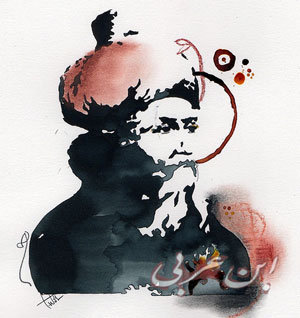
THE SPECIAL LOVE by Ibn el Arabi
Mystic, philosopher, poet, sage, Muhammad Ibn el Arabi is one of the world’s greatest spiritual teachers. He was born in Murcia, Al-Andalus in 1165 and his writings had an immense impact throughout the Islamic world and beyond.
The most famous idea attributed to el Arabi is wahdat al-wojud “the oneness of being.” Although he never employs the term, the idea is implicit throughout his writings. In the manner of both theologians and philosophers, Ibn el Arabi employs the term wojud to refer to God as the Necessary Being. Like them, he also attributes the term to everything other than God, but he insists that wojud does not belong to the things found in the cosmos in any real sense. Rather things borrow wojud from God, much as the earth borrows light from the sun.
THE SPECIAL LOVE
by Ibn el Arabi
As the full moon appears from the night, so appears
her face amid the tresses.
From sorrow comes the perception of her: the eyes
crying on the cheek; life the black narcissus
Shedding tears upon a rose.
More beauties are silenced: her fair quality is
overwhelming.
Even to think of her harms her subtlety (thought is
Too coarse a thing to perceive her). If this be
So, how can she correctly be seen by such a clumsy
organ as the eye?
Her fleeting wonder eludes thought.
She is beyond the spectrum of sight.
When description tried to explain her, she overcame it.
Whenever such an attempt is made, description is
put to flight.
Because it is trying to circumscribe.
If someone seeking her lowers his aspirations (to
Feel in terms of ordinary love),
– there are always others who will not do so.
MAD GIRL’S LOVE SONG by Sylvia Plath
MAD GIRL’S LOVE SONG
By Sylvia Plath
“I shut my eyes and all the world drops dead;
I lift my lids and all is born again.
(I think I made you up inside my head.)
The stars go waltzing out in blue and red,
And arbitrary blackness gallops in:
I shut my eyes and all the world drops dead.
I dreamed that you bewitched me into bed
And sung me moon-struck, kissed me quite insane.
(I think I made you up inside my head.)
God topples from the sky, hell’s fires fade:
Exit seraphim and Satan’s men:
I shut my eyes and all the world drops dead.
I fancied you’d return the way you said,
But I grow old and I forget your name.
(I think I made you up inside my head.)
I should have loved a thunderbird instead;
At least when spring comes they roar back again.
I shut my eyes and all the world drops dead.
(I think I made you up inside my head.)”
1953
my review: bab aziz (the prince who contemplated his soul)
“there are as many paths to god as there are souls on earth.” thus starts “bab aziz” a film by tunisian artist, writer and director nacer khemir, which explores sufism – the islam of mystics. khemir believes that sufism represents not only the tenderness of islam but also its pulsating heart. far from being a marginal phenomenon, it is the esoteric dimension of the islamic message.
abou hassan al nouri, a great sufi, once said: “sufism is the renouncement of all selfish pleasures because true love cannot be selfish. a true sufi has no possessions, and he himself is possessed by nothing.” khemir insists that “one cannot understand the aesthetics of islamic culture without studying sufi texts.”
the film follows bab aziz, an old sufi, and his granddaughter as they travel through the desert on a quest to find a gathering of dervishes that only takes place once every 30 years. they find many fellow travelers on this journey. everyone has their own story, their own gift, their own holy grail. each must find his or her own path. “he who has faith never gets lost,” bab aziz reminds them. yet whether they’re in search of a lost love, a dream palace, or god himself, the characters and their stories are partly steeped in melancholy. there is this sense of the human search for something ephemeral, something unattainable which slips through one’s fingers like fine desert sand. this gentle sense of disquiet builds up throughout the film and reaches a climax at the end. as bab aziz prepares for his own death, he comforts hassan, a young man who finds death disturbing, with some of the most brilliant, satisfying words in the film:
bab aziz: if the baby in the darkness of its mother’s womb were told, “outside there’s a world of light, with high mountains, great seas, undulating plains, beautiful gardens in blossom, brooks, a sky full of stars and a blazing sun. and you refuse all these marvels and stay enclosed in this darkness.” the unborn child, knowing nothing about these marvels, wouldn’t believe any of it. like us when we’re facing death. that’s why we’re afraid.
hassan: but there can’t be light in death because it’s the end of everything.
bab aziz: how can death be the end of something that doesn’t have a beginning? don’t be sad on my wedding night.
hassan: your wedding night?
bab aziz: yes, my marriage with eternity.
the complementary title of “the prince who contemplated his soul” comes from a ceramic plate painted in 12th century iran with the exact same inscription. according to an afghan fable, a handsome prince left his throne to sit day and night by a small pool of water. people said: “you’d think he’s looking at his reflection in the water.” but a dervish explained to them: “maybe it’s not his image. only those who are not in love see their own reflection. he’s contemplating his soul, don’t wake him, it might take wing.”
shot beautifully in both the iranian central desert and in the tunisian desert in tataouine, the film brings together actors from iran, iraq, tunisia, kurdistan, and algeria. the musical score is equally rich and diverse. khemir explains: “in arab culture, poetry’s raison d’être is singing. songs and music create ambivalence between presence and absence, the visible and the invisible, reality and mystery. mysticism runs through both the popular and scholarly traditions of arab, persian and turkish cultures. the “baraka” (the blessing) springs out of this mystic voice. it envelops and permeates humans, places, objects. vocal music is often accompanied by dance, as in the performances of whirling dervishes who dance with one hand directed towards the sky, in order to receive the divine blessing, and the other hand directed towards the earth, to transmit this blessing to the audience. these sacred and popular types of music convey an extraordinary vitality and a communicative joy from asia to africa, from the arab world to the persian world. they guarantee a cohesion that asserts its unity and its desire for life.”
bab aziz is more of an audio-visual allegory than a linear story. khemir encourages the viewer to put aside his or her ego and open up to the world. the film “borrows the structure of the visions narrated by dervishes and the structure of their spiraling, whirling dances. characters change but the theme remains the same: love in its many forms.” in the words of the famous sufi ibn arabi:
my heart can take many shapes:
for a monk it becomes a monastery, for idols – a temple,
for gazelles – a pasture, for the faithful – kaaba.
it can become a roll of the torah or the koran.
my belief is love; wherever its caravan might lead me,
love remains my religion and belief…
Slackistan Trailer
cannot wait to see this!
In Memoriam: Asim Butt
Asim Butt (1978 – 2010) was a Pakistani painter and sculptor, with an interest in graffiti and printmaking. He was a member of the Stuckist art movement. He spoke out against the imposition of a state of emergency in Pakistan, in November 2007, by starting an “art protest” movement. He spray-stencilled the “eject” symbol (a red triangle over a red rectangle) all over Karachi. That image has now become widespread in the city. He said it was to “eject the military from the presidency.” A tribute: http://blogs.aljazeera.net/asia/2010/01/15/death-artist-asim-butt-1978-2010
Al Jazeera English – The role of media in the USA
amy goodman on the riz khan show: Has the mainstream media in the US replaced serious coverage with “junk news” and tabloidism? Especially in foreign affairs, are Americans less informed than ever? Who is shaping their perceptions of the rest of the world? And who is policing US foreign policy? Watch interview.