
LOVE him…
Author: mara.ahmed
orwell gets it right, as usual…
Every war when it comes, or before it comes, is represented not as a war but as an act of self-defense against a homicidal maniac. (George Orwell)
More on “The Raven”
“The Raven” is a narrative poem by the American writer Edgar Allan Poe, first published in January 1845. It is noted for its musicality, stylized language, and supernatural atmosphere. It tells of a talking raven’s mysterious visit to a distraught lover, tracing the latter’s slow descent into madness. The lover, often identified as being a student, is lamenting the loss of his love, Lenore. The raven, sitting on a bust of Pallas, seems to further instigate his distress with its constant repetition of the word, “Nevermore.” Throughout the poem, Poe makes allusions to folklore and various classical works. (Wikipedia)
THE RAVEN by Edgar Allen Poe
Once upon a midnight dreary, while I pondered weak and weary,
Over many a quaint and curious volume of forgotten lore,
While I nodded, nearly napping, suddenly there came a tapping,
As of some one gently rapping, rapping at my chamber door.
`’Tis some visitor,’ I muttered, `tapping at my chamber door –
Only this, and nothing more.’
Ah, distinctly I remember it was in the bleak December,
And each separate dying ember wrought its ghost upon the floor.
Eagerly I wished the morrow; – vainly I had sought to borrow
From my books surcease of sorrow – sorrow for the lost Lenore –
For the rare and radiant maiden whom the angels named Lenore –
Nameless here for evermore.
And the silken sad uncertain rustling of each purple curtain
Thrilled me – filled me with fantastic terrors never felt before;
So that now, to still the beating of my heart, I stood repeating
`’Tis some visitor entreating entrance at my chamber door –
Some late visitor entreating entrance at my chamber door; –
This it is, and nothing more,’
Presently my soul grew stronger; hesitating then no longer,
`Sir,’ said I, `or Madam, truly your forgiveness I implore;
But the fact is I was napping, and so gently you came rapping,
And so faintly you came tapping, tapping at my chamber door,
That I scarce was sure I heard you’ – here I opened wide the door; –
Darkness there, and nothing more.
Deep into that darkness peering, long I stood there wondering, fearing,
Doubting, dreaming dreams no mortal ever dared to dream before
But the silence was unbroken, and the darkness gave no token,
And the only word there spoken was the whispered word, `Lenore!’
This I whispered, and an echo murmured back the word, `Lenore!’
Merely this and nothing more.
Back into the chamber turning, all my soul within me burning,
Soon again I heard a tapping somewhat louder than before.
`Surely,’ said I, `surely that is something at my window lattice;
Let me see then, what thereat is, and this mystery explore –
Let my heart be still a moment and this mystery explore; –
‘Tis the wind and nothing more!’
Open here I flung the shutter, when, with many a flirt and flutter,
In there stepped a stately raven of the saintly days of yore.
Not the least obeisance made he; not a minute stopped or stayed he;
But, with mien of lord or lady, perched above my chamber door –
Perched upon a bust of Pallas just above my chamber door –
Perched, and sat, and nothing more.
Then this ebony bird beguiling my sad fancy into smiling,
By the grave and stern decorum of the countenance it wore,
`Though thy crest be shorn and shaven, thou,’ I said, `art sure no craven.
Ghastly grim and ancient raven wandering from the nightly shore –
Tell me what thy lordly name is on the Night’s Plutonian shore!’
Quoth the raven, `Nevermore.’
Much I marvelled this ungainly fowl to hear discourse so plainly,
Though its answer little meaning – little relevancy bore;
For we cannot help agreeing that no living human being
Ever yet was blessed with seeing bird above his chamber door –
Bird or beast above the sculptured bust above his chamber door,
With such name as `Nevermore.’
But the raven, sitting lonely on the placid bust, spoke only,
That one word, as if his soul in that one word he did outpour.
Nothing further then he uttered – not a feather then he fluttered –
Till I scarcely more than muttered `Other friends have flown before –
On the morrow he will leave me, as my hopes have flown before.’
Then the bird said, `Nevermore.’
Startled at the stillness broken by reply so aptly spoken,
`Doubtless,’ said I, `what it utters is its only stock and store,
Caught from some unhappy master whom unmerciful disaster
Followed fast and followed faster till his songs one burden bore –
Till the dirges of his hope that melancholy burden bore
Of “Never-nevermore.”‘
But the raven still beguiling all my sad soul into smiling,
Straight I wheeled a cushioned seat in front of bird and bust and door;
Then, upon the velvet sinking, I betook myself to linking
Fancy unto fancy, thinking what this ominous bird of yore –
What this grim, ungainly, ghastly, gaunt, and ominous bird of yore
Meant in croaking `Nevermore.’
This I sat engaged in guessing, but no syllable expressing
To the fowl whose fiery eyes now burned into my bosom’s core;
This and more I sat divining, with my head at ease reclining
On the cushion’s velvet lining that the lamp-light gloated o’er,
But whose velvet violet lining with the lamp-light gloating o’er,
She shall press, ah, nevermore!
Then, methought, the air grew denser, perfumed from an unseen censer
Swung by Seraphim whose foot-falls tinkled on the tufted floor.
`Wretch,’ I cried, `thy God hath lent thee – by these angels he has sent thee
Respite – respite and nepenthe from thy memories of Lenore!
Quaff, oh quaff this kind nepenthe, and forget this lost Lenore!’
Quoth the raven, `Nevermore.’
`Prophet!’ said I, `thing of evil! – prophet still, if bird or devil! –
Whether tempter sent, or whether tempest tossed thee here ashore,
Desolate yet all undaunted, on this desert land enchanted –
On this home by horror haunted – tell me truly, I implore –
Is there – is there balm in Gilead? – tell me – tell me, I implore!’
Quoth the raven, `Nevermore.’
`Prophet!’ said I, `thing of evil! – prophet still, if bird or devil!
By that Heaven that bends above us – by that God we both adore –
Tell this soul with sorrow laden if, within the distant Aidenn,
It shall clasp a sainted maiden whom the angels named Lenore –
Clasp a rare and radiant maiden, whom the angels named Lenore?’
Quoth the raven, `Nevermore.’
`Be that word our sign of parting, bird or fiend!’ I shrieked upstarting –
`Get thee back into the tempest and the Night’s Plutonian shore!
Leave no black plume as a token of that lie thy soul hath spoken!
Leave my loneliness unbroken! – quit the bust above my door!
Take thy beak from out my heart, and take thy form from off my door!’
Quoth the raven, `Nevermore.’
And the raven, never flitting, still is sitting, still is sitting
On the pallid bust of Pallas just above my chamber door;
And his eyes have all the seeming of a demon’s that is dreaming,
And the lamp-light o’er him streaming throws his shadow on the floor;
And my soul from out that shadow that lies floating on the floor
Shall be lifted – nevermore!
1845
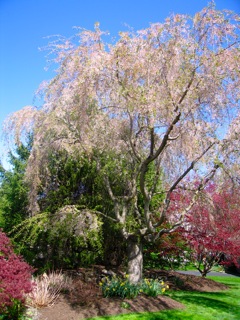
spring is here…
so beautiful in rochester – our weeping cherry, apr 23rd 2010:
Under God: The church that hates dead soldiers
the crazies hail from everywhere – not just the muslim world.
The 4th U.S. Circuit Court of Appeals has ordered the family of a slain Marine to pay $16,510.80 in court costs to a congregation that organized an anti-gay protest during the Marine’s funeral. The congregation, which claims God is using soldiers’ deaths to punish America for “the sin of homosexuality,” plans to use some of that money to fund more demonstrations at soldiers’ funerals.
Seems like the only people being punished here are grieving family members of the dead soldiers.
“By the court making this decision, they’re not only telling me that they’re taking their side, but I have to pay them money to do this to more soldiers and their families,” Albert Snyder, whose son, Lance Cpl. Matthew Snyder, was killed in action in Iraq in 2006, told CNN.
The court’s order follows its ruling earlier this month in favor of the free speech and assembly rights of the protesters from Westboro Baptist Church, who waved signs saying “God hates the USA”, “Thank God for Dead Soldiers” and signs with anti-gay slurs at Snyder’s funeral in Maryland.
The Snyder family sued the congregation in 2007, claiming privacy invasion, intentional infliction of emotional distress and civil conspiracy. A jury awarded the family $2.9 million in compensatory damages plus $8 million in punitive damages, amounts later reduced to $5 million. The congregation appealed and earlier this month the 4th Circuit reversed the jury’s verdict. Full article.
Ahmed Rushdi – Ko Ko Korina
song from pakistani movie “armaan” (desire), 1966. ko ko korina is a reference to coca cola apparently (see bottles at the bar and glued to waiter’s tray). pakistani artist iftikhar dadi thinks that coke is being fetishized here as a symbol of westernization. others argue it’s post-colonial mimicry at best. u decide.
Radiohead – There There
THERE THERE
In pitch dark I go walking in your landscape.
Broken branches trip me as I speak.
Just ’cause you feel it doesn’t mean it’s there.
Just ’cause you feel it doesn’t mean it’s there.
There’s always a siren
Singing you to shipwreck
(Don’t reach out, don’t reach out
Don’t reach out, don’t reach out)
Steer away from these rocks
We’d be a walking disaster
(Don’t reach out, don’t reach out
Don’t reach out, don’t reach out)
Just ’cause you feel it doesn’t mean it’s there.
(There’s someone on your shoulder)
(There’s someone on your shoulder)
Just ’cause you feel it doesn’t mean it’s there.
(There’s someone on your shoulder)
(There’s someone on your shoulder)
There there!
Why so green and lonely?
And lonely And lonely
Heaven sent you to me
To me To me
We are accidents
Waiting Waiting to happen.
We are accidents
Waiting Waiting to happen
Watch video here.
spreading democracy?
It is now taken for granted that great military power licenses large-scale political and social change, whatever damage that may entail. And the fact that one’s own side will not suffer many casualties seems only to stimulate more fantasies about surgical strikes, clean war, high technology battlefields, changing the entire map, creating democracy and so on, all of this giving rise to dreams of omnipotence. (Edward Said)
who does she think she is?
saw this fantastic film last saturday at the memorial art gallery:
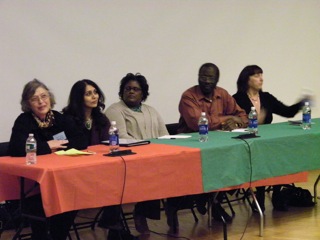
Crossing borders at RIT
Screening of Crossing Borders followed by discussion, RIT Webb Auditorium, Apr 22, 2010. From L to R: Tanya Schueler-Choukairi, Mara Ahmed, Martha Morgan, Edward Kannyo and Conerly Casey.
Demand a UN Investigation of the Military Cover-Up of the Civilian Killings
After weeks of lying about the incident, U.S. and allied forces under General McChrystal’s command have finally admitted that Special Operations units killed three innocent Afghan women, two of them pregnant, in a raid on a civilian household in February. Now it appears that Special Ops personnel may have dug bullets from bodies to cover their tracks and prevent the truth from being revealed. And yet, the forces under McChrystal’s command propose to investigate themselves.
This is unacceptable. We demand an independent, United-Nations-led investigation of the Pentagon’s cover-up of the night raid killings in Gardez and real accountability for those involved. Sign petition on FB page.
on a civilizing mission?
It is now taken for granted that great military power licenses large-scale political and social change, whatever damage that may entail. And the fact that one’s own side will not suffer many casualties seems only to stimulate more fantasies about surgical strikes, clean war, high technology battlefields, changing the entire map, creating democracy and so on, all of this giving rise to dreams of omnipotence. (Edward Said)
EARTH DAY: Rachel Carson’s “Silent Spring”
From the New Yorker
Today, the fortieth anniversary of Earth Day, is the perfect occasion on which to feature the work of Rachel Carson, whose book, “Silent Spring” gave birth to the modern environmental movement.
In the first part of “Silent Spring,” published in 1962, Carson, having already enumerated the poisonous properties of such commonly used chemicals as DDT and dieldrin, describes the accumulation of those toxic compounds in the earth’s water supply. (The movement from the general idea to the specific instance in this passage is characteristic of Carson’s writing and a source of much of its power.)
Water, of course, supports long chains of life—from the small-as-dust green cells of the drifting plant plankton, through the minute water fleas, to the fish that strain plankton from the water and are, in turn, eaten by other fish or by birds, mink, raccoons, and man himself, in an endless transfer of materials from life to life. We know that the minerals necessary for all these forms of life are extracted from the water and passed from link to link of the food chains. Can we assume that the poisons we introduce to the waters will not follow the same course? The answer is to be found in the recent history of Clear Lake, California. Clear Lake lies in mountainous country some ninety miles north of San Francisco and has long been popular with anglers. The name is plainly inappropriate; actually, the lake is rather turbid, because its bottom, which is shallow, is covered with soft black ooze. Unfortunately for the fishermen and the resort dwellers on its shores, its waters have long provided an ideal habitat for a small gnat. Chaborus astictopus. Although the gnat is closely related to mosquitoes, it is not a bloodsucker…. However, human beings who came to share its habitat found it annoying, because of its sheer numbers. Efforts were made to control it, but they were largely fruitless, until, in the late nineteen-forties, the chlorinated-hydrocarbon insecticides offered a new weapon. The chemical chosen for a direct attack was DDD, an insecticide that apparently offered fewer threats to fish life than DDT…. The lake was surveyed, its volume was determined, and the insecticide was applied in the concentration of one part to every seventy million parts of water. Control of the gnats was good at first, but by September of 1954 the treatment had to be repeated, and this time the chemical was added in the concentration of one part in fifty million parts of water. The destruction of the gnats was then thought to be virtually complete.
The following winter months brought the first intimation that other life was affected; the western grebes on the lake began to die, and soon more than a hundred of them had been reported dead. At Clear Lake, the western grebe is a breeding bird and also a winter visitant, attracted by the abundant fish of the lake. It is a bird of spectacular appearance and beguiling habits, building floating nests in shallow lakes of the western United States and Canada…. Following a third assault on the ever-resilient gnat population, in September, 1957—again in a concentration of one part of DDD to fifty million parts of water—more grebes died. Both then and in 1954, no trace of infectious disease could be discovered in examination of the dead birds. But when someone thought of analyzing the fatty tissues of the grebes, they were found to be loaded with DDD in the extraordinary concentration of sixteen hundred parts per million. How could the chemical have built up to such prodigious levels? When the fish of Clear Lake were also analyzed, the picture began to take form: The poison had been picked up by the smallest organisms, concentrated, and passed on to the larger ones, which concentrated it further…. It was a house-that-Jack-built sequence, in which the large carnivores had eaten the smaller carnivores, which had eaten the herbivores, which had eaten the plankton, which had absorbed the poison from the water.
Urge your Representative to support the Conflict Minerals Trade Act
A small window of opportunity just opened this week that could finally break the cycle of weapons freely flowing in to the Democratic Republic of Congo (DRC) and conflict minerals irresponsibly being mined out.
Right now, the House of Representatives is weighing a piece of legislation that would make it easier to identify imports into the United States that contain minerals such as coltan, cassiterite, wolframite – commonly found in cell phones, laptops and other electronic devices – used to fund the activities of armed groups operating in the DRC. If Congress required companies to disclose the origins of the minerals used in their products, then we, as consumers, could be assured that the electronics and products we purchase do not directly finance conflict or fuel human rights abuses. Send an email to your Representatives right now and urge them to co-sponsor the Conflict Minerals Trade Act. Sign petition.