
our first friend from rochester to visit us here in setauket! so lovely to hang out with arseniy <3

our first friend from rochester to visit us here in setauket! so lovely to hang out with arseniy <3
Lauren Jimerson: On the reservation, I didn’t think about my life past 18 or 20. It was hard to imagine being an adult. When I was 12, I saw the first young person pass away. Someone I grew up with, my cousin and neighbor. He was 19 or 20 and died in a car accident. I saw all these young people passing away. I didn’t know what the future looked like. Then I had Angel and it changed the course of my life.
Photograph by Erica Jae


Etel Adnan: You know, sunsets are violently beautiful, I would say that they are so by definition, but there are lights, not even colorful in the habitual sense, lights elemental, mercurial, silvery, sulfurous, copper-made, that make us stop, then lose balance, make us open our arms not knowing what else to do, arrest us as if struck by lightning, a soft lightning, a welcome one. I wait for those lights, I know some of you do too, wherever you are, I mean when you are standing by an ocean, alone, within the calmness of your spirit. Be planetary.

[West Meadow Beach today]
this makes me sooooo happy. as i’ve said before, give me michelle yeoh all day and every day. to more films that center the stories of and performances by people of color, immigrants, refugees, minorities, marginalized communities, and women, especially older women. it will make for much better art, as is proven over and over again. we want our culture to reflect our realities. the days of the ubiquitous straight white dude are over.
Listening to Lu Highmith’s mellifluous voice and wise words. At the end of the interview, her daughters Ari and Taryn played brilliant music for us. Cinematography by Rajesh Barnabas.

an adjunct professor at hamline university was fired for showing students paintings of prophet muhammad. the fact is that these paintings exist — commissioned by muslim rulers, crafted by pious muslim artists, for the consumption of muslim communities. it’s only in the last 100-150 years that salafi/ wahabi interpretations of islam made such images taboo. we cannot erase history. this is not charlie hebdo, racism or islamophobia. pls listen to the brilliant omid safi. watch here.
saw ‘triangle of sadness’ by ruben ostlund, then went back and watched ‘the square’ again. will rewatch ‘force majeure’ as well. what a brilliant, hilarious, provocative filmmaker. have been thinking about his work and how to encapsulate it. he likes to invert or complicate what is ‘normal.’ he strips away western society’s veneer of civilization, exposes its violent vulgar core, and pokes holes in what is considered the social contract.
he does this stylistically as well, by inserting sounds and visual disturbances in his scenes (an elevator door that keeps closing in the middle of an intense convo, baby cries during a marketing pitch, chairs crashing to the ground while a couple confront each other after an awkward one-night stand, etc).
he reaches for some of the mightiest, most glittery symbols of high culture (modern art, fashion, even winter sports), roots them out from their aesthetic safe place, and reveals the social rot, money, privilege, and absurdity they engender.
his films are always set in exclusive, elitist contexts – a bougie ski resort, a contemporary art museum, a luxury yacht – where the rich and beautiful prance and prevaricate about their wealth. a russian capitalist who quotes ronald reagan, a cute old couple who’ve made their fortune as arms dealers, a museum curator who is proudly liberal but couldn’t cut it without the privileges he wields, art collectors and aristos who remain paralyzed in the face of an assault on one of their own, how power hierarchies can be flipped like a switch, how the elite are completely bereft of survival skills, ideas of masculinity, the marginalization of people of color, horrors of the service industry, capitalism and homelessness, capitalism and art, beauty as trade and industry, the list goes on.
there’s always so much to unpack.
walk at west meadow beach yesterday evening (well, at 430pm). today we met the kids in nyc. had lunch at tengri tagh uyghur in midtown. hearty noodles with spicy, cumin-flavored lamb & beef + baked buns – a delicious take on the samosa (every culture has its own version). pastries from zeppola italian bakery and deep discussions with our daughter.

Wa Thiong’o montre que la centralité des langues et des cultures européennes est à la fois le symptôme et l’outil d’un ordre néocolonial porté par des bourgeoisies qui se sont substituées au colonisateur. Par la question linguistique, Wa Thiong’o, nourri par Frantz Fanon, décrypte la trahison de ces bourgeoisies :
‘L’aliénation coloniale se met en place dès que la langue de la conceptualisation, de la pensée, de l’éducation scolaire, du développement intellectuel se trouve dissociée de la langue des échanges domestiques quotidiens ; elle revient à séparer l’esprit du corps et à leur assigner deux sphères séparées. À une échelle plus globale, elle aboutit à une société d’esprits sans corps et de corps sans esprits.’
Cette dissociation corps-esprit se traduit à un niveau plus global par le clivage entre deux classes. D’un côté le peuple, dont n’est reconnu ni la langue ni la culture et qui est jugé, exploité, commandé, administré dans une langue qui lui est étrangère. Privé de mots, il est condamné au silence, à l’incompréhension face à la violence du système qui l’exploite.
De l’autre côté la bourgeoisie pro-impérialiste, pour laquelle langues et cultures européennes sont les outils idéaux de collaboration avec les anciennes ou futures puissances tutélaires. Outils idéaux de sauvegarde de leur classe, du maintien du peuple loin des affaires politiques et de filtrage social par le biais d’une éducation discriminante.
More here.
as we start the new year, i can’t help but reflect on the linearity of time (a western concept imposed on many of us). i hope to continue to struggle against that programming. in urdu, for example, kal means both yesterday and tomorrow. it’s the same word. there are no borders between the past, present and future.
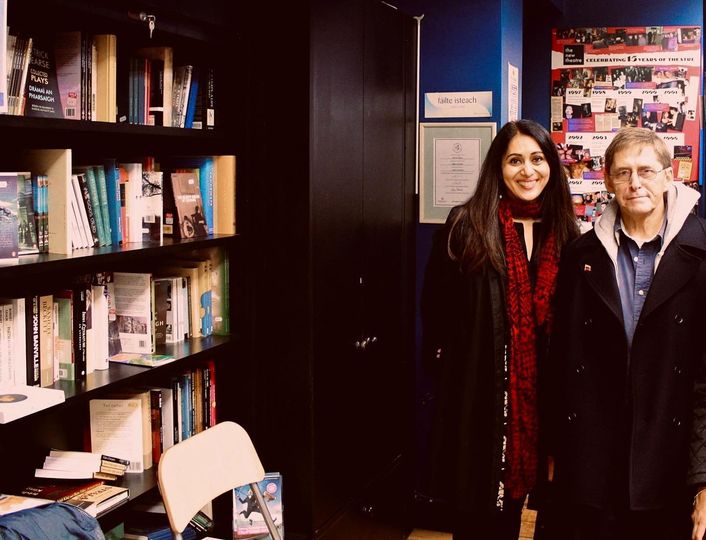
we lost a dear friend and comrade yesterday, on new year’s eve. my friend Robert Navan. i went to ireland three times, in 2013, 2016 and 2018. each time i met robert. he always gave me a little tour, took me out for coffee and pastries, for cuban food and beer in the most authentic pubs (even though i stuck with lemonade) and had plenty of recommendations about what to do in dublin.
most importantly, robert supported my work via the progressive film club. they screened ‘pakistan one on one’ and organized a brilliant screening/community event for ‘a thin wall’ (one of the best post-screening discussions i’ve ever had). they also put together a retrospective of my work and showed all three documentaries, including ‘the muslims i know.’
how lucky, how amazing to have audiences engage with my work, on the other side of the pond, in a country that’s special to me. i have always been proud to say i have wonderful friends in ireland, all of them opposed to war and imperialism, all of them fervent supporters of justice in palestine. robert was/is one of them. an old school socialist who had been to cuba many times. he told the best stories. they will continue to be with me. how i will miss him. rest in power my friend <3
Why I went to the Met and where I spent most of my time:
‘Organized around a single object—the marble bust Why Born Enslaved! by French sculptor Jean-Baptiste Carpeaux—Fictions of Emancipation: Carpeaux Recast is the first exhibition at The Met to examine Western sculpture in relation to the histories of transatlantic slavery, colonialism, and empire.
Created in the wake of American emancipation and some twenty years after the abolition of slavery in the French Atlantic, Why Born Enslaved! was shaped by the enduring popularity of antislavery imagery, the development of 19th century ethnographic theories of racial difference, and France’s colonialist fascination with Africa. The exhibition explores the sculpture’s place within these contexts.’
The white male gaze, subjection and fetishization, colonialism and empire, the sexual component of enslavement (which was never separate from the work component according to co-curator Wendy S. Walters), the branding of works as anti-slavery to market France’s enlightenment, how values from past regimes continued to masquerade as liberalism, the depiction of “types” and the limits of the European imaginary, pseudoscientific theories of ethnography and phrenology, and more. I’ve never seen such politicization of art before in a major museum.
I chose to photograph ‘Why born enslaved!’ from the side, in profile, to focus on the woman’s vitality and sheer determination. Didn’t want to include the rope or exposed breast, an unsettling mix of violence and eroticism. More works in next post.
Saw ‘Polychromy’ at the Met. So interesting how color has been erased from “Western” history.
Carl Jennings: Color is a code, a sign, a message – we use it to communicate and in turn, it has the power to shape how we think and feel. For the last 500 years or so… to be civilized is to eschew color, to resist its temptations and its charms. As Goethe observed of his times, nearly 200 years ago, “… savage nations, uneducated people, and children have a great predilection for vivid colors… people of refinement avoid vivid colours in their dress”. And Charles Blanc, the French Minister of Culture, expressing a sentiment shared by many scholars and art historians, over the perceived opposition between line and color in art, stated in 1848 that, “…colour is the peculiar characteristic of the lower forms of nature, while drawing becomes the medium of expression, more and more dominant, the higher we rise in the scale of being”.
These quotes belie a sentiment common in Western culture and eloquently documented in David Batchelor’s fascinating book on the topic, a sentiment that sees color as “something for children, savages, minorities, and women”: a loathing and a fear of color that he calls — chromophobia.
But it wasn’t always this way. The history of the west is nothing if not colorful — but very little of that evidence exists nowadays. Color has either faded with time and the elements, or it has been purposefully removed and whitewashed. The Greek and Roman statues of antiquity, pure and ethereal in their whiteness, are an illusion. They were never white. Instead, they were painted, in great and often garish detail.