
From Rabindranath Tagore’s My Life In My Words
Why I went to the Met and where I spent most of my time:
‘Organized around a single object—the marble bust Why Born Enslaved! by French sculptor Jean-Baptiste Carpeaux—Fictions of Emancipation: Carpeaux Recast is the first exhibition at The Met to examine Western sculpture in relation to the histories of transatlantic slavery, colonialism, and empire.
Created in the wake of American emancipation and some twenty years after the abolition of slavery in the French Atlantic, Why Born Enslaved! was shaped by the enduring popularity of antislavery imagery, the development of 19th century ethnographic theories of racial difference, and France’s colonialist fascination with Africa. The exhibition explores the sculpture’s place within these contexts.’
The white male gaze, subjection and fetishization, colonialism and empire, the sexual component of enslavement (which was never separate from the work component according to co-curator Wendy S. Walters), the branding of works as anti-slavery to market France’s enlightenment, how values from past regimes continued to masquerade as liberalism, the depiction of “types” and the limits of the European imaginary, pseudoscientific theories of ethnography and phrenology, and more. I’ve never seen such politicization of art before in a major museum.
I chose to photograph ‘Why born enslaved!’ from the side, in profile, to focus on the woman’s vitality and sheer determination. Didn’t want to include the rope or exposed breast, an unsettling mix of violence and eroticism. More works in next post.
Saw ‘Polychromy’ at the Met. So interesting how color has been erased from “Western” history.
Carl Jennings: Color is a code, a sign, a message – we use it to communicate and in turn, it has the power to shape how we think and feel. For the last 500 years or so… to be civilized is to eschew color, to resist its temptations and its charms. As Goethe observed of his times, nearly 200 years ago, “… savage nations, uneducated people, and children have a great predilection for vivid colors… people of refinement avoid vivid colours in their dress”. And Charles Blanc, the French Minister of Culture, expressing a sentiment shared by many scholars and art historians, over the perceived opposition between line and color in art, stated in 1848 that, “…colour is the peculiar characteristic of the lower forms of nature, while drawing becomes the medium of expression, more and more dominant, the higher we rise in the scale of being”.
These quotes belie a sentiment common in Western culture and eloquently documented in David Batchelor’s fascinating book on the topic, a sentiment that sees color as “something for children, savages, minorities, and women”: a loathing and a fear of color that he calls — chromophobia.
But it wasn’t always this way. The history of the west is nothing if not colorful — but very little of that evidence exists nowadays. Color has either faded with time and the elements, or it has been purposefully removed and whitewashed. The Greek and Roman statues of antiquity, pure and ethereal in their whiteness, are an illusion. They were never white. Instead, they were painted, in great and often garish detail.
on monday, lunch with lovely friends who happen to be my neighbors. one of them is a hollywood set designer and has worked on succession, julie & julia, spider-man, john wick, little children, and a million other films. her work goes all the way back to big and heartburn. 1 oscar, 8 nominations. pretty cool, no? when we met she asked me: ‘are u a member of the academy?’ i’ve never even considered such a question:)

‘Postcolonial theory is a body of thought primarily concerned with accounting for the political, aesthetic, economic, historical, and social impact of European colonial rule around the world in the 18th through the 20th century. Postcolonial theory takes many different shapes and interventions, but all share a fundamental claim: that the world we inhabit is impossible to understand except in relationship to the history of imperialism and colonial rule. This means that it is impossible to conceive of “European philosophy,” “European literature,” or “European history” as existing in the absence of Europe’s colonial encounters and oppression around the world. It also suggests that the colonized world stands at the forgotten center of global modernity. The prefix “post” of “postcolonial theory” has been rigorously debated, but it has never implied that colonialism has ended; indeed, much of postcolonial theory is concerned with the lingering forms of colonial authority after the formal end of Empire. Other forms of postcolonial theory are openly endeavoring to imagine a world after colonialism, but one which has yet to come into existence.’ More here.
yes, there are serious problems with fifa, with professional sports in general, with the horrors that come from hosting large scale international events, and with oppressive war-making regimes. btw most countries of the world fall within those parameters.
however, whatever happens on wed, when morocco goes against france in the semi finals, this much is clear:
1. solidarity from the global south: whether african, amazigh, arab, maghrebi, middle eastern, south asian, muslim, brown or black, people from the colonized south have rallied and celebrated morocco’s history-making games en masse
2. we are the majority: from 1492 to 1914, most of the world was colonized by tiny european nations with limited resources and infinite animus toward each other. therefore, 80% of humans are still coming to grips with colonization and genocide
3. colonialism never ended (it simply transformed and metastasized): we are still controlled by and embedded in racist, capitalist systems so the fight is not over. this is why when the western military-industrial complex goes into overdrive and never-ending wars are activated (like the war on terror or the war on drugs), they whisk together disparate regions and peoples with no regard for history, culture, or political realities – afghanistan, iraq, pakistan, libya, syria, somalia, sudan, yemen, the philippines, cambodia, vietnam, laos, colombia, cuba, guatemala, haiti, honduras, mexico, nicaragua, panama, and puerto rico can all become a monolithic ‘other’
4. consistent support for palestine: palestine has become a symbol of colonial subjugation and a rallying cry for resistance to global systems of oppression. it’s obvious that no amount of political or economic finagling can change that. people are not their governments or regimes, many of which are installed and protected by the colonizing west. the palestinian flag is a f—k you to censorship, political blackmail, and economic arm twisting
so whatever happens on wednesday friends, this is a historic moment. let’s remember it.
morocco beats portugal and makes history. the global south celebrates en masse. it’s also my birthday. i get to hear from lovely people i’ve known across decades and continents – primary and middle school in brussels, high school in islamabad, college in karachi, university in connecticut, filmmaking / activism / beloved community in rochester, new friends on long island, like-minded compadres on facebook, and family all over the world. my husband and i spend the day in nyc. we meet our kids and have dinner at ‘let’s meat’ in koreatown. after enjoying an excellent meal, we walk to my son’s apt, eat cake, play with the fabulous loulou, and watch ‘top gun: maverick’ together. how fun is that? thank u everyone for all the warmth, love and sweet wishes – i couldn’t be more grateful <3

new glasses! took me forever to find them, made mistakes along the way, but here they are at last.
i finally watched ‘farha,’ a film by jordanian director darin sallam, on netflix last night. i knew that it’s a film about the nakba (or the catastrophe) in which more than 700,000 palestinians were forcibly expelled from palestine in 1948, to make room for the jewish-supremacist state of israel.
i also knew that the israeli government has been applying pressure on netflix to censor/remove the film from their library. a bit funny considering the heretofore love affair between israel and netflix. you can read about it in belén fernández’s excellent piece ‘netflix and israel: a special relationship’ in which she shows how “netflix has been willingly subsumed into the israeli hasbara industry.”
the nakba is a vast and important episode in human history, yet sallam’s approach is small, specific, and spare. the story is told through the eyes of a 14-year old girl who becomes an unwitting witness to shocking atrocities committed by israeli soldiers. as we spend most of the film seeing the world through farha’s eyes, we too are called to witness and testify.
the experience transforms farha – gone are her dreams of studying in the city and investing her life in her community. the nakba was meant to destroy palestinian society, very deliberately, one bureaucratic and military step at a time, over multiple decades and generations.
israel’s war on ‘farha’ is enraging. not only because palestinians might be some of the few people in the world who are not allowed to tell the stories of their own dispossession and ethnic cleansing, but also because the facts of what we see in the film are not new. the terror (including theft, rape and massacres) wielded against palestinians during the nakba is well-known and well-documented, including testimonies by israeli soldiers who carried it out.
u’d have to live under a rock not to have heard of the deir yassin massacre, for example. many parts of tel aviv itself are built on depopulated palestinian villages.
in any case, the bots are out in huge numbers trying to sabotage farha’s ratings, so pls watch the film, ‘love’ it on netflix (two hearts), make an imdb account, give the film 10 stars, go to the film on google and letterboxd and give it 5 stars. write a review if u like.
let’s make sure we see more stories by and about the oppressed and their histories, and less state propaganda packaged as art. we can make a difference.
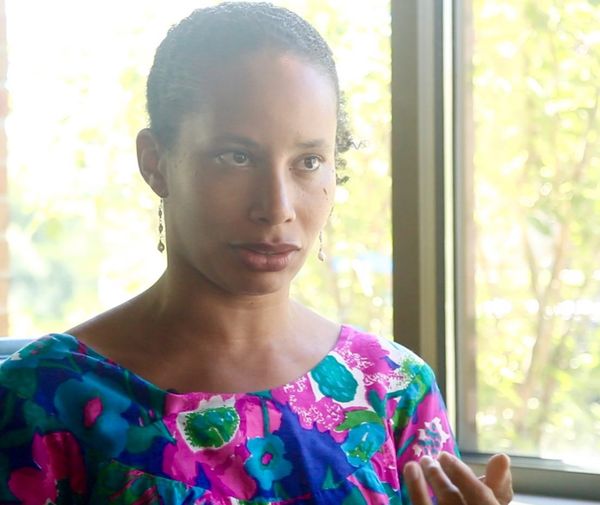
Listening to a brilliant convo between Mercedes Phelan, Erica Bryant and Tianna Manon.
-Mercedes: I was brought up to be tough – don’t show your emotions, no crying, breaking down is weakness… It’s difficult to learn to express my emotions in a positive way.
-Erica: Black women carry generational trauma, personal trauma, all these micro-aggressions. And there is no healing for it. We must reverse that stigma. Taking care of yourself emotionally and psychologically is important.
-Tianna: There are institutional issues. For a long time health professionals were not trained to deal with trauma faced by Black people. So it wasn’t always good help. Also, how many can afford it? There are some free things out there. But how do you navigate that system? This is on top of how we force each other to be tough.
with the wonderful christophe lima, juror for the new exhibition at huntington arts council which opened today. the theme of the exhibition is the exploration of the human body. i wrote a poem called ‘the body has memory’ and created a short experimental film around it. not only was it selected for the exhibition but it won ‘best in show.’ couldn’t be more excited!
thank u Rajesh Barnabas for the beautiful cinematography and Mariko Yamada for the dance choreography. stunning dance performances by Cloria Iampretty and mariko. mostly thank u all for being who u are. sharing some of rochester’s talent and heart here on long island <3

watched ‘the prime of miss jean brodie’ again last night, with the magnificent maggie smith. this film, made in 1969, always shocks me on account of its boldness and contemporary relevance. the characters, including the titular jean brodie, are deeply flawed, their trespasses unsettling, the emotional tenor of the film (novel by muriel spark) is ambiguous, everything painted in grey, without the comfort and predictability of black and white. in short, it’s a fearless portrayal of life with all its contradictions and unsavory realities (including the allure of fascism). i remember a teacher somewhat like that in high school, back in islamabad. it was an all girls school. i was never in her orbit but she created some commotion in our midst, before being let go.
wonderful journalism and documentary career panel discussion yesterday, organized by pronto in bay shore. pronto is a nonprofit doing amazing work on long island, from being a food pantry, to helping with govt paperwork and providing after school programs to students, it’s a one-stop support system that people can rely on. thank u ginger for inviting me to the panel <3
