
“We refuse to acknowledge the separation of the museum from the rest of society,” the group says. “We see MoMA as existing on the same plane as the violence of the ruling class that has controlled it…As MoMA winds down and we extract our imagination from its orbit, our energies, resources and labor power will be freed up for creating alternatives in its place,” the group adds. “Alternatives controlled by workers and communities, not billionaires and their enablers. This could be a first step for a city-wide process.” — yes, please! More here.
Month: March 2021
asian/pacific american heritage day 2020
a series of videos i did for asian/pacific american heritage day last year. this was the intro.
The Warp & Weft – Fourth Set of Stories
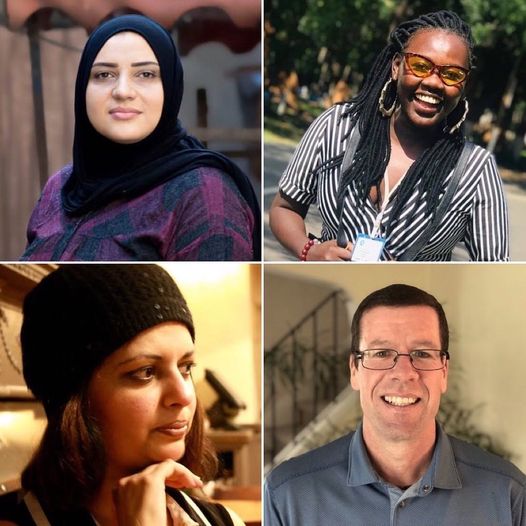
4 new warp & weft stories today including one from gaza (palestine) by Ashwaq Auf, one from the gambia by Khadee’ja Fatty, another from toronto by way of london by Amra Jamal-Ahmad, and one about healing the collective body by Michael Boucher. finally a beautiful poetic response to the archive by Andrea Anderson Gluckman. pls read and listen.
Repost from Rochester Contemporary Art Center:
Head over to maraahmedstudio.com and listen to the newest stories from The Warp & Weft archive!
Harsher Than War by Ashwaq Abualoof
The feeling of being isolated from the outside world because we live in the cage of the Gaza Strip has become a feeling of impenetrability, as if we are immune to the spread of the coronavirus. [Photo: Soltan Khaled]
Pay It Forward by Kaddijatou Fatty
My keen interest in the performing arts, as a tool for social development in The Gambia, has motivated me to pursue training in the arts. Since 2011, I have received intensive training in acting, speech and voice production, singing, stage management and scriptwriting. I have discovered that the arts are a much more effective means of communicating with people, especially when working with children and youths.
Wistful While I Work by Amra Jamal-Ahmad
I have been a commuter for my entire working life. That’s 32 years of trains, subway trains and buses getting me to my job in the city. For 27 years that city was London, England, and now since 2016, it is Toronto, Canada.
Our Body is Trying to Heal by Mike Boucher
I have been reflecting on healing and hope in recent years, in part because my work as a social worker and counselor immerses me in this conversation on a daily basis. [Photo: Lynne Boucher]
“wadi” by andrea a. gluckman: A poetic response to the archive
Listen to/read the full stories here.
The Warp & Weft is a multilingual archive of stories that seeks to capture the 2020 zeitgeist. The archive is curated by interdisciplinary artist and activist filmmaker @maraahmed. A set of new stories will be released each week via RoCo and Mara’s social media, during the course of ‘Last Year on Earth.’
haseena moin (1941-2021)
pakistani playwright and screenwriter haseena moin has passed away. tv shows she wrote like ‘tanhayiaan’ and ‘dhoop kinaray’ will always be a part of my childhood (and that of an entire generation of pakistanis). although i didn’t like some of the detours in her writing and most of the comic relief, i appreciated the strong and complex female protagonists she created. that a woman who was born in 1941 was one of the most popular, enduring, and beloved scriptwriters and storytellers in pakistan at a time when there was only one tv channel and no internet, tells one how much power she commanded. many of her lines and characters figured prominently in popular culture and opened people’s eyes to women who were independent, funny, eccentric and in charge of their narratives. feels like the end of an era. may she rest in peace.
the present
‘the present’ is a palestinian short film directed by farah nabulsi and nominated for an oscar. now available on netflix. it opens a small window and gives us a peek into what it’s like to live under occupation. although i know about settler colonialism in palestine, i couldn’t help but feel the horror and humiliation of it in my bones. pls watch.
The Debt We Owe Edward Said
Kaleem Hawa: “Edward Said was our prince,” the Egyptian novelist Ahdaf Soueif recently said in a conversation reflecting on the Palestinian public intellectual’s life and writings. An incomparable thinker, Said is credited with founding postcolonial studies, penning histories of cultural representation and “the Other,” and, in so doing, upending the Anglo-American academy. His Orientalism, published in 1978, is among the most cited books in modern history, by some accounts above Marx’s Capital and Darwin’s On the Origin of Species. Throughout decades of essays, books, and reviews, Said showed his care for form and the structures of feeling, seeing in their examination a means of understanding music, literature, the world, and Palestine, his home.
Said was many other things—a critic, a dandy, a narcissist, a mentor, a polemicist, and a singular wit. In 1995’s Peace and Its Discontents—the first of his books intended for an Arab audience—Said describes the Oslo Accords as a “degrading spectacle of Yasser Arafat thanking everyone for what amounted to a suspension of his people’s rights,” shrouded in the “fatuous solemnity of Bill Clinton’s performance, like a twentieth century Roman empire shepherding two vassal knights through rituals of reconciliation and obeisance.” The Palestinian leader for decades, Arafat would come to ban Said’s books in the West Bank and Gaza, a result of Said’s early positions in support of the one-state solution and his criticisms of Oslo.
Said’s commitment to the liberation of the Palestinian people made him enemies closer to home as well. Late in his life, and after 9/11, Said felt isolated by his American friends and colleagues, as if they had “suddenly discovered they were imperialists after all, and had turned themselves into mouthpieces for the status quo,” as he said in one of his final interviews, filmed by English documentarian Mike Dibb in 2003, just a few months before leukemia would take Said’s life. After being faced with the capricious nature of American letters, Said found solace among Arabs.
Many who opposed Said’s political commitments to Palestine spent years attempting to tear him down, and those who owe a debt to him as a person and a scholar have had to rely on private conversations and his own enormous œuvre to contest those depictions. Timothy Brennan, an author and professor who was Said’s former graduate student and a close friend, has attempted to change that with Places of Mind, his biography of Said.
As the reviews of the book have come in, though, it has been dispiriting to see a procession of white writers get Said wrong. Dwight Garner, in his review for The New York Times, “A Study of Edward Said, One of the Most Interesting Men of His Time,” seems to find every possible thing interesting about Said except his identity as a Palestinian, devoting more lines to Said’s sex life than his views on the liberation of his own people. This reflects Garner’s paper’s own treatment of Said when he was alive (The New York Times Book Review published Said 10 times, zero times on Palestine) and echoes its consistent overlooking of Palestinian voices—publishing almost 2,500 op-eds on Palestine since 1970, with only 46 authored by Palestinians. This recent review only furthers something white critics have always misunderstood about Said: In treating his Palestinian identity as a curiosity rather than an animating feature of his life and work, they miss how generative the experiences of the (albeit privileged) colonial subject were to the writing of Orientalism (or Beginnings, Covering Islam, and The Question of Palestine, for that matter). These currents are convincingly traced in Brennan’s intellectual history.
In our conversation, Brennan discusses Said’s literary influences, his relationship to Marxism, his views on the growing movement to boycott Israel, his friendship with anti-war leader Eqbal Ahmed, and his experiences with the New York media. More here.
The Warp & Weft on Reclaiming the Narrative
Dear all, Reclaiming the Narrative has been kindly broadcasting some of the Warp & Weft stories as the last segment of their weekly show on WXIR (Fridays at 1pm and Saturdays at 7:30am) and on WAYO (Saturdays at 4pm and Sundays at 7pm).
All their shows are available on Soundcloud. Last Friday (March 19) they shared ‘El Lenguaje es mi Tierra, mi Identidad’ by Tania Day-Magallon, the Friday before (March 12), they aired ‘Celebrate With Me’ by Erica Bryant, and finally, on Friday, March 5, they shared ‘Black Futures Matter’ by Quajay Donnell. Thank you RTN for sending these powerful stories out in the world via multiple channels.
lorraine o’grady’s ‘miscegenated family album’
o’grady’s iconic ‘miscegenated family album’ (1980/1994) consisting of 16 diptychs of photographs that compare her sister devonia’s family to that of nefertiti, is displayed right in the middle of the museums’s egyptian art gallery. the title of this work reclaims the pejorative term “miscegenation.” here’s some background on the series:
‘When the Boston-born, New York–based artist Lorraine O’Grady (born 1934) visited Egypt in her 20s, two years after the unexpected death of her sister, she found herself surrounded for the first time by people who looked like her. While walking the streets of Cairo, the loss of her only sibling, Devonia, became confounded with the image of “a larger family gained.” Upon returning to the US, O’Grady began painstaking research on ancient Egypt, particularly the Amarna period of Nefertiti and Akhenaton, finding narrative and visual resemblances between their family and her own.’

day at the brooklyn museum
spent wednesday at the @brooklynmuseum to see lorraine o’grady’s ‘both/and’ and loved it. both/and represents o’grady’s refusal to kowtow to binaries and western ‘either/or’ thinking. she challenges white-centered art history and how ‘museums enforce both literal and conceptual segregation in the art world.’ in line with this thinking, the brooklyn museum has displayed o’grady’s art throughout their galleries, ‘revealing her critical interventions in these dominant histories.’ so for example, her ‘announcement of a new persona,’ with its lush, large size, staged photographic prints, is mixed together with rodin’s expressive, muscular sculptures. makes complete sense. one work elevates the other, divulging emotions and details one might have missed otherwise.

The future of L.A. is here. Robin D.G. Kelley’s radical imagination shows us the way
robin d.g. kelley is one of my favorite thinkers/people in the world. the depth and breadth of his knowledge is astonishing and he is a dyed in the wool activist at heart. some gems from this interview, reminders that things are never without contradictions or unidimensional:
The class reductionist versus race reductionist debate doesn’t really advance us. Cedric advances us by helping us understand how capitalism is based on racial regimes. So, for example, property may be capital, in the Marxist sense, but property values are dependent on things that are nonmaterial — that are ideological, or superstructural — like race. Capitalism is rooted in a civilization that is based on difference. This doesn’t at all mean that white people are the enemy, or that Black people are all victims, which I totally reject. It doesn’t mean that all white people benefit. It just simply means that capitalism is structured through difference.
I have made a point of the fact that Cedric was writing a critique of Marxism — but not a hostile critique.
[…] it’s really important for me to be engaged in these movements, to make no pretense about some kind of dispassionate, detached objectivity. I think that we need to practice something that’s even better than objectivity. And that is, as you know, critique. Critique, to me, is better than objectivity. Objectivity is a false stance. I’m not neutral. I’ve never been neutral. I write about struggles and social movements because I actually don’t think the world is right and something needs to change.
As a historian, as a writer, I’ve got to try to be as critical as possible. I’m always trying to be truthful. As I write and produce this work, I learn things that we didn’t see before, but then, the work also reveals things that I failed to understand. And so to me, it’s always a process.
[…] where does Jesse Jackson get the idea of the Rainbow Coalition? It comes from Fred Hampton. He coined the term. The Black Panther Party, Illinois chapter, coined the term. And it’s through, specifically, a man named Jack O’Dell. I knew him. Jack was a former Black Communist, a close associate of Dr. King’s and then of Jesse’s, who bridged the generations and brought a left orientation to the civil rights movement. He was the one who introduced the Rainbow Coalition to Jackson. In our current moment, it’s hard to talk about things like a Rainbow Coalition politically. It goes against the white-ally idea, which I’m not really big into, where the ally is perceived to stand aside, standing there ready to be… “happy to help.” The Rainbow Coalition’s more like, “We need to build a movement and we’re all in it.” More here.
solidarity with asian communities
in view of continuing hate crimes against asians and asian americans and the horrific killings in atlanta, so much love for and solidarity with asian communities.
white supremacy is a deadly disease.
The Warp & Weft – Third Set of Stories
4 new warp & weft stories today including one from kashmir by Akmal Hanan, one about post world war II germany from ireland by Renate Debrun, a powerful poem by Selena Fleming, a raw, courageous story by Annette Ramos, and a beautiful dance response by Alaina Olivieri. pls listen and watch here.
Repost from Rochester Contemporary Art Center:
Today the third set of stories from the Warp & Weft archive launch! Head over to maraahmedstudio.com and listen to:
Because Every Goliath Meets Its David by Selena Fleming
I’m fresh off the boat—the one fashioned from ramparts of a journey laden with trauma, ugly-fulfilling prophecies, can’t-get-it-together tendencies and shoulders that have borne more than any one person should ever be allowed to bear.
If Mountains Were Oceans by Akmal Hanan
The world has seven continents and more than 190 countries, but destiny decreed that I was born in a landlocked country called Kashmir. [Photo: Shahnawaz Shah]
COVID Rebirth by Annette Ramos
Two years before COVID-19 spread around the world I was already facing one of the biggest challenges of my life. My creative life was in transformation.
Gertrud by Renate Debrun
In old family photographs I sometimes catch a glimpse of her: a stolid, middle-aged woman always in the background or at the margins. All that remains of her life now is in a small cardboard box in my sister’s attic: some papers, postcards, photographs, a bible. This is Gertrud. [Photo: Raymond Deane]
Empty Spaces by Alaina Olivieri: A dance response to the archive
Listen to/read the full stories at maraahmedstudio.com
The Warp & Weft is a multilingual archive of stories that seeks to capture the 2020 zeitgeist. The archive is curated by interdisciplinary artist and activist filmmaker Mara Ahmed (@mara__ahmed). A set of new stories will be released each week via RoCo and Mara’s social media, during the course of ‘Last Year on Earth.’

My art video ‘Le Mot Juste’ is here
My experimental/art video is here! Check out ‘Le Mot Juste‘ along with 20 other works of art! I created this piece out of footage shot by Rajesh Barnabas and a dance performance by Mariko Yamada and Cloria Sutton <3
Enter the Diasporic Rhizome to experience the works of 21 artists who are reexamining our histories, commenting on current social issues, and dreaming of new realities. The collective works in this virtual exhibition use innovation and imagination as change agents where the digital space becomes the apparatus for community building, challenging the world around us to transform and address our growing needs.
The 21 participating artists in Diasporic Rhizome were selected from an open call by the following jury: Faisal Anwar, Ambika Trasi, Brendan Fernandes. (Ambika Trasi curated the Salman Toor exhibition that I loved at the Whitney Museum)
Diasporic Rhizome is produced by South Asia Institute.

How Portugal silenced ‘centuries of violence and trauma’
Ana Naomi de Sousa: There are monuments and statues up and down the country dedicated to navigators, missionary priests responsible for the conversion of Africans and Indigenous people to Catholicism, or soldiers who fought against African independence in the colonial wars. Meanwhile, it is often said that “Portugal is not a racist country”, despite enormous structural inequalities and decades of documented discrimination. “There has been a silencing here of centuries of violence and trauma,” says Kia Henda.
However, a burgeoning movement here – the Movimento Negro – along with global calls to “decolonise history”, have begun to challenge the way Portugal views itself, from past to present. The Movimento Negro has been around in various forms in Portugal since the start of the last century; the latest resurgence of it is now in its second generation. Most of the sizeable Black population in Portugal today are immigrants and their descendants from the former Portuguese African colonies, who emigrated here from the 1960s and hold in their memories and histories a very different version of Portugal’s past. Kia Henda’s memorial is seen as part of this process; erupting on the national landscape and expected to stay.
Significantly, the memorial is not an initiative of the Portuguese government, but came about in 2017, when the Djass Afro-descendent Association, a non-governmental organisation (NGO) founded by the Portuguese MP, Beatriz Gomes Dias, won a popular vote for public funds.
That the memorial’s artist comes from Angola, the country that suffered the most catastrophic loss of lives during the trade in enslaved people at the hands of the Portuguese, is poignant. By the 19th century, Angola had become the largest source of enslaved people taken to the Americas. “For me, it is about building a bridge to the past as a way of establishing a dialogue about these historical cycles of violence,” says Kia Henda.
“The modern world would not exist if it was not for enslavement,” he says. “The modernity you see here was built on the backs of Black people. It’s important that there is awareness about that.” More here.
my art/video work part of south asia institute’s diasporic rhizome
thrilled to announce that my art/video work will be included in this juried #art #show coming up soon: #DiasporicRhizome by the south asia institute in #chicago starting march 15th!
