
Brian Terrell is headed to prison at the end of this month for having nonviolently protested drone wars. Brian is a co-coordinator of Voices for Creative Nonviolence. He discusses the immorality of drone wars and the protest and trial that have led to his incarceration. Listen here, host: David Swanson.
Month: November 2012
Orientalism with a surgical twist
For much of its contemporary history, Beirut has been characterised as the Paris of the Middle East, a cosmopolitan metropolis that misfortune has placed in the middle of a region otherwise hostile to the civilised pleasures of material excess, free-flowing alcohol and exposed female skin.
Of course, Beirut’s Parisian charm has tended to become less apparent during periods of mass sectarian slaughter. In the introduction to his seminal text Orientalism, the late Edward Said notes repercussions of civil conflict in Lebanon on the European consciousness:
The civil war may indeed have upset a regional landscape constructed over time by European scholars, poets, travellers and other self-appointed authorities, who, as Said argues, helped institutionalise Eurocentric prejudice, deny agency to the actual inhabitants of the romanticised exotic lands and thus facilitate imperial and colonial conquest.
The civil war did not, however, halt Orientalist traditions – something that was made quite clear in manuscripts like From Beirut to Jerusalem, unleashed to wide acclaim in 1989 by former New York Times Beirut bureau chief Thomas Friedman.
According to Friedman’s account, civil war-era Lebanon was populated by “buxom, Cleopatra-eyed Lebanese girls”, whose presence threw invading Israeli soldiers for a loop: “This was not the Sinai, filled with cross-eyed Bedouins and shoeless Egyptian soldiers”. That such caricatures were permitted to pass as insight exposes the delusional nature of Friedman’s subsequent complaint that “a toxic political correctness infected the academic field of Middle Eastern studies”. (Belen Fernandez)
…
The point of taking issue with such idealised odes to money and fashion is not to deny the affluence that exists in the city or the comparatively liberal nature of its society. However, the marketing of a Beirut brand of “joie de vivre” that is so blatantly equated with material wealth becomes morally problematic when we acknowledge the glaring economic disparity in the country, visible in the capital itself.
Consider, for example, the aesthetic differences between the refurbished downtown and the overcrowded and neglected Palestinian refugee camps and primarily Shia southern suburbs, where recent infrastructure projects have included the rampant flattening of apartment blocks by the Israeli air force in 2006.
Needless to say, less sanitary aspects of life in Lebanon – such as the enslaved status of many migrants employed in the domestic help sector – have no place in the portrait of Beirut as a paradise of wealth, where tantalising opportunities await foreign visitors and their pocket-books.
…
[T]he representation of Beirut as a Middle Eastern Paris brimming with wealth and cleavage – in other words, a place the West can relate to on account of its fervent materialism – can also function on behalf of imperialism, eliminating as it does all context legitimising other aspects of Lebanon’s identity, like resistance to Israeli regional designs.
More here.
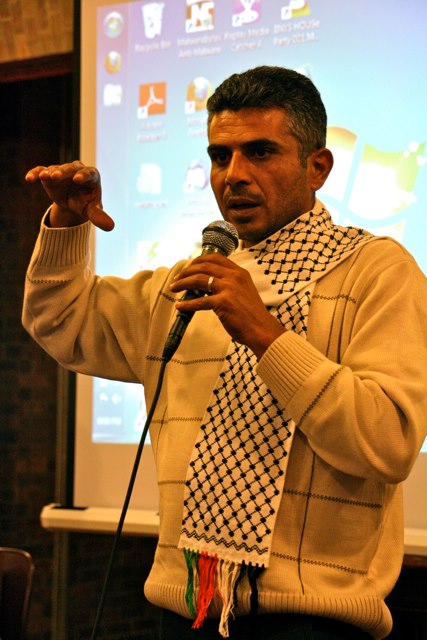
iyad burnat in rochester – november 11, 2012
met iyad burnat yesterday evening. he was here in rochester to talk about 8 yrs of non-violent resistance to military occupation, in the village of bil’in. he’s been arrested 12 times and life is unimaginably challenging in palestine, but he’s as defiant as ever. when asked how he could remain hopeful in the face of politicians such as netanyahu or lieberman, he said simply: “they r not king of the world.” he added: “u should have a revolution in america.”
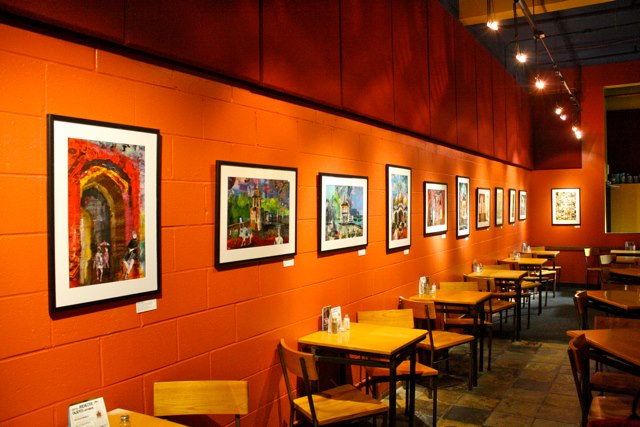
my artwork from the new series “this heirloom” up at the little theatre cafe!
my artwork is up at the little theatre cafe (nov 10-dec 7). thx to gallery manager kathleen farrell and photographer jason flack for helping me put it up – it looks brilliant. so happy!
Angola: Birth of a Movement
having just read “human love” by andre makine (the story of a young angolan revolutionary whose struggles start with the fight against portuguese colonialism) i found this piece v interesting.
…
Angola’s post-war economy is booming and its capital, Luanda, is the most expensive city in the world after Tokyo. Although the country is Africa’s second-biggest oil producer, most Angolans live on less than $2 a day. Meanwhile, the country’s president and his ruling party have clung on to power for over three decades, gaining tight control of both the public and private sectors, and stifling dissent and protest. But in 2011 – inspired by the Arab uprisings – a group of young Angolan activists took to the streets, demanding an end to decades of mismanagement and corruption. Arrested, harassed, beaten – the activists refuse to step down. This is the story of the birth of their movement. (Ana de Sousa)
More here.
Also, check out Pablo Moses’s “We Should Be In Angola” (1976) and the title track “Revolutionary Dream”.
Should People Vote for Obama or Third Parties in Swing States?
well said david swanson! the anti-war movement died as soon as obama became president. but it shouldn’t have. we are involved in more wars now than ever before. same thing with the erosion of civil liberties, corporate thuggery, financial shenanigans, institutionalized racism, the criminalization of the poor, etc. swanson says it v clearly in this interview: we need to look beyond elections and the two party system. we need to stay focused on the movement. it’s our only chance.
…
There was a major – reprehensibly small and weak, but a major and significant peace and justice movement by 2005 and 2006 (you read Bush’s memoirs, and the top Republican in the Senate is running to him secretly and saying, we must get out of Iraq, the public is turning against us), and as the Democrats came into power in Congress in ’07. And then it became a presidential election year in ’08, which always shuts down all useful activism. The movement faded away, disappeared, dried up, and was defunded. And it should not have. We should not go through these cycles of being willing to stand up in large numbers in serious ways for what we care about based on who’s in office and whether there’s an election.
…
There is a very small number of people who are very well informed about Obama’s crimes, and are even engaged in active resistance, who nonetheless say we should vote for Obama. I’m not slandering those people by suggesting they are ignorant or uninformed or not engaged in activism; I’m suggesting that the activist movement as a whole is dramatically weakened when its position is we denounce your war crimes and we will vote for you if you continue and escalate them, that that is a weak stand to be building a movement from. (David Swanson)
More here.
Is OWS Outperforming the Red Cross in Disaster Relief?
So how did an offshoot of Occupy Wall Street, best known as a leaderless movement that brought international attention to issues of economic injustice through the occupation of Zucotti Park in the financial district last year, become a leader in local hurricane relief efforts? Ethan Murphy, who was helping organize the food at St. Jacobis and had been cooking for the occupy movement over the past year, explained there wasn’t any kind of official decision or declaration that occupiers would now try to help with the hurricane aftermath. “This is what we do already, “ he explained: Build community, help neighbors, and create a world without the help of finance. Horst said, “We know capitalism is broken, so we have already been focused on organizing to take care of our own [community] needs.” (Katherine Goldstein)
More here.
Breaking Through Walls of Bias
“Watch out! Gypsies steal little children.”
That’s what Mugur Varzariu was often warned when he was growing up in Bucharest, Romania. Years later, working as a marketing strategist, he regularly heard — in “polite society,” no less — that the Roma people were lazy or criminals.
The Roma are often referred to as Gypsies, a term many consider offensive. Their ancestors, who came to Europe from India, have faced oppression and violence for centuries in Europe. They share language, culture and — until the 20th century — a nomadic way of life.
Mr. Varzariu, 42, knew very few Roma before he switched careers two years ago to become a photographer. In July 2011, after hearing that the mayor of Baia Mare, a small city in northern Romania, was building a 6-foot wall to separate a Roma community from its neighbors — creating a ghetto — Mr. Varzariu traveled there to see for himself. The Roma he met were different from the racist stereotypes he was raised with.
…
Though detested by the Roma, the wall was quite popular among most of Baia Mare’s population. And it proved to be a smart political move for the mayor, Catalin Chereches, who was overwhelmingly re-elected this year.
After building the wall, the mayor forcibly evicted another community of Roma on the outskirts of Baia Mare in May and June of this year. They were moved into a former office building and laboratory that was part of an abandoned copper factory. Cyanide and other toxic chemicals lingered in the walls and floors, and many of the Roma fell ill. More here.
Where is the Green Party?
Obama, who has stated that “climate change is the one of the biggest issues of this generation” and promised to “begin to slow the rise of the oceans and heal the planet”, has nevertheless given the green light for offshore oil leases in the environmentally sensitive Arctic Ocean, leaving the 66 per cent of US citizens who favour tax breaks to curb greenhouse gas emissions without a candidate.
Six-time presidential candidate Ralph Nader blames the absence of awareness of the Green Party among most Americans on what he calls an “electoral system dominated by a two-party tyranny” and “a duopoly of the Republicans and Democrats”.
“The Green Party not having a chance in this election is not because its proposals aren’t supported by the majority of Americans,” Nader told Al Jazeera. “Polls show their proposals like a living wage, cracking down on corporate crime, ending corporate bailouts, campaign finance reform, and many others, are what most people want. But since the two main parties are dialing for the same corporate dollars, they are the two heads of the corporate party, and this makes it nearly impossible for people to get on the ballot if they aren’t in one of those parties.” More here.
my new collage series “this heirloom” on show at the little cafe, starting nov 10th
this is the first collage in the new series inspired by my filmwork on the partition of india and by the idea of bearing witness as a dynamic act. that’s my maternal grandfather in the foreground. he went to aligarh university (in uttar pradesh, india). he spoke fluent urdu, english and sanskrit. he was a lawyer, an excellent tennis player and a soccer referee. altho he and his family survived partition, he died soon after moving to pakistan. maybe he couldn’t recover from the trauma and dislocation. i never knew him. i’ve seated him in front of delhi gate in lahore, which is one of the doorways to the walled city. it’s 1946. my grandfather is my connection to the turbulent history of the indian subcontinent. what he witnessed binds us together. agha shahid ali talks about this inextricable bond in his poem “snowmen.” his ancestors came from the himalayas.
“This heirloom,
his skeleton under my skin, passed
from son to grandson,
generations of snowmen on my back.
They tap every year on my window,
their voices hushed to ice.”

Remi Kanazi – Normalize This!
YES!!!
mixed media on canvas by syrian artist adel dauood
reminds me of surrealist “automatic” free-hand pen drawings.
“I attempt through this exhibition as well as with all my other work to reach some state of balance and harmony between the expressive aspect of my work – which is conveyed through simplifying forms and strongly showing the expressions of the lines and touches of color – with the abstract aspect of my work through which I address vast spaces by creating visual rhythms… I try to create that [balance] by spontaneously moving the paint brush on an empty canvas until I reach a free and quick outcome.” (Adel Dauood)
Activists and homeowner evicted from foreclosed house by SWAT team
thx to the banks that we the taxpayers bailed out and saved from extinction:
Sahara Donahue and activists were evicted by the Idaho Springs Sheriff department around 3 p.m. on October 30, 2012. Yesterday, Donahue went to US Bank’s main office in downtown Denver and spoke with a VP about getting a 60 day extension before being evicted from her home. US Bank declined to extend the eviction date and forwarded her to Vericrest Financial. […] It was reported that at around 3 p.m. the SWAT team arrived, forcing activists and the media to the ground. 3 arrests were made but soon released with citations. Sahara Donahue is currently seeking a place to rent and to secure her belongings. More here.
Casting Out: The Eviction of Muslims from Western Law and Politics (review)
am reading “casting out: the eviction of muslims from western law and politics” by sherene razack.
‘The War on Terror has gripped the Western world with internally discriminatory laws and policies, ranging from the denial of habeas corpus rights to restrictions on wearing hijab in public spaces. Sherene Razack’s new monograph demonstrates, however, that much more than discrimination is at work. Casting Out highlights how political community is being reconfigured through the socio-legal abandonment of “Muslim-looking” people who increasingly lack “the right to have rights.” Central to Razack’s analysis is Hannah Arendt’s concept of race thinking, a world view that differentiates between two orders of humanity, promoting the exclusion of one for the “survival” of the other. Today this thinking circulates as a popular narrative that sees the West as besieged by a Muslim threat. Razack draws on the work of Giorgio Agamben, showing how the resultant exclusion of Muslim peoples gives rise to the “camp”—a state of exception wherein the rule of law, that is, the rules of political community, do not apply.’ More here.
sandy hits u.s. northeast
this is southampton, ny. here in rochester spectacular wind and rain continue. schools r closed tomorrow. hoping we won’t have any power outages. be safe everyone.