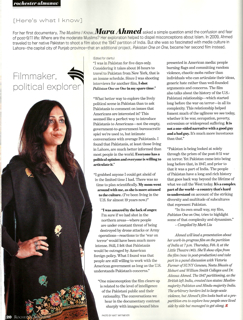
Nearer to Truth than History: Gabrielle Calvocoressi interviews Reza Aslan

on one of my favorite books, the stunning “tablet and pen: literary landscapes from the modern middle east”

In this work, we see the history of the Middle East unfolding as a wide-ranging, passionate, sometimes discordant conversation. I was consistently struck by the interiority of the voices and how rarely, in these days when the “Middle East” is often the lead story in the news, we are given any sense of the intimate and varied intellectual and emotional life of its people. The anthologist’s job is about creating borders, be they historical, formal, chronological, etc. As an editor, Aslan makes a double music as he pushes against the notion of border and statehood imposed by the West while using the historical reality of partition and colonialism to bring forward the very specific ideas of exile and isolation that recur in almost all of the poems and stories in this book.

I truly do believe that art is the universal language. I’ve spent the last ten years trying to build bridges between the peoples and cultures of the West and of the Middle East, trying to educate Americans about Islam and about Middle Eastern cultures. Yet anti-Muslim sentiment is even higher today than it was after 9/11. So, it’s hard not to feel like a failure.

So with BoomGen Studios [a film production company] and with my new focus on art and literature, I’ve recognized that minds are changed, perceptions are re-framed, not through knowledge, not through information, but through relationships—through stories. And that’s where the arts come in. You need the arts—literature, music, film—as a universal language that allows people to see beyond the walls that separate us. To stop thinking of each other as different religions, or different cultures, or different ethnicities, or nationalities, and start thinking of each other as human beings. As people with the same aspirations, and the same dreams, the same conflicts and the same issues. It’s only through that recognition of same-ness that you really do change people’s minds.

More here.

Tell Obama to Cease FDA Ties to Monsanto

President Obama, I oppose your appointment of Michael Taylor, a former VP and Lobbyist for Monsanto, the widely criticized Genetically Modified (GM) food multinational as Senior Advisor to the Commissioner at the FDA. Taylor is the same person who was Food Safety Czar at the FDA when Genetically Modified Organisms were allowed into the US food supply without undergoing a single test to determine their safety or risks. This is a travesty. Taylor was in charge of policy for Monsanto’s now-discredited GM Bovine Growth Hormone (rGBH) which is directly linked to cancer and opposed by many medical and hospital organizations. It was Michael Taylor who pursued a policy that milk from rGBH-treated cows should not be labeled with disclosures. Michael Taylor and Monsanto do not belong in our government. Sign petition here.

Indians Against Democracy by Pankaj Mishra

The international image of an inexorably “rising” India is largely due to these Indian beneficiaries of global capitalism. As Amartya Sen points out, “since the fortunate group includes not only business leaders and the professional classes, but also the bulk of the country’s intellectuals, the story of unusual national advancement gets, directly or indirectly, much aired — making an alleged reality out of what is at best a very partial story.”

Keeping the definition of corruption deliberately vague, and speaking of it in mostly moral and sentimental terms, Hazare’s campaign acquired some support from the urban poor, even as he worked to put the democratic system at the mercy of a few self-appointed guardians of morality. Hazare never focused on the distress resulting from income inequality, which has doubled in the last two decades, or on the gross abuses of corporate as well as state power: the dispossession, for instance, of the rural poor by mining companies, or human rights abuses by Indian security forces in Muslim-majority Kashmir. There was more clarity to be had about the aims of Hazare’s movement from its affluent supporters, which included glamorous figures from Bollywood, the media, and India’s iconic companies. Many of them call for an end to the state’s subsidies for the poor and low-caste Indians. These “rising” Indians see social welfare programs as wasteful, and endangering the apparently smooth working of the free market, even though, as Amartya Sen recently observed, they “don’t question things such as subsidy on diesel for rich people… Whenever something is thought of to help poor, hungry people, some bring out the fiscal hat and say, ‘My God, this is irresponsible.’”

Few assumptions about India’s middle class, or even about the “free” Indian media, as carriers of democratic values have emerged unscathed from his movement. The social media networks that helped Hazare were far from being hard-wired for democracy. Citing an extensive survey that revealed urban youth in India to be profoundly right-wing, the Indian novelist and TV anchor Sagarika Ghose pointed out recently that Facebook and Twitter, crucial to the Tahrir Square uprising in Egypt, are “dominated” in India “by young people openly pouring scorn on ‘pseudo-secular liberals,’ minorities and the so-called ‘anti-nationals.’”

More here.

Václav Havel (1936–2011) by Paul Wilson

Like many great Czechs before him, Havel insisted on the importance of truth, but with a difference. “Truth and love,” he was fond of saying, “must prevail over lies and hatred.” He was often ridiculed for what seemed like a Hallmark sentiment (“Why love?” people asked), but he defended the slogan by referring to one of his greatest insights: truth, by itself, is a malleable concept that depends for its truthfulness on who utters it, to whom it is said, and under what circumstances. As a playwright, Havel turned this insight into a dramatic device: in most of his plays, the main characters constantly lie to one another and to themselves, using words that, in other circumstances, would be perfectly truthful. Truth by itself is not enough: it needs a guarantor, someone to stand behind it. It must be uttered with no thought for gain, that is, in Havel’s words, with a love that seeks nothing for itself and everything for others. More here.

Diary: In Pyongyang – Tariq Ali

Colonised by the Japanese between 1910, when they annexed the country, and the end of the Second World War, Korea experienced both ‘modernity’ and extreme brutality and repression. The country’s mineral wealth was used to buttress Japanese militarism; local workers were paid starvation wages; tens of thousands of women were treated as prostitutes by the occupiers but not paid for their services. The defeat of Japan in 1945 was greeted joyously, and popular committees sprang up in a number of cities. The future of Korea wasn’t discussed at Yalta where the division of Europe was decided, but Moscow and Washington privately agreed on a similar division of the Korean peninsula. The Red Army marched into North Korea, with Kim Il-sung reportedly in one of its tanks; the United States took the South.

The involvement of the US and the Soviet Union had put an end to any chance of Korean autonomy, but Soviet prestige was still high and many believed that the Russians would help liberate and reform the whole country. Few believed partition was permanent. Kim Il-sung, installed as leader of the People’s Committee by the Soviets, was barely known, but local Communists had no reason to doubt him.

Growing popular anger in the South and an overwhelming desire for reunification triggered the invasion of the South by the North in 1950. Lacking popular support, the Rhee government collapsed and had to be rescued by US troops. The Soviet Union boycotted a Security Council session at which they could have vetoed America’s war, conducted under the UN flag. The Chinese revolution had panicked Washington. It couldn’t be allowed to spread.

US troops and their allies (including the Japanese navy) pushed the North Korean army back. The Chinese revolution was less than a year old and its leaders saw the war in Korea as an attempt to reverse events in China. A Politburo meeting determined to save the Koreans. Chinese troops under the command of General Peng Dehuai crossed the Yalu River in droves. The Americans and their allies were driven back to the 38th parallel. General MacArthur declared that it might be necessary to nuke Chinese air bases; Truman sacked him. In 1953 a truce was signed at Panmunjom on the 38th parallel. Around a million soldiers and two million civilians had died (there are many different estimates). One of them was Mao’s oldest and favourite son.

Twenty years later I was about to cross the Yalu River on a Chinese train. At Sinuiju, I was welcomed onto the sacred soil of the DPRK with a bunch of flowers. Standing in front of a life-size statue of Kim Il-sung, my host told me that he was a bit disturbed by the scale of the personality cult in China. In Pyongyang a Young Pioneer gave me another bouquet of flowers. I was shocked at what I saw as we drove through the city: we could have been in Eastern Europe after the Second World War. Then I remembered that what General Curtis LeMay had threatened to do to North Vietnam had already been done to North Korea: it had been bombed into the Stone Age. There were no protests in the West against the heavy bombing of Pyongyang at only 15 minutes’ notice: 697 tons of bombs were dropped on the city, 10,000 litres of napalm; 62,000 rounds were used for ‘strafing at low level’.

Three years earlier in Phnom Penh the Australian journalist Wilfred Burchett had told me that what I had seen in Vietnam was ‘nothing compared to what they did to Korea. I was there. There were only two buildings left standing in Pyongyang.’ It was alleged that the US had used germ warfare, and although the US dismissed these claims as ‘outrageous’, on 9 August 1970 the New York Times reported that chemical weapons had been considered after ‘American ground forces in Korea were overwhelmed by Chinese Communist human wave attacks near the Yalu River’. Pentagon policymakers wanted to ‘find a way to stop mass infantry attacks’, so ‘the army dug into captured Nazi chemical warfare documents describing sarin, a nerve gas so lethal that a few pounds could kill thousands of people in minutes if the deadly material were disbursed effectively.’ Was it used in Korea? Probably not, though germ warfare tests were conducted in US cities. In one test ‘harmless’ bacteria were introduced into the Pentagon’s air-conditioning system.

More here.

Blackwater’s Black Ops

Blackwater did business with a range of multinational corporations. According to internal Total Intelligence communications, biotech giant Monsanto—the world’s largest supplier of genetically modified seeds—hired the firm in 2008–09. The relationship between the two companies appears to have been solidified in January 2008. After a meeting in Zurich, Black sent an e-mail to other Blackwater executives, including to Prince and Prado at their Blackwater e-mail addresses. Black wrote that Wilson “understands that we can span collection from internet, to reach out, to boots on the ground on legit basis protecting the Monsanto [brand] name….” Black added that Total Intelligence “would develop into acting as intel arm of Monsanto.” Black also noted that Monsanto was concerned about animal rights activists and that they discussed how Blackwater “could have our person(s) actually join [activist] group(s) legally.”

Former Pakistani Prime Minister Benazir Bhutto worked with the company [Blackwater] when she returned to Pakistan to campaign for the 2008 elections, according to the documents. In October 2007, when media reports emerged that Bhutto had hired “American security,” senior Blackwater official Robert Richer wrote to company executives, “We need to watch this carefully from a number of angles. If our name surfaces, the Pakistani press reaction will be very important. How that plays through the Muslim world will also need tracking.” Richer wrote that “we should be prepared to [sic] a communique from an affiliate of Al-Qaida if our name surfaces (BW). That will impact the security profile.” Clearly a word is missing in the e-mail or there is a typo that leaves unclear what Richer meant when he mentioned the Al Qaeda communiqué. Bhutto was assassinated two months later. Blackwater officials subsequently scheduled a meeting with her family representatives in Washington, in January 2008.

More here.

Monsanto, World’s Largest Genetically Modified Food Producer, To Be Charged With Biopiracy In India

Farmers’ opposition to Monsanto and genetically modified crops in India goes back to before the eggplant controversy, and traces its roots at least partly to an earlier controversy about genetically modified cotton. After successfully introducing GM cotton to India, Monsanto was besieged by bad publicity when a failed crop allegedly caused farmers to commit suicide. Crop failures are common in India, but when the GM cotton crop failed, the farmers growing it were saddled with enormous debt. By some counts, the suicide toll related to GM crop failure is in the hundreds of thousands, though some observers have challenged that notion. The company has also been accused of using child labour in its cotton seed production operations. More here.

iraq…

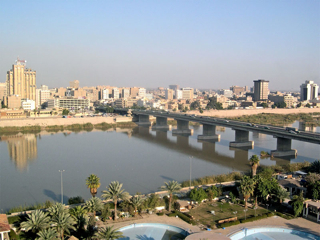
met a beautiful young woman from iraq. an obgyn at home, she and her husband had to restart everything from scratch after they were displaced. they were refugees in jordan for many years before they immigrated to the united states. she’s from baghdad. i went there as a child and this is what it looked like. this was before the genocidal wars and sanctions of course. how does one even begin to apologize?

baghdad

Guernica – The Other Face of Silence

Elia Suleiman’s accurately composed moments, farcical and tragic, leave the viewer aching. His way of giving details a breath and voice, making them actual narrators, is moving and a powerful transmittance of the occupation’s audacity. In one of the most affecting moments of the film, Suleiman’s character returns to present-day Nazareth and the West Bank to find a more perplexing landscape. His silent communion with his mother is a culminating point. He seems to be saying: the portrait of this quietness tells our story but warns not to misunderstand—this is a determined presence, not an absence. More here.

Tariq Ali: Obama’s Expansion of Af-Pak War “Has Blown Up in His Face”

JUAN GONZALEZ: And we here are so consumed, increasingly, by the presidential elections and the various Republican debates. The reaction in Pakistan to what’s going on among the candidates for president here in the U.S., if any?

TARIQ ALI: Bemusement. I mean, they are basically suffering because Obama, arrogantly, escalated the war in Afghanistan and Pakistan and thought he could get away with it. That has now blown up in his face. The candidate who people take quite seriously is Ron Paul, but simply because he says he’s in favor of withdrawing U.S. troops from all over the world and ending the imperial role. And that, of course, is very popular all over the world. And people are not aware of some of his other positions, but this one they concentrate on, because they say no other candidate is even talking about America as an empire. More here.

John Steinbeck on Falling in Love: A 1958 Letter

First — if you are in love — that’s a good thing — that’s about the best thing that can happen to anyone. Don’t let anyone make it small or light to you.

Second — There are several kinds of love. One is a selfish, mean, grasping, egotistical thing which uses love for self-importance. This is the ugly and crippling kind. The other is an outpouring of everything good in you — of kindness and consideration and respect — not only the social respect of manners but the greater respect which is recognition of another person as unique and valuable. The first kind can make you sick and small and weak but the second can release in you strength, and courage and goodness and even wisdom you didn’t know you had. More here.